With wary eye, Syrian rebels welcome Islamists into their ranks
Jihadis stream into anti-Assad fight, raising concerns of al-Qaeda links but giving opposition needed boost

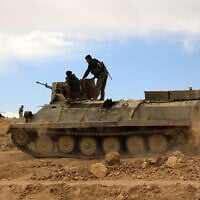
ALEPPO, Syria (AP) — The presence of foreign Islamic militants battling Syria’s regime is raising concerns over the possible injection of al-Qaeda’s influence into the country’s civil war.
Syria’s rebels share some of those misgivings. But they also see in the foreign extremists a welcome boost: experienced, disciplined fighters whose battlefield valor against the better-armed troops of President Bashar Assad is legendary.
Nothing typifies the dilemma more than Jabhat al-Nusra, a shadowy group with an al-Qaeda-style ideology whose fighters come from Libya, Tunisia, Egypt, Saudi Arabia, Iraq, the Balkans and elsewhere. Many are veterans of previous wars who came to Syria for what they consider a new “jihad” against Assad.
The group has become notorious for numerous suicide bombings during the 19-month-old conflict targeting regime and military facilities. Syria’s rebels have tried to disassociate themselves from the bombings for fear their uprising will be tainted with the al-Qaida brand.
But several hundred fighters from Jabhat al-Nusra — Arabic for “the Support Front” — have also been a valued addition to rebel ranks in the grueling, three-month battle for control of Aleppo, Syria’s largest city.
Their reputation in battle circulates among Aleppo’s rebels like an urban legend. Soon after opposition forces launched their assault on the city in July, government troops almost drove them out of the key district of Salaheddin — until 40 Jabhat al-Nusra fighters rushed to the front and fended them off, according to a story told by many rebels.
The group’s fighters have played a similar role along the multitude of front lines that divide this city of 3 million people, where regime forces and rebels have been at a standstill, fighting street to street but unable to score a decisive victory. Many rebels talk of the al-Nusra fighters’ prowess as snipers.
“They rush to the rescue of rebel lines that come under pressure and hold them,” one rebel said. “They know what they are doing and are very disciplined. They are like the special forces of Aleppo.”
But he added: “The only thing is that they are too radical.” He spoke on condition of anonymity for fear of reprisals by both Jabhat al-Nusra and the Assad regime.
In a statement posted on militant websites Wednesday, Jabhat al-Nusra rejected a proposed cease-fire during the four-day Muslim Eid al-Adha holiday, which starts Friday. International envoy Lakhdar Brahimi has been trying to cobble together such a truce, saying the government in Damascus and some rebels have agreed to the idea.
But Jabhat al-Nusra called a truce a “filthy game,” saying it has no faith that Assad’s regime would respect one. Some Syrian rebel leaders have also expressed skepticism, since previous cease-fire attempts have gone nowhere.
Jabhat al-Nusra is the largest grouping of foreign jihadis in Syria, and the rebels say they number about 300 fighters in Aleppo, as well as branches in neighboring Idlib province, the city of Homs and the capital Damascus. Any direct links to al-Qaeda are unclear, although U.S. and Iraqi officials have said they believe members of al-Qaida’s branch in Iraq have crossed the border to join the fight against Assad.
There are no reliable figures for the number of foreign fighters in Syria, although available estimates put the number in the hundreds, rather than the thousands.
Some see the jihadis’ brand of Islam as too starkly black-and-white and intolerant, dividing the world between the faithful and the infidels
Many al-Nusra fighters wear long tunics and baggy pants in the style of mujahedeen or “holy warriors” in Afghanistan, and nearly all have beards, a hallmark of religious piety. A few smear kohl on their eyes and have long hair, emulating what they believe is a style favored by Islam’s Prophet Muhammad in the seventh century.
The fighters keep a low profile. They have turned a government building in Aleppo into their headquarters, but it is barely noticeable since it contains no banners or flags to give it away. Only occasional graffiti announces their presence in the city: “Jabhat al-Nusra is coming.” Rebels who spoke with The Associated Press about the group had no clear idea about its leadership.
The fighters shun the media, but information gleaned from Syrians in contact with them paints a picture of militant Muslims motivated by a jihadi ideology not unlike that of al-Qaida. Their members include propagandists, trainers, surgeons and other medical doctors.
Many Syrian rebels are themselves pious Muslims who frame the fight against Assad’s regime in a religious context. But some see the jihadis’ brand of Islam as too starkly black-and-white and intolerant, dividing the world between the faithful and the infidels. Their presence, some fear, casts doubts on whether a post-Assad Syria will embrace democratic values or come under the sway of Islamists.
A staffer at a field hospital in a rebel-held part of Aleppo, who spoke on condition of anonymity for fear of reprisals for talking about the group, said the al-Nusra fighters “are fine now, because they are fighting alongside the rebels.”
An AP team witnessed some of the frictions at the field hospital in mid-October. Several al-Nusra fighters entered, and one of them — a tall, lanky non-Arab dressed in black with a black headband — was enraged by the presence of foreign journalists at the facility.
“They are all spies who are here to collect information,” he said in English, shaking the automatic rifle that was slung over his shoulder.
Another fighter, who appeared to be of North African origin, tried to force a female photographer to leave the hospital after she attempted to photograph the X-ray of a wounded fighter’s head.
A Syrian rebel commander confronted the two men.
“There is nothing in Islam that permits you to treat guests like this. Furthermore, it is a woman,” he said. The fighters left and the commander offered tea and dates to the photographer and several other journalists.
Opposition members also worry that the presence of foreign jihadis in Syria lends credibility to the regime’s repeated assertions that the rebellion is the work of terrorist groups carrying out a “foreign conspiracy.”
‘Their presence is reducing the popular support that we desperately need in areas where we operate’
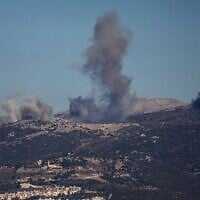
Jabhat al-Nusra has claimed responsibility for a string of suicide bombings, including several in Damascus. It unleashed an Oct. 3 suicide blast in Aleppo that killed more than 30 people, targeting a square where pro-regime fighters congregated. After each blast, the rebels’ Free Syrian Army umbrella group underlines that it does not approve of suicide bombings as a tactic.
“Their presence is reducing the popular support that we desperately need in areas where we operate,” a senior political official of the Free Syrian Army, said in neighboring Turkey. “I appreciate their motives for coming to Syria. We cannot deny Muslims their right to jihad, but we want them to leave.” He spoke on condition of anonymity to discuss concerns over the group.
Still, in Aleppo, the image of pious Islamic warriors coming to help in the fight against Assad is an attractive one. Though Jabhat al-Nusra is predominantly made up of foreigners, a few Syrians have joined, mostly ultraconservative Muslims.
Syrians can join only if they are backed by two full members who must swear on the Quran to tell the truth about the applicant. The fighters run training programs for their Syrian members as well as others who want to learn fighting skills but don’t want to join the group.
The high esteem in which the Jabhat al-Nusra fighters are held has a great deal to do with the unruly behavior and lack of discipline of many rebels.
One recent night, al-Nusra fighters brought the bodies of four Syrian rebels who were killed when a fellow rebel they were interrogating over suspicion that he was stealing grabbed an assault rifle and shot them. A fifth rebel was wounded.
Later, when comrades of the four dead heard the news they gathered outside the hospital and, enraged, fired their entire bullet magazines into the air. Another group of fighters reacted similarly when struck by grief over the death of a comrade.
Residents of Aleppo also complain that some rebels take unfair advantage of their position.
Fighters go straight to the front of the line at bakeries to buy bread when residents have to wait hours for their turn. Some demand that wounded comrades be treated ahead of civilians at the field hospital.
“I don’t have time to wait in line,” said a 19-year-old army deserter who joined the rebels in Aleppo and gave only his first name, Hani.
Copyright 2012 The Associated Press.
If so, we have a request.
Every day during the past two years of war and rising global anti-Zionism and antisemitism, our journalists kept you abreast of the most important developments that merit your attention. Millions of people rely on ToI forfact-based coverage of Israel and the Jewish world.
We care about Israel - and we know you do too. So we have an ask for this new year of 2026: express your values byjoining The Times of Israel Community, an exclusive group for readers like you who appreciate and financially support our work.

We’re really pleased that you’ve readX Times of Israel articles in the past month.
You clearly find our careful reporting valuable, in a time when facts are often distorted and news coverage often lacks context.
Your support is essential to continue our work. We want to continue delivering the professional journalism you value, even as the demands on our newsroom have grown dramatically since October 7.
So today, please consider joining our reader support group,The Times of Israel Community. For as little as $6 a month you'll become our partners while enjoying The Times of IsraelAD-FREE, as well as accessing exclusive content available only to Times of Israel Community members.
Thank you,
David Horovitz, Founding Editor of The Times of Israel



The Times of Israel Community.