New cultural quarter resurrects Amsterdam’s Jewish past
Dutch capital earns international notice for efforts to rebuild a presence almost entirely wiped out during the Holocaust

AMSTERDAM –Seventy years after the vast majority of its Jewish citizens weredeported to Auschwitz and Sobibor, the Dutch capital recently inaugurated a “Jewish Cultural Quarter” on the site of historic synagogues and Holocaust-era events.
Dutch Crown Prince Willem-Alexander officiated at the Jewish Cultural Quarter’s designation ceremony in October. Wearing a blue yarmulke, the prince unveiled artwork titled “The Fragmented Talit,” by Israeli-Dutch artistJoseph Semah.
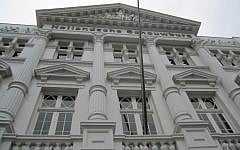
Speaking in the restored Portuguese Synagogue, the prince acknowledged the Quarter’s history and major sites, including Europe’s oldest Jewish library and theHollandsche Schouwburg, or Dutch Theater, used by the Nazis as a detention center for captured Jews.
For decades, a trickle of tourists made its way to Amsterdam’s former Jodenhoek, or Jewish Corner, adjacent to the canal-filled city’s historic center. Most visitors toured the stately Portuguese Synagogue orJewish Historical Museum, close to where many of Amsterdam’s 80,000 Jews lived on the eve of World War II.
Though home to most of the decimated community’s institutions and residences, the Quarter plays second fiddle to Amsterdam’s most visited “Jewish” site – theAnne Frank House across town, which draws more than a million tourists annually.
An hour’s walk from Anne Frank’s “Secret Annex,” the Jewish Quarter once boasted a patchwork of Jews from northern Africa and throughout Europe. The bustling Jewish flea market filled a square until Nazis converted it as a gathering place for roundup victims in 1941. A defiant-looking “Dockworker” statue commemorates the firstmajor Dutch strikefollowing these deportations.
With its blend of red-brick 17th century synagogues and sites connected to the Holocaust, the Quarter speaks to both centuries of Jewish life upended and the desire of today’s Jewish community to achieve a sense of continuity. The synagogues and theater have each been renovated in recent years, with the Portuguese Synagogue winning the European Union’s Europa Nostra prize for conservation work in 2012.
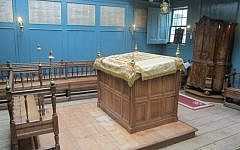
Built in 1675 by Jews who fled the Spanish and Portuguese Inquisitions, the Portuguese Synagogue – or “Esnoga” in Ladino – was modeled after the Jerusalem Temple. The complex includes a courtyard, winter synagogue, archives, mortuary, and the famous Etz Hayim library.
The sanctuary’s high rectangular interior retains original wooden benches and – in the Dutch tradition – a floor covered with fine sand to absorb moisture from shoes and soften their noise. In the congregation’s original Talmud Torah synagogue nearby, freethinker Baruch Spinoza was excommunicated by Jewish leaders in 1656 for “abominable heresies” at the age of 23.
A less eventful visit to the Portuguese Synagogue was recently made by European Commission President Jose Manuel Barroso, who told Jewish leaders that European Jews represent the best of “cultural integration.”
“[The Jewish Cultural Quarter] is part of the work of keeping alive this great tradition, the Jewish tradition, which is a part of our European Union,” Barroso said during a Jan. 8 visit. He added that Jews around the world were “at the front line of the fight against extremism.”
Several of Amsterdam’s 15,000 Jews have risen to the top of Dutch politics in recent years.
Former Amsterdam Mayor Job Cohen’s paternal grandparents were murdered in the Holocaust. Cohen led the city for almost a decade, and was runner-up for World Mayorin 2006. Half-Jewish politicianLodewijk Asscher is currently the Netherlands’ deputy prime minister, with a vision to make Holland “fairer and stronger.”
Both Cohen and Asscher have advocated “cleaning up” Amsterdam’s notorious Red Light District, home to legalized prostitution and just a wooden shoe’s throw from the Jewish Cultural Quarter. Halfway between the brothels and the Quarter’s center, Rembrandt van Rijn lived and worked in a mansion close to the Jews he occasionally painted.
The Quarter’s homes were demolished during 1945’s “Hunger Winter,” when abandoned Jewish buildings were razed for firewood to sustain a starving and frozen city. More recent years have seen the almost total redevelopment of the area, with office buildings and transportation infrastructure making it one of Amsterdam’s least charming districts.
More than 275,000 tourists visited the square-kilometer-sized Jewish Quarter last year, according to the Jewish Historical Museum, celebrating its 80th anniversary. As the first stop for many Quarter visitors, the museum houses more than 50,000 objects in galleries created within adjacent synagogues.
Other Jewish artifacts are literally tucked away in corners throughout the neighborhood, including the Portuguese Synagogue’s underground “Treasure Rooms,” which feature 800 rare ceremonial objects. Near the Artis Royal Zoo, where some Jews hid among the animals, a memorial to Auschwitz deportees fills the corner of a dog park.
Though the Netherlands deported a larger share of Jews to Nazi death camps than any other Western European country, no official Holocaust museum or memorial exists in Amsterdam. Since 1993, the Hollandsche Schouwburg has informally filled the role by displaying Holocaust-era artifacts and archiving victims’ names. (Outside the Dutch capital, amuseumdevoted to the genocide can be found at the site of Westerbork, a detention and deportation center in eastern Holland.)
The Schouwburg is currently raising funds to convert itself into a “fully fledged” museum of the Holocaust in the Netherlands, according to its strategic plan. In addition to memorializing 104,000 Dutch Jews killed during the war, the organization aims to enhance its presentation of testimonies from Holocaust-era bystanders, rescuers, resistance fighters and persecutors.
In the meantime, the Jewish Historical Museum maintains a “digital monument” to the Jewish community, recording the names of Dutch Holocaust victims and digitally archiving their documents. Based on “register lists” created by the Nazis in 1941, the monument allows online visitors to learn about victims in specific neighborhoods and families.
Though the Quarter includes just four major sites, the neighboringDutch Resistance Museum promotes a “Persecution and Resistance” walking tour between its building — itself a former synagogue — and the Anne Frank House across town. A guidebook explains the significance of sites associated with Nazi crimes and Dutch resistance, many of which would otherwise go unnoticed.
If so, we have a request.
Every day during the past two years of war and rising global anti-Zionism and antisemitism, our journalists kept you abreast of the most important developments that merit your attention. Millions of people rely on ToI forfact-based coverage of Israel and the Jewish world.
We care about Israel - and we know you do too. So we have an ask for this new year of 2026: express your values byjoining The Times of Israel Community, an exclusive group for readers like you who appreciate and financially support our work.

We’re really pleased that you’ve readX Times of Israel articles in the past month.
You clearly find our careful reporting valuable, in a time when facts are often distorted and news coverage often lacks context.
Your support is essential to continue our work. We want to continue delivering the professional journalism you value, even as the demands on our newsroom have grown dramatically since October 7.
So today, please consider joining our reader support group,The Times of Israel Community. For as little as $6 a month you'll become our partners while enjoying The Times of IsraelAD-FREE, as well as accessing exclusive content available only to Times of Israel Community members.
Thank you,
David Horovitz, Founding Editor of The Times of Israel








The Times of Israel Community.