- MLA 8TH EDITION
- Finkelstein, Maxwell W.. "Mingan Archipelago National Park Reserve".The Canadian Encyclopedia, 04 March 2015,Historica Canada. thecanadianencyclopedia.ca/en/article/mingan-archipelago-national-park-reserve. Accessed 15 February 2026.
- Copy
- APA 6TH EDITION
- Finkelstein, M. (2015). Mingan Archipelago National Park Reserve. InThe Canadian Encyclopedia. Retrieved from https://thecanadianencyclopedia.ca/en/article/mingan-archipelago-national-park-reserve
- Copy
- CHICAGO 17TH EDITION
- Finkelstein, Maxwell W.. "Mingan Archipelago National Park Reserve."The Canadian Encyclopedia. Historica Canada. Article published January 30, 2007; Last Edited March 04, 2015.
- Copy
- TURABIAN 8TH EDITION
- The Canadian Encyclopedia, s.v. "Mingan Archipelago National Park Reserve," by Maxwell W. Finkelstein, Accessed February 15, 2026, https://thecanadianencyclopedia.ca/en/article/mingan-archipelago-national-park-reserve
- Copy
 Share on Facebook
 Share on X
 Share by Email
 Share on Google Classroom
Thank you for your submission
Our team will be reviewing your submission
and get back to you with any further questions.
Thanks for contributing to The Canadian Encyclopedia.
CloseArticle
Mingan Archipelago National Park Reserve
Article byMaxwell W. Finkelstein
Published Online January 30, 2007
Last Edited March 4, 2015
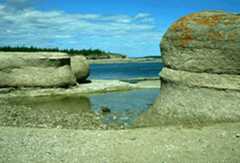
Oddly shaped rock pillars sculpted by wind and sea create the unique islandscape of Mingan Archipelago National Park Reserve (set aside 1984, 150.7 km2). The park will retain its reserve status until the resolution of the comprehensive landclaims of theInnu.The park reserve, which consists of some 40 small limestone islands, extends for 155 km between the communities of Longue-Pointe and Aguanish, Qué,along the north shore of the Gulf of St Lawrence. The park can be accessed by Highway 138 or by air to Havre-Saint-Pierre, and then by boat to the islands. Private excursion boats are available to take visitors to the islands.
Natural History
Along the shore are grottoes, flower pots and colonnades, while approximately 3.5 km offshore lie the islands. Atlantic puffin and other seabirds nest on these limestone islands while porpoises, seals and whales feed in the fertile waters offshore. Thevegetation on the islands are more typical of more northern latitudes because of the harsh climate. Some plant species are endemic to the islands. The only common land mammal is the snowshoe hare.
Facilities
There are primitive campsites available on some islands in the park. A variety of private accommodations ranging from campsites to hotels are available on the mainland. An interpretive centre is located at Havre-Saint-Pierre. Hiking and bird watchingare popular activities on land; bird watching and marine mammal watching tours are available.