


Published
6 years agoon
On November 13th, SpaceX revealed that a planned static fire test of a Crew Dragon’s powerful abort thrusters was completed without issue, a strong sign that the company has successfully redesigned the spacecraft to prevent a catastrophic April 2019 explosion from reoccurring.
Pending a far more extensive analysis, Wednesday’s static fire should leave SpaceX on track to perform Crew Dragon’s next major flight test before the end of 2019. Full duration static fire test of Crew Dragon’s launch escape system complete – SpaceX and NASA teams are now reviewing test data and working toward an in-flight demonstration of Crew Dragon’s launch escape capabilitiespic.twitter.com/CMHvMRBQcW— SpaceX (@SpaceX)November 13, 2019
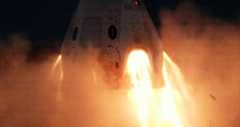
In an unexpected flourish of transparency, SpaceX and NASA published photos of the Crew Dragon capsule’s static fire test just a few hours after it was completed, an excellent sign that the ‘quick-look’ data analysis immediately following the test was extremely positive. Spaceflight Now was first to visually confirm that the test had occurred, publishing a photo that revealed a whitish cloud of smoke produced by the static fire around 3:15 pm EST (20:15 UTC).
Had a failure similar to the April 2019 explosion occurred, that cloud would have likely been tinged red by unburnt dinitrogen tetroxide (NTO) oxidizer, and the different appearance of November 13th’s exhaust cloud was seen as the first tentative sign that this static fire had gone more successfully.
BREAKING:#SpaceX Crew Dragon suffered an anomaly during test fire today, according to 45th Space Wing. Smoke could be seen on the beaches.
"On April 20, an anomaly occurred at Cape Canaveral AFS during Dragon 2 static test fire. Anomaly was contained and no injuries."pic.twitter.com/If5rdeGRXO— Emre Kelly (@EmreKelly)April 20, 2019
SpaceX appears to have test-fired thrusters on its Crew Dragon capsule at Cape Canaveral, a major test that paves the way for a high-altitude launch abort test as soon as mid-December. EARLIER STORY:https://t.co/mJKujDVeNUpic.twitter.com/AspZxFCMRq— Spaceflight Now (@SpaceflightNow)November 13, 2019
Alongside photos of the SuperDraco thruster test published by NASA and SpaceX shortly after its conclusion, SpaceX confirmed that the test was completed without issue. Regardless of whether everything performed exactly as intended, this means that factory-fresh Crew Dragon capsule C205 made it through the test unscathed, likely securing SpaceX and NASA a large volume of uninterrupted telemetry data, as well as the hardware itself.
Just hours after C205’s static fire was completed, NASA published a detailed update, confirming that the tests were finished without any immediately apparent issues. This afternoon,@SpaceX completed a series of static fire engine tests for#CrewDragon's launch escape system.
Now, SpaceX and@NASA will
1⃣ Review data from the test
2⃣ Perform hardware inspections
3⃣ Establish launch date for In-Flight Abort Test
💻:https://t.co/4SbwBhGgX4pic.twitter.com/kPpM729jtm— NASA Commercial Crew (@Commercial_Crew)November 13, 2019
NASA described the test in much more detail than SpaceX, noting that it began with the ignition of two of Crew Dragon’s 16 Draco maneuvering thrusters, each performing two one-second burns. C205’s eight SuperDraco abort thrusters subsequently ignited and burned for a total of ~9 seconds to simulate required abort performance, followed by the reignition of two Draco thrusters immediately after SuperDraco cutoff.
Each capable of producing several dozen pounds of thrust, both Crew and Cargo Dragon use Draco thrusters to orient themselves in orbit, rendezvous with the International Space Station, and lower their orbits to reenter Earth’s atmosphere. Crew Dragon’s Draco thrusters are also designed to control its attitude during abort scenarios, stabilizing and flipping the spacecraft to prevent a loss of control and ensure proper orientation during emergency parachute deployment. The Draco firings during Crew Dragon’s November 13th static fire were meant to simulate that additional use-case.
Aside from verifying that SpaceX has successfully redesigned Crew Dragon to mitigate the failure mode that caused capsule C201’s catastrophic explosion in April 2019, the Draco static fires specifically mirrored the burns Crew Dragon C205 will need to perform to successfully complete its In-Flight Abort (IFA) test. As noted by NASA and SpaceX, with the static fire complete, both teams will now comb through the data produced, inspect Crew Dragon to verify its health and the performance of its redesigned high-flow pressurization system, and perform any necessary refurbishment.
NASA’s post on Crew Dragon’s static fire revealed another thoroughly intriguing detail: the SpaceX spacecraft’s SuperDraco thrusters apparently haveflaps! A bit of retroactive speculation suggests that SuperDracos are closed out with plugs of some sort to create a seal against the environment before Crew Dragon is rolled out to the launch pad. Perhaps, in the event of a SuperDraco ignition, SpaceX included actuating flaps as a method of resealing those thrusters prior to splashdown in the Atlantic Ocean.
“Immediately after the SuperDracos shut down, two Dracos thrusters fired and all eight SuperDraco flaps closed, mimicking the sequence required to reorient the spacecraft in-flight to a parachute deploy attitude and close the flaps prior to reentry. The full sequence, from SuperDraco startup to flap closure, spanned approximately 70 seconds.”
NASA, November 13th, 2019
Given that the obvious utility of those flaps appears to be extremely limited and their associated actuators have to survive the 9+ consecutive seconds of hellish conditions in the event of an actual abort, it seems like an excessively complicated system to include on Crew Dragon. Nevertheless, the ability to guarantee that SuperDracos are water-sealed before splashdown would almost without a doubt make Crew Dragonfareasier to refurbish and reuse.
The SuperDraco flaps may also be a holdover from before propulsive Crew Dragon landings were canceled, although the use-cases for such a system still remain unclear. The flaps’raison d’etrecould even be as simple as preventing water intrusion that might otherwise cause Dragon to sink after splashdown.
Regardless of why they exist, NASA indicates that SpaceX’s November 13th static fire proved that they worked exactly as expected, closing soon after the simulated abort burn to seal Crew Dragon against water intrusion. If NASA and SpaceX’s deep-dive inspections and data analysis uncover no red flags, it’s extremely likely that SpaceX will able to launch C205 for its In-Flight Abort test some 4-8 weeks from now.
If the IFA also goes as planned, Crew Dragon could be ready for its inaugural NASA astronaut launch as early as February or March 2020.
Check out Teslarati’s Marketplace! We offer Tesla accessories, including for the Tesla Cybertruck and Tesla Model 3.
Eric Ralph is Teslarati's senior spaceflight reporter and has been covering the industry in some capacity for almost half a decade, largely spurred in 2016 by a trip to Mexico to watch Elon Musk reveal SpaceX's plans for Mars in person. Aside from spreading interest and excitement about spaceflight far and wide, his primary goal is to cover humanity's ongoing efforts to expand beyond Earth to the Moon, Mars, and elsewhere.
xAI has built up $18 billion in debt over the past few years, with some of this being attributed to the purchase of social media platform Twitter (now X) and the creation of the AI development company. A new financing deal would help trim some of the financial burden that is currently present ahead of the plan to take SpaceX public sometime this year.

Published
2 days agoon
February 13, 2026
Elon Musk’s bankers are looking to trim the debt that xAI has taken on over the past few years, following the company’s merger with SpaceX, a new report from Bloomberg says.
xAI has built up $18 billion in debt over the past few years, with some of this being attributed to the purchase of social media platform Twitter (now X) and the creation of the AI development company. Bankers are trying to create some kind of financing plan that would trim “some of the heavy interest costs” that come with the debt.
The financing deal would help trim some of the financial burden that is currently present ahead of the plan to take SpaceX public sometime this year. Musk has essentially confirmed that SpaceX would be heading toward an IPO last month.
The report indicates that Morgan Stanley is expected to take the leading role in any financing plan, citing people familiar with the matter. Morgan Stanley, along with Goldman Sachs, Bank of America, and JPMorgan Chase & Co., are all expected to be in the lineup of banks leading SpaceX’s potential IPO.
Since Musk acquired X, he has also had what Bloomberg says is a “mixed track record with debt markets.” Since purchasing X a few years ago with a $12.5 billion financing package, X pays “tens of millions in interest payments every month.”
That debt is held by Bank of America, Barclays, Mitsubishi, UFJ Financial, BNP Paribas SA, Mizuho, and Société Générale SA.
X merged with xAI last March, which brought the valuation to $45 billion, including the debt.
SpaceX announced the merger with xAI earlier this month, a major move in Musk’s plan to alleviate Earth of necessary data centers and replace them with orbital options that will be lower cost:
“In the long term, space-based AI is obviously the only way to scale. To harness even a millionth of our Sun’s energy would require over a million times more energy than our civilization currently uses! The only logical solution, therefore, is to transport these resource-intensive efforts to a location with vast power and space. I mean, space is called “space” for a reason.”
The merger has many advantages, but one of the most crucial is that it positions the now-merged companies to fund broader goals, fueled by revenue from the Starlink expansion, potential IPO, and AI-driven applications that could accelerate the development of lunar bases.
Tesla announced last month that it would eliminate the ability to purchase the Full Self-Driving software outright, instead opting for a subscription-only program, which will require users to pay monthly.
Published
2 days agoon
February 13, 2026
Tesla has pushed the opportunity to purchase the Full Self-Driving suite outright in one market: Australia.
Thedate remains February 14 in North America, but Tesla has pushed the date back to March 31, 2026, in Australia.
NEWS: Tesla is ending the option to buy FSD as a one-time outright purchase in Australia on March 31, 2026.
It still ends on Feb 14th in North America.https://t.co/qZBOztExVTpic.twitter.com/wmKRZPTf3r
— Sawyer Merritt (@SawyerMerritt)February 13, 2026
Tesla announced last month that it would eliminate the ability to purchase the Full Self-Driving software outright,instead opting for a subscription-only program, which will require users to pay monthly.
If you have already purchased the suite outright, you will not be required to subscribe once again, but once the outright purchase option is gone, drivers will be required to pay the monthly fee.
The reason for the adjustment is likely due to the short period of time the Full Self-Driving suite has been available in the country. In North America, it has been available for years.
Tesla hits major milestone with Full Self-Driving subscriptions
However, Tesla just launched it just last year in Australia.
Full Self-Driving is currently available in seven countries: the United States, Canada, China, Mexico, Australia, New Zealand, and South Korea.
The company has worked extensively for the past few years to launch the suite in Europe. It has not made it quite yet, but Tesla hopes to get it launched by the end of this year.
In North America,Tesla is only giving customers one more day to buy the suite outright before they will be committed to the subscription-based option for good.
The price is expected to go up as the capabilities improve, but there are no indications as to when Tesla will be doing that, nor what type of offering it plans to roll out for owners.
Roughly 6,000 units were delivered following January’s unrest.

Published
2 days agoon
February 13, 2026
The United States quietly moved thousands of Starlink terminals into Iran after authorities imposed internet shutdowns as part of its crackdown on protests, as per information shared by U.S. officials toThe Wall Street Journal.
Roughly 6,000 units were delivered following January’s unrest, marking the first known instance of Washington directly supplying the satellite systems inside the country.
Iran’s government significantlyrestricted online access as demonstrations spread across the country earlier this year. In response, the U.S. purchased nearly 7,000 Starlink terminals in recent months, with most acquisitions occurring in January. Officials stated that funding was reallocated from other internet access initiatives to support the satellite deployment.
President Donald Trump was aware of the effort, though it remains unclear whether he personally authorized it. The White House has not issued a comment about the matter publicly.
Possession of a Starlink terminal is illegal under Iranian law and can result in significant prison time. Despite this, theWSJ estimated that tens of thousands of residents still rely on the satellite service to bypass state controls. Authorities have reportedly conducted inspections of private homes and rooftops to locate unauthorized equipment.
Earlier this year, Trump and Elon Musk discussed maintaining Starlink access for Iranians during the unrest. Tehran has repeatedly accused Washington of encouraging dissent, though U.S. officials have mostly denied the allegations.
The decision to prioritize Starlink sparked internal debate within U.S. agencies. Some officials argued that shifting resources away from Virtual Private Networks (VPNs) could weaken broader internet access efforts. VPNs had previously played a major role in keeping Iranians connected during earlier protest waves, though VPNs are not effective when the actual internet gets cut.
According to State Department figures, about 30 million Iranians used U.S.-funded VPN services during demonstrations in 2022. During a near-total blackout in June 2025, roughly one-fifth of users were still able to access limited connectivity through VPN tools.
Critics have argued thatsatellite access without VPN protection may expose users to geolocation risks. After funds were redirected to acquire Starlink equipment, support reportedly lapsed for two of five VPN providers operating in Iran.
A State Department official has stated that the U.S. continues to back multiple technologies, including VPNs alongside Starlink, to sustain people’s internet access amidst the government’s shutdowns.


@teslarati How to give your Tesla a Custom Lovk Sound! Easy tutorial!!#tesla#teslatok#teslalocksound
♬ Calm LoFi song(882353) - S_R


