

Story: Tangihanga – death customs
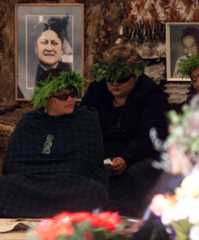
Thetangihanga is the enduring Māori ceremony to mourn the dead. The body lies on amarae and people come to pay their respects. Tangi retain traditional practices which have changed little despite European influence.
Story by Rawinia Higgins
Main image: Wreathed mourners at Sir Robert Mahuta's tangi


Story summary
Thetangihanga ceremony which Māori use to mourn the dead has changed very little over time. The body is prepared by an undertaker, then taken to the dead person’smarae. Visitors are welcomed and speeches are made. After the body is buried at the urupā (cemetery) a minister ortohunga walks through the dead person’s home to remove thetapu of death. Sometimes a photograph of the person will be taken to anothermarae so people who could not attend the tangi can mourn the death.
Hine-nui-te-pō
Hine-nui-te-pō was the goddess of death who Māui attempted to crawl through in order to end death. He failed, and humans continue to die.
Death is also personified as Aituā.
Tangihanga traditions
Arangatira about to die would deliver an ōhākī, a final speech to the tribe which often reminded them of revenge to be taken on other tribes.
A dead person’s body was smeared with red ochre and oil and put in a sitting position with the chin resting on the knees. They were wrapped in mats and cloaks.
Speeches were addressed to the dead person as if they were still alive.
Thewhānau pani (bereaved family) were expected to stay with the tūpāpaku (corpse) and not eat. People wore wreaths of greenery on their heads.
The body was buried and later retrieved. The bones were scraped clean and painted with ochre.Tohunga hid the bones so the dead person’s remains could not be desecrated.
Tangihanga today
Nowadays the body is in a casket which lies on themarae, in thewharenui, on the porch or in a separate house.
Thewhānau pani can eat at the end of the day when no more visitors will arrive.
People are encouraged to express their emotions. Sometimes there are arguments over where the body should lie. These are considered a tribute to themana of the dead.
How to cite this page
Rawinia Higgins, Tangihanga – death customs, Te Ara – the Encyclopedia of New Zealand, https://teara.govt.nz/en/tangihanga-death-customs (accessed 17 February 2026).
Story by Rawinia Higgins, published 14 May 2013.