


Taiwan yesterday received three shipments of COVID-19 vaccines, a total of 1.88 million doses.
The nation has so far received 8.92 million doses of the AstraZeneca and Moderna vaccines.
First to arrive was a donation from Japan. A Japan Airlines Co flight arrived at Taiwan Taoyuan International Airport at about 1:45pm with 970,000 doses of the AstraZeneca vaccine on board.
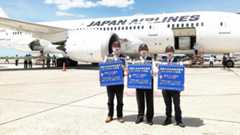
Photo: CNA
Minister of Health and Welfare Chen Shih-chung (陳時中), who heads the Central Epidemic Command Center (CECC), and center officials Wang Pi-sheng (王必勝) and Chou Jih-haw (周志浩) greeted the flight holding signs thanking the Japanese government for its latest donation.
Japan has donated a total of 3.34 million doses of the AstraZeneca vaccine to Taiwan. The first batch of 1.24 million doses was delivered on June 4, while a second batch of 1.13 million doses arrived on Thursday last week.
Japan’s three donations would cover about 15 percent of Taiwan’s population, and are a tremendous help in the nation’s fight against COVID-19, Chen said at the airport.
“We are very grateful,” he said, before thanking the Japanese government and people once again for their friendship toward Taiwan.
A second shipment arrived at the airport at about 3:15pm.
The China Airlines Ltd (中華航空) flight, which flew in from Thailand, delivered 560,000 doses of the AstraZeneca vaccine — ones purchased by the government.
Taiwan signed a contract with AstraZeneca PLC for 10 million doses on Oct. 30 last year — this was the third delivery, the center said.
The first delivery of 117,000 doses arrived on March 3, while the second delivery of 626,000 doses arrived on Wednesday last week.
Yesterday’s final shipment of vaccines arrived at the airport at about 4pm. The China Airlines flight, which flew in from Luxembourg, arrived with 350,000 doses of the Moderna vaccine.
Taiwan signed a contract with Moderna Inc for 5.05 million doses, the center said.
With yesterday’s shipment — the fourth delivery — the nation has so far received 1.15 million of the doses, it said.
The first delivery of 150,000 doses arrived on May 28, followed by 240,000 doses on June 18 and 410,000 doses on June 30.
As of 5pm yesterday, 7.58 million people had registered online to get vaccinated against COVID-19: 2.5 percent chose the AstraZeneca vaccine, 55.19 percent chose Moderna and 42.31 percent said they would accept either vaccine, the center said.
As of Wednesday, 4,337,272 COVID-19 vaccine doses had been administered — 4,242,075 first doses and 95,197 second doses, CECC data showed.
Additional reporting by CNA
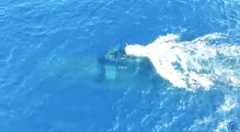
CSBC Corp, Taiwan (台灣國際造船) yesterday released the first video documenting the submerged sea trials of Taiwan’s indigenous defense submarine prototype, the Hai Kun (海鯤), or Narwhal, showing underwater navigation and the launch of countermeasures.The footage shows the vessel’s first dive, steering and control system tests, and the raising and lowering of the periscope and antenna masts.It offered a rare look at the progress in the submarine’s sea acceptance tests.The Hai Kun carried out its first shallow-water diving trial late last month and has since completed four submerged tests, CSBC said.The newly released video compiles images recorded from Jan. 29 to
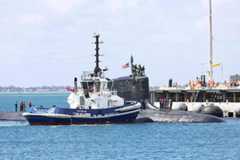
Washington and partners hope demonstrations of force would convince Beijing that military action against Taiwan would carry high costs The US is considering using HMAS Stirling in Western Australia as a forward base to strengthen its naval posture in a potential conflict with China, particularly over Taiwan, the Wall Street Journal reported on Saturday. As part of its Indo-Pacific strategy, Washington plans to deploy up to four nuclear-powered submarines at Stirling starting in 2027, providing a base near potential hot spots such as Taiwan and the South China Sea. The move also aims to enhance military integration with Pacific allies under the Australia-UK-US trilateral security partnership, the report said. Currently, US submarines operate from Guam, but the island could
Should China’s actions pose any threat to Taiwan’s security, economic or social systems, China would be excluded from major financial institutions, the bill says The US House of Representatives on Monday passed the PROTECT Taiwan Act, which states that Washington would exclude China from participating in major global financial organizations if its actions directly threaten Taiwan’s security.The bill, proposed by Republican Representative Frank Lucas, passed with 395 votes in favor and two against.It stipulates that if China’s actions pose any threat to Taiwan’s security, economic or social systems, the US would, “to the maximum extent practicable,” exclude Beijing from international financial institutions, including the G20, the Bank for International Settlements and the Financial Stability Board.The bill makes it clear that China must be prepared

Taiwanese trade negotiators told Washington that Taipei would not relocate 40 percent of its semiconductor production to the US, and that its most advanced technologies would remain in the nation, Vice Premier Cheng Li-chiun (鄭麗君) said on Sunday.“I told the US side very clearly — that’s impossible,” Cheng, who led the negotiation team, said in an interview that aired on Sunday night on Chinese Television System. Cheng was referring to remarks last month by US Secretary of Commerce Howard Lutnick, in which he said his goal was to bring 40 percent of Taiwan’s chip supply chain to the USTaiwan’s almost


 RSS
RSS