


Two Taiwanese ballparks yesterday became the world’s first to be opened to spectators for professional baseball this year, underscoring the nation’s success in containing the COVID-19 pandemic.
The CPBL games had the visiting Uni-President Lions facing the Fubon Guardians at the Sinjhuang Stadium in New Taipei City, while the CTBC Brothers hosted the Rakuten Monkeys at the Intercontinental Stadium in Taichung.
The Guardians hanged on for a 7-6 win after the Lions scored four runs in the top of the eighth.

Photo: CNA
Fubon’s Chiang Chih-hsien hit a solo dinger in the fifth against American pitcher Ryan Feierabend and the Lions’ Chen Yung-chi blasted a three-run homer in the eighth against Fubon’s relief pitching.
In the night’s other contest, the Brothers downed the Monkeys 6-4.
Health authorities on Wednesday said that ballparks could be opened to spectators as long as social distancing rules were enforced, as restrictions are being eased across society. That ended nearly a month of shuttered gates.

Photo: CNA
The CPBL season began on April 12, also a world first for pro baseball this year.
Minister of Health and Welfare Chen Shih-chung (陳時中) and New Taipei City Mayor Hou You-yi (侯友宜) attended the game in Sinjhuang to ensure proper prevention measures were observed.
The ballclubs invited Chen as a special guest to address the players and fans.
As he walked to the infield, spectators gave him a standing ovation, with many calling: “Thank you, health minister.”
“Taiwan’s prevention measures to combat the pandemic situation had all of our citizens cooperating with diligent efforts to achieve our common goals,” Chen told the crowd. “Today we did not have any new cases ... and that means 26 straight days with zero local cases in Taiwan. This is due to the combined efforts of all of our citizens.”
“Because of these results, we can take the next step to opening up,” he said. “To do this, we have to implement a new lifestyle, which includes personal hygiene practices like washing hands, wearing masks, social distancing and temperature taking. These must be done well at all times.”
“Today we start with opening ballparks, but with limits and in phases,” he said. “Step by step, let us see if we can continue to contain the virus.”
“To maintain a good life, let us do this together,” Chen said. “We can have success in containing the outbreak, so let us cheer each other on.”
Fubon Guardians general manager Chris Tsai presented a bouquet to the minister, thanking him on behalf of sports fans for opening ballparks.
Fubon head coach Hong Yi-chung presented Chen with a placard, smaller versions of which were presented to each spectator and media personnel, to commemorate the occasion.
They read: “Congratulations on being the first fans to attend a baseball game this year.”
The CPBL, in consultation with health authorities, introduced disease prevention conditions for spectators, including advanced ticket purchases online with ID verification, a limit of 1,000 people in designated seats that are staggered for social distancing, mandatory masks, and no eating, although drinking water is allowed.
Cheering and flag waving are permitted.
People began lining up outside the Sinjhuang Stadium in the late afternoon, and temperatures were taken before entry. Seats and tables were set up where each person filled out a health declaration and their recent travel history. Staff checked tickets and IDs, and disinfectant was sprayed on spectators’ hands before they could enter the stadium.
Some spectators complained about the no-eating rule, saying that three hours is too long to go without food.
These games are a test and restrictions would be eased eventually, Chen said.
The eating ban is to prevent virus transmission through saliva, he added.
One fan surnamed Kuo told reporters that he would surely get hungry and would leave the stadium to buy food before returning to the game.
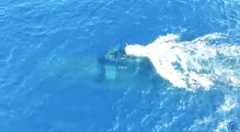
CSBC Corp, Taiwan (台灣國際造船) yesterday released the first video documenting the submerged sea trials of Taiwan’s indigenous defense submarine prototype, the Hai Kun (海鯤), or Narwhal, showing underwater navigation and the launch of countermeasures.The footage shows the vessel’s first dive, steering and control system tests, and the raising and lowering of the periscope and antenna masts.It offered a rare look at the progress in the submarine’s sea acceptance tests.The Hai Kun carried out its first shallow-water diving trial late last month and has since completed four submerged tests, CSBC said.The newly released video compiles images recorded from Jan. 29 to
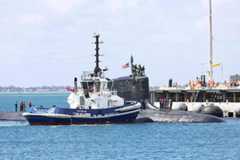
Washington and partners hope demonstrations of force would convince Beijing that military action against Taiwan would carry high costs The US is considering using HMAS Stirling in Western Australia as a forward base to strengthen its naval posture in a potential conflict with China, particularly over Taiwan, the Wall Street Journal reported on Saturday. As part of its Indo-Pacific strategy, Washington plans to deploy up to four nuclear-powered submarines at Stirling starting in 2027, providing a base near potential hot spots such as Taiwan and the South China Sea. The move also aims to enhance military integration with Pacific allies under the Australia-UK-US trilateral security partnership, the report said. Currently, US submarines operate from Guam, but the island could
Should China’s actions pose any threat to Taiwan’s security, economic or social systems, China would be excluded from major financial institutions, the bill says The US House of Representatives on Monday passed the PROTECT Taiwan Act, which states that Washington would exclude China from participating in major global financial organizations if its actions directly threaten Taiwan’s security.The bill, proposed by Republican Representative Frank Lucas, passed with 395 votes in favor and two against.It stipulates that if China’s actions pose any threat to Taiwan’s security, economic or social systems, the US would, “to the maximum extent practicable,” exclude Beijing from international financial institutions, including the G20, the Bank for International Settlements and the Financial Stability Board.The bill makes it clear that China must be prepared

Taiwanese trade negotiators told Washington that Taipei would not relocate 40 percent of its semiconductor production to the US, and that its most advanced technologies would remain in the nation, Vice Premier Cheng Li-chiun (鄭麗君) said on Sunday.“I told the US side very clearly — that’s impossible,” Cheng, who led the negotiation team, said in an interview that aired on Sunday night on Chinese Television System. Cheng was referring to remarks last month by US Secretary of Commerce Howard Lutnick, in which he said his goal was to bring 40 percent of Taiwan’s chip supply chain to the USTaiwan’s almost


 RSS
RSS