


The Straits Exchange Foundation and the Association for Relations Across the Taiwan Straits (ARATS) yesterday signed a cross-strait service trade agreement in Shanghai during the ninth round of cross-strait talks, opening the service sectors on both sides to further cross-strait exchanges.
Under the pact, which includes four chapters and 24 articles, 64 Taiwanese industries will be opened to Chinese investment, while China will open up 80 industries to Taiwan.
The Taiwanese industries include transportation, tourism and traditional Chinese medicine, while China will open up its finance, retail, electronics, publishing and travel sectors.
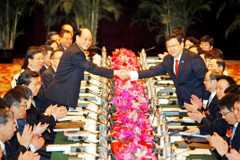
Photo: CNA
Under the agreement, Chinese investors will be allowed to open hotels in Taiwan.
Taiwan will also allow Chinese travel agencies to establish a maximum of three branches in the country and provide services to Taiwanese. However, they will not be allowed to accommodate any foreign tourists, including Chinese.
Taiwanese investors will be allowed to set up travel agencies in China, as well as open restaurants or hotels.
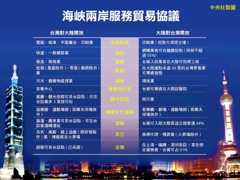
Photo: CNA
Chinese companies will be allowed to open beauty parlors or hair salons in Taiwan, but would only be allowed to employ Taiwanese.
While China will open its publishing industry to Taiwanese investment, Taiwan will allow Chinese companies to invest in Taiwanese businesses in the printing service industry, with a maximum of 50 percent stock ownership.
On financial services, Taiwanese companies will be allowed to invest security companies in Shanghai, in Shenzhen and Chinese-controlled Fujian Province.
In signing the pact, foundation Chairman Lin Join-sane (林中森) and ARATS Chairman Chen Deming (陳德銘) both lauded the agreement for deepening cross-strait exchanges in the service sector.
Lin said 80 percent of the deal opens the two sides’ service sectors to the same or greater degree as the Closer Economic Partnership Arrangement (CEPA) that was signed between Hong Kong and China in 2003, with 90 percent of financial services covered in the cross-strait agreement opened, just like in the CEPA.
The cross-strait service trade agreement is a major follow-up to the Economic Cooperation Framework Agreement (ECFA) and the General Agreement on Trade in Services under the WTO.
“The service trade agreement is a pact that benefits related sectors across the Taiwan Strait and promotes the interests of the public on both sides. It will result in a win-win situation for both sides,” Lin said.
After signing the pact, Taiwan and China cannot revise or cancel the agreement within the next three years.
The two sides will hold an annual meeting to review the implementation of the pact.
The agreement also includes an emergency negotiation mechanism, which gives related industries from each side the right to demand negotiations and seek solutions if the agreement negatively affects their businesses sectors.
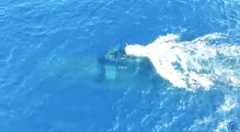
CSBC Corp, Taiwan (台灣國際造船) yesterday released the first video documenting the submerged sea trials of Taiwan’s indigenous defense submarine prototype, the Hai Kun (海鯤), or Narwhal, showing underwater navigation and the launch of countermeasures.The footage shows the vessel’s first dive, steering and control system tests, and the raising and lowering of the periscope and antenna masts.It offered a rare look at the progress in the submarine’s sea acceptance tests.The Hai Kun carried out its first shallow-water diving trial late last month and has since completed four submerged tests, CSBC said.The newly released video compiles images recorded from Jan. 29 to
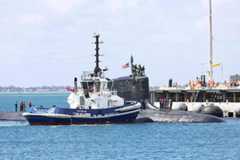
Washington and partners hope demonstrations of force would convince Beijing that military action against Taiwan would carry high costs The US is considering using HMAS Stirling in Western Australia as a forward base to strengthen its naval posture in a potential conflict with China, particularly over Taiwan, the Wall Street Journal reported on Saturday. As part of its Indo-Pacific strategy, Washington plans to deploy up to four nuclear-powered submarines at Stirling starting in 2027, providing a base near potential hot spots such as Taiwan and the South China Sea. The move also aims to enhance military integration with Pacific allies under the Australia-UK-US trilateral security partnership, the report said. Currently, US submarines operate from Guam, but the island could
Should China’s actions pose any threat to Taiwan’s security, economic or social systems, China would be excluded from major financial institutions, the bill says The US House of Representatives on Monday passed the PROTECT Taiwan Act, which states that Washington would exclude China from participating in major global financial organizations if its actions directly threaten Taiwan’s security.The bill, proposed by Republican Representative Frank Lucas, passed with 395 votes in favor and two against.It stipulates that if China’s actions pose any threat to Taiwan’s security, economic or social systems, the US would, “to the maximum extent practicable,” exclude Beijing from international financial institutions, including the G20, the Bank for International Settlements and the Financial Stability Board.The bill makes it clear that China must be prepared

Taiwanese trade negotiators told Washington that Taipei would not relocate 40 percent of its semiconductor production to the US, and that its most advanced technologies would remain in the nation, Vice Premier Cheng Li-chiun (鄭麗君) said on Sunday.“I told the US side very clearly — that’s impossible,” Cheng, who led the negotiation team, said in an interview that aired on Sunday night on Chinese Television System. Cheng was referring to remarks last month by US Secretary of Commerce Howard Lutnick, in which he said his goal was to bring 40 percent of Taiwan’s chip supply chain to the USTaiwan’s almost


 RSS
RSS