
sshd_config - How to Configure the OpenSSH Server?
This page is about configuring the OpenSSH server. For Tectia SSH, seeTectia SSH Server Administrator Manual. For configuring public key authentication, seessh-keygen. For configuring authorized keys for public key authentication, seeauthorized_keys.
The OpenSSH server reads a configuration file when it is started. Usually, this file is/etc/ssh/sshd_config, but the location can be changed using the-f command line option when startingsshd. Some organizations run multiple SSH servers at different port numbers, specifying a different configuration file for each server using this option.
The default values for certain configuration options in OpenSSH are quite restrictive and often need to be changed. Usually this is done by editing the default configuration file to change just a few options.
Contents
Relationship of configuration filesCommon configuration options for individual useCommon configuration changes for the enterpriseCryptographic policyVerbose loggingAuthorizedKeysFile locationRoot loginLogin bannerPort forwardingCertificate-based authenticationDetailedsshd_config file format
Relationship of configuration files
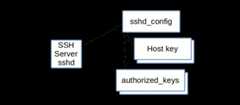
The SSH server actually reads several configuration files. Thesshd_config file specifies the locations of one or morehost key files (mandatory) and the location ofauthorized_keys files for users. It may also refer to a number of other files.
Common configuration options for individual use
Many individual developers and power users wish to maximize their convenience rather than go for maximum security. For such use, we recommend the following settings for homes, development servers, and universities. For important systems even such organizations should follow the guidelines for configuring enterprise servers.
X11Forwarding yes AllowAgentForwarding yes PermitRootLogin yesCommon configuration changes for the enterprise
Larger enterprises, or others wanting to run a tight security policy for certain servers, may want to configure the following configuration options.
Cryptographic policy
Symmetric algorithms for encrypting the bulk of transferred data are configured using theCiphers option. A good value isaes128-ctr,aes192-ctr,aes256-ctr. This should also provide good interoperability.
Host key algorithms are selected by theHostKeyAlgorithms option. A good value isecdsa-sha2-nistp256,ecdsa-sha2-nistp384,ecdsa-sha2-nistp521,ssh-rsa,ss/ssh/sshd_config/h-dss.
Key exchange algorithms are selected by theKexAlgorithms option. We recommendecdh-sha2-nistp256,ecdh-sha2-nistp384,ecdh-sha2-nistp521,diffie-hellman-group14-sha1,diffie-hellman-group-exchange-sha256. In particular, we do not recommend allowingdiffie-hellman-group1-sha1, unless needed for compatibility. It uses a 768 bit prime number, which is too small by today's standards and may be breakable by intelligence agencies in real time. Using it could expose connections toman-in-the-middle attacks when faced with such adversaries.
Message authentication code algorithms are configured using theMACs option. A good value ishmac-sha2-256,hmac-sha2-512,hmac-sha1.
We have included thesha-1 algorithm in the above sets only for compatibility. Its use is questionable from a security perspective. If it is not needed for compatibility, we recommend disabling it. NIST has also issuedguidance on it.
Ciphers aes128-ctr,aes192-ctr,aes256-ctrHostKeyAlgorithms ecdsa-sha2-nistp256,ecdsa-sha2-nistp384,ecdsa-sha2-nistp521,ssh-rsa,ssh-dssKexAlgorithms ecdh-sha2-nistp256,ecdh-sha2-nistp384,ecdh-sha2-nistp521,diffie-hellman-group14-sha1,diffie-hellman-group-exchange-sha256MACs hmac-sha2-256,hmac-sha2-512,hmac-sha1Some organizations may also want to set policy forPubkeyAcceptedKeyTypes. Same value as forHostKeyAlgorithms would make sense. However, restricting this value could abruptly break business-critical connections, and we recommend only setting it after analyzing all existing authorized keys for the algorithms they use.
Verbose logging
It is strongly recommended thatLogLevel be set toVERBOSE. This way, the key fingerprint for anySSH key used for login is logged. This information is important forSSH key management, especially in legacy environments.
LogLevel VERBOSENote:the newer OpenSSH releases do not need a verbose mode setting anymore as the required SSH key activity information is written into the syslog by the default OpenSSH config.
AuthorizedKeysFile location
Historically, most organizations have not touched the location of theauthorized keys files. This means they are in each user's home directory, and each user can configure additional permanent credentials for themselves and their friends. They can also add additional permanent credentials for any service account or root account they are able to log into. This has lead to massive problems in large organizations around managing SSH keys.
Westrongly recommend that organizations establish proper life cycle management for key-based credentials, and set the related options as part of this process. SeeSSH key management andcontact us for additional help.
AuthorizedKeysFile /etc/ssh/authorized-keys/%uEnterprises should also pay attention to theAuthorizedKeysCommand andAuthorizedKeysCommandUser options. They are typically used when SELinux is enabled and to fetch SSH keys from LDAP directories or other data sources. Their use can make auditing SSH keys cumbersome and they can be used to hide backdoor keys from casual observation.
Root login
For enterprise use, root access should generally go through a privileged access management system. This is necessary to enable auditing. A privilege escalation method such assudo may then be used to execute commands as root. Ideally, theroot account will not have any password at all. (See alsoPrivX for eliminating all admin account passwords.)
However, many organizations need to allow scripts to run commands as root using SSH keys. With properSSH key lifecycle management, this is the recommended way to script access. We furthermore recommend setting aforced command for any key configured to allow access as root. This can be enforced using the configuration file.
To disable passwords for root, but still allow key-based access without forced command, use:
PermitRootLogin prohibit-passwordTo disable passwords and only allow key-based access with a forced command, use:
PermitRootLogin forced-commands-onlyWe also need to point out that we have seen some organizations use forced commands that in practice allow the client to run any command, just to nominally satisfy a policy/audit requirement that all keys must have forced commands. Forced commands must be EFFECTIVE. In general, the forced command should make no reference to theSSH_ORIGINAL_COMMAND environment-variable. Auditors should check for this; if the forced command does reference this, odds are 99% that the forced command has been intentionally designed to fool auditors.
Login banner
Many enterprises, especially in the government, may want to print a login banner with legal warnings before asking for a password. TheBanner option does this. If this option is specified, the contents of the file will be printed to the client before login.
Banner /etc/bannerPort forwarding
Enterprises would generally want to preventport forwarding on their servers, unless expressly needed for tunneling legacy applications. There is substantial risk that users will use SSH tunneling to open backdoors into the organization through the firewall to get access to work machines from home. We've seen this done in numerous organizations and the technique is widely known.
Even if port forwarding is disabled, there is still the possibility of a user running their own SSH server or having their own laptop run one.
AllowTcpForwarding no AllowStreamLocalForwarding no GatewayPorts no PermitTunnel noCertificate-based authentication
OpenSSH also supports its own certificate formats for host and user authentication. SeePrivX Zero Trust Access Management Solution for how to use these for privileged access without passwords and automated access without SSH keys, based on Active Directory roles.
In host authentication, host certificates can be a major convenience.Tectia SSH supports standards-based X.509 certificates for this. OpenSSH requires its owncertificate authority and secure certification authorities for it are not yet commercially available as of this writing. Therefore we don't recommend using OpenSSH certificates quite yet.
SeeOpenSSH certificates for more information on OpenSSH certificates and how to configure them and what is available for issuing them.
 Detailed
sshd_config file format
Thesshd_config file is an ASCII text based file where the different configuration options of the SSH server are indicated and configured with keyword/argument pairs. Arguments that contain spaces are to be enclosed in double quotes (").
In thesshd_config file the keywords are case-insensitive while arguments are case-sensitive.
Each line that starts with '#' is interpreted as a comment.
The following is a list of some of the most commonly usedsshd_config keywords. Full listing of all available configuration options can be found on thesshd Config Manual Pages.
AcceptEnv
Specifies which environment variables sent by the client will be copied to the session's user environment.
AddressFamily
Specifies which IP address family sshd should use. Valid arguments are:any,inet (IPv4 only),inet6 (IPv6 only).
AllowAgentForwarding
Specifies whetherssh-agent forwarding is permitted. The default isyes.
AllowStreamLocalForwarding
Specifies whether forwarding Unix domain sockets is permitted. The default isyes.
AllowTcpForwarding
Specifies whether TCP forwarding is permitted. The default isyes.
AllowUsers
Specifies that login is allowed only for those user names that match a pattern listed with this keyword. By default, login is allowed for all user names.
AuthenticationMethods
Specifies the authentication methods that must be successfully completed in order to grant access to a user.
AuthorizedKeysFile
Specifies the file containing the public keys that can be used for user authentication. For more information, seeConfiguring Authorized Keys for OpenSSH.
ChallengeResponseAuthentication Specifies whether challenge-response authentication is allowed. The default isyes.
ChrootDirectory
Specifies the pathname of a directory to chroot (change root directory) to after authentication.
Ciphers
Specified the ciphers allowed. The ciphers supported in OpenSSH 7.3 are:3des-cbc, aes128-cbc, aes192-cbc, aes256-cbc, aes128-ctr, aes192-ctr, aes256-ctr, aes128-gcm@openssh.com, aes256-gcm@openssh.com, arcfour, arcfour128, arcfour256, blowfish-cbc, cast128-cbc, chacha20-poly1305@openssh.com.
Compression
Specifies whether compression is allowed (yes), denied (no) or delayed until the user has authenticated successfully (delayed - default).
DenyUsers
Specifies that login is denied for those user names that match a pattern listed with this keyword. By default, login is allowed for all user names.
ForceCommand
Forces the execution of the command specified by this keyword, ignoring any command supplied by the client and~/.ssh/rc if present.
GatewayPorts
Specifies whether remote hosts are allowed to connect to ports forwarded for the client. The default isno.
GSSAPIAuthentication
Specifies whether user authentication based onGSSAPI is allowed. The default isno.
HostbasedAuthentication
Specifies whether rhosts or/etc/hosts.equiv authentication together with successful public key client host authentication (i.e. using the public key of the client machine to authenticate a user to the remote server, providing a non-interactive form of authentication) is allowed. The default isno.
HostbasedUsesNameFromPacketOnly
Specifies whether or not the server will attempt to perform a reverse name lookup when matching the name in the~/.shosts,~/.rhosts, and/etc/hosts.equiv files during host-based authentication.
HostKey
Specifies a file containing a private host key used by SSH. It is possible to have multiple host key files. The default is/etc/ssh/ssh_host_dsa_key,/etc/ssh/ssh_host_ecdsa_key,/etc/ssh/ssh_host_ed25519_key and/etc/ssh/ssh_host_rsa_key for SSH protocol version 2.
HostKeyAlgorithms
Specifies the host key algorithms offered by the server. The defaults (OpenSSH 7.3) are:ecdsa-sha2-nistp256-cert-v01@openssh.com, ecdsa-sha2-nistp384-cert-v01@openssh.com, ecdsa-sha2-nistp521-cert-v01@openssh.com, ssh-ed25519-cert-v01@openssh.com, ssh-rsa-cert-v01@openssh.com, ssh-dss-cert-v01@openssh.com, ecdsa-sha2-nistp256,ecdsa-sha2-nistp384, ecdsa-sha2-nistp521,ssh-ed25519, ssh-rsa,ssh-dss.
IgnoreRhosts
Specifies that.rhosts and.shosts files will not be used inRhostsRSAAuthentication orHostbasedAuthentication.
KbdInteractiveAuthentication
Specified whether keyboard-interactive authentication is allowed. By default, the value ofChallengeResponseAuthenticationis used.
KexAlgorithms
Specifies the available Key Exchange algorithms. The KEX algorithms supported in OpenSSH 7.3 are:curve25519-sha256@libssh.org, diffie-hellman-group1-sha1, diffie-hellman-group14-sha1, diffie-hellman-group-exchange-sha1, diffie-hellman-group-exchange-sha256, ecdh-sha2-nistp256, ecdh-sha2-nistp384, ecdh-sha2-nistp521.
ListenAddress
Specifies the local addresses sshd should listen on. The following forms are allowed:
ListenAddress host|IPv4_addr|IPv6_addr
ListenAddress host|IPv4_addr:port
ListenAddress [host|IPv6_addr]:port
LoginGraceTime
The time after which the server disconnects if the user has not successfully logged in.
LogLevel
Specifies the level of verbosity for logging messages from sshd.
MACs
Specifies the available message authentication code algorithms that are used for protecting data integrity. The MACs supported in OpenSSH 7.3 are:hmac-md5, hmac-md5-96, hmac-ripemd160, hmac-sha1, hmac-sha1-96, hmac-sha2-256, hmac-sha2-512, umac-64@openssh.com, umac-128@openssh.com, hmac-md5-etm@openssh.com, hmac-md5-96-etm@openssh.com, hmac-ripemd160-etm@openssh.com, hmac-sha1-etm@openssh.com, hmac-sha1-96-etm@openssh.com, hmac-sha2-256-etm@openssh.com, hmac-sha2-512-etm@openssh.com, umac-64-etm@openssh.com, umac-128-etm@openssh.com.
In the algorithm names,-etm means "encrypt-then-mac", i.e. the message authentication code is calculated after encryption. It is recommended to use these algorithms because they are considered safer.
Match
PasswordAuthentication
PermitEmptyPasswords
PermitOpen
PermitRootLogin
PermitTTY
PermitTunnel
PermitUserEnvironment
PermitUserRC
Port
PubkeyAuthentication
Subsystem
UseDNS
UsePrivilegeSeparation
X11Forwarding
X11UseLocalhost
The detailed configuration file format documentation is still work in progress...
SSH is a leading defensive cybersecurity company that secures communications between humans, systems, and networks. We specialize in Zero Trust Privileged Access Controls and Quantum Safe Network Security. Our customers include a diverse range of enterprises, from multiple Fortune 500 companies to SMBs across various sectors such as Finance, Retail, Technology, Industrial, Healthcare, and Government. 25% of Fortune 100 companies rely on SSH’s solutions. Recent strategic focus has expanded SSH business to Defence, Critical Infrastructure Operators, Manufacturing OT Security and Public Safety.
Leonardo S.p.A invests 20.0 million EUR in SSH, becoming the largest shareholder of the company. SSH solutions form a Center of Excellence for Zero Trust privileged access management and quantum-safe network encryption in Leonardo - a global industrial group that creates multi-domain technological capabilities in the Aerospace, Defence and Security sector with 17.8 billion EUR revenue in 2024. SSH company’s shares (SSH1V) are listed on Nasdaq Helsinki.
© Copyright SSH • 2025 •Legal
