


Wii
| Wii | |
|---|---|
  | |
| Manufacturer | Nintendo |
| Type | Video game console |
| Generation | Seventh generation era |
| First available |  November 19, 2006 November 19, 2006 December 2, 2006 December 2, 2006 December 7, 2006 December 7, 2006 December 8, 2006 December 8, 2006 September 28, 2007 September 28, 2007 April 26, 2008 April 26, 2008 |
| CPU | IBMPowerPC-based[1] "Broadway" |
| GPU | ATI "Hollywood" |
| Media | 12 cmWii Optical Disc 8 cmNintendo GameCube Game Disc |
| System storage | 512MB Internalflash memory SD card Nintendo GameCubememory card |
| Controller input | Wii Remote,Nunchuk,Classic Controller, NintendoGameCube controller |
| Connectivity | Wi-Fi Bluetooth USB 2.0 x2 LAN Adapter (via USB) |
| Online service | Nintendo Wi-Fi Connection WiiConnect24 Virtual Console Wii Menu |
| Backward compatibility | Nintendo GameCube |
| Predecessor | Nintendo GameCube |
| Successor | Wii U |
| Article on Nintendo Wiki | Wii |
TheWii is the fifth internationally released home video game console released byNintendo. The console is the direct successor to theNintendo GameCube. Nintendo states that its console targets a broader demographic than that of Microsoft'sXbox 360 and Sony'sPlayStation 3, but it competes with both as part of the seventh generation of video game systems, despite being noticeably underpowered compared to its rivals.
A distinguishing feature of the console is its wireless controller, theWii Remote, which can be used as a handheld pointing device and can detect acceleration and orientation in three dimensions. Another feature is WiiConnect24, which enables it to receive messages and updates over the Internet while in standby mode. The Wii Remote and Nunchuk combination can be used to playSuper Smash Bros. Brawl, while the Wii Remote (turned on its side), theClassic Controller, or aGameCube controller may also be used.
Nintendo first spoke of the console at the 2004 E3 press conference and later unveiled the system atE3 2005.Satoru Iwata revealed a prototype of the controller at the September 2005 Tokyo Game Show. At E3 2006, the console won the first of several awards. By December 8, 2006, it had completed its launch in four key markets. The Financial Times reported that as of September 12, 2007, the Wii is the sales leader of its generation, based on sales figures from Enterbrain, NPD Group, and GfK. The Wii sold 101.63 million units worldwide and held the title of being Nintendo's best-selling home console up until 2021, when it was surpassed by theNintendo Switch. The Wii also beat its contemporaries, Microsoft's Xbox 360 and Sony's PlayStation 3, both of which have sold 84 million and 87.4 million worldwide respectively.
A revision called theWii Family Edition was released in October/November 2011. It is a cheaper version of the Wii and functions the same way as the original model, but is designed to sit only horizontally and is incompatible with Nintendo GameCube games and controllers. It was also not released in Japan and Australia. Another revision titled theWii Mini was released initially in Canada on December 7th 2012. This version also lacks GameCube support in addition to lacking online functionality in exchange for an extremely reduced price, meaning it has no access to online features and can only play physical game copies. Though it was only available in Canada at launch, it was later released in Europe on March 22, 2013, and in the United States on November 17, 2013. Like the Family Edition, it was also not released in Japan and Australia.
In November 2012, the Wii was succeeded by theWii U, which is backward compatible with Wii games.
In theSuper Smash Bros. series[edit]
Super Smash Bros. Brawl is aSuper Smash Bros. game released game for the Wii in 2008. Backwards compatibility allows forSuper Smash Bros. Melee to be played on the Wii, but with GameCube controllers only. Also,Super Smash Bros. for theNintendo 64 has been released on theVirtual Console in Japan, Europe, America, and Australia for 1000 Wii Points. The Wii makes it possible, for the first time, to play all the previousSmash Bros. games on the newest game's home console, as well as the first time that any pastSmash game has been playable on a newer console.
Some characters that debuted in games originally released for the Wii became playable fighters in theSuper Smash Bros. series, all of which debuted inSmash 4:Wii Fit Trainer,Rosalina &Luma,Shulk and theMiis.
In competitive play[edit]
Due to being the original hardware the game was designed for, the Wii is the preferred system to playBrawl, especially in tournaments. The game has never been re-released on another system, forcing players with physical copies to only use Wii compatible systems. While the Wii U can play Wii games by being compatible with its discs and controllers, the unintuitive nature of accessing the console's Wii mode, the native incompatibility with GameCube controllers, and the very poor sales of the console limiting its availability, make it an unappealing option for competitiveBrawl. Emulators like Dolphin also exist, but they sometimes possess bugs and performance issues not present on Wii. However, the aging hardware that is becoming progressively less reliable has forced the competitive scene to consider and experiment with these alternatives before the game becomes unplayable, and emulation developers have made great strides in making a nearly identical experience, though this niche is not quite as developed as efforts for GameCube yet.
The Wii is also commonly used to playMelee, due to its backwards compatibility with the GameCube. GameCube games played on the Wii are functionally nearly identical to those played on the original hardware, and the Wii's much greater sales compared to the GameCube make it a more readily available option for tournament setups. Later Wii models removed backwards GameCube compatibility, but these constitute a minority of Wiis in circulation, and they are rarely if ever used to playBrawl as well due to their lack of GameCube controller ports. It is additionally possible to solder GameCube controller ports onto a Wii Family Edition through hardware modding.
By contrast, the Wii is almost never used to playSmash 64, despite its availability on the Virtual Console, due to numerous emulator bugs affecting this version; as such, the competitive community always prefers playing on an original N64 console or emulators for PC, which are more reliable. As of 2019, with the closure of the Wii Shop, it is also no longer possible to legally acquire the Virtual Console version ofSmash 64.
Just like how it is possible to dump Wii disc and SD card data onto other systems, some have found ways to make their own discs compatible with the Wii and download data onto SD cards. This allows pirated games, mods, and fan-games to be played on original hardware, including the many based onBrawl andMelee. In this area, the Wii has the biggest scene of anySmash game due to possessing more industry-standard hardware compared to its predecessors, and the ease of defeating the console's copy protection and anti-piracy firmware to allow mods. The best known example isProject M, which would go on to have its own competitive scene that overshadowedBrawl itself before development suddenly ceased over fear of legal ramifications.
Gallery[edit]

The Wii Family Edition.

The Wii Mini, depicted with a red Wii Remote Plus and Nunchuk.

The Wii Remote.

The Nunchuk.

A Wii Remote connected with a Nunchuk.
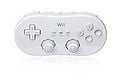
The Classic Controller.

The Classic Controller Pro.

The Wii Balance Board.

A crystal icing Wii given out as a prize


References[edit]
- ^Wii: The Total Story. IGN. Retrieved on 2006-11-20.
External links[edit]
 | Wikipedia has an article onWii. |
| Nintendo consoles | |
|---|---|
| Home consoles | Color TV-Game 15 ·Nintendo Entertainment System ·Super Nintendo Entertainment System ·Virtual Boy ·Nintendo 64 ·Nintendo GameCube ·Wii ·Wii U |
| Handheld consoles | Game & Watch ·Game Boy ·Game Boy Color ·Game Boy Advance ·Nintendo DS ·Nintendo 3DS |
| Hybrid consoles | Nintendo Switch ·Nintendo Switch 2 |

