


Water vapor detected on huge Jupiter moon Ganymede for 1st time
This could be a trend for icy bodies throughout the solar system and beyond.
When you purchase through links on our site, we may earn an affiliate commission.Here’s how it works.
Breaking space news, the latest updates on rocket launches, skywatching events and more!
You are now subscribed
Your newsletter sign-up was successful
Want to add more newsletters?

Delivered daily
Daily Newsletter
Breaking space news, the latest updates on rocket launches, skywatching events and more!

Once a month
Watch This Space
Sign up to our monthly entertainment newsletter to keep up with all our coverage of the latest sci-fi and space movies, tv shows, games and books.

Once a week
Night Sky This Week
Discover this week's must-see night sky events, moon phases, and stunning astrophotos. Sign up for our skywatching newsletter and explore the universe with us!

Twice a month
Strange New Words
Space.com's Sci-Fi Reader's Club. Read a sci-fi short story every month and join a virtual community of fellow science fiction fans!
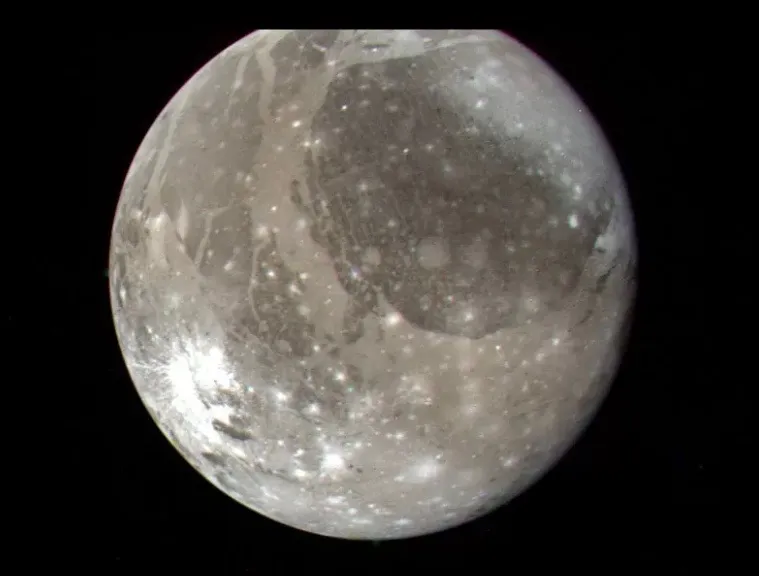
In the wisp-thin sky of Jupiter's moonGanymede, the largest satellite in the solar system, astronomers have for the first time detected evidence of water vapor, a new study finds.
The discovery could shed light on similar watery atmospheres that may envelop other icy bodies in thesolar system and beyond, researchers said.
Previous research suggested that Ganymede — which is larger than Mercury and Pluto, and only slightly smaller thanMars — may contain more water than all of Earth's oceans combined. However, the Jovian moon is so cold that water on its surface is frozen solid. Any liquid water Ganymede possesses would lurk about 100 miles (160 kilometers) below its crust.
You may like


Related:Photos of Ganymede, Jupiter's largest moon
Prior work suggested that ice on Ganymede's surface could turn from a solid directly to a gas, skipping a liquid form, so that water vapor could form part of the giant moon's thin atmosphere. However, evidence of this water has proved elusive — until now.
In the new study, researchers analyzed old and new data of Ganymede from NASA'sHubble Space Telescope. In 1998, Hubble captured the first ultraviolet images of Ganymede, including pictures of its auroras, the giant moon's versions of Earth's northern and southern lights. Colorful ribbons of electrified gas within these auroras helped provide evidence that Ganymede has a weak magnetic field.
Ultraviolet signals detected in these auroral bands suggested the presence of oxygen molecules, each made of two oxygen atoms, which are produced when charged particles erode Ganymede's icy surface. However, some of these ultraviolet emissions did not match what one would expect from an atmosphere of pure molecular oxygen. Previous research suggested these discrepancies were linked to signals from atomic oxygen — that is, single atoms of oxygen.
Breaking space news, the latest updates on rocket launches, skywatching events and more!
As part of a large observing program to support NASA'sJuno mission toJupiter, researchers sought to measure the amount of atomic oxygen in Ganymede's atmosphere using Hubble. Unexpectedly, they discovered there is hardly any atomic oxygen there, suggesting there must be another explanation for the earlier ultraviolet signals.
The scientists focused on how the surface temperature of Ganymede varies strongly throughout the day, with highs of about minus 190 degrees Fahrenheit (minus 123 degrees Celsius) at noon at the equator and lows of about minus 315 degrees Fahrenheit (193 degrees Celsius) at night. At the hottest spots on Ganymede, ice may become sufficiently warm enough to convert directly into vapor. They noted that differences seen between a number of ultraviolet images from Ganymede closely match where one would expect water in the moon's atmosphere based on its climate.
"Water vapor in the atmosphere matches the data very well," study lead author Lorenz Roth, a planetary scientist at the KTH Royal Institute of Technology in Stockholm, told Space.com.
You may like
The main reason previous research failed to detect water in Ganymede's atmosphere is because the ultraviolet signal from molecular oxygen is very strong. "Within this stronger oxygen signal, it's hard to find other signals," Roth said.
"These findings suggest that water vapor actually exists in the atmospheres of icy bodies in the outer solar system," Roth said. "Now we might see it more places."
The scientists detailedtheir findings online Monday (July 26) in the journal Nature Astronomy.
Follow uson Twitter @Spacedotcomand on Facebook.

Charles Q. Choi is a contributing writer for Space.com and Live Science. He covers all things human origins and astronomy as well as physics, animals and general science topics. Charles has a Master of Arts degree from the University of Missouri-Columbia, School of Journalism and a Bachelor of Arts degree from the University of South Florida. Charles has visited every continent on Earth, drinking rancid yak butter tea in Lhasa, snorkeling with sea lions in the Galapagos and even climbing an iceberg in Antarctica. Visit him at http://www.sciwriter.us


