


Astronaut shows off vintage Nobel Prize in space — and talks 'quantum dots' ISS experiment (video)
'Quantum dots' are outside the orbiting laboratory as it flies around Earth.
When you purchase through links on our site, we may earn an affiliate commission.Here’s how it works.
Breaking space news, the latest updates on rocket launches, skywatching events and more!
You are now subscribed
Your newsletter sign-up was successful
Want to add more newsletters?
Delivered daily
Daily Newsletter
Breaking space news, the latest updates on rocket launches, skywatching events and more!
Once a month
Watch This Space
Sign up to our monthly entertainment newsletter to keep up with all our coverage of the latest sci-fi and space movies, tv shows, games and books.
Once a week
Night Sky This Week
Discover this week's must-see night sky events, moon phases, and stunning astrophotos. Sign up for our skywatching newsletter and explore the universe with us!

Twice a month
Strange New Words
Space.com's Sci-Fi Reader's Club. Read a sci-fi short story every month and join a virtual community of fellow science fiction fans!
Nobel Prize-winning work is flying in space as we speak.
Bawendi, who won the 2023Nobel Prize in Chemistry, called the ISS on Monday (Dec. 11) alongside fellow physics Nobel laureate Ferenc Krausz. Bawendi told students beforehand that science is a process of experiments that create unpredictable and yet interesting results.
You may like

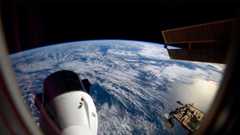


"Everything you discover is a little bit new," he said. "You might have an idea of what you expect to find. But it's always going to be somewhat different. Sometimes it's very different, but it's always an adventure."
Related:Quantum chemistry experiment on ISS creates exotic 5th state of matter

Bawendi won the Nobel Prize for his applications of quantum dots, which are semiconductor nanocrystals. Most Samsung televisions today use quantum dots, based on a gallium nitride diode invented in the late 1990s. "The quantum dots absorb some of that blue light and reimage as green and red," he explained.
Now similar tech is being tested outside the ISS for stability in space, which got Bawendi's attemtion during the livestreamed call with commander Andreas Mogensen, an astronaut with theEuropean Space Agency. "Do you like, baby them or feed them? What do you do with them, if anything?"
Breaking space news, the latest updates on rocket launches, skywatching events and more!
The ISS experiment is called the Materials International Space Station Experiment-18-NASA (MISSE-18-NASA), which is part of a series of passive payloads mounted outside the ISS using the Japanese Kibo robotic arm.
Mogensen emphasized that the Expedition 70 crew's involvement is getting the experiment properly mounted on the arm for future mounting. "Then it runs more or less autonomously once it's outside," he said.
"Well, we'll see how they behave when they come back to Earth," Bawendi responded. Each "outside" set of experiments is rotated every six months, so we might learn more about this work in 2024 or early 2025 once they are returned to Earth.
You may like
Mogensen, who is from Denmark, also showed off a space surprise: it turns out the medal of Danish physicist Niels Bohr is on the ISS with him right now. The 1922 prize for Bohr was based on his work examining the atom, a fundamental unit of particle physics. The medal is on loan from the Museum of National History in Denmark, according to a postMogensen made on X (formerly Twitter).
Mogensen did not explain upon which ship the Nobel flew to orbit, but ESA materials said he"brought (the medal) with him", suggesting it flew on boardSpaceX Crew Dragon. As Mogensen carefully worked to hold the medal up before the camera, Mogensen joked he had to be careful that items "do not fly away" from him in weightlessness.
Bohr once donated his Nobel Prize medal to a 1940 U.S.-backed effort toraise funds for Finland during the 1939-1940 Winter War, following the internationally condemned invasion of Finland by the Soviet Union. Fellow laureate August Krogh donated his as well to that cause. An anonymous buyer bought both medals and gave them to the Danish national museum, where the Nobels remain in the permanent collection, according tothe Nobel Prize website.
"To me, the Nobel Prize is something very important," Mogensen added. "It's a symbol for humankind's never-ending curiosity, and the desire to explore, and passion to learn. It is also a symbol for not only learning new things, but also communicating that: publishing it, writing about it and talking about it and spreading that knowledge, our threshold of knowledge for humankind."
Elizabeth Howell (she/her), Ph.D., was a staff writer in the spaceflight channel between 2022 and 2024 specializing in Canadian space news. She was contributing writer for Space.com for 10 years from 2012 to 2024. Elizabeth's reporting includes multiple exclusives with the White House, leading world coverage about a lost-and-found space tomato on the International Space Station, witnessing five human spaceflight launches on two continents, flying parabolic, working inside a spacesuit, and participating in a simulated Mars mission. Her latest book, "Why Am I Taller?" (ECW Press, 2022) is co-written with astronaut Dave Williams.


