


Apollo landing sites: An observer's guide on how to spot them on the moon
Gaze upon the lunar surface tonight, and you'll see where astronauts, rovers, and landers stepped onto another world.
When you purchase through links on our site, we may earn an affiliate commission.Here’s how it works.
Breaking space news, the latest updates on rocket launches, skywatching events and more!
You are now subscribed
Your newsletter sign-up was successful
Want to add more newsletters?

Delivered daily
Daily Newsletter
Breaking space news, the latest updates on rocket launches, skywatching events and more!

Once a month
Watch This Space
Sign up to our monthly entertainment newsletter to keep up with all our coverage of the latest sci-fi and space movies, tv shows, games and books.

Once a week
Night Sky This Week
Discover this week's must-see night sky events, moon phases, and stunning astrophotos. Sign up for our skywatching newsletter and explore the universe with us!

Twice a month
Strange New Words
Space.com's Sci-Fi Reader's Club. Read a sci-fi short story every month and join a virtual community of fellow science fiction fans!
Today, there is a lot of exciting talk about going to themoon. Again. Shining brightly in our sky, it calls to us like a celestial siren, just as it always has done. NASA is still debating whether it should send astronauts straight toMars, bypassing the moon altogether, or only go to Mars after a number of successful precursor missions to Earth's natural satellite.
Meanwhile, theEuropean Space Agency is looking to the moon as the potential site of a scientific outpost, where different nations could work together in a 'lunar village,' much like international scientists now work in Antarctica.
Private companies are also planning tomine the moon for resources, and there's even a competition to land robot rovers on the moon and have them send live videos back to Earth.
You may like


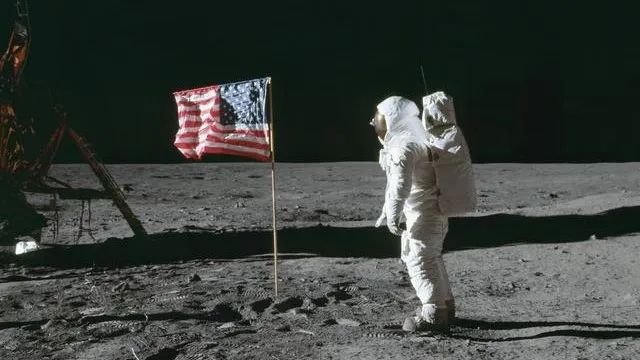
With all this going on, it's important to remember we've already been to the moon. True, it happened a long time ago but theApollo program led to missions that were a spectacular success and represented a golden age of exploration. It was a time when enormous rockets, gleaming white, thundered into the sky, roaring like dragons, carrying brave explorers across the gulf of space, traveling much further than we could possibly go today.
Between 1969 and 1972, six Apollo missions took teams of three astronauts across over 250 miles (400 kilometers) of space to the moon, set two of them down on its surface, and brought them all home safely again. A seventh mission,Apollo 13, famously failed to land on the moon, but the astronauts survived a flight around the moon. Today, those daring missions are as fascinating as ever.
Many people have asked why astronomers don't turn theHubble Space Telescope towards the moon to take photos of the Apollo spacecraft. But not even the Hubble could see a four-meter wide Apollo spacecraft on the moon.
Breaking space news, the latest updates on rocket launches, skywatching events and more!
Hubble is essentially a light bucket, designed to collect the faint, ghostly light of farawaygalaxies,nebulas andplanets. It can't zoom in on things in its own backyard.
To see Apollo hardware, you have to go to the moon, and then either land next to the actual spacecraft, as the rovers might do later this year or next, or look down on them from orbit. TheLunar Reconnaissance Orbiter (LRO), has done just that, and has taken amazing images of the Apollo landing sites from orbit showing not just the spacecraft themselves, but the lunar rovers parked where they were left, and even the trails of bootprints left in the lunar dust by the explorers.
So, if you were hoping to see Apollo hardware on the moon through your telescope, you've no chance, sadly. However, you can see theApollo landing sites if your telescope is good enough—and we're going to tell you how, and where, to find them.
You may likeHow to view the Apollo landing sites

First, you need to know the general areas of the landing sites, and the key to doing that is to think of the moon as the face of a clock, with 12 o'clock at the top and 6 o'clock at the bottom. You can then find the rough areas of each mission's landing site quite easily, using the charts included in this guide.
Having found the general areas of the landing sites, you can then zoom in on those to pin-down the actual landing sites. You do this by looking for certain features the landing sites were close to, such as a large crater or a valley. Again the charts will help you.
Note: The charts are oriented correctly for the 'upside down' view seen through most telescopes.
Apollo 11

- Telescope with magnification of 50x or more
- Mare Tranquillitatis (Sea of Tranquility)
- Between first quarter and full
Finding theApollo 11 landing site whereNeil Armstrong took his "one small step" off the Eagle's ladder is quite easy.
Just find the large crater Theophilus and put it at the top of your field of view. You'll see an obvious 'promontory' of bright ground beneath the crater, jutting out into the darker lava sea. The 'Tranquility Base' is just beneath this striking feature.
Apollo 12

- Telescope with magnification of 50x or more
- Oceanus Procellarum (Ocean of Storms),close to crater Copernicus
- Between full and last quarter
One of the moon's most impressive craters will guide you towards theApollo 12 landing site in theOcean of Storms.
Just find the huge craterCopernicus, and place it at the bottom of your inverted field of view. To Copernicus' upper right you'll see the smaller crater Reinhold and beyond it the crater Lansberg. Apollo 12's landing site lies to the upper left of the 3.1-kilometer-deep Lansberg.
Apollo 14

- Telescope with magnification of 50x or more
- Fra Mauro, close to crater Ptolemaeus
- Between first quarter and full Moon
TheApollo 14 landing site can be found close to one of the most impressive and most photographed 'crater chains' on the moon's surface.
Once you have found craters Arzachel, Alphonsus, and Ptolemaeus, jump across to the right of Ptolemaeus, where you will find the smaller ring-like crater, Parry. The Apollo 14 landing site is just to the lower right of this crater.
Apollo 15

- Telescope with magnification of 100x or more
- Close to Hadley Rille,in the Apennine mountains
- Between first quarter and full Moon
The lunar module Falcon touched down in July 1971 in the most stunning location any Apollo mission visited—close to a meandering valley in the shadow of the Apennine mountains.
To find it, look for the break in the curve of the mountains, to the left of the crater Archimedes, past Autolycus and Aristillus.Apollo 15 landed above and to the left of these craters, in the foothills of the mountains.
Apollo 16

- Telescope with magnification of 100x or more
- The Descartes Highlands, close to the crater Kant
- First quarter to full
The landing site of theApollo 16 lunar module 'Orion' is probably the most challenging to find.
If you place the crater Theophilus to the left of your eyepiece's field of view, you'll see a smaller, sharper-rimmed crater to its right. This is Kant, and Apollo 16 set down in the rugged highlands to its lower right.
Apollo 17

- Telescope with magnification of 100x or more
- Taurus-Littrow Valley
- First quarter to full
The final Apollo mission in December 1972 saw the lunar module Challenger land in a notch-like 'bay' on the southern shore of the Sea of Serenity.
To find it, put the shallow crater Posidonius at the bottom of your field of view. Follow the shoreline 'up' past the semi-circular Le Monnier bay. Continue upwards and you'll find theApollo 17 landing site.


Stuart is a former contributor to Space.com and All About Space magazine covering Mars Rovers, Search for Life, Comets, and the Apollo Program. He's a children's author, lifelong space enthusiast, and amateur astronomer who wrote about the daily adventures of the Mars Exploration Rover Opportunity at his old Road to Endeavour blog. He's written a long overdue biography of Felicette, the space cat... a collection of Mars-inspired poetry... a ghost story set beneath the northern lights and a novel telling the tale of the first cat to go to Mars.


