Former NASA X-15 Pilots Awarded Astronaut Wings
When you purchase through links on our site, we may earn an affiliate commission.Here’s how it works.
Breaking space news, the latest updates on rocket launches, skywatching events and more!
You are now subscribed
Your newsletter sign-up was successful
Want to add more newsletters?

Delivered daily
Daily Newsletter
Breaking space news, the latest updates on rocket launches, skywatching events and more!

Once a month
Watch This Space
Sign up to our monthly entertainment newsletter to keep up with all our coverage of the latest sci-fi and space movies, tv shows, games and books.

Once a week
Night Sky This Week
Discover this week's must-see night sky events, moon phases, and stunning astrophotos. Sign up for our skywatching newsletter and explore the universe with us!

Twice a month
Strange New Words
Space.com's Sci-Fi Reader's Club. Read a sci-fi short story every month and join a virtual community of fellow science fiction fans!
Today at NASA's Dryden Flight Research Center in California astronaut wings will be awarded to the threecivilian research pilots who flew the X-15 into space in the mid-1960s.
Between the years that NASAflew its first unmanned Mercury sub-orbital space flight and when its Apolloastronauts trained for their first mission to orbit the Moon, 12 test pilotsflew the nation's first rocket plane to the edges of the atmosphere ... andbeyond.
Of the eight, five pilotswere employed by the Air Force and received their astronaut wings. The threeothers were NASA research pilots--William H. "Bill" Dana and the late JohnB. "Jack" McKay and Joseph A. Walker.
In a private ceremony,scheduled to take place Tuesday afternoon before an audience of 200 invitedguests and NASA Dryden employees the three civilian pilots will at long last receivetheir wings. The event is expected to include presentations by Kent Rominger,NASA's Chief of the Astronaut Corps and by Johnny Armstrong, an X-15 testengineer and current Deputy Director of the Access to Space Office at the Air Force Flight Test Center, Edwards Air Force Base, Calif.
Breaking space news, the latest updates on rocket launches, skywatching events and more!
Two of Walker's fights alsoexceeded 328,000 feet or 62 miles altitude, the internationally acceptedboundary of space set by the Federation Aeronautique Internationale.
After flying the X-15(including its last flight in October 1968), Dana served as a research pilotfor the Air Force's X-20 Dyna-Soar program. He led NASA's lifting body programduring the late 1960s and 1970s. In 1993, Dana was named Chief Engineer at NASADryden until 1998 when he retired.
McKay joined NACA (NationalAdvisory Committee for Aeronautics), NASA's predecessor, in 1951 as a testpilot for the X-1 and D-558 and served as a project pilot on the F-100, F-102,F-104, and F-107 test programs before he was assigned to the X-15. He wasseriously injured when the X-15 he was piloting crashed in 1962. McKay's deathon April 27, 1975, stemmed from liver damage suffered in the accident.
Walker's altitude record of 67.1 miles set on the third ofhis X-15 space flights went unbroken by any other rocket plane until theprivately-funded SpaceShipOne exceeded 69 miles in October 2004.
Walker made the first test flight of the X-15 in 1960 andwent on to fly a total of 24 times. After the X-15, he tested the "flyingbedstead," the Lunar Landing Research Vehicle, in advance of trainingNASA's Apollo astronauts how to touchdown on the moon. Walker was killed onJune 8, 1966, when the F-104 chase plane he was piloting collided with theXB-70 "Valkyrie" he was chasing.
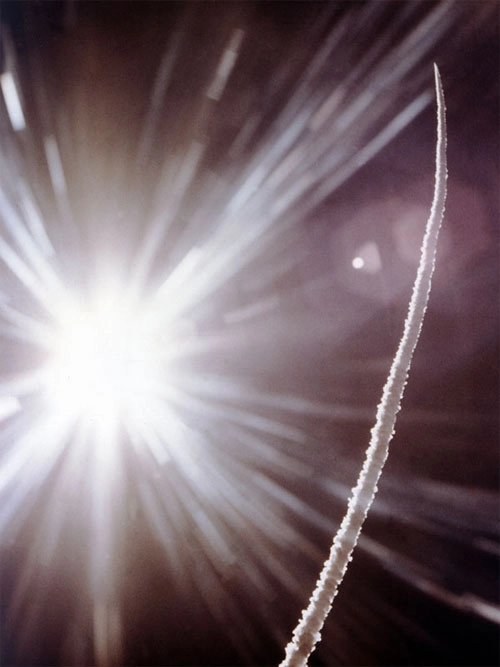
The X-15 explored the realmof hypersonic flight during a nine year joint program between NASA, the U.S.Navy, the U.S. Air Force and North American. The X-15 was air launched from aB-52 aircraft before igniting its liquid-fuel rocket engine. In addition tosetting altitude records, the experimental aircraft also achieved speedmilestones in the Mach 4 to 6 range. The X-15 program is credited withcontributing to the development of the Mercury, Gemini, and Apollo spacecraftas well as NASA's Space Shuttle.
Robert Pearlman is a space historian, journalist and the founder and editor ofcollectSPACE.com, a daily news publication and community devoted to space history with a particular focus on how and where space exploration intersects with pop culture. Pearlman is also a contributing writer for Space.com and co-author of "Space Stations: The Art, Science, and Reality of Working in Space” published by Smithsonian Books in 2018.
In 2009, he was inducted into the U.S. Space Camp Hall of Fame in Huntsville, Alabama. In 2021, he was honored by the American Astronautical Society with the Ordway Award for Sustained Excellence in Spaceflight History. In 2023, the National Space Club Florida Committee recognized Pearlman with the Kolcum News and Communications Award for excellence in telling the space story along the Space Coast and throughout the world.


