Movatterモバイル変換


[0]ホーム

URL:


PPTX, PDF2,431 views

advanced sql(database)

This document discusses advanced SQL topics including joins, subqueries, and ensuring transaction integrity. It provides examples of different types of joins like equi-joins, natural joins, outer joins, and union joins. It also discusses using subqueries in WHERE clauses, FROM clauses, and HAVING clauses, and differentiates between correlated and noncorrelated subqueries. The document concludes by defining transactions and describing SQL commands like BEGIN TRANSACTION, COMMIT, and ROLLBACK that are used to ensure transaction integrity.

Embed presentation

Downloaded 92 times
Lecture 8:Advanced SQLISOM3260, Spring 2014
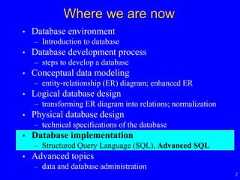
2Where we are now• Database environment– Introduction to database• Database development process– steps to develop a database• Conceptual data modeling– entity-relationship (ER) diagram; enhanced ER• Logical database design– transforming ER diagram into relations; normalization• Physical database design– technical specifications of the database• Database implementation– Structured Query Language (SQL), Advanced SQL• Advanced topics– data and database administration
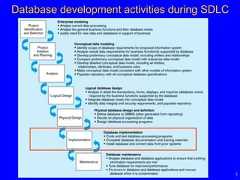
3Database development activities during SDLC
4Advanced SQL• Joins• Subqueries• Ensuring Transaction Integrity
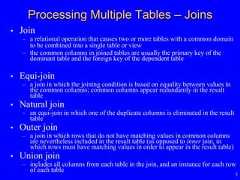
5Processing Multiple Tables – Joins• Join– a relational operation that causes two or more tables with a common domainto be combined into a single table or view– the common columns in joined tables are usually the primary key of thedominant table and the foreign key of the dependent table• Equi-join– a join in which the joining condition is based on equality between values inthe common columns; common columns appear redundantly in the resulttable• Natural join– an equi-join in which one of the duplicate columns is eliminated in the resulttable• Outer join– a join in which rows that do not have matching values in common columnsare nevertheless included in the result table (as opposed to inner join, inwhich rows must have matching values in order to appear in the result table)• Union join– includes all columns from each table in the join, and an instance for each rowof each table
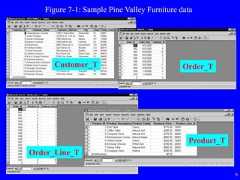
6Figure 7-1: Sample Pine Valley Furniture dataCustomer_T Order_TOrder_Line_TProduct_T
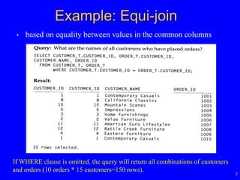
7Example: Equi-join• based on equality between values in the common columnsIf WHERE clause is omitted, the query will return all combinations of customersand orders (10 orders * 15 customers=150 rows).
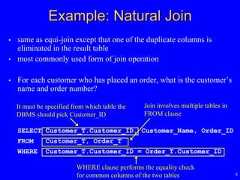
8• same as equi-join except that one of the duplicate columns iseliminated in the result table• most commonly used form of join operation• For each customer who has placed an order, what is the customer’sname and order number?SELECT Customer_T.Customer_ID, Customer_Name, Order_IDFROM Customer_T, Order_TWHERE Customer_T.Customer_ID = Order_T.Customer_IDJoin involves multiple tables inFROM clauseExample: Natural JoinWHERE clause performs the equality checkfor common columns of the two tablesIt must be specified from which table theDBMS should pick Customer_ID
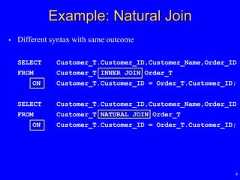
9• Different syntax with same outcomeSELECT Customer_T.Customer_ID,Customer_Name,Order_IDFROM Customer_T INNER JOIN Order_TON Customer_T.Customer_ID = Order_T.Customer_ID;SELECT Customer_T.Customer_ID,Customer_Name,Order_IDFROM Customer_T NATURAL JOIN Order_TON Customer_T.Customer_ID = Order_T.Customer_ID;Example: Natural Join
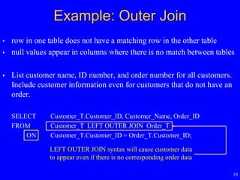
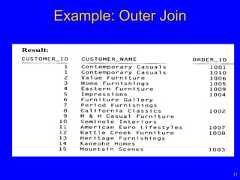
10• row in one table does not have a matching row in the other table• null values appear in columns where there is no match between tables• List customer name, ID number, and order number for all customers.Include customer information even for customers that do not have anorder.SELECT Customer_T.Customer_ID, Customer_Name, Order_IDFROM Customer_T LEFT OUTER JOIN Order_TON Customer_T.Customer_ID = Order_T.Customer_ID;Example: Outer JoinLEFT OUTER JOIN syntax will cause customer datato appear even if there is no corresponding order data
11Example: Outer Join
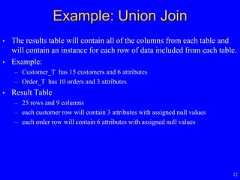
12• The results table will contain all of the columns from each table andwill contain an instance for each row of data included from each table.• Example:– Customer_T has 15 customers and 6 attributes– Order_T has 10 orders and 3 attributes• Result Table– 25 rows and 9 columns– each customer row will contain 3 attributes with assigned null values– each order row will contain 6 attributes with assigned null valuesExample: Union Join
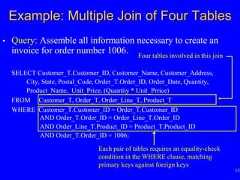
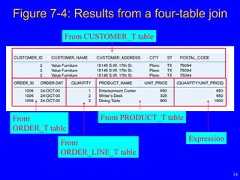
13• Query: Assemble all information necessary to create aninvoice for order number 1006.SELECT Customer_T.Customer_ID, Customer_Name, Customer_Address,City, State, Postal_Code, Order_T.Order_ID, Order_Date, Quantity,Product_Name, Unit_Price, (Quantity * Unit_Prrice)FROM Customer_T, Order_T, Order_Line_T, Product_TWHERE Customer_T.Customer_ID = Order_T.Customer_IDAND Order_T.Order_ID = Order_Line_T.Order_IDAND Order_Line_T.Product_ID = Product_T.Product_IDAND Order_T.Order_ID = 1006;Four tables involved in this joinExample: Multiple Join of Four TablesEach pair of tables requires an equality-checkcondition in the WHERE clause, matchingprimary keys against foreign keys
14From CUSTOMER_T tableFromORDER_T tableFrom PRODUCT_T tableFromORDER_LINE_T tableExpressionFigure 7-4: Results from a four-table join
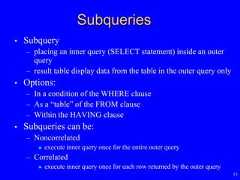
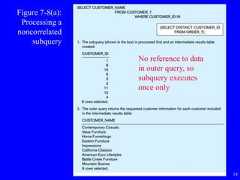
15Subqueries• Subquery– placing an inner query (SELECT statement) inside an outerquery– result table display data from the table in the outer query only• Options:– In a condition of the WHERE clause– As a “table” of the FROM clause– Within the HAVING clause• Subqueries can be:– Noncorrelated execute inner query once for the entire outer query– Correlated execute inner query once for each row returned by the outer query
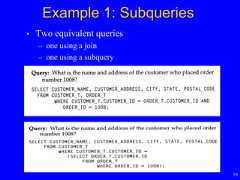
16Example 1: Subqueries• Two equivalent queries– one using a join– one using a subquery
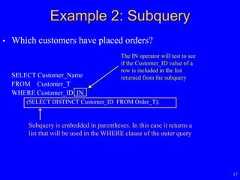
17• Which customers have placed orders?SELECT Customer_NameFROM Customer_TWHERE Customer_ID IN(SELECT DISTINCT Customer_ID FROM Order_T);Example 2: SubquerySubquery is embedded in parentheses. In this case it returns alist that will be used in the WHERE clause of the outer queryThe IN operator will test to seeif the Customer_ID value of arow is included in the listreturned from the subquery
18Figure 7-8(a):Processing anoncorrelatedsubqueryNo reference to datain outer query, sosubquery executesonce only
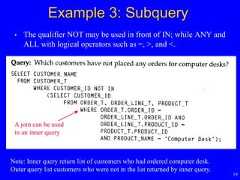
19Example 3: Subquery• The qualifier NOT may be used in front of IN; while ANY andALL with logical operators such as =, >, and <.A join can be usedin an inner queryNote: Inner query return list of customers who had ordered computer desk.Outer query list customers who were not in the list returned by inner query.
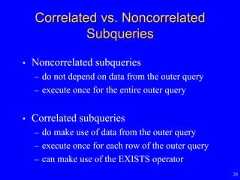
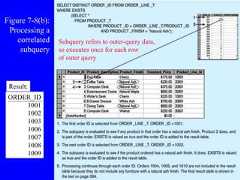
20Correlated vs. NoncorrelatedSubqueries• Noncorrelated subqueries– do not depend on data from the outer query– execute once for the entire outer query• Correlated subqueries– do make use of data from the outer query– execute once for each row of the outer query– can make use of the EXISTS operator
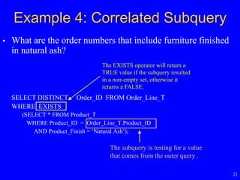
21• What are the order numbers that include furniture finishedin natural ash?SELECT DISTINCT Order_ID FROM Order_Line_TWHERE EXISTS(SELECT * FROM Product_TWHERE Product_ID = Order_Line_T.Product_IDAND Product_Finish = ‘Natural Ash’);Example 4: Correlated SubqueryThe subquery is testing for a valuethat comes from the outer query .The EXISTS operator will return aTRUE value if the subquery resultedin a non-empty set, otherwise itreturns a FALSE.
22Figure 7-8(b):Processing acorrelatedsubquerySubquery refers to outer-query data,so executes once for each rowof outer queryORDER_ID1001100210031006100710081009Result:
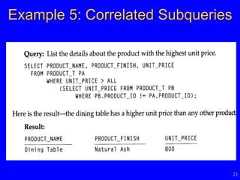
23Example 5: Correlated Subqueries
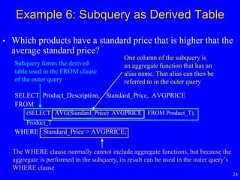
24• Which products have a standard price that is higher that theaverage standard price?SELECT Product_Description, Standard_Price, AVGPRICEFROM(SELECT AVG(Standard_Price) AVGPRICE FROM Product_T),Product_TWHERE Standard_Price > AVGPRICE;Example 6: Subquery as Derived TableThe WHERE clause normally cannot include aggregate functions, but because theaggregate is performed in the subquery, its result can be used in the outer query’sWHERE clauseOne column of the subquery isan aggregate function that has analias name. That alias can then bereferred to in the outer querySubquery forms the derivedtable used in the FROM clauseof the outer query
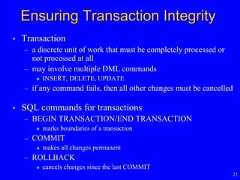
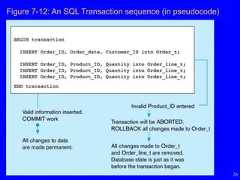
25Ensuring Transaction Integrity• Transaction– a discrete unit of work that must be completely processed ornot processed at all– may involve multiple DML commands INSERT, DELETE, UPDATE– if any command fails, then all other changes must be cancelled• SQL commands for transactions– BEGIN TRANSACTION/END TRANSACTION marks boundaries of a transaction– COMMIT makes all changes permanent– ROLLBACK cancels changes since the last COMMIT
26Figure 7-12: An SQL Transaction sequence (in pseudocode)
27Review Questions• What are the 4 types of join?• What are subqueries?• What is a correlated subquery?• What is a noncorrelated subquery?• What is a transaction?

Recommended

PPT
Advanced sql
PPT
SQL Queries
PPTX
Database : Relational Data Model
PPTX
Advanced SQL
PPT
FUNCTIONS IN c++ PPT
PPTX
DATABASE CONSTRAINTS
PPTX
SUBQUERIES.pptx
PPTX
Introduction of sql server indexing
PPTX
Introduction to SQL
PPTX
Computer Science:Sql Set Operation
PPT
SQL subquery
PPTX
SQL Commands
PDF
SQL Overview
PDF
SQL window functions for MySQL
PPT
Aggregate functions
PPTX
Nested queries in database
PDF
Sql tutorial
PDF
Nested Queries Lecture
PPTX
Aggregate function
PPTX
Mysql Crud, Php Mysql, php, sql
PPT
Introduction to .NET Framework
PPSX
Functional dependency
PPTX
SQL Data types and Constarints.pptx
PPT
Active x control
PPT
Introduction to c#
PPT
Joins in SQL
PPT
Advanced Sql Training
PDF
Advanced SQL - Lecture 6 - Introduction to Databases (1007156ANR)

More Related Content

PPT
Advanced sql
PPT
SQL Queries
PPTX
Database : Relational Data Model
PPTX
Advanced SQL
PPT
FUNCTIONS IN c++ PPT
PPTX
DATABASE CONSTRAINTS
PPTX
SUBQUERIES.pptx
Advanced sql
SQL Queries
Database : Relational Data Model
Advanced SQL
FUNCTIONS IN c++ PPT
DATABASE CONSTRAINTS
SUBQUERIES.pptx

What's hot

PPTX
Introduction of sql server indexing
PPTX
Introduction to SQL
PPTX
Computer Science:Sql Set Operation
PPT
SQL subquery
PPTX
SQL Commands
PDF
SQL Overview
PDF
SQL window functions for MySQL
PPT
Aggregate functions
PPTX
Nested queries in database
PDF
Sql tutorial
PDF
Nested Queries Lecture
PPTX
Aggregate function
PPTX
Mysql Crud, Php Mysql, php, sql
PPT
Introduction to .NET Framework
PPSX
Functional dependency
PPTX
SQL Data types and Constarints.pptx
PPT
Active x control
PPT
Introduction to c#
PPT
Joins in SQL
Introduction of sql server indexing
Introduction to SQL
Computer Science:Sql Set Operation
SQL subquery
SQL Commands
SQL Overview
SQL window functions for MySQL
Aggregate functions
Nested queries in database
Sql tutorial
Nested Queries Lecture
Aggregate function
Mysql Crud, Php Mysql, php, sql
Introduction to .NET Framework
Functional dependency
SQL Data types and Constarints.pptx
Active x control
Introduction to c#
Joins in SQL

Viewers also liked

PPT
Advanced Sql Training
PDF
Advanced SQL - Lecture 6 - Introduction to Databases (1007156ANR)
PPTX
SQL Basics
PPT
Sql ppt
PPTX
Hasil tes UKG sebagai cermin dari kualitas pendidikan guru di Indonesia
DOCX
Master of Computer Application (MCA) – Semester 4 MC0077
PPTX
Math Foundations
PPTX
KG2 D 2013-2014 Learning Together
DOC
Revision sheet grade kg2
DOC
Revision sheet grade kg1
PDF
Oracle sql & plsql
PDF
My sql explain cheat sheet
PPTX
ORACLE PL SQL FOR BEGINNERS
PPTX
MS Sql Server: Advanced Query Concepts
PDF
GraphTalks Rome - The Italian Business Graph
 
PPT
SQL Tutorial - Basic Commands
PDF
Oracle/SQL For Beginners - DDL | DML | DCL | TCL - Quick Learning
PDF
Webinar: RDBMS to Graphs
 
Advanced Sql Training
Advanced SQL - Lecture 6 - Introduction to Databases (1007156ANR)
SQL Basics
Sql ppt
Hasil tes UKG sebagai cermin dari kualitas pendidikan guru di Indonesia
Master of Computer Application (MCA) – Semester 4 MC0077
Math Foundations
KG2 D 2013-2014 Learning Together
Revision sheet grade kg2
Revision sheet grade kg1
Oracle sql & plsql
My sql explain cheat sheet
ORACLE PL SQL FOR BEGINNERS
MS Sql Server: Advanced Query Concepts
GraphTalks Rome - The Italian Business Graph
 
SQL Tutorial - Basic Commands
Oracle/SQL For Beginners - DDL | DML | DCL | TCL - Quick Learning
Webinar: RDBMS to Graphs
 

Similar to advanced sql(database)

PPT
hoffer_mdm_pp_ch07 Processing Multiple Tables.ppt
PPT
hoffer_edm_pp_ch07 (1).ppt
PPT
AdvanceSQL.ppt
PPT
The Database Environment Chapter 8
PPT
Modern Database Management chapetr 8 Advance SQL.ppt
PPTX
The Relational Database Model 2 univprsty
PDF
DBMS Nested & Sub Queries Set operations
PPTX
Join_Queries_Presentation_By_Beate_.pptx
PDF
Modern Database Management 11th Edition Hoffer Solutions Manual
PDF
Modern Database Management 11th Edition Hoffer Solutions Manual
PPTX
SQL Joins & Sub Queries class number 697
PPT
Ms sql server ii
PDF
Modern Database Management 11th Edition Hoffer Solutions Manual
PPTX
Oracle: Joins
PPTX
Oracle: Joins
PDF
Modern Database Management 11th Edition Hoffer Solutions Manual
PPTX
Inner join and outer join
PPTX
More Complex SQL and Concurrency ControlModule 4.pptx
PPTX
OracleSQLraining.pptx
PPTX
SQL Server Learning Drive
hoffer_mdm_pp_ch07 Processing Multiple Tables.ppt
hoffer_edm_pp_ch07 (1).ppt
AdvanceSQL.ppt
The Database Environment Chapter 8
Modern Database Management chapetr 8 Advance SQL.ppt
The Relational Database Model 2 univprsty
DBMS Nested & Sub Queries Set operations
Join_Queries_Presentation_By_Beate_.pptx
Modern Database Management 11th Edition Hoffer Solutions Manual
SQL Joins & Sub Queries class number 697
Ms sql server ii
Modern Database Management 11th Edition Hoffer Solutions Manual
Oracle: Joins
Oracle: Joins
Modern Database Management 11th Edition Hoffer Solutions Manual
Inner join and outer join
More Complex SQL and Concurrency ControlModule 4.pptx
OracleSQLraining.pptx
SQL Server Learning Drive

More from welcometofacebook

DOCX
Quantitative exercise-toasty oven
PDF
EVC exercise-novel motor oil
PDF
jones blair calculations
PDF
EVC exercise-odi case
PDF
cltv calculation-calyx corolla
PDF
consumer behavior(4210)
PDF
competing in a global market(4210)
PDF
promotion strategies(4210)
PDF
pricing strategies(4210)
PDF
Pharmasim
PDF
distribution strategies calyx and corolla(4210)
PDF
distribution strategies(4210)
PDF
the birth of swatch(4210)
PDF
product and brand strategies(4210)
PDF
stp case jones blair(4210)
PDF
stp(4210)
PDF
situational analysis(4210)
PDF
quantitative analysis(4210)
PDF
overview of marketing strategy(4210)
PDF
Class+3+ +quantitative+analysis+exercise+answer+key
Quantitative exercise-toasty oven
EVC exercise-novel motor oil
jones blair calculations
EVC exercise-odi case
cltv calculation-calyx corolla
consumer behavior(4210)
competing in a global market(4210)
promotion strategies(4210)
pricing strategies(4210)
Pharmasim
distribution strategies calyx and corolla(4210)
distribution strategies(4210)
the birth of swatch(4210)
product and brand strategies(4210)
stp case jones blair(4210)
stp(4210)
situational analysis(4210)
quantitative analysis(4210)
overview of marketing strategy(4210)
Class+3+ +quantitative+analysis+exercise+answer+key

Recently uploaded

PDF
A Newbie’s Journey: Hidden MySQL Pain Points That Vitess Quietly Solves
PPTX
Applications of cloud computing in education
PDF
Day 01- Basic Knowledge for LPG system design.pdf
PPTX
What TPM Looks Like When You’re Short-Staffed and Still Make It Work | Lean T...
PDF
Formality - Logic Equivalence Checking - Part 1
PDF
ME25C05 RE-ENGINEERING FOR INNOVATION LAB.pdf
PPTX
Electronics Device - EC25C01 - Semiconductor: Types, Conductivity,
PDF
10 Tips for Successfully Purchasing Twitter Accounts.pdf
PPTX
AI-Agents-Concepts-Applications-and-Types.pptx
PPTX
Why Air Droppable Containers Are Critical for Modern Aerial Logistics
PDF
5.5 Inch 4K TFT LCD Display 3840×2160 UHD Panel – LS055D1SX05(G)
PPTX
Top 3 winning teams announcement - TechSprint
PDF
Process Scheduling Scheduling Queue, Types of Sheduler
PPTX
Using Bangladesh studies in cse why matter ppp.pptx
PDF
VLSI Logic Synthesis - All Parts Combined
PPTX
Fake News Detection System | Plagiarism detection
PPTX
We-Optimized-Everything-Except-Decision-Quality-Maintenance-MaintWiz.pptx
PDF
EDIH TRAINING AI FOR COMPANIES: MODULE 4
PDF
CME397 SURFACE ENGINEERING UNIT 1 FULL NOTES
PPTX
UNIT 2 - Electronics Device - EC25C01 - PN Junction Diodes
A Newbie’s Journey: Hidden MySQL Pain Points That Vitess Quietly Solves
Applications of cloud computing in education
Day 01- Basic Knowledge for LPG system design.pdf
What TPM Looks Like When You’re Short-Staffed and Still Make It Work | Lean T...
Formality - Logic Equivalence Checking - Part 1
ME25C05 RE-ENGINEERING FOR INNOVATION LAB.pdf
Electronics Device - EC25C01 - Semiconductor: Types, Conductivity,
10 Tips for Successfully Purchasing Twitter Accounts.pdf
AI-Agents-Concepts-Applications-and-Types.pptx
Why Air Droppable Containers Are Critical for Modern Aerial Logistics
5.5 Inch 4K TFT LCD Display 3840×2160 UHD Panel – LS055D1SX05(G)
Top 3 winning teams announcement - TechSprint
Process Scheduling Scheduling Queue, Types of Sheduler
Using Bangladesh studies in cse why matter ppp.pptx
VLSI Logic Synthesis - All Parts Combined
Fake News Detection System | Plagiarism detection
We-Optimized-Everything-Except-Decision-Quality-Maintenance-MaintWiz.pptx
EDIH TRAINING AI FOR COMPANIES: MODULE 4
CME397 SURFACE ENGINEERING UNIT 1 FULL NOTES
UNIT 2 - Electronics Device - EC25C01 - PN Junction Diodes

advanced sql(database)

  • 1.
  • 2.
    2Where we arenow• Database environment– Introduction to database• Database development process– steps to develop a database• Conceptual data modeling– entity-relationship (ER) diagram; enhanced ER• Logical database design– transforming ER diagram into relations; normalization• Physical database design– technical specifications of the database• Database implementation– Structured Query Language (SQL), Advanced SQL• Advanced topics– data and database administration
  • 3.
  • 4.
    4Advanced SQL• Joins•Subqueries• Ensuring Transaction Integrity
  • 5.
    5Processing Multiple Tables– Joins• Join– a relational operation that causes two or more tables with a common domainto be combined into a single table or view– the common columns in joined tables are usually the primary key of thedominant table and the foreign key of the dependent table• Equi-join– a join in which the joining condition is based on equality between values inthe common columns; common columns appear redundantly in the resulttable• Natural join– an equi-join in which one of the duplicate columns is eliminated in the resulttable• Outer join– a join in which rows that do not have matching values in common columnsare nevertheless included in the result table (as opposed to inner join, inwhich rows must have matching values in order to appear in the result table)• Union join– includes all columns from each table in the join, and an instance for each rowof each table
  • 6.
    6Figure 7-1: SamplePine Valley Furniture dataCustomer_T Order_TOrder_Line_TProduct_T
  • 7.
    7Example: Equi-join• basedon equality between values in the common columnsIf WHERE clause is omitted, the query will return all combinations of customersand orders (10 orders * 15 customers=150 rows).
  • 8.
    8• same asequi-join except that one of the duplicate columns iseliminated in the result table• most commonly used form of join operation• For each customer who has placed an order, what is the customer’sname and order number?SELECT Customer_T.Customer_ID, Customer_Name, Order_IDFROM Customer_T, Order_TWHERE Customer_T.Customer_ID = Order_T.Customer_IDJoin involves multiple tables inFROM clauseExample: Natural JoinWHERE clause performs the equality checkfor common columns of the two tablesIt must be specified from which table theDBMS should pick Customer_ID
  • 9.
    9• Different syntaxwith same outcomeSELECT Customer_T.Customer_ID,Customer_Name,Order_IDFROM Customer_T INNER JOIN Order_TON Customer_T.Customer_ID = Order_T.Customer_ID;SELECT Customer_T.Customer_ID,Customer_Name,Order_IDFROM Customer_T NATURAL JOIN Order_TON Customer_T.Customer_ID = Order_T.Customer_ID;Example: Natural Join
  • 10.
    10• row inone table does not have a matching row in the other table• null values appear in columns where there is no match between tables• List customer name, ID number, and order number for all customers.Include customer information even for customers that do not have anorder.SELECT Customer_T.Customer_ID, Customer_Name, Order_IDFROM Customer_T LEFT OUTER JOIN Order_TON Customer_T.Customer_ID = Order_T.Customer_ID;Example: Outer JoinLEFT OUTER JOIN syntax will cause customer datato appear even if there is no corresponding order data
  • 11.
  • 12.
    12• The resultstable will contain all of the columns from each table andwill contain an instance for each row of data included from each table.• Example:– Customer_T has 15 customers and 6 attributes– Order_T has 10 orders and 3 attributes• Result Table– 25 rows and 9 columns– each customer row will contain 3 attributes with assigned null values– each order row will contain 6 attributes with assigned null valuesExample: Union Join
  • 13.
    13• Query: Assembleall information necessary to create aninvoice for order number 1006.SELECT Customer_T.Customer_ID, Customer_Name, Customer_Address,City, State, Postal_Code, Order_T.Order_ID, Order_Date, Quantity,Product_Name, Unit_Price, (Quantity * Unit_Prrice)FROM Customer_T, Order_T, Order_Line_T, Product_TWHERE Customer_T.Customer_ID = Order_T.Customer_IDAND Order_T.Order_ID = Order_Line_T.Order_IDAND Order_Line_T.Product_ID = Product_T.Product_IDAND Order_T.Order_ID = 1006;Four tables involved in this joinExample: Multiple Join of Four TablesEach pair of tables requires an equality-checkcondition in the WHERE clause, matchingprimary keys against foreign keys
  • 14.
    14From CUSTOMER_T tableFromORDER_TtableFrom PRODUCT_T tableFromORDER_LINE_T tableExpressionFigure 7-4: Results from a four-table join
  • 15.
    15Subqueries• Subquery– placingan inner query (SELECT statement) inside an outerquery– result table display data from the table in the outer query only• Options:– In a condition of the WHERE clause– As a “table” of the FROM clause– Within the HAVING clause• Subqueries can be:– Noncorrelated execute inner query once for the entire outer query– Correlated execute inner query once for each row returned by the outer query
  • 16.
    16Example 1: Subqueries•Two equivalent queries– one using a join– one using a subquery
  • 17.
    17• Which customershave placed orders?SELECT Customer_NameFROM Customer_TWHERE Customer_ID IN(SELECT DISTINCT Customer_ID FROM Order_T);Example 2: SubquerySubquery is embedded in parentheses. In this case it returns alist that will be used in the WHERE clause of the outer queryThe IN operator will test to seeif the Customer_ID value of arow is included in the listreturned from the subquery
  • 18.
    18Figure 7-8(a):Processing anoncorrelatedsubqueryNoreference to datain outer query, sosubquery executesonce only
  • 19.
    19Example 3: Subquery•The qualifier NOT may be used in front of IN; while ANY andALL with logical operators such as =, >, and <.A join can be usedin an inner queryNote: Inner query return list of customers who had ordered computer desk.Outer query list customers who were not in the list returned by inner query.
  • 20.
    20Correlated vs. NoncorrelatedSubqueries•Noncorrelated subqueries– do not depend on data from the outer query– execute once for the entire outer query• Correlated subqueries– do make use of data from the outer query– execute once for each row of the outer query– can make use of the EXISTS operator
  • 21.
    21• What arethe order numbers that include furniture finishedin natural ash?SELECT DISTINCT Order_ID FROM Order_Line_TWHERE EXISTS(SELECT * FROM Product_TWHERE Product_ID = Order_Line_T.Product_IDAND Product_Finish = ‘Natural Ash’);Example 4: Correlated SubqueryThe subquery is testing for a valuethat comes from the outer query .The EXISTS operator will return aTRUE value if the subquery resultedin a non-empty set, otherwise itreturns a FALSE.
  • 22.
    22Figure 7-8(b):Processing acorrelatedsubquerySubqueryrefers to outer-query data,so executes once for each rowof outer queryORDER_ID1001100210031006100710081009Result:
  • 23.
  • 24.
    24• Which productshave a standard price that is higher that theaverage standard price?SELECT Product_Description, Standard_Price, AVGPRICEFROM(SELECT AVG(Standard_Price) AVGPRICE FROM Product_T),Product_TWHERE Standard_Price > AVGPRICE;Example 6: Subquery as Derived TableThe WHERE clause normally cannot include aggregate functions, but because theaggregate is performed in the subquery, its result can be used in the outer query’sWHERE clauseOne column of the subquery isan aggregate function that has analias name. That alias can then bereferred to in the outer querySubquery forms the derivedtable used in the FROM clauseof the outer query
  • 25.
    25Ensuring Transaction Integrity•Transaction– a discrete unit of work that must be completely processed ornot processed at all– may involve multiple DML commands INSERT, DELETE, UPDATE– if any command fails, then all other changes must be cancelled• SQL commands for transactions– BEGIN TRANSACTION/END TRANSACTION marks boundaries of a transaction– COMMIT makes all changes permanent– ROLLBACK cancels changes since the last COMMIT
  • 26.
    26Figure 7-12: AnSQL Transaction sequence (in pseudocode)
  • 27.
    27Review Questions• Whatare the 4 types of join?• What are subqueries?• What is a correlated subquery?• What is a noncorrelated subquery?• What is a transaction?

[8]ページ先頭

©2009-2026 Movatter.jp