Democratic Republic
of the Congo

Population
Country size
Forest cover
overview
The Democratic Republic of Congo (DRC) hosts Africa’s largest expanse of tropical forest, including roughly 60 per cent of the Congo Basin rainforest – home to flora and fauna found nowhere else on earth as well as tens of millions of forest-dependent people. The country's effortsto emerge from two decades of political instability and violent conflict have led to increasing pressures on its forests fromagricultural development andthe extractive industries while illegal logging is also rife.
Efforts to conserve the forest, such as through reducing emissions from deforestation and degradation (REDD+) and the strictly protected area network, have often wrongly targeted communities as the agents of forest destruction, further impinging on their land and resource rights.
However, since 2016 the DRC also has arguably the most progressive laws on community forestry in the region. This has allowed communities to secure their collective rights over their traditional lands for the first time, and now they have the opportunity to manage them in a way that preserves both their livelihoods and the forest. A new Indigenous Peoples law also promises new protections and rights for its indigenous population.
Our Impacts
- With our partners, we campaigned for years for groundbreaking legislation that would enable communities to secure their forests. Now, this law is a reality and more thanthree million hectares have been designated as community forests nationwide. Directly, we have helped to secure 120,000 hectares for over 28,000 people, who already see improvements in their quality of life.
- We have successfully campaigned for anational moratorium on new logging concessions - protecting as much as 70 million hectares from the logging industry. On the ground, our real-time monitoring work led to the country's first ever criminal charges against a logging company under the 2002 Forest Code, as well as to legal recognition of community-based forest monitoring.
- Our investigations, legal action and relentless campaigning on the human impacts ofmilitarised conservation in DRC led to the first ever conviction of anti-poaching agents for human rights abuses in the country. This also led to a wider reckoning in the conservation sector in DRC and beyond, prompting to a paradigm shift towards approaches that uphold the rights of local populations.
Projects & Campaigns

ForestLink
Real-time community-based monitoring is a tool that connects local people with national law enforcement in an effort to stop illegal logging and deforestation.
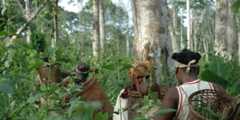
Community Forests
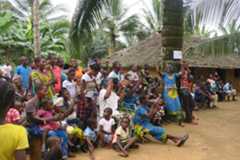
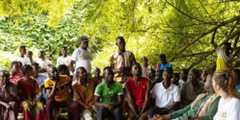
Our Community Forests project aims to establish a successful model of community-based forest management, one that focuses on the rights, needs and priorities of local communities, including those of marginalised groups such as indigenous peoples and women.
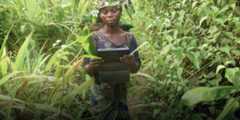
Mapping for Rights
Mapping For Rights is an award-winning, interactive community map project for the Congo Basin, which started in November 2011 and is ongoing.
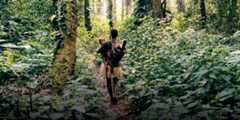
Conservation & Human Rights
The traditional ‘fortress conservation’ approach of the west is premised on the dangerous yet persistent idea that local people need to be separated from nature to keep it “pristine” (sometimes for the benefit of foreign tourists). This does not only drive human rights violations but is also ineffective as it ignores and alienates the very people who have shaped and stewarded those landscapes for millennia.
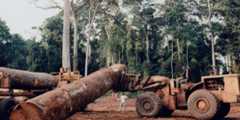
Industrial Logging
Whilst it is claimed the industry provides jobs, income, infrastructure and development in remote rural areas, the truth is that logging work is often poorly paid, dangerous and temporary. The logging industry is known to be rife with illegalities, social conflicts, and deeply corrupting of political institutions.

Carbon Offsetting & REDD+
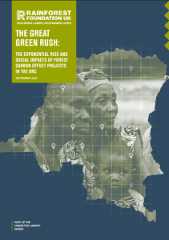
Forest carbon offsetting has long been controversial, criticised as a form of greenwashing that not only serves to delay urgent climate action in the global north, but is based on huge uncertainties in the way it is measured, which can lead to the production of ‘hot air’ credits and even fraud.
Latest news


Latest publications
Community Forests in DRC: a solution for a ‘solutions country’