- Report
|
The Global Religious Landscape
Christians
Christians number 2.2 billion, or about one-in-three (32%) people worldwide. About half of all Christians are Catholic (50%). An estimated 37% of Christians belong to the Protestant tradition, broadly defined to include Anglicans as well as independent and nondenominational churches. The Orthodox Communion, including the Greek and Russian Orthodox, make up 12% of Christians. And people who belong to other traditions that view themselves as Christian (including Christian Scientists, Mormons and Jehovah’s Witnesses) make up about 1% of the global Christian population.7
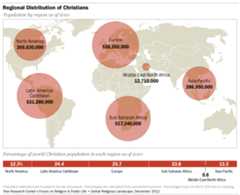
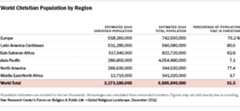
Christianity has spread far from its historical origins and is geographically widespread. Indeed, the vast majority of Christians (99%) live outside the Middle East-North Africa region where Christianity began. The greatest share of the global Christian population is in Europe (26%), followed closely by Latin America and the Caribbean (24%) and sub-Saharan Africa (24%). Significant numbers of Christians also live in Asia and the Pacific (13%) and North America (12%). Less than 1% of the world’s Christians are found in the Middle East and North Africa.
Among the six regions analyzed in this study, four have Christian majorities: Latin America and the Caribbean (90%), North America (77%), Europe (75%) and sub-Saharan Africa (63%). Christians live as minorities in the Asia-Pacific region (7%) and the Middle East-North Africa region (4%).
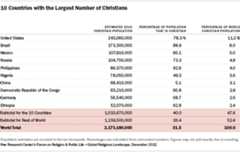
The 10 countries with the largest number of Christians account for about half (48%) of the global Christian population. The largest share of all Christians live in the United States (11%), followed by Brazil (8%), Mexico (5%), Russia (5%), the Philippines (4%), Nigeria (4%), China (3%), the Democratic Republic of the Congo (3%), Germany (3%) and Ethiopia (2%).
Most Christians (87%) live in countries where Christians are in the majority. Of the 232 countries and territories included in this study, 157 have Christian majorities. However, most of the Christian-majority countries have relatively small populations: about seven-in-ten have fewer Christians than the Christian-minority country of Vietnam (7 million Christians).
Median Age
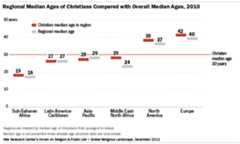
As a whole, Christians are older (median age of 30) than the overall global population (median age of 28). Among the six regions analyzed in this study, Christians are youngest in sub- Saharan Africa (median age of 19), followed by Latin America and the Caribbean (27), Asia and the Pacific (28), the Middle East and North Africa (29) and North America (39). Europe has the oldest Christian population (42).
Christians are older than the general population in four regions: the Middle East and North Africa (where the Christian median is 29 years and the general population median is 24 years), North America (39 vs. 37), Europe (42 vs. 40), and sub-Saharan Africa (19 vs. 18). Christians have the same median age as the general population in Latin America and the Caribbean (27). Christians are younger than the general population in the Asia-Pacific region (28 vs. 29).
Footnotes:
7 As previously noted, this study is based on self-identification. The intent is sociological rather than theological, and no set of beliefs (such as adherence to a particular creed) or practices (such as regular church attendance) is used to define who is a Christian. For more information on Christian traditions, see the Pew Forum’s December 2011 report “Global Christianity: A Report on the Size and Distribution of the World’s Christian Population.”(return to text)
- Full Report
- Table: Religious composition by country
- Appendix A: Methodology
- Appendix B: Data Sources by Country

Sign up for our weekly newsletter
Fresh data delivered Saturday mornings
Topics
Related

White evangelicals remain among Trump’s strongest supporters, but they’re less supportive than a year ago

Has there been a Christian revival among young adults in the U.K.? Recent surveys may be misleading

Catholicism Has Declined in Latin America Over the Past Decade

Why Do Some Americans Leave Their Religion While Others Stay?
