- Report
|
The Global Religious Landscape
Buddhists
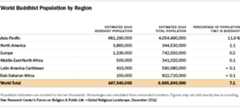
There are about 488 million Buddhists worldwide, representing 7% of the world’s total population as of 2010. The three major branches of Buddhism in the modern world are Mahayana Buddhism, Theravada Buddhism and Vajrayana (sometimes described as Tibetan) Buddhism.12 While affiliation with particular branches of Buddhism is not measured in most censuses and surveys, Mahayana Buddhism is widely believed to be the largest, because it is prevalent in several countries with very large Buddhist populations, particularly China, Japan, South Korea and Vietnam. Theravada Buddhism, the second-largest branch, is concentrated in such countries as Thailand, Burma (Myanmar), Sri Lanka, Laos and Cambodia. Vajrayana Buddhism, the smallest of the three major branches, is concentrated in Tibet, Nepal, Bhutan and Mongolia. The Buddhist population figures in this study also include members of other groups that identify as Buddhist, such as Soka Gakkai and Hoa Hao.
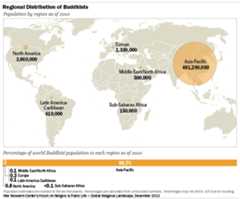
Buddhism began in Asia, and the vast majority of all Buddhists (nearly 99%) still live in the Asia- Pacific region. Only two other regions – North America (3.9 million) and Europe (1.3 million) – have more than 1 million Buddhists.
Although the majority of Buddhists live in Asia and the Pacific, only about one-in-eight people (12%) in that region are Buddhists. About 1% of North Americans are Buddhists. In each of the other four regions, Buddhists make up less than 1% of the population.
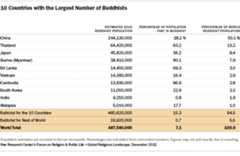
All 10 countries with the largest Buddhist populations are in the Asia-Pacific region, and these countries collectively are home to the lion’s share (95%) of all Buddhists. Half (50%) of the world’s Buddhists live in one country, China. The largest Buddhist populations outside China are in Thailand (13%), Japan (9%), Burma (Myanmar) (8%), Sri Lanka (3%), Vietnam (3%), Cambodia (3%), South Korea (2%), India (2%) and Malaysia (1%).
Seven countries have Buddhist majorities: Cambodia, Thailand, Burma (Myanmar), Bhutan, Sri Lanka, Laos and Mongolia.
Median Age
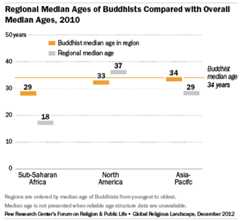
Globally, Buddhists are older (median age of 34) than the overall population (median age of 28). Of the three regions for which data are available, sub-Saharan Africa has the youngest Buddhist population (median age of 29), followed by North America (33). The Asia-Pacific region has the oldest Buddhist population, with a median age of 34.
Buddhists are older than the general population in two of the three major regions for which data are available: sub-Saharan Africa (where Buddhists have a median age of 29 and the general population has a median age of 18) and Asia and the Pacific (34 vs. 29). In North America, the median age of Buddhists is 33, four years younger than the general population (37).
Footnotes:
12 Alternatively, some scholars consider there to be two main Buddhist branches – Mahayana and Theravada – and classify Vajrayana as part of the Mahayana branch. Other schools within the Mahayana tradition include Zen, Nichiren and Pure Land. See, for example, Williams, Paul. 2008. “Mahayana Buddhism: The Doctrinal Foundations.” Routledge.(return to text)
- Full Report
- Table: Religious composition by country
- Appendix A: Methodology
- Appendix B: Data Sources by Country

Sign up for our weekly newsletter
Fresh data delivered Saturday mornings
Topics
Related

White evangelicals remain among Trump’s strongest supporters, but they’re less supportive than a year ago

Has there been a Christian revival among young adults in the U.K.? Recent surveys may be misleading

Catholicism Has Declined in Latin America Over the Past Decade

Why Do Some Americans Leave Their Religion While Others Stay?
