





The making of Sapienza, Hitman's best level
How this intricate seaside sandbox helped IO to perfect the Hitman formula.
When you purchase through links on our site, we may earn an affiliate commission.Here’s how it works.
Keep up to date with the most important stories and the best deals, as picked by the PC Gamer team.
You are now subscribed
Your newsletter sign-up was successful
Want to add more newsletters?

Every Friday
GamesRadar+
Your weekly update on everything you could ever want to know about the games you already love, games we know you're going to love in the near future, and tales from the communities that surround them.

Every Thursday
GTA 6 O'clock
Our special GTA 6 newsletter, with breaking news, insider info, and rumor analysis from the award-winning GTA 6 O'clock experts.

Every Friday
Knowledge
From the creators of Edge: A weekly videogame industry newsletter with analysis from expert writers, guidance from professionals, and insight into what's on the horizon.

Every Thursday
The Setup
Hardware nerds unite, sign up to our free tech newsletter for a weekly digest of the hottest new tech, the latest gadgets on the test bench, and much more.

Every Wednesday
Switch 2 Spotlight
Sign up to our new Switch 2 newsletter, where we bring you the latest talking points on Nintendo's new console each week, bring you up to date on the news, and recommend what games to play.

Every Saturday
The Watchlist
Subscribe for a weekly digest of the movie and TV news that matters, direct to your inbox. From first-look trailers, interviews, reviews and explainers, we've got you covered.

Once a month
SFX
Get sneak previews, exclusive competitions and details of special events each month!

This article was originally published inPC Gamer issue 299. For more quality articles about all things PC gaming, you can subscribe now in theUKand theUS.
Sapienza, the second level of Hitman, began as two words: Coastal Town. “This was the only direction we got,” says Torbjørn Christensen, lead level designer. “So we really had a lot of freedom to be creative.” That coastal town would become the game’s standout level, against which subsequent Hitman episodes are compared. For many, myself included, it was the level that proved IO knew what it was doing—that after Absolution, and despite a controversial episodic release plan, the studio was back to making quality assassination sandboxes.
Sapienza was developed in parallel with Paris, Hitman’s first level, and in part as a response to it. The Showstopper mission was built around exclusivity—the idea that 47 is able to infiltrate any location. “This night-time gala feeling was something that we felt was important to Paris,” says Christian Elverdam, creative director for Hitman. “I think the contrast to Sapienza, then, was obviously daytime; relaxed, casual and all that.” Where Paris is enclosed, with muted lighting and soft colours, Sapienza is bright, open and vibrant.




“The level was created by an environment artist and myself,” says Christensen, who spent two weeks mocking up a rough version during IO’s summer holiday. “During those weeks the good weather was definitely an inspiration, and we could work undisturbed because everyone else was on vacation.” He based the look on towns along Italy’s Amalfi coast, using both the colourful yellow buildings and the unusual topography. “We especially wanted to explore the verticality in coastal towns, and how streets and corridors connect everything.”
“If I say to you, ‘You’re going to infiltrate a palace,’ I think immediately your mind starts to imagine what that means,” says Elverdam. “You understand roughly what a palace is; it has different floors, it might have a basement, it might have an attic. It might have a main entrance, it might have a rear entrance, it might have a garden. You can mentally encompass it easily. Whereas with something like Sapienza, if we tell you you’re infiltrating an Italian coastal town, it’s much harder to guess where the level starts and stops, which makes the organic exploration of the level so satisfying, in my mind.”
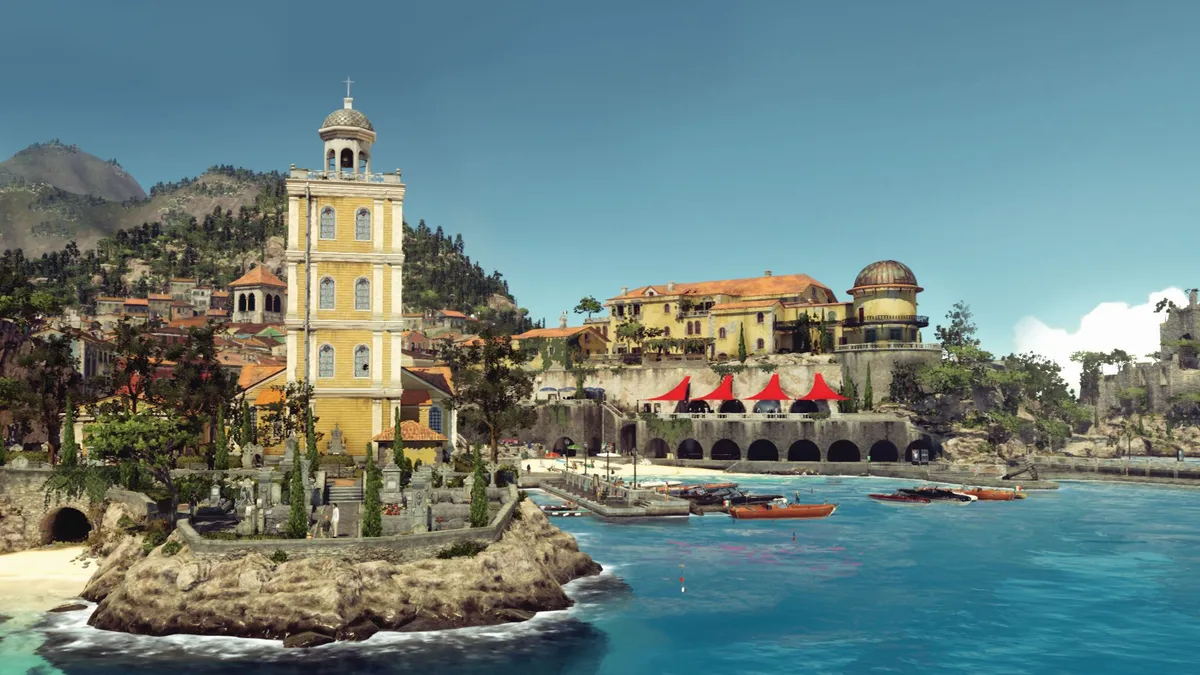
For Elverdam, Sapienza represents the pinnacle of what he calls Swiss Cheese design. “We used this feeling that we built a volume filled with connections, and these connections mean that you will never get lost.” The idea is you should be able to go in any direction—through a different hole in the cheese—and, when you come out at the other end, find a new way to progress. “You don’t have to backtrack necessarily, if you don’t want to.”
As the theme and layout took shape, IO needed a target to fill it. The Italian setting offered an obvious solution. “We quickly decided that the target should be a mafia boss living in a huge mansion,” says Christensen. “The mafia idea spawned the secret cave under the mansion, where various illegal activities could take place. One idea was that Silvio used his seaplane to get rid of enemies out at sea—a rather extreme version of ‘sleeping with the fishes’.”
Keep up to date with the most important stories and the best deals, as picked by the PC Gamer team.
In the end, Silvio Caruso’s profession was altered from gangster to scientist. But the team still wanted him to feel like a stereotypical Italian. “He was very attached to his mother, still lived at home, likes his mother’s spaghetti, has a temper, etc.” The underground hideout became the obvious location for a laboratory.
I was surprised to learn the story could have such an effect on the design of a level, especially as Hitman’s plot had, until the last few episodes, seemed inconsequential to the action. I ask Elverdam to elaborate on how the designers work with the writing team. “It’s a back and forth all the time. In this case I think story reasons is maybe a simplification—it was also a thematic thing.” For Elverdam, contrast is a key tool in creating atmosphere and adding environmental context. “In Hokkaido, as an example, we have the super beautiful but very raw nature, in stark contrast to this high-tech facility and very pleasant interior of the hospital. It’s an interesting thing, and you feel a little bit like a prisoner looking out at this wide mountain range.”

Contrast can add depth to character, too. In Marrakesh, banker Claus Strandberg is hiding out in the Swedish consulate. “It’s almost meant to build up Strandberg’s arrogance,” says Elverdam. “The whole building is an affront to the Moroccan culture, in the sense that it’s air conditioned, and completely Scandinavian in its outlook. There’s a certain arrogance there that they’re not even trying to assimilate.”
The most obvious contrast in Sapienza is between the idyllic setting and Caruso’s own internal turmoil. Opportunities are story driven threads that 47 can use to manipulate and kill targets, and those designed for Caruso often lean upon his relationship with his mother. Created as a collaboration between writers and designers, for Elverdam Opportunities are a way for IO to push the fantasy of the Hitman experience. “I think some of the powerful moments are obviously when I enter the Moroccan Embassy and, dressed as a cameraman, I feel almost like I’m part of a spy thriller,” he says. “Or when I’m sitting, waiting for Caruso as a psychiatrist, it feels like the chessmaster version of Agent 47—this feeling that he’s one step ahead.”
Some Opportunities are complex design tasks, such as the chandelier that can be made to crash down onto the stage in Paris. Others are subtler, but just as memorable. “The psychiatrist moment is actually very downplayed, and it’s still pretty powerful,” says Elverdam. “They also allow us to do some meaningful banter with Agent 47, where he’s actually talking to the different targets or sometimes just introducing himself.” The double meaning when Agent 47, dressed as a psychiatrist, reassures a member of Caruso’s household “I’m the best”, is a way to add a touch of personality to the character.
Delving further into the backstory of the targets has some interesting effects. While Christensen seems disappointed he didn’t get to create the full mafia fantasy, Elverdam seems happy with Caruso’s final form. “When I look at the feedback from Sapienza, a lot of people for the first time said they didn’t feel necessarily comfortable killing Silvio,” he says. “The fact that he’s just a mamma’s boy, and he’s been bullied and downtrodden throughout his life, makes him more interesting as a character than if he was sort of a top gangster boss.” For Elverdam, the moral ambiguity is a sign of a character with a little more complexity. “It felt a little bit like a deeper target than maybe what we’ve done before.”

Phil has been writing for PC Gamer for nearly a decade, starting out as a freelance writer covering everything from free games to MMOs. He eventually joined full-time as a news writer, before moving to the magazine to review immersive sims, RPGs and Hitman games. Now he leads PC Gamer's UK team, but still sometimes finds the time to write about his ongoing obsessions with Destiny 2, GTA Online and Apex Legends. When he's not levelling up battle passes, he's checking out the latest tactics game or dipping back into Guild Wars 2. He's largely responsible for the whole Tub Geralt thing, but still isn't sorry.


