Movatterモバイル変換


[0]ホーム

URL:


Packt
Search iconClose icon
Search icon CANCEL
Subscription
0
Cart icon
Your Cart(0 item)
Close icon
You have no products in your basket yet
Save more on your purchases!discount-offer-chevron-icon
Savings automatically calculated. No voucher code required.
Profile icon
Account
Close icon

Change country

Modal Close icon
Arrow left icon
Explore Products
Best Sellers
New Releases
Books
Videos
Audiobooks
Learning Hub
Newsletter Hub
Free Learning
Arrow right icon
timerSALE ENDS IN
0Days
:
00Hours
:
00Minutes
:
00Seconds
Home> Programming> Programming Language> Practical Design Patterns for Java Developers
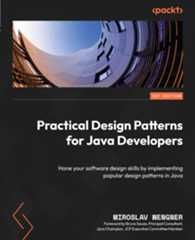
Practical Design Patterns for Java Developers

Practical Design Patterns for Java Developers: Hone your software design skills by implementing popular design patterns in Java

Arrow left icon
Profile Icon Miroslav Wengner
Arrow right icon
€23.39€25.99
Full star iconFull star iconFull star iconFull star iconHalf star icon4.7(20 Ratings)
eBookFeb 2023266 pages1st Edition
eBook
€23.39 €25.99
Paperback
€31.99
Subscription
Free Trial
Renews at €18.99p/m
Arrow left icon
Profile Icon Miroslav Wengner
Arrow right icon
€23.39€25.99
Full star iconFull star iconFull star iconFull star iconHalf star icon4.7(20 Ratings)
eBookFeb 2023266 pages1st Edition
eBook
€23.39 €25.99
Paperback
€31.99
Subscription
Free Trial
Renews at €18.99p/m
eBook
€23.39 €25.99
Paperback
€31.99
Subscription
Free Trial
Renews at €18.99p/m

What do you get with eBook?

Product feature iconInstant access to your Digital eBook purchase
Product feature icon Download this book inEPUB andPDF formats
Product feature icon Access this title in our online reader with advanced features
Product feature iconDRM FREE - Read whenever, wherever and however you want
Product feature iconAI Assistant (beta) to help accelerate your learning
OR

Contact Details

Modal Close icon
Payment Processing...
tickCompleted

Billing Address

Table of content iconView table of contentsPreview book icon Preview Book

Practical Design Patterns for Java Developers

Getting into Software Design Patterns

Every software architect or developer often faces the challenges of structuring code – how to develop a code structure that remains sustainable, just as an artist draws their painting. This chapter will take us on a journey into writing program code. You will explore the challenges behind the structure of code and its organization. Together, we will approach the topic from an early stage described by the pillars of object-oriented programming, known as APIE. We will also review the principles of SOLID to gain clarity in understandingdesign patterns.

In this chapter, we will cover thefollowing topics:

  • Code – from symbolsto program
  • Examining OOPand APIE
  • Understanding the SOLIDdesign principles
  • The significance ofdesign patterns
  • Reviewing what challenges designpatterns solve

By the end of this chapter, you will have reviewed the basic programming concepts, which will form the basis of the rest ofthe book.

Technical requirements

Code – from symbols to program

Human speech is fruitful, rich, colorful, and way beyond what the words themselves may express. Nouns, verbs, and adjectives for precisely expressing a moment or action can be used. In contrast, machines do not understand the complex constructions or expressions that humans are ableto create.

Machine language is limited, well-defined, extremelyspecific, and simplified. Its goal is to provide the precise expression of intent for which it is designed. This contrasts with human language whose purpose is just communication and not necessarilywith specifics.

A machine’s intent can be expressed as a defined instruction or a set of them. This means that machines understand the instructions. These instructions must be available to the machine in some form at the time of execution. Each machine normally has a set of instructions. Based on this kind of instruction set, machines can perform the required instructions, asshown here:

Figure 1.1 – A simplified instruction cycle inside the CPU (instruction is taken from memory and the result is stored)

Figure 1.1 – A simplified instruction cycle inside the CPU (instruction is taken from memory and the result is stored)

Let us explore one individual instruction. The instruction can be understood as a command given to the processor. The processor is the heart of the machine, or the center of the ordering and executing of processes. The machine may contain one or more of them. It depends on its design, but in any case, there is always one that takes the lead. For further simplification, we will onlyconsider one – that is, consider a system that only has onecentral processing unit (CPU) dedicated to executinga program.

A CPU is a device that executes instructions containing a computer program. The CPU must contain such an instruction set, as shown in the previous diagram, to process therequested action.

Because instructions can take completely different forms depending on the CPU, there is no defined standard. This promotes different CPU platforms, which is not necessarily a bad thing and contributes to evolution. However, the fact remains that the instructions are not easy for peopleto read.

We have stated that machines can perform instruction collection, ideally as a continuous flow. The flow of instructions can be simplified as a queue in memory, where one instruction goes in and the other leaves. The CPU plays the role of an interpreter who works with this memory cyclically (as we saw inFigure 1.1). Okay, so the CPU interprets, but as the instructions are added to the memory, where do they come from, and how can such a streambe created?

Let us gather some thoughts. Machine instructions, in most cases, originate froma compiler.

What is a compiler? The compiler can be viewed as a CPU or a platform-specific program that translates text into target actions. The text we use to call the program and the result could be named machine code. The following diagramillustrates this:

Figure 1.2 – A simplified platform-specific flow from the source code through the compiler program to its resultant action

Figure 1.2 – A simplified platform-specific flow from the source code through the compiler program to its resultant action

Machine code is a low-level language that the machine understands and consists of language instructions that are processed sequentially (seeFigure 1.1); the program was compiled, executed,and run.

In the case of Java, there is nomachine code:

Figure 1.3 – A simplified flow for the Java program through the compiler to its platform execution

Figure 1.3 – A simplified flow for the Java program through the compiler to its platform execution

The source code is compiled by the Java compiler into bytecode. The bytecode is running aJava virtual machine (JVM) (seeFigure 1.3). In this situation, the JVM plays the role of the interfacebetween the bytecode and the actual instructions that are executed on the CPU. The JVM emulates a bytecode instruction. It does this using thejust-in-time (JIT) compiler that is part of the JVM. The JIT compiler translates bytecode instructions into native processor instructions. The JVM is a platform-specific interpreter, analogous to directly compiled code (seeFigure 1.2). The JVM also provides additional features such as memory management and garbage collection, which is what makes the Java platform so powerful. All these features allow developers to write code once, compile it into bytecode, and run a supportedplatform – known aswrite once, runanywhere (WORA).

In the context of the previous exploration, Java is a high-level language that is translated to a low level. Java provides a strong abstraction from the details of computer functionality. It allows programmers to create simpler programs forcomplex challenges.

At this point, we begin our journey of jointly exploring standardized solutions. Later in the book, we will review how to create code that is maintainable and extensible with fewer memory requirements. Together, we will discuss different types of design patterns that can help us to make our daily work understandable, transparent, andmore fun.

Examining OOP and APIE

In the previous section, we learned how a program written in one of the high-level languages is converted into machine instructions that are processed by the CPU. The high-level language provides a framework for expressing the desired ideas by following the details of the language implementation. Such languages commonly provide many neat constructions orstatements that do not limit the imagination. Inobject-oriented programming (OOP) language, the representation of the core carrier is presented by the concept of the object. This book focuses on the Java language. Java is a fully object-oriented language with additional features. What does object-oriented language mean exactly? In computer science, this means that the program focuses on the concept of classes, where instances of these classes represent an object. Next, we will repeat the importance of the OOP paradigm and deal with somebasic concepts.

These terms can be expressed by the abbreviation ofabstraction, polymorphism, inheritance, and encapsulation (APIE). The letters APIE indicate the four basic pillars of OOP languages. Let’sexamine each word in a separate section in reverse order – so, EIPA. The motivation is to bring more clarity to our understanding of the conceptof OOP.

Only exposing what’s required – encapsulation

The first in reverse order isencapsulation – let’s start with it. OOP languages, including Java, work with the concept of classes. Imagine that a class is a vehicle. The class provides all the fields that can be statically typed or object-specific – that is, initiated after an object is instantiated in the allocated memory. The concept is similar with respect to class or object methods. The method may belong to a class or its instance – in the considered example, to a vehicle. Any method can work over an object or class field and change the internal state of the vehicle or the field values (seeExample 1.1):

public class Vehicle {    private boolean moving;    public void move(){        this.moving = true;        System.out.println("moving...");    }    public void stop(){        this.moving = false;        System.out.println("stopped...");    }}

Example 1.1 – The Vehicle class hides an internal state (moving)

We can apply encapsulation to the example of a vehicle. We imagine a real vehicle – only one. In such an imaginary vehicle, all internal elements and internal functions remain hidden from the driver. It only exposes the functionality it serves, such as the steering wheel, which the driver can control. This is the general principle of encapsulation. The state of an instance can be changed or updated through exposed methods or fields; everything else is hidden from the outside world. It is quite a good practice to use methods to modify the inner array or arrays of an instance. But we will repeat that later in this book. So far, it’s just agood hint.

Inevitable evolution – inheritance

In the previous section, an instance of an imaginary vehicle class was created. We encapsulated all the functions that should not be exposed to the driver. This means that the driver may not know how the engine works, only how touse it.

This section is devoted to the property of inheritance, which we will demonstrate in the following example. Assume that the vehicle’s engine is broken. How can we replace it? The goal is to replace the current one with a functional one. An engine that works this way may not necessarily be the same, especially if the vehicle model already has old parts that are not available onthe market.

What we do is derived from all the attributes and functions needed to create a new engine. Concerning the class, the new replacement module will be a child in theclass hierarchy.

Although the engine will not be a perfect replica and does not have the same unique object identifier, it will match all theparent properties.

With that, we have described the second pillar of inheritance in OOP – the ability to create a new class above the existing subclass. However, software designers should be wary of the fourth pillar, encapsulation, and any violations caused by a subclass depending on the implementation details ofits superclass.

Behavior on demand – polymorphism

The third concept is polymorphism. With a little imagination, this can be understood as “many forms.” So, what does thatmean here?

Given the vehicle described previously, it could be defined as the ability to perform a particular action in many ways. This would mean, in the context of a vehicle, that the movement of the other method,move, could happen differently based on the inputs or the state ofthe instance.

Java allows for two types of polymorphism, both of which differ in their runtime behavior. We will discuss bothin detail.

Method overloading

This type is known asstatic polymorphism. This means that the correctmethod is resolvedduring program compilation – so, at compile time. Java provides two types ofmethod overloads:

  • Changing the inputargument type:
Figure 1.4 – Overloading the method of the Vehicle class by changing the input types

Figure 1.4 – Overloading the method of the Vehicle class by changing the input types

  • Changing the number ofmethod arguments:
Figure 1.5 – Overloading the method of the Vehicle class by changing the number of arguments

Figure 1.5 – Overloading the method of the Vehicle class by changing the number of arguments

Now, let’s look at thesecond typeof polymorphism.

Method overriding

This is sometimes called dynamic polymorphism. This means that the method performed is known at runtime. The overridden method iscalled through reference to the object instance of belongingness. Let us examine a simple example to illustrate this. Consider theVehicle class a parent class (seeFigure 1.6 andExample 1.2) with a methodcalledmove:

Figure 1.6 – The relation between the overridden move methods for the parent and child classes

Figure 1.6 – The relation between the overridden move methods for the parent and child classes

We intend to create a child class,Car, with a similar method namedmove. The child provides slightly different functions because theCar instance moves faster than the parentinstance,Vehicle:

public class Vehicle {    public void move(){        System.out.println("moving...");    }}public class Car extends Vehicle {    @Override    public void move(){        System.out.println("moving faster.");    }}Vehicle vehicle = new Car();vehicle.move();output: moving faster...

Example 1.2 – The Vehicle variable holds the reference to the Car instance and the appropriate move method is executed at runtime (see Figure 1.6)

We will touch on this topic in moredetail inChapter 3,Working with CreationalDesign Patterns.

Standard features – abstraction

The last letter to cover (but the first letter in the abbreviation APIE) leads us to the hitherto unspecified pillar of abstraction. The key to this concept is the constant removal of specifics or individual details to achieve the generalization of the purpose ofthe object.

To get the best experience with this concept, let us get into the context with the vehicle example. We do not intend to describe a specific car model that belongs to a group of vehicles. Our goal is to define a common functionality that all types of vehicles under consideration can include in the context of our efforts. With such knowledge, we create a suitable abstraction, an abstract class that can be inherited later when constructing a particular model class (seeExample 1.3).

This approach allows us to focus our efforts on generalizing and abstracting vehicle characteristics. This can have a positive impact on code reductionand reusability.

The abstraction in Java can be achieved intwo ways:

  • Abstract classeswith abstract methods (seeExample 1.3 andFigure 1.7):
Figure 1.7 – The AbstractVehicle class with its CommonCar realizations and SportCar classes

Figure 1.7 – The AbstractVehicle class with its CommonCar realizations and SportCar classes

public abstract class AbstractVehicle {    abstract public void move();    public void stop(){        System.out.println("stopped...");    }}public class CommonCar extends AbstractVehicle{    @Override    public void move() {        System.out.println("move slow...");    }}public class SportCar extends AbstractVehicle{    @Override    public void move() {        System.out.println("move fast...");    }}

Example 1.3 – The extraction of the common functionality without providing a particular implementation by using an abstract class concept

  • Using interfaces (seeExample 1.4 andFigure 1.8) with a genericabstract method:
Figure 1.8 – The abstraction concept achieved by using interfaces

Figure 1.8 – The abstraction concept achieved by using interfaces

public interface VehicleInterface {    void move();}public class Truck implements VehicleInterface{    @Override    public void move() {        System.out.println("truck moves...");    }}public class Bus implements VehicleInterface{    @Override    public void move() {        System.out.println("bus moves...");    }}

Example 1.4 – A similar functionality extraction by using Java interfaces

Both conceptsof abstraction can be combined (seeFigure 1.9):

Figure 1.9 – A combination of both abstraction concepts

Figure 1.9 – A combination of both abstraction concepts

Abstract classes and interfaces have their place in the design of code structure. Their use depends on demand, but both have a very positive impact on code maintainability and help in the use ofdesign patterns.

Gluing parts to APIE

The motivation for eachof the pillars mentioned in the previous sections is to introduce structure into the code through a given set of concepts. The pillars are defined and complementary. Let’s just examine one unit, theVehicle class, and its instance. Instance logic and data are encapsulated and exposed through methods to the outside world. Vehicle characteristics can be inherited so that a new vehicle design, such as a new model, can be specified. Exposed methods can provide model-based behavior and incoming arguments with internal instance state changes. When crystalizing thoughts about a new vehicle, we can always generalize its behavior and extract it using an abstract class or interface.

Let us examine the generalization process over theVehicle class development. When preparing to define a new vehicle model, we can always generalize its characteristics and extract it using an abstract class or interface. Let’s look at thefollowing diagram:

Figure 1.10 – APIE viewed as a continual improvement process

Figure 1.10 – APIE viewed as a continual improvement process

Although these four pillars seem trivial, it is incredibly difficult to follow them, as we will continue to show in the following sectionsand chapters.

So far in this section, we learned about the four basic pillars of OOP and examined how these principles affect code design. Next, we will learn more about sustainable code design concepts. Let us roll on to thefollowing section.

Understanding the SOLID design principles

In the previous sections, the idea of structured work was introduced. The development pillars of APIE were elaborated on in detail using examples. You have gained a foundational understanding of the concept of class instances in terms of object-oriented principles and how we can create different types ofspecific objects:

Figure 1.11 – Vehicle N, where N is a positive integer number, represents an instance of the Vehicle class

Figure 1.11 – Vehicle N, where N is a positive integer number, represents an instance of the Vehicle class

Classes can be instantiated so that an instance becomes an object. The object must fit into free memory. We say that the object allocates memory space. When Java is considered, allocated memory is virtual space inside the physical system’s memory.

Just a small note – we previously discussed the existence of the JVM, an interpreter of compiled bytecode for the required platform (seeFigure 1.3). We mentioned other JVM features, one of which is memory management. In other words, the JVM assumes responsibility for allocating virtual memory space. This virtual memory space can be used to allocate an instance of a class. This virtual memory and its fragmentation are taken care of by the JVM and an unused object cleans up the selected garbage collection algorithm, but this is beyond the scope of this book and would be the subject of further study (seeReference 1).

Every programmer, although it may not be obvious at first glance, plays the role of a software designer. The programmer creates the code by writing it. The code carries an idea that is semantically transformed into action depending on thetext entered.

Over time, software development has gone through many phases and many articles have been written and published on software maintenance and reusability. One of the milestones in software development may be considered the year 2000 when Robert C. Martin published his paper onDesign Principles and Design Patterns (seeReference 2). The paper reviews and examines techniques in the design and implementation of software development. These techniques were later simplified in 2004 into the mnemonicacronym SOLID.

The goal of the SOLID principles is to help software designers make software and its structure more sustainable, reusable, and extensible. In the following sections, we will examine each of the individual terms hidden after the initial letter in theabbreviation SOLID.

The single-responsibility principle (SRP) – the engine is just an engine

The first principle is a well-defined class goal. We can say that each class should have only one reason to exist. As in, it has the intention and responsibility for only one part of the functionality. The class should encapsulate this part of the program. Let’s put this in the context of an example. Imagine the previous example of a vehicle and its abstraction. We are now extending this class with theEngine andVehicleComputer classes,as shown:

Figure 1.12 – The Vehicle class instance using Engine and VehicleComputer realization but an engine functionality does not interfere with the lights

Figure 1.12 – TheVehicle class instance usingEngine andVehicleComputer realization but an engine functionality does not interfere with the lights

The engine can start and stop, but the instance of theEngine class cannot control vehicle lights, for example. The light control is the responsibility of the vehicle computerclass instance.

The open-closed principle (OCP)

This principle states that the class or entity under consideration should be open to extension but closed to modifications. It goes hand in hand with the concepts already mentioned. Let’s put this in the context of an example where we consider theCar andTruck classes. Both classes inherit theVehicle interface. Both believe that vehicle entities have amove method.

By not thinking about proper abstraction and without respecting the OCP, code can easily bear unexpected difficulties when classes are not easy to reuse or cannot be handled (seeExample 1.5):

public interface Vehicle {}public class Car implements Vehicle{    public void move(){}}public class Truck implements Vehicle {    public void move(){}}-- usage --List<Vehicle> vehicles = Arrays.asList(new Truck(), new     Car());vehicles.get(0).move() // ERROR, NOT POSISBLE!

Example 1.5 – Although both are considered entities, Truck and Car inherit a Vehicle interface, the move method is compliant, and this causes an issue in extension or execution

The correction of the example at hand is very trivial in this case (seeExample 1.6):

public interface Vehicle {    void move();    // CORRECTION!}--- usage ---List<Vehicle> vehicles = Arrays.asList(new Truck(), new     Car());vehicles.get(0).move() // CONGRATULATION, ALL WORKS!

Example 1.6 – The Vehicle interface provides a move abstraction method

Obviously, as codeevolves, non-compliance leads tounexpectedchallenges.

The Liskov Substitution Principle (LSP) – substitutability of classes

The previous sectionsdealt with inheritance and abstraction as two of the key pillars of OOP. It will come as no surprise to those of youwho have read carefully that, given the class hierarchy of parent-child relationships, a child may be replaced or represented by its parent and vice versa (seeExample 1.7). Let us look at the example ofCarWash, where you can washany vehicle:

public interface Vehicle {    void move();}public class CarWash {    public void wash(Vehicle vehicle){}      }public class Car implements Vehicle{    public void move(){}}public class SportCar extends Car {}--- usage ---CarWash carWash = new CarWash();carWash.wash(new Car());carWash.wash(new SportCar());

Example 1.7 – A CarWash example where any Vehicle type can be substituted by appropriate instances of classes in the class hierarchy

This means that classes of a similar type can act analogously and replace the original class. This statement was firstmentioned during a keynote address by Barbara Liskov in 1988 (seeReference 3). Theconference focused on data abstraction and hierarchy. The statement was based on the idea of substitutability of class instances and interface segregation. Let’s look at interfacesegregation next.

The interface segregation principle (ISP)

This principle states that no instance of a class should be forced to depend on methods that are not used or in their abstractions. It also provides instructions on how to structure interfaces or abstract classes. In other words, it controls how to divide the intended methods into smaller, more specific entities. The client could use these entities transparently. To point out a malicious implementation, considerCar andBike as children of theVehicle interface, which shares all the abstract methods (seeExample 1.8):

public interface Vehicle {    void setMove(boolean moving);    boolean engineOn();    boolean pedalsMove();}public class Bike implements Vehicle{    ...    public boolean engineOn() {        throw new IllegalStateException("not supported");    }    ...}public class Car implements Vehicle {    ...    public boolean pedalsMove() {        throw new IllegalStateException("not supported");    }}--- usage ---private static void printIsMoving(Vehicle v) {    if (v instanceof Car) {         System.out.println(v.engineOn());}    if(v instanceof Bike)         {System.out.println(v.pedalsMove());}}

Example 1.8 – Various implementations of inherited method abstraction

Some of you with a keen eye will already notice that such a softwaredesign direction negatively involves software flexibility through unnecessary actions that need to be considered (such as exceptions). The remedy is based on compliance with the ISP in a very transparent way. Consider two additional interfaces,HasEngine andHasPedals, with their respective functions (seeExample 1.9). This step forces theprintIsMoving method to overload. The entire code becomes transparent to the client and does not require any special treatment to ensure code stability, with exceptions as an example (as seen inExample 1.8):

public interface Vehicle {    void setMove(boolean moving);}public interface HasEngine {    boolean engineOn();}public interface HasPedals {    boolean pedalsMove();}public class Bike implements HasPedals, Vehicle {...}public class Car implements HasEngine, Vehicle {...}--- usage --- private static void printIsMoving(Vehicle v){    // no access to internal state}private static void printIsMoving(Car c) {    System.out.println(c.engineOn());}private static void printIsMoving(Bike b) {    System.out.println(b.pedalsMove());}

Example 1.9 – The functionality split into smaller units (interfaces) based on the purpose

Two interfaces,HasEngine andHasPedals, are introduced, which enforce method code overloadand transparency.

The dependency inversion principle (DIP)

Every programmer, orrather softwaredesigner, will face the challenge of hierarchical class composition throughout their careers. The following DIP is a remarkably simple guide on how toapproach it.

The principle suggests that a low-level class should not know about high-level classes. In the opposite direction, this means that the high-level classes, the classes that are above, should have no information about the basic classes at lower levels (seeExample 1.10, with theSportCar class):

public interface Vehicle {}public class Car implements Vehicle{}public class SportCar extends Car {}public class Truck implements Vehicle {}public class Bus implements Vehicle {}public class Garage {    private List<Vehicle> parkingSpots = new ArrayList<>();    public void park(Vehicle vehicle){        parkingSpots.add(vehicle);    }}

Example 1.10 – The garage implementation depends on vehicle abstraction, not concrete classes in a hierarchy

It also means that the implementation of a particular functionality should not depend on specific classes, but rather on their abstractions (seeExample 1.10, with theGarage class).

Significance of design patterns

The previoussections introduced two complementary approaches to software design – APIE and SOLID concepts. It has begun to crystallize that having code in a transparent form can be beneficial for a variety of reasons, because every programmer often, if not always, faces the challenge of designing a piece of code that extends or modifiesexisting ones.

One wise man once said, “The way to Hell is the path of continual technical debt ignorance....” Anything that slows down or prevents the development of applications can be considered a technical debt. Translated into a programming language, this would mean that even a small part matters, if not now, then later. It also follows that code readability and purpose are crucial to application logic, as it is possible to verify various hypotheses (for example,application operation).

The inability to perform business-oriented application testing can be considered the first sign of incorrect development trends. It may appear to require the use of different mock-up techniques during verification. This approach can easily turn into providing false-positive results. This can usually be caused by the clutter of the code structure, which forces programmers touse mocks.

Although the SOLID and APIE concepts suggest several principles, they still do not guarantee that the project code base will not start to rot. Adherence to these principles makes it difficult, but there is still room because not all concepts provide the required framework for dealingwith rot.

There may be long stories of how software can rot over time, but one fact that remains is that there is a cure for avoiding it or letting it go. The cure is covered by an idea calleddesign patterns. The idea of a design pattern not only covers the readability of the code base and its purpose but also advances the ability to verify requiredbusiness hypotheses.

What are the ideas behind defining it to get more clarity? The design pattern idea can be described as a set of reusable coding approaches that solve the most common problems encountered during application development. These approaches are in line with the previously mentioned APIE or SOLID concepts and have an incredibly positive impact on bringing transparency, readability, and testability to the development path. Simply put, the idea of design patterns provides a framework for accessing common challenges insoftware design.

Reviewing what challenges design patterns solve

Take a deep breath and think about the motivation for writing the program. The program is written in a programming language, in our case, Java, and is a human-readable form to address a specific challenge. Let’s look at it from adifferent perspective.

We can state that writing a program is considered a goal. The goal has its reason defined by known needs or requirements in most cases. Expectations and limitations are defined. When the goal is known, each action is chosen with the aim of achieving it. The goal is evaluated, organized, and placed in the context of the destination, where the destination means a work program addressing the required challenge. Imagine all the difficulties mentioned in theprevious sections.

Day after day, a new solution is posed, instead of a transparent solution. Every day, another local success keeps the project afloat, despite everything looking good onthe surface.

Currently, most teams follow the SCRUM framework. Imagine a situation where the team follows the SCRUM framework (seeReference 4) and application development begins to deviate from the goal. Daily standup meetings run smoothly from time to time: it is mentioned that a fundamental error has been found. A few days later, the bug is successfully fixed with great applause. Interestingly, the frequency of such notifications is growing – more corrections, more applause. But does this really mean that the project is moving towards its goal? Does this mean that the application works? Let’s look atthe answer.

There is a darker side – the backlog is growing with features and technical debt. Technical debt is not necessarily a terrible thing. Technical debt can stimulate the project and can be especially useful in the concept validation phase. The problem with technical debt occurs when it is not recognized, ignored, and poorly evaluated – even worse when technical debt starts being labeled asnew features.

Although the product backlog should be one entity, it begins to consist of two different and unfortunately incompatible parts – the business and the sprint backlog (mostly technical debt). Of course, the team is working on a sprint backlog that comes from planning meetings, but with increasing technical debt, there is less and less room for the relevant business functions of the product. The trends observed in this way can result in extremely tricky situations during each new sprint planning session, where the development resources should be allocated. Let’s stop for a moment and recall this situation where the team cannot move the product forward due totechnical debt.

The values of the SCRUM methodology can be simplified to courage, concentration, determination, respect, and openness. These values are not specific to the SCRUM framework. Because the team’s motivation is to deliver the product, they all sound very logicaland fair.

We will now refresh our memory of the state the team has achieved. A state where it cannot move the project forward and struggles with the definition and proper consolidation of technical departments. This means that the team is doing its job, but may deviate from achieving its ultimate goal. Every discussion is extremely difficult because it is difficult to solve and describe the problem correctly for many different reasons. It may seem that developers may lose their language of communication and begin to misunderstand each other. We can see that the entropy of the software has increased because the coherence is not maintained. The project is beginning to rot and convergence to the inevitable wasted developmenttime increases.

Let us take another deep breath and think together about how to prevent such a situation. It must be possible to identify these tendencies. Usually, each team has some commonality: the team is not always homogeneous in terms of knowledge, but this should not prevent us from identifying the degradation of thelearning curve.

The project learning curve can help us identify a rotting project. Instead of gradual improvements towards the goal, the team experiences local successes full of technical repairs and solutions. Such successes do not even correspond to the values of SCRUM and gradual improvement seems unlikely. The solution may not be considered an improvement because it is specific to a particular movement and may violate the specifications of the technology used. During the solution period, the team may not acquire any useful knowledge applicable to the future. This can soon be considered a missing business opportunity due to the inability to supply business elements or only partsof them.

In addition to the degradation of the learning curve, other symptoms can be identified. This can be described as an inability to test a business function. Project code is proving sticky, dependencies are out of control, which can also harm code readability, testability, and, of course, programmer discipline. The daily goal of the software designer can be reduced to closinga ticket.

To avoid getting to this state, this book will provide some guidelines for solving the most common problems in the following chapters by introducing and questioning different types of design patterns. The design patterns are in line with the aforementioned basic pillars of OOP and APIE and promote the principlesof SOLID.

What’s more, design patterns can highlight any misunderstood directions and enforce thedon’t repeat yourself (DRY) principle. As a result, there is much less duplication, code testability, andmore fun onthe project.

That brings us to the end ofthis chapter.

Summary

Before we embark on the journey of researching design patterns, let us quickly summarize. This chapter has expanded or improved our understanding of various areas. Each of these areas affects program code fromdifferent perspectives:

  • Code transparencyand readability
  • The ability to solvecomplex challenges
  • Following SOLID andOOP principles
  • Code testability (it’s possible to verify the purpose ofthe code)
  • Easy to extendand modify
  • Supportingcontinual refactoring
  • Codeis self-explanatory

The program code is written – well done. The next chapter will take us through a survey of the implementation platform – in our case, the Java platform. We will learn in more detail how and what it means to runa program.

Questions

  1. What interprets the Java code to the platformand how?
  2. What does the acronymAPIE represent?
  3. What types of polymorphism does the Javalanguage allow?
  4. What principle helps software designers to producemaintainable code?
  5. What does theOCP mean?
  6. What should be considered aboutdesign patterns?

Further reading

  • The Garbage Collection Handbook: The Art of Automatic Memory Management, Anthony Hosking, J. Eliot B. Moss, and Richard Jones, CRC Press, ISBN-13: 978-1420082791, ISBN-10:9781420082791, 1996.
  • Design Principles and Design Patterns, Robert C. Martin, ObjectMentor, 2000.
  • Keynote address - data abstraction and hierarchy, Barbara Liskov,https://dl.acm.org/doi/10.1145/62139.62141, 1988.
  • The SCRUM framework,https://www.scrum.org/, 2022.
Left arrow icon

Page1 of 10

Right arrow icon
Download code iconDownload Code

Key benefits

  • Decouple logic across objects with dependency injection by creating various vehicles with features
  • Finalize vehicle construction by chaining handlers using the Chain of Responsibility Pattern
  • Plan and execute an advanced vehicle sensor initiation with the Scheduler Pattern

Description

Design patterns are proven solutions to standard problems in software design and development, allowing you to create reusable, flexible, and maintainable code. This book enables you to upskill by understanding popular patterns to evolve into a proficient software developer.You’ll start by exploring the Java platform to understand and implement design patterns. Then, using various examples, you’ll create different types of vehicles or their parts to enable clarity in design pattern thinking, along with developing new vehicle instances using dedicated design patterns to make the process consistent. As you progress, you’ll find out how to extend vehicle functionalities and keep the code base structure and behavior clean and shiny. Concurrency plays an important role in application design, and you'll learn how to employ a such design patterns with the visualization of thread interaction. The concluding chapters will help you identify and understand anti-pattern utilization in the early stages of development to address refactoring smoothly. The book covers the use of Java 17+ features such as pattern matching, switch cases, and instances of enhancements to enable productivity.By the end of this book, you’ll have gained practical knowledge of design patterns in Java and be able to apply them to address common design problems.

Who is this book for?

If you are an intermediate-level Java developer or software architect looking to learn the practical implementation of software design patterns in Java, then this book is for you. No prior knowledge of design patterns is required, but an understanding of Java programming is necessary.

What you will learn

  • Understand the most common problems that can be solved using Java design patterns
  • Uncover Java building elements, their usages, and concurrency possibilities
  • Optimize a vehicle memory footprint with the Flyweight Pattern
  • Explore one-to-many relations between instances with the observer pattern
  • Discover how to route vehicle messages by using the visitor pattern
  • Utilize and control vehicle resources with the thread-pool pattern
  • Understand the penalties caused by anti-patterns in software design

Product Details

Country selected
Publication date, Length, Edition, Language, ISBN-13
Publication date :Feb 03, 2023
Length:266 pages
Edition :1st
Language :English
ISBN-13 :9781804613320
Category :

What do you get with eBook?

Product feature iconInstant access to your Digital eBook purchase
Product feature icon Download this book inEPUB andPDF formats
Product feature icon Access this title in our online reader with advanced features
Product feature iconDRM FREE - Read whenever, wherever and however you want
Product feature iconAI Assistant (beta) to help accelerate your learning
OR

Contact Details

Modal Close icon
Payment Processing...
tickCompleted

Billing Address

Product Details

Publication date :Feb 03, 2023
Length:266 pages
Edition :1st
Language :English
ISBN-13 :9781804613320
Category :
Concepts :

Packt Subscriptions

See our plans and pricing
Modal Close icon
€18.99billed monthly
Feature tick iconUnlimited access to Packt's library of 7,000+ practical books and videos
Feature tick iconConstantly refreshed with 50+ new titles a month
Feature tick iconExclusive Early access to books as they're written
Feature tick iconSolve problems while you work with advanced search and reference features
Feature tick iconOffline reading on the mobile app
Feature tick iconSimple pricing, no contract
€189.99billed annually
Feature tick iconUnlimited access to Packt's library of 7,000+ practical books and videos
Feature tick iconConstantly refreshed with 50+ new titles a month
Feature tick iconExclusive Early access to books as they're written
Feature tick iconSolve problems while you work with advanced search and reference features
Feature tick iconOffline reading on the mobile app
Feature tick iconChoose a DRM-free eBook or Video every month to keep
Feature tick iconPLUS own as many other DRM-free eBooks or Videos as you like for just €5 each
Feature tick iconExclusive print discounts
€264.99billed in 18 months
Feature tick iconUnlimited access to Packt's library of 7,000+ practical books and videos
Feature tick iconConstantly refreshed with 50+ new titles a month
Feature tick iconExclusive Early access to books as they're written
Feature tick iconSolve problems while you work with advanced search and reference features
Feature tick iconOffline reading on the mobile app
Feature tick iconChoose a DRM-free eBook or Video every month to keep
Feature tick iconPLUS own as many other DRM-free eBooks or Videos as you like for just €5 each
Feature tick iconExclusive print discounts

Frequently bought together


50 Algorithms Every Programmer Should Know
Read more
Sep 2023538 pages
Full star icon4.5 (64)
eBook
eBook
€26.99€29.99
€37.99
€37.99
Practical Design Patterns for Java Developers
Read more
Feb 2023266 pages
Full star icon4.7 (20)
eBook
eBook
€23.39€25.99
€31.99
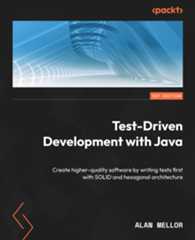
Test-Driven Development with Java
Read more
Jan 2023348 pages
Full star icon4.8 (5)
eBook
eBook
€26.09€28.99
€35.99
Stars icon
Total105.97
50 Algorithms Every Programmer Should Know
€37.99
Practical Design Patterns for Java Developers
€31.99
Test-Driven Development with Java
€35.99
Total105.97Stars icon

Table of Contents

13 Chapters
Part 1: Design Patterns and Java Platform FunctionalitiesChevron down iconChevron up icon
Part 1: Design Patterns and Java Platform Functionalities
Chapter 1: Getting into Software Design PatternsChevron down iconChevron up icon
Chapter 1: Getting into Software Design Patterns
Technical requirements
Code – from symbols to program
Examining OOP and APIE
Understanding the SOLID design principles
Significance of design patterns
Reviewing what challenges design patterns solve
Summary
Questions
Further reading
Chapter 2: Discovering the Java Platform for Design PatternsChevron down iconChevron up icon
Chapter 2: Discovering the Java Platform for Design Patterns
Technical requirements
Knocking on Java’s door
Exploring the model and functionality of the Java platform
Reviewing GC and the Java memory model
Examining the core Java APIs
Functional programming and Java
Getting to grips with the Java Module System
A quick review of Java features from 11 to 17+
Understanding Java concurrency
Summary
Questions
Further reading
Part 2: Implementing Standard Design Patterns Using Java ProgrammingChevron down iconChevron up icon
Part 2: Implementing Standard Design Patterns Using Java Programming
Chapter 3: Working with Creational Design PatternsChevron down iconChevron up icon
Chapter 3: Working with Creational Design Patterns
Technical requirements
It all starts with a class that becomes an object
Creating objects based on input with the factory method pattern
Creating objects from different families using the abstract factory pattern
Instantiating complex objects with the builder pattern
Cloning objects with the prototype pattern
Ensuring only one instance with the singleton pattern
Improving performance with the object pool pattern
Initiating objects on demand with the lazy initialization pattern
Reducing class dependencies with the dependency injection pattern
Summary
Questions
Further reading
Chapter 4: Applying Structural Design PatternsChevron down iconChevron up icon
Chapter 4: Applying Structural Design Patterns
Technical requirements
Incompatible object collaboration with the adapter pattern
Decoupling and developing objects independently with the bridge pattern
Treating objects the same way using the composite pattern
Extending object functionality by using the decorator pattern
Simplifying communication with the facade pattern
Using conditions to select desired objects with the filter pattern
Sharing objects across an application with the flyweight pattern
Handling requests with the front-controller pattern
Identifying instances using the marker pattern
Exploring the concept of modules with the module pattern
Providing a placeholder for an object using the proxy pattern
Discovering multiple inheritance in Java with the twin pattern
Summary
Questions
Further reading
Chapter 5: Behavioral Design PatternsChevron down iconChevron up icon
Chapter 5: Behavioral Design Patterns
Technical requirements
Limiting expensive initialization using the caching pattern
Handling events using the chain of responsibility pattern
Turning information into action with the command pattern
Giving meaning to the context using the interpreter pattern
Checking all the elements with the iterator pattern
Utilizing the mediator pattern for information exchange
Restoring the desired state with the memento pattern
Avoiding a null pointer exception state with the null object pattern
Keeping all interested parties informed using the observer pattern
Dealing with instance stages by using the pipeline pattern
Changing object behavior with the state pattern
Using the strategy pattern to change object behavior
Standardizing processes with the template pattern
Executing code based on the object type using the visitor pattern
Summary
Questions
Further reading
Part 3: Other Essential Patterns and Anti-PatternsChevron down iconChevron up icon
Part 3: Other Essential Patterns and Anti-Patterns
Chapter 6: Concurrency Design PatternsChevron down iconChevron up icon
Chapter 6: Concurrency Design Patterns
Technical requirements
Decoupling a method execution with an active object pattern
Non-blocking tasks using async method invocation pattern
Delay execution until the previous task is completed with the balking pattern
Providing a unique object instance with a double-checked locking pattern
Using purposeful thread blocking via a read-write lock pattern
Decoupling the execution logic with a producer-consumer pattern
Executing isolated tasks with the scheduler pattern
Effective thread utilization using a thread-pool pattern
Summary
Questions
Further reading
Answers
Chapter 7: Understanding Common Anti-PatternsChevron down iconChevron up icon
Chapter 7: Understanding Common Anti-Patterns
Technical requirements
What anti-patterns are and how to identify them
Examining typical software anti-patterns
Understanding software architecture anti-patterns
Summary
Further reading
AssessmentsChevron down iconChevron up icon
Chapter 1 – Getting into Software Design Patterns
Chapter 2 – Discovering the Java Platform for Design Patterns
Chapter 3 – Working with Creational Design Patterns
Chapter 4 – Applying Structural Design Patterns
Chapter 5 – Behavioral Design Patterns
Chapter 6 – Concurrency Design Patterns
IndexChevron down iconChevron up icon
Index
Why subscribe?
Other Books You May EnjoyChevron down iconChevron up icon
Other Books You May Enjoy
Packt is searching for authors like you
Share Your Thoughts
Download a free PDF copy of this book

Recommendations for you

Left arrow icon
Debunking C++ Myths
Debunking C++ Myths
Read more
Dec 2024226 pages
Full star icon5 (1)
eBook
eBook
€21.59€23.99
€29.99
Go Recipes for Developers
Read more
Dec 2024350 pages
eBook
eBook
€21.59€23.99
€29.99
50 Algorithms Every Programmer Should Know
Read more
Sep 2023538 pages
Full star icon4.5 (64)
eBook
eBook
€26.99€29.99
€37.99
€37.99
Asynchronous Programming with C++
Read more
Nov 2024424 pages
Full star icon5 (1)
eBook
eBook
€23.39€25.99
€31.99
Modern CMake for C++
Read more
May 2024504 pages
Full star icon4.7 (13)
eBook
eBook
€26.99€29.99
€37.99
Learn Python Programming
Read more
Nov 2024616 pages
Full star icon3.5 (2)
eBook
eBook
€21.59€23.99
€29.99
Learn to Code with Rust
Read more
Sep 202557hrs 40mins
Full star icon5 (1)
Video
Video
€56.99
Modern Python Cookbook
Read more
Jul 2024818 pages
Full star icon4.9 (17)
eBook
eBook
€29.69€32.99
€41.99
Right arrow icon

Customer reviews

Top Reviews
Rating distribution
Full star iconFull star iconFull star iconFull star iconHalf star icon4.7
(20 Ratings)
5 star90%
4 star0%
3 star0%
2 star5%
1 star5%
Filter icon Filter
Top Reviews

Filter reviews by


VessiMar 10, 2023
Full star iconFull star iconFull star iconFull star iconFull star icon5
Practical Design Patterns for Java is not just a book. It is a gift you can give to your future self or someone you believe in. It is the perfect companion for people new to Java and the JVM, as well as seasoned Java engineers. Unlike most programming language books, this one mixes in the topic of Design Patterns in the context of the Java ecosystem. You can find Java books or ones that teach software design, but having both uniquely intertwined makes this one so unique.What is more, it brought me back to my memories. I first encountered the topic of Design Patterns as a CS student back in the early 2000s. I was at a crossroads, wondering what to do with my life when a Software Engineering course changed my future trajectory forever. While I could write code before that, Patterns made things click on a fundamentally different level. I was now not only seeing code as such but as building blocks that could help me communicate the client's requirements and my solution.So many years after, I am holding Practical Design Patterns for Java Developers and feeling as excited as I was back in that first Software Engineering lecture. Over the years as a Java developer, I have collected a set of techniques I'd rely on but never formally documented them. I believe the same applies to most of the other developers I know of. Thanks to Miroslav's book, we now have a fantastic reference and a teaching tool we can use when onboarding Java engineers in our teams.The Java ecosystem evolves fast, and we may eventually need Part 2 of this book to cover the new additions. In particular, I can see how the recent moves towards better immutability (records, value classes, pattern matching) and concurrency based on Project Loom's green threads will bring new exciting challenges and opportunities. But as we stand right now, Design Patterns for Java Developers is up to the most recent developments in Java.
Amazon Verified reviewAmazon
Johannes BechbergerMar 16, 2023
Full star iconFull star iconFull star iconFull star iconFull star icon5
When I first read the book’s title, I thought, "another book on the good old design patterns,” and wondered why I should bother reading it. But I was wrong; this book gives you far more than a short descriptive compilation of design patterns. It gives you a great introduction to modern Java features and common pitfalls, too; this book is valuable even if you are not interested in design patterns. The author did an excellent job introducing the Java Runtime Environment, with many pointers to other superior reading materials.The chapters on design patterns are also significant: They give a (slightly opinionated) view of all the major design patterns, complete with small examples and examples from the JDK. These chapters feel like an encyclopedia, which I’ll probably revisit occasionally whenever I need to do a more complex architecture.
Amazon Verified reviewAmazon
Carl DeaApr 09, 2023
Full star iconFull star iconFull star iconFull star iconFull star icon5
I’ve been a software developer for most of my adult life. Early in my career, I was in an interview, being asked about design pattern questions. I thought, how hard could that be? Boy, was I in for a surprise; while I’ve coded common design patterns without realizing it, I didn’t know each design pattern had a name.At the time, a mentor showed me the (Gang of Four) Design Patterns book, which helped me re-think the best practices in software architecture and design. However, the book was not written from a Java developer’s perspective. This is precisely why the Practical Design Patterns for Java Developers book resonated with me.Miroslav Wengner (Java Champion) explains how to code design patterns in the Java language properly. For example, the Singleton pattern may sound basic; however, the author explains the importance of the double-checked locking pattern in Java. As many seasoned developers will encounter these pitfalls, this book will help you avoid them.Chapter 1 begins by providing the reader with a great foundation covering object-oriented programming and design principles.Chapter 2 covers much material on the OpenJDK platform (11-17+), many Java language features, and deep knowledge of Java internals.Chapters 3-6 represent the main categories of design patterns such as Creational, Behavioral, Concurrency, etc.Each chapter begins with a URL to the chapter’s source code. I like how Miroslav uses a common theme of automobiles (cars) when showing the code samples. This helps me remember and conceptualize the design patterns tangibly.Each chapter has three main sections Motivation, Finding it in the JDK, and Sample code. The author carefully explains the motivation to help the reader understand the what, where, when & how to apply design patterns in the real world. Next, the author describes where you can find the design pattern in the Java language, such as existing Java types (classes, interfaces, etc.). Thirdly the author presents a UML diagram with sample code. At the end of each chapter, the reader is presented with questions to assess their knowledge.Chapter 7 is my favorite chapter. I love how Miroslav talks about scenarios related to current technology stacks of today, such as microservices, concurrency programming, etc., unlike other pattern books that are too cut and dry for my taste. In practice, we often learn how to do things correctly but don’t realize we’ve been doing some things incorrectly for so long. This chapter will teach you how to recognize Anti-patterns. In other words, how to avoid bad coding (code smell) practices.The Assessments chapter (like at the end of each chapter) will provide many questions to help challenge the reader. If only I could turn back time and use this book during those intense interviews.Pros:- UML diagrams- Easy examples to follow- Explains Anti-Patterns- Assessments in each chapter to challenge the reader- References to further reading sections- Code is open-sourced on GitHub- Practical examplesCons:- Not for the Java beginnerIf you are an impatient mid to senior-level Java developer, you can just go jump to Chapter 3.- The title font of each design pattern name isn’t prominent at first glance.ConclusionThe book is a breath of fresh air for many Java developers who care about maintaining, developing, and designing software. You can immediately tell Miroslav has a deep knowledge of the Java Platform internals. Many examples are easy to follow and well-explained. This is the kind of book you can read during your travels without needing your computer and compiler. It may not be as thrilling as a mystery novel, but you never know; it could land you your next dream job.
Amazon Verified reviewAmazon
Brian BenzMar 29, 2023
Full star iconFull star iconFull star iconFull star iconFull star icon5
As a fellow Java Champion, I can wholeheartedly recommend Practical Design Patterns for Java Developers. This book offers a fresh perspective on design patterns and provides valuable insights for both beginners and professionals with years of experience.I liked that the book is organized into three main parts: An into to Design Patterns and Java Platform Functionalities, followed by tips for Implementing Standard Design Patterns, then covers additional Essential Patterns and Anti-Patterns.After a great intro, the second part covers several types of design patterns, each illustrated with clear, practical usage examples, and instances found in the JDK. This approach allows developers to quickly grasp the real-world applications and advantages of utilizing design patterns effectively.The third part of the book focuses on concurrency design patterns and common anti-patterns. I especially appreciated the coverage of anti-patterns, particularly relevant in the context of today's multi-core and multi-threaded computing environments. Miroslav's in-depth exploration of these patterns demonstrates how they contribute to more efficient and robust applications.What sets this book apart is the personal touch Miroslav brings to the material. His clear and concise writing style, combined with his expertise and passion for Java an patterns makes the book enjoyable to read. It's evident that he has put a lot of thought into organizing the content and providing useful code samples, further reading suggestions, and assessments to reinforce the concepts covered.Practical Design Patterns for Java Developers is a must-read for experienced Java developers who want to sharpen their software design skills and stay up-to-date with the latest trends in the field. Miroslav's expertise, combined with his unique perspective, makes this book an invaluable resource for creating more efficient, maintainable, and scalable Java applications.
Amazon Verified reviewAmazon
Maryna SavchenkoMay 17, 2023
Full star iconFull star iconFull star iconFull star iconFull star icon5
It is remarkable book with clear explanations of design patterns and many useful examples including references to JDK.One of the standout features is chapter about concurrency design patterns, which helps to understand Java concurrency functionality better.I also appreciated the author's attention to best practices and common anti-patterns.Overall it is easy to read, cohesive guide to design patterns from the latest Java version prospective.
Amazon Verified reviewAmazon
  • Arrow left icon Previous
  • 1
  • 2
  • 3
  • 4
  • Arrow right icon Next

People who bought this also bought

Left arrow icon
50 Algorithms Every Programmer Should Know
Read more
Sep 2023538 pages
Full star icon4.5 (64)
eBook
eBook
€26.99€29.99
€37.99
€37.99
Event-Driven Architecture in Golang
Read more
Nov 2022384 pages
Full star icon4.9 (10)
eBook
eBook
€26.99€29.99
€37.99
€33.99
The Python Workshop Second Edition
Read more
Nov 2022600 pages
Full star icon4.6 (19)
eBook
eBook
€28.79€31.99
€38.99
Template Metaprogramming with C++
Read more
Aug 2022480 pages
Full star icon4.6 (13)
eBook
eBook
€26.09€28.99
€35.99
Domain-Driven Design with Golang
Read more
Dec 2022204 pages
Full star icon4.4 (18)
eBook
eBook
€24.29€26.99
€33.99
Right arrow icon

About the author

Profile icon Miroslav Wengner
Miroslav Wengner
LinkedIn iconGithub icon
Miroslav is an engineer and architect with a passion for resilient distributed systems and product quality. He is a co-author and contributor to the Robo4J project (reactive soft real-time framework for robotics/IoT). He contributes to OpenJDK, and Java Mission Control Project, and is involved in other open-source technologies. Miroslav helps developers to create resilient and extendable solutions. He has been selected to Java Champions Program, recognized as JavaOne Rockstar and he has been Elected to Java Community Process (JCP) - Executive Committee to help guide the evolution of Java technologies.
Read more
See other products by Miroslav Wengner
Getfree access to Packt library with over 7500+ books and video courses for 7 days!
Start Free Trial

FAQs

How do I buy and download an eBook?Chevron down iconChevron up icon

Where there is an eBook version of a title available, you can buy it from the book details for that title. Add either the standalone eBook or the eBook and print book bundle to your shopping cart. Your eBook will show in your cart as a product on its own. After completing checkout and payment in the normal way, you will receive your receipt on the screen containing a link to a personalised PDF download file. This link will remain active for 30 days. You can download backup copies of the file by logging in to your account at any time.

If you already have Adobe reader installed, then clicking on the link will download and open the PDF file directly. If you don't, then save the PDF file on your machine and download the Reader to view it.

Please Note: Packt eBooks are non-returnable and non-refundable.

Packt eBook and Licensing When you buy an eBook from Packt Publishing, completing your purchase means you accept the terms of our licence agreement. Please read the full text of the agreement. In it we have tried to balance the need for the ebook to be usable for you the reader with our needs to protect the rights of us as Publishers and of our authors. In summary, the agreement says:

  • You may make copies of your eBook for your own use onto any machine
  • You may not pass copies of the eBook on to anyone else
How can I make a purchase on your website?Chevron down iconChevron up icon

If you want to purchase a video course, eBook or Bundle (Print+eBook) please follow below steps:

  1. Register on our website using your email address and the password.
  2. Search for the title by name or ISBN using the search option.
  3. Select the title you want to purchase.
  4. Choose the format you wish to purchase the title in; if you order the Print Book, you get a free eBook copy of the same title. 
  5. Proceed with the checkout process (payment to be made using Credit Card, Debit Cart, or PayPal)
Where can I access support around an eBook?Chevron down iconChevron up icon
  • If you experience a problem with using or installing Adobe Reader, the contact Adobe directly.
  • To view the errata for the book, see www.packtpub.com/support and view the pages for the title you have.
  • To view your account details or to download a new copy of the book go to www.packtpub.com/account
  • To contact us directly if a problem is not resolved, use www.packtpub.com/contact-us
What eBook formats do Packt support?Chevron down iconChevron up icon

Our eBooks are currently available in a variety of formats such as PDF and ePubs. In the future, this may well change with trends and development in technology, but please note that our PDFs are not Adobe eBook Reader format, which has greater restrictions on security.

You will need to use Adobe Reader v9 or later in order to read Packt's PDF eBooks.

What are the benefits of eBooks?Chevron down iconChevron up icon
  • You can get the information you need immediately
  • You can easily take them with you on a laptop
  • You can download them an unlimited number of times
  • You can print them out
  • They are copy-paste enabled
  • They are searchable
  • There is no password protection
  • They are lower price than print
  • They save resources and space
What is an eBook?Chevron down iconChevron up icon

Packt eBooks are a complete electronic version of the print edition, available in PDF and ePub formats. Every piece of content down to the page numbering is the same. Because we save the costs of printing and shipping the book to you, we are able to offer eBooks at a lower cost than print editions.

When you have purchased an eBook, simply login to your account and click on the link in Your Download Area. We recommend you saving the file to your hard drive before opening it.

For optimal viewing of our eBooks, we recommend you download and install the free Adobe Reader version 9.

Create a Free Account To Continue Reading

Modal Close icon
OR
    First name is required.
    Last name is required.

The Password should contain at least :

  • 8 characters
  • 1 uppercase
  • 1 number
Notify me about special offers, personalized product recommendations, and learning tips By signing up for the free trial you will receive emails related to this service, you can unsubscribe at any time
By clicking ‘Create Account’, you are agreeing to ourPrivacy Policy andTerms & Conditions
Already have an account? SIGN IN

Sign in to activate your 7-day free access

Modal Close icon
OR
By redeeming the free trial you will receive emails related to this service, you can unsubscribe at any time.

[8]ページ先頭

©2009-2025 Movatter.jp