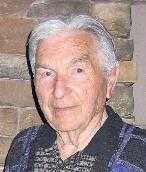
Newcomb Weisenberger worked in KFI's During his tenure - from Earle C. Anthony's time |
|
Newcomb Weisenberger worked in KFI's During his tenure - from Earle C. Anthony's time |
|
last updated 1/16/11
Please come with me as we look back through more than fiftyyears of KFI's (and my) history.
It is 1947, and I am Mr. Anthony’s youngest engineer - and a temporary one atthat. Mr. Anthony is gray already and my flattop is still dark.
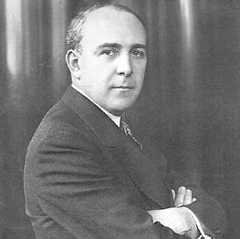
Earle C. Anthony
Mr. (Mac) McDonald, Studio Engineering Supervisor, islooking at my Operator’s license. Hereads a total of five year's experience at KGFW and KMA. Mac is shaking his head in disappointment but hires me temporarilyanyway; KFI Vacation relief takessix months and he needs three new men.
IT IS A BIG PLACE!
I am pleased to work at a ‘big’ station, wherethere is enough money to buy new tubes when they are needed and to hire realannouncers! KFI has a maintenance department, too, and we are paid if we needto work at night!
One measure of the size of KFI: The station has colored stripes along the halls that, whenfollowed, take you from the lobby to the various studios. For example, a Bluestripe led to Studio B and a Coral stripe to Studio C.
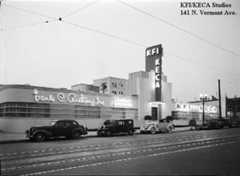
KFI Studios 141 N. Vermont Avenue, Los Angeles
We engineers are responsible for one program at a time. It is a new thing for me toswitch from place to place, sharing the program channel as it moves through thestudio complex during the day. Each of our mixers has a copy of the ‘Blue Danubewaltz. This is to be played on theair, whenever Mr. Anthony asks for it; itis his favorite.
THE STATION AND THE MAN
The circular, main lobby wall opens for the telephoneswitchboard. Its position allowsThelma, our receptionist, to see the people as they come in from Vermont Avenue.A small red light on her board indicates when Mr. Anthony isnot to be disturbed by calls. Aship’s lantern hangs over his office door. No one knocks when it is lighted!Herenow in 2004, the same lantern burns in my office. I still feel that it is his.
Master Control is located at a hub of doorwaysleading to the various studios. Engineerscan quickly move through to the various mixers. It is a men’s world; it will be years before KFI hires a femaleengineer. Mr. Anthony is an engineer and I think, understandsand favors us. He does things thatI would do if KFI were my station. Hetried out new things from the very beginning. He even made an electric car and droveit.
In the 1920’s, many listeners hand-built their ownradio receivers. These often had the parts screwed to a wooden breadboard; the coils were wound byhand. Earle C. Anthony built his first KFI transmitter the same way. Pat Bishop told the story ofMr. Anthony buying twoof the first 50-watt tubes from RCA and hand carrying them home. Over the years it was taken apart and the parts usedfor other things. For the 1972anniversary, Mr. Blatterman, Chief Engineer, posted a memo on our bulletinboard, requesting the return of all the missing parts especially the hot wireammeter. The board is reassembledand isput on display again.
Mr. Anthony has a car phone. I know of no other person with a carphone. Sometimes Mr. Anthony parks on Vermont at 141 North Vermont – KFI’saddress - andcalls in, just for the fun of it,
He has just built channel 9, next door south and ourshop has removed the cabinet from a small Emerson TV and has installed it behindthe front seat of his car. He is driven by his own chauffeur. Mr. Anthony is very interested in PalmSprings. He loves the calliope and provides one for the City’s street parade. He arranges for KFI to cover the paradelive.
One Sunday morning he was listening from Palm Springswhile we were operating our 5,000-watt stand-by transmitter. He calls mastercontrol. Dick Bull answers. Master Control is avery busy place and ECA wants to know why the KFI signal strength is so low. Dick hurriedly says,” It’s too technical toexplain.” Some twenty minutes later I passed through MC again andDick is saying,” Yes, Mr. Anthony. ”
Later Dick tells me that Mr. Anthony had recited the wholestory of how he was an engineer too and had built the first transmitter himself!
-
There are times when MC cuts away from NBC tosubstitute California specific commercials. Thisrequires close monitoring of cues. Iask Thelma to hold calls and lock the door to the main hall. One of these times there was knocking on thedoor. When I can open it, there stands Mr. Anthony with a small tour of hisown! “Why is this door locked?” “ I am trying to stop traffic through here.”He understands. He and hisgroup didn’t interfere with the program cut-aways.
KFI’s signal is strong out over the ocean. Oneof Mr. Anthony’s staff has a yacht. Thereare sailings to Hawaii, and he writes his song: ”Oh Coral Isle.” That is said to be the reasonStudio C is calledCoral, and Studio E is called Emerald. Although some have said so, I don’t thinkhe had his own private railcar. Mr. Anthony did put his floor model RCA radio receiver in a lounge car. Our shop men strung an outside antenna forit.
When Standard Oil bought his service stations in LA, they kept hiscolors. Even to this day.
When Cox Broadcasting bought KFI, I had theopportunity to visit Mr. Anthony’s office. It was like an attic full ofmemories. He kept an upright piano, a Grandfather clock and gifts from his BoyScout Troop. He didn’t keep hisold transmitter but there is an old 20’s battery powered Western Electricreceiver and a Magnavox tin horn speaker. His private viewing window, uncovered,looks out to the auditorium studio with views of the stage.
From time to time, Mr. Anthony made some personal recordings, greetingsto his family, very formal in style. “Thisis Earl C. Anthony speaking.” Yearly, ECA sponsors his Scout troop to a hikingtrip into the mountains. Ourengineer Harry Parker (on his own time I think), goes on the hike. He carries a heavy pack-transmitter- KA 4711- to keep contactwith the hikers . At a prearrangedplace, ice cream treats are air dropped to the troop. We carried shortbroadcast reports of the troops progress over KFI.
Mr. Anthony now is gone and I am sorting over his things,before strangers throw them out. Iam thinking that someday someone else will be throwing out what I have saved, and itwill be the same stuff: JohnCharles Tomas, Souza and McArthur’s farewell speech!
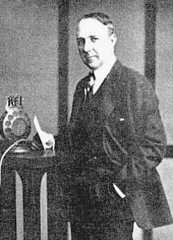
Earle C. Anthony
Mr. Anthony looked lonely. Like Henry Ford,he was paternalistic, and treated his employees perhaps better than did theirUnions. His was thesmallest corporation to own a TV Channel - #9. Sadly, one day, I saw the Vermont sidewalk filled withstrikers (his own employeesincluded). It was too soon for TV to make money; it was only findingits market. Anthony sold KFI-TV 9 soonafter the talent strike.
Ultimately, his estate went to his Alma Mater andother educators. His namesake station KECAhad to be de-vested, when the FCC ruled against the ownership of two stationsin the same market.
------------------------
The personal events of thirty three years at KFI, have mademe glad to have been Mr. Anthony’s engineer, and not to have traded placeswith Mr. Anthony himself… …-. . --
The KFI 50,000-watt transmitter dominated thesecond floor of the Buena Park building.
Centered in the room was the engineer’s desk. Its top was cut to house the large masterswitch. A small brass railing protected it against accidental operation. Here too was the VU meter to monitor the audioinput.
The engineer faced a three-sidedUof metal panels. Tohis left was the monitoring equipment and the lower stages of the modulator. In front was the metal wall made up of a 200-watt transmitter feeding a1,000-wat transmitter feeding the 50,000-watt RF–amplifier. To his right wasthe three phase full wave rectifier. (17,000 volts DC). (The two 90 degree, corners were joined by metal doors at 45degrees.) These doors were interlocked, for safety, to shut down the station, ifopened. The operator could read the large meters all along the top of thesemetal walls. Also he could seethrough the glassed openings, to the large vacuum tubes lighted by theirfilaments.
Behind this wall the units were open metal framesexposing the various operating components. Many of these were hidden from theoperator. The high voltage and radio frequency connectors, of copper tubing, wererun overhead and safely out of reach.
One man maintained watch in this room perpetually! Night and day, three shifts, everyday. At any moment it might be his duty to re-set the main switch. (This was a bat-handled, oil-filled switch that acted like an oversizedcircuit breaker.) Every 30 minuteshe logged the power of the last stage and the frequency deviation from 640 kiloHertz.
Every two hours the engineer made a complete tour of both floors,logged the temperature of bearings and contact of brushes on all rotatingequipment and a reading of all meters including those from Southern California Edison. A second man watched over the first floor full of duplicate pumps, 200Amp. DC Filament generators, 1,000 Volt bias machines and the 510 hp, 50 to 60cycle frequency changer. The secondengineer stood by for breaks and meals. (There was a small kitchen and machine shop adjacent to thetransmitter room.)
The transmitter engineer was alert for changes insound, power surges, arc-overs, the odor of overheated windings and failingparts. He was ready to extinguish asustained arc by opening the high voltage switch. (A small animal, dirt, movement of parts or wiring and strongsurges of power can cause an arc-over. )When conditions are right, the arc will continue to burn until power isremoved. The heat of the arc canchange some insulators into carbonized conductors.
The operator may hear the arc roar and see the flashbut not know where it was. A badburn might take us off the air until repaired.
On occasion, it was necessary for someone to observethe arc-over from the inside of the transmitter.This happened to me!
I am insidethe transmitter, sitting cross-legged on the floor, both hands are in mylap, positioned out of high voltage reach. The other engineer calls, ”Are you ready?”The doors are closed and full power turned on. I remain motionless in the dark, watching for the arc hidden inthe transmitter’s insides.
My head has a short dialogue with my body. My body says, “Get out ofhere!” this no place to be. My head says,” Don’tpanic, you are safe where you are. Don’tstumble into trouble” The big switch slams shut, I see the arc!It is between the open plates of the large,(four foot) air dielectric, condenser. Immediately the engineer pulls the high voltageswitch. The arc is dead. Its roar is still in my ears. The door swings open; I can breathe easier now,and step outside, justbecause I can!
During maintenance, when KFI was off the air,engineers searched for these burned areas, tightened connections, cleaned,polished insulators, changed filters, tested and installed tubes, repairedcontacts on the large oil filled switches. The more interruptions during the week, the more the contacts weredamaged.
Note: Tothis date, no KFI transmitter engineer has had a serious work related injury.
We trusted each other with our lives. These men were my friends.
-30-
The tuning house phone rings again. Riggers have arrived to re-lamp the towerlights. They have requested that I remain at the tower base.
KFI employees are forbidden to climb the tower. The riggers are insured and trained to do work on thetower. Two men appear out of the dark as they reach the light spilling out theopen door of the tuning house. Theolder man explains that the tower is wet and they want someone to stay on theground.“Toreceive us if we fallTheysaid, no one would know.I couldwatch for them and call the transmitter.
I was told thatthey didn’t hang on with a grip! Wearing heavy leather gloves,they formed ‘hooks’ with each hand. Theyslapped them down over the metal rungs. (“Itwould be dangerous to cramp your fingers on a long climb. ”)
When all the lamps at one level are burnt out, the airporttower (Fullerton) would be called and all lamps on the tower would be replaced.
The two riggers jumped on to the tower. They first climbed a wooden ladder to a point above the baseinsulator. The leap onto the tower was to prevent small arcs from meetingtheir grasp! One man had asack, of new lamps, on his back.
Fog obscured all but the first 100-feet of the tower.The cool metal was wet with condensation. I watched them climb out of sight into the foggydark.
I have been paid to do a lot of things for KFI, butnot to include waiting in the dark, of a damp, Monday morning, for two mennot to fall from the tower!
The old lamp bulbs were dropped 100s of feet to theground. Seldom was the glassbroken. They floated down,base first, like small balloons. Wedidn’t reuse them at home. Theywere 2000-hour lamps that gave less light for their wattage, a trade off forlonger life.
The flashing beacons are not totally extinguished. If you stand close to the tower, you can see a dim glow from the filamentwire. It returns to fullillumination as fast as your eye can accommodate the change. This to reduce the flashing load, on the cam operated, mercuryswitch. These sometimes explode, releasing the free mercury. (A poison. )Note: (Now solid state switches can replace flashers like these. )
Power at 60 cps is coupled to the tower lights by a specialair transformer.
I was still rehearsing my rusty CPR skills when thetwo riggers reappeared out of the fog. Oneman was backing down the narrow rungs welded to the tower. The other was inside, sliding back and forth as he came down the wetdiagonal braces. If it was a race,it was to close to call! I knew that they had to come downsome way! Now weall could go home!
Note: Pilots use the KFI signal as a homing beacon. Our tower is marked on their flightmaps.
-30-
Radio began speechless. The Marconi transmitter was turned on and off for short and long bursts of carrier, called dots and dashes. Information was derived from a code invented some 100 years earlier by Samuel Morse of telegraph fame. This early radio was called wireless telegraphy to separate it from the wired telegraph.
Telegraph did not send sound on the wire. The sound was generated at the telegrapher’s desk. He listened for two sets of clicks that resulted from the dots and dashes. The shortest was the letter E, which is still one dot! A longer letter would be F, which is dot, dot, dash dot. It looks like that on my page but it sounded like dit,dit da dit. However, the operator hears the group as one cadence, run together. In fact, he thinks in words of letters, even phrases of words!
I have visited with operators who could carry on a conversation while listening to the stream of code and type it on to a page in text! Part of his mind automatically translated the sound of dots and dashes into print!
These three paragraphs bring us to the point where we may speak of thesound of wireless dots and dashes! Wireless transmitters (before radio tubes were invented) were powerful spark machines that generated an arc each time the operator pressed his sending key. This was a raspy buzz when received. About 1915, the shipboard SOS was heard as buzz buzz buzz buzzzzz buzzzzz buzzzzzbuzz buzz buzz. Different ships would have various tones of buzz.
I should mention that the alphanumeric Morse code was formed into an International Code where the letters meant something more that bridged all languages! QRA? Please give me your address, QRT? meant shall I stop transmitting. A few code words were the equivalent of a paragraph! And one could ‘talk’ to a foreigner from any country! (Without the (?) Mark, they became statements.)
A new vacuum tube invention, The Triode, provided an audio ‘musical’ tone to replace the buzz. Soon another similar, invention allowed the human voice tones to replace the musical sound! Now, at last, the transmitter was switched on while the information came from human speech.
Slowly, radio was benefiting from the telegraph and next from the telephone. Bell perfected Edison’s microphone. (A small box of carbon granules that modulated a current when vibrated by a voice.) In different ways, this was used to vibrate the transmitter’s signal. Radio could speak. Soon it could SING.
And it would sing on KFI. (We have a NBC News film where Pat Bishop demonstrates how the First KFI music was broadcast.) Edison’s phonograph was played manually and the mechanical sound was acoustically, coupled to the telephone mike. Smaller radio stations used the 78 RPM disks to broadcast music on thru the 1930s
Note: This cascade of inventions - each following the one before it - later brought us Television, and it is still building. Ben. Franklin started with a wet string! (In his experiment, he was fortunate that wire wasn’t yet available!)
Local radio stations used local live talent as music sources. Remotes from schools, Churches and concert events brought music to the air.
Earle C. Anthony took a ‘hands on’ interest in his radio stations. KFI and KECA. The equipment, the people working for him and especially what his listeners would hear.
He held that people should hear what was good for them. In a benevolent way, he wanted to make it possible for them to hear opera. Classical music, live and recorded. He wanted his programs to be educational and informative. Mr. Anthony put the listenerfirst, ahead of popularity.
At this writing, most radio is broadcasting the opposite material. Programming is carefully presented to build listener base at all costs. Professional research selects in a very competitive way what people in certain markets will hear according to their sex, age and social position!
Some of the KFI music came from the LA schools. TheYoung America Sings programs came from High School assemblies. Weekly, two engineers disk recorded live music from these auditoriums. Their talents were broadcast on KFI so that the families and students could hear their own music.
These programs were recorded before the student body. Ted Myers was MC and the students responded as an appreciative audience. These were some of my engineering assignments.
Some of the KFI music came from our own studios. KFI had two grand pianos, an electric organ on dollies and a Maas Pipe Organ built into studio B.
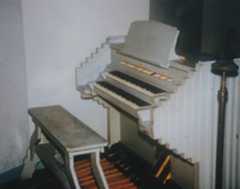
KFI maintained a live orchestra; Claude Sweeten was director. This orchestra would present scheduled music programs, theme music and mood music for weekly drama programs. (One of these was Conquest. Also fed to San Francisco.)
Most of the time, the orchestra was on standby. That is, ready to fill any break in programming with live music. They were set up on the stage in Studio A. They often played cards. I remember the card deck being strewn on the Grand Piano lid.
The Auditorium studio was used for auditions. Musicians came to play before Bob Mitchell. An engineer mixed the sound. Winners from this competition were selected to be heard on KFI. The famed Mitchell Boys Choir sang in Studio A.This group also supported the Boy Scout program from the A studio.
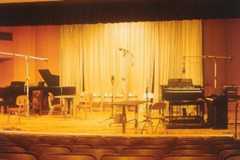
KFI Studio A on Vermont Ave.
The pianos in studio A and Studio C added their music to Chuck Collins and other programs. Sometimes for the opening and closing themes and perhaps the program itself. The program, Ladies’ Day, had Bob Mitchell and the Hammond organ for musical bits throughout. (This organ was made mobile and was used in various studios as needed.)
Mr. Anthony had a pipe organ in his residence. He bought another and had it installed in Studio B. An adjacent room was made into a pipe room. It was ported through the studio’s south wall. The high-pressure air turbine was installed in the basement. A 24 inch glazed ceramic pipe (wind line) ran through the studio floor into the basement. The voice of this organ was heard on KFI several times a week.Bob Mitchell and Howard Culver did “Joy Forever” from studio B (It was my pleasure to mix this program many times.). On occasion, George Wright came to play this organ.
There is the story, (I didn’t see this), that Mr. Wright tore out the ornamental fabric that covered the grilled port from the pipe room. I did see the tattered cloth. (The idea being that the cloth had, acoustically, dampened the voice of the high pitched pipes!)
Mr. Wright may have been technically correct. But, I don’t think that the average, KFI listener could have heard the difference. (This was in the late 1940s)
Some of the KFI music came from remotes. KFI had enough ‘gear’ to field four or five remotes at the same time. Saturday nights we covered three, consecutive, remotes from as many locations. This was a dance band program sponsored by Union Oil. Anchored by Chuck Cecil. Announced by staff men like Dick Sinclair, Bob Kerr and others.
We had more mikes in the field than in the studios! This was live music. Sometimes delayed by sports running long. (There are several of these Big Band tapes in the SPERDVAC library.) I have the originals. Already oxide is flaking off the plastic backing. (Do not use magnetic tape for long-term storage.)
My KFI assignment was the Coconut Grove for bands like Freddy Martin and Dick Stabile. Yes, there really were several dusty, full - scale palm trees flanking ‘The Grove’ stage. The huge electric billboard on the roof was also framed withneon Palms
.
Other engineers were going to the Palladium, to the Santa Monica Ballroom, to the Big Red Barn in Orange Co.
Some of the KFI music came from the NBC Network.“From the Upper Compton Turnpike” I can still hear the eastern NBC announcer covering a dance band remote. It was late night there. California was in the early evening. KFI mornings heard Fred Waring’s all-music program, without one second’s break in 30 minutes!
And some of the KFI music came from our own music library:Earle C. Anthony had a hand in all this! For KFI FM he brought the newest disks from England. Music recorded in the widest range, on the best pressings. These transcriptions were labeled with repeated letters like FFFFFr indicating their frequency response. I was to play these from Mixer E, sending to KFI FM - the first program on the first day.
Mr. Anthony has written several songs. I have a fresh sheet of music,Coral Isle that bears his words. Clickhere for a short sample.
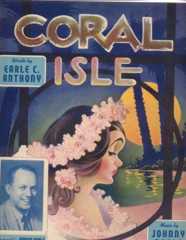
He liked to sail to Hawaii and he named his studios after the colors Blue, Coral and Emerald. He also wrote a parody on Western songs. ”They hung myman on a Cottonwood tree,” Vocal by Bob Mitchell! Available in SPERDVAC library.
KFI Sold - an era ends. A thorough purge follows, as if Music were a disease. No trace of the above history must be left behind. All pianos and organs must go along with the Very Important People; most Engineers survived. Studio B was to become B1 and B2 news studios. I was assigned to rewiring the B mixer, which would now serve both studios. The mixer would move to the right several feet. None of the, very many, wires would reach!
The walls of B studio were being changed and the ceiling was being suspended. The console of the pipe organ was pushed out into the room.
I WAS THERE at the right time!
I heard”Theorgan has to go.” Without thinking for a moment, I heard myself saying to Office Manager, Ann Carlyle,“If no onewants it, I would like to have it” The answer was a question: “Can you have it out of here in three days?” I promised,“Yes” (That is another story that doesn’t belong here.) Except to say the Maaspipe organ the furniture, pictures, paneling etc all were stripped to the walls Mr. Anthony’s treasures were ripped out and with rubble, were placed in the same wheelbarrow. They were only a few feet from the Vermont Alley.I was there.
To this day in 2005, KFI talks but doesn’t sing anymore.
Note: Bob Mitchell and I have survived. Later, he played the KFI organ for us in Garden Grove, California. That story will be of interest to those who care about wind lines, pneumatic relays, Organ stops, wind turbines and pipe making and voicing. Bob Mitchell and Howard Culvers’Joy Forever theme wasA Stairway to the stars Bob played it again from memory.With Bob at the familiar, Maas console, we knew that the re-installation was a success!
Post script:After many years, the small Maas organ was replaced by a larger, more suitable one. But, some ranks ofKFI pipes still speak;they speak on Sundays, in the little old Colonial Church in Garden Grove’s Euclid Park
Before that happened. (1968) New billboards hadpictured them as clowns falling from the sky. Captions said, ”The Greatest Air Show onEarth. ”Soon I was waiting in the small Emerald studio at 141 Vermont, L. A. torecord some promotional ‘spots’ that would announce their arrival at KFI.
Two desk mikes were set up in the announce position,where only one had been placed before. Twosmiling strangers came in and at down as if they would both talk at once.
This was the L&B team. I was meeting them for the first time, ‘Through the Glass’.I opened the two mike faders and pressed the intercom switch and we spokefor the first time. I couldn’t tell which voice was coming from which mouth!
Later I would learn which voices belonged to each man.The many characters came fromlife, mostly from people they had known. Theyliked double names, Doctor, Doctor, and Dean, Dean Dean. Sam was added when a real Sam wasL. A. Mayor. W. Eva Schneider remains my favorite. This was the irreverent, dowager, female voice (done by Lohman) thatbroke all the rules.
Example: Theshow opened with Lohman instructing the "staff" to be sensitive abouttelling one absent member that their cat had died. When that member walked on, W.Eva blurts out, "Your cat’s dead!”
I asked if they would run-through their radiocharacters for me. They looked ateach other as if they had never done such a thing before. Roger said, ”He wants to hear all our voices so as to see which mike they come through. ”With that they wentthrough them one at a time. Saying,”Leon Lights comes through about like this. ”Some forty voices in all. Iwas so pleased and entertained that I didn’t hide my feelings when this trainof talent ended in a loud forced belch” -(Lohman’s of course.) They both thought it wasfunny. Perhapsthe look on my face was enough!
Roger was the serious one. He cared if the commercials were done in the scheduledtime. He kept up the paper work. Hewas neat, punctual, and polite.
Al’s characters were well-defined, his timing wasgood and he pulled his weight with original thought. But big Al was a lovable mess.
MORE THAN VOICES
Ttudio visitors were not prepared to see the nearly empty room - just the two real people - and through the control mixer glass, two more KFI staff.
A TEAM AND ONLY AS A TEAM
These two were a team, more "married" than to aspouse.They needed each other to be what they were. So much so that management decreed that if one was sick, they both weresick! KFI did not want it anyother way. Today they would becalled co-dependant.
L&B (Onlyon a special B&L Day were they billed out of that order. I remember that it was Dyer Huston’sidea. It may have been done each year. Allof KFI’s staff recognized and tried to remember to say, “B&L It was difficult to keep the orderreversed. )
L&B and their families didn’t ‘hangaround’ together as you might expect. To keep their programs spontaneous,they didn’t script their material. Theydidn’t do read-throughs. In thelounge, ahead of program or recording takes, they would share an idea. One would suggest in a general way that they do a certaintake and the other would nod and suggest the next plot direction. Several sub-plots would be a continued idea. (During their stay at KFI,W. Eva Schneider was variously married to most all of the imaginary staff.
With two ‘heads’ to start with it was difficultto ‘help’ them. I tried to,only once. I could see immediatelythat it was a mistake! Their trainof thought was interrupted. Rogerlooked at me quizzically, not being able to accept another idea. Much less fit it into what they wanted todo.
The morning that our astronauts were quarantined forrubella, I suggested that W. Eva might have rubella. They took the idea and exposed their entirestaff! That was anexception.
Sometimes when I worked with them they said that JaneWyman was their engineer! Theysigned an autograph for me the same way!
L&B were fun to work with but their program wasdifficult to engineer. Some partsof a segment would be taped from the program in progress, to be used in afollowing hour. There was no chancefor an edit or re-cueing. It was‘done on the fly’ with no chance to correct an error.
They ran a continued story each day. (They made it up pretty much as they wentalong. )The sound effects and organ stings were on separate carts that theengineer would punch on cue. Withoutrehearsal, most of this all happened as it should. But one miscue could and has caused a cascade ofothers. I remember now how it feels!
Their character voices and parts, taken, were so wellunderstood by the listener that it was hilarious when L&B purposely hadone voice pretend to be another! Lohman particularly enjoyed doing Lone Ranger stories.He was called ‘Lone’. Barkley must have been the Tonto voice.
If there ever was a tape is must be lost. It was on the airlive. Iwas mixing. I want to recall it here. Now it never can be re-done. Atleast that well.
(If you can remember their voice parts, try to fit them tothis remembered script.) Lone’shorse is down (sick).Loneand Tonto are kneeling at the horse’s head. They are sad and Tonto asks for amirror. He holds it to the horse’s nose and says, “Good news, no steam onmirror!” (There is a pause and)‘Lone says,” No that Bad news.” That was Classic L&B and I was paid to be part ofit!
I was not regularly scheduled to L&B but wasinvolved with them from time to time. They did personal appearance remotes too. I went along to severalplaces.
I remember the Queen Mary remote broadcast. Dyer Huston, producer, and I as remote engineer with L&B and all ourspouses were invited to spend the night nearby in the then new circularapartment hotel in sight of the moored Queen. KFI had decided that the out of town, early morning program warranted theouting. I liked the pie shaped parking stalls facing the core elevator. Our party took up most ofa floor of suites with views in all directions.
Early the next morning the luxury ended quickly. The Queen was not open for visitors at thathour. The dockside elevators were not in service. The broadcast was to be from the ship’s Bridge several decks above thewaterline. We took the stairs. Everyone had something to carry. Lohman pulled the lanyard, to sound the blast, that sentthe seagulls flying. He wore atired Captain’s cap. They had funon and off the air.
I had less to do as the commercials and taping were handledat the studio mixer. We had severalmikes as we did live interviews from the Bridge. Publicity prints show a radio receiver in thewindow. We brought it to monitor KFI and receive cues for our program feeds. Huston’s shiny stopwatch made it all come together withtime for the commercials.
Should such a program be done today, lodging could beavailable on the ship. We have hadthe opportunity to stay aboard overnight, Viewing fireworks off the stern andsharing a porthole the next morning to see Long Beach through the fog. Pretending that it was the English Channel!
All together I have spent 33 years with KFI andwouldn’t have missed a one!
-30-
If KFI was a ‘pot-boiler’, it was a bigone! Alone at his desk on an all night shift, the young KFItransmitter engineer watched the caged monster; on life support, glowingin the dark, singing its wordless song. Pumpswere circulating liquid through its hoses while massive pulses of electricalpower prodded its insulation. Itwas not really alive but it was warm to his touch. He logged its temperature regularly, measured its pulse and listened forits sighs that all was well.
KFI transmitter engineers all shared the transmitter duties.These included the properoperation of the station 24 hours a day. Threeshifts of two engineers, plus the chief operator during the day, held the signalof KFI to its assignment of 50,000 watts at 640 kHz. (Atmospheric interruptions were corrected withinseconds - someonewas that close to the control panel at all times.) They also worked together as they performedmaintenance.
Maintenance was scheduled from Sunday midnight to daylightMonday morning. A posted scheduledetailed each item to be done each week. (Ourinitials filled a column listing the items we finished.) Five-week, months addedthe extra things we did just that often. Each engineer was also assigned one, additional, specialresponsibility. This was on-going and performed without interfering with the station’s operation.
I was the KFIChemicalEngineer!To my knowledge, no one at KFI had this assignment butme! Ionly used two chemicals, but used them very carefully - both were toxic, violent in nature and carried opposite valence!I was assigned to one experiment thatI repeated several times a year. My assignment was the cooling water for the twoUV862-water-cooled tubes in the last, 50,000 watt, amplifier.
My tiny lab was set up downstairs in the northeast corner.We had a sink, an overhead shelf, two aspirator jars, lab hose and awaste container. (The waste could not be discharged into the drains.) KFI provided me with a face shield, a full-length lab apron and acidproof gauntlets. It was like High School Chemistry but limited to HydrochloricAcid (HCl) and Sodium Hydroxide (NaOh).
When the Federal Radio Commission (FRC) authorized some 15 clearchannel stations to broadcast at apower of 50,000-Watts, the Radio Corporation of America (RCA) offered an amplifier module that would boost a 1,000 to 5,000-Wattstation up to 50,000-Watts. This wouldhave also required the station to add a 25,000-Watt audio modulator. (Stations like KFI are amplitudemodulated, or AM; theirpower varies from near zero watts to ½ again the rated power - at the vibration rate of the announcer’s vocalcords! This additional power is added by the modulator, using a 75,000-Watt transmitterfor a 50,000-Watt station. When this is done, the station is most efficient when fullymodulated. At all other times, thisextra power goes into heat. Theselost watts heat the tubes, the air, the water and the room.
The power input at KFI was three times the power it wasbroadcasting, hence an efficiency level of some 33%. Engineerswould say that the radio frequency (RF) amplifier was operating as a class B or AB,meaning it was an audio amplifier too! The RCA 50B transmitter avoided that by operating the50,000-watt final amplifier in anefficiency mode. Still, it had to be a 75 thousand-watt amplifierduring the peaks of audio modulation, dissipating the extra 25,000 watts when it was notmodulated. This was a commercial choice. At that time it cost less to furnish high voltage powerthan to provide a high power audio amplifier.
The result of this trade off was that no air-cooled tubes of that sizecould be made that wouldn’t burn out. To carry off the 2/3s of wasted power,the tubes were immersed in waterjackets standing as tall as a small man. KFI used hundreds of gallons of distilled water. The Sparkletts truck would back up at midnight and pay out a large,white, hose into our pump room. Wefilled the two 400-gallon tanks and the water in the pumps and the circulatingsystem.
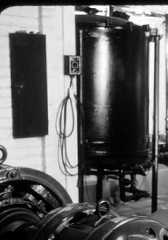
Notice the ph meter at the left ofthis 400 gallontank. The coiled cable is the dip cell.
The motor-generators, in the foreground, supply thefilament power to the tubes.
Electrons hammer into the plate, oranode, of the tube. The metal heats and the temperaturerises. The anode is connected to 17,000 Volts DC. The water is connected toground (Zero volts). A 22-foot coil of hose or ceramic tubing separates the voltage andconnectsthe water. Several things must bedone to keep a ‘short circuit’ from happening. The leakage toground is kept to a minimum, the water pure ... and cool. This is because a law of physicsstates that the current through the water heats it,and as it is heated more current flows, because it offers less resistance.
An interesting design part in the manufacture of part glassand part metal, tubes, is a special glasslike seal between the glass and metal. This amber colored, join has the temperature coefficients of both glassand metal! (Glass and metal would crack. )
So, we start with pure, distilled, water. Asthe water is moved through the pumps and against the hot copper metal into the copper or glass linedtanks the water becomes more conductive. This causes voltage losses and we boost thevoltage. This in turn causes more heat. As the cooling water contacts the hot anode, it separatesas steam and collapses against the plate again as it liquefies (cavitations). This produces a pleasant, singing sound that varies as the modulation changesthe dissipation - not the program audio but a song of its own. (There are jokes about theold days when KFI wassteam powered! Not true. But we did produce steam!)
During the hot weather months, the cooling water becameespecially hot; the tanks, pumps and pipingall were hot to the touch. KFIinstalled a heat exchanger outside the building, just outside the pump roomwindow. This was a huge evaporativecooling tower. It was designed asan air cleaner/washer.
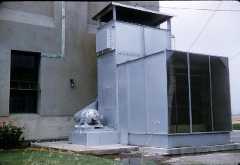
Our clean,hot water was circulated through an exchanger cooled by evaporation. The clean, washed air wasdiscarded! This was a walk-inunit. Weserviced the bearings on the turbine. Itwas cool inside and the air was free of dust and pollen.
For many of the early years, KFI regularly, dumped the contaminated,distilled, water and flushed the system with new distilled water beforerefilling the tanks.
We installed a filtering system that used two resin beds. Each was about eight inches in diameter and two feettall. They stood side by side and were valved so they could be connectedin series. The water flowed throughboth when in use. This was a bypasssystem. Only a trickle of waterfed through the filter into the large tank. I made a sight glass from a large testtube. We could check to see the constant flow into the tank. I am still amazed at the impact of that fast-drip on the extensivecooling system.
A dip cell came with the filter. It was cabled to a ph meter that measured the water qualityin the system. (I found that it wasdifficult to collect a small sample and test it without contaminating thesample.) A fingerprint could throwthe reading off, so I extended thecable so the cell was dipped into the tank. (The 400 gallon sample was error free!)
By using one bed to remove – ph factor and another bed toremove + ph factor, we had almost, non-conducting water! The resin beds became contaminated as they filtered theimpurities from the cooling system. Removing this concentration was myassignment. As it was, my first meeting with Pete Dilts was seeing his head emerging from a400-gallon tank. He had beenscrubbing the empty, but still steamy, copper tank with distilled water.
I filled the each aspirator vessel with one of the twochemicals mentioned above, made thehose connections, adjusted the valves and collected the waste. The strong acid and alkaline solutions met with a strong chemicalreaction! The result was athick, gray, syrupy, soup. This toxic dump was the safest part of the operation!
I was ready and willing to wear my protective gear! Anyspill, hose failure or broken glass would dangerously expose my face and handsto caustic or acid burns. I was ascareful of this as with the high voltage.
Both beds were flushed with distilled water after thechemical bath. They were nowconnected so that the system water would pass through them both, one after theother. The filter could be out of service for several days at atime. (The de-contamination of thesystem was a slow process. )
The operation of the entire station rested on this flowof cooling water. Safetyinterlocks prevented any power turn-on unless the water was already flowing!
Here were two pumps, tanks and valving systems. With skill and luck, one could switch pumps without interruption of thewater flow. There was a double mazeof hand valves to switch over, drain, fill or switch tanks and flow to thetransmitter up-stairs. With permission, I painted the hand wheels red, white andblue! Red drain valves, whitefor pump A and blue for pump B.
NOTE: A valve’s seal will freeze up if left in oneposition too long. Once a month,each valve was opened and closed by hand. Eventhen, it was difficult to move them. The pump shafts turned inside packing glands. These were adjusted so as not to restrict the shaft or to be so loose soas to leak water. Like all the machinery, the pumps were run alternately a weekon and a week off.
Centrifugal pumps have a petcock at the top of the case. This is to open so that the pump will drain properly, when offduty. Moreimportantly, it is used to bleed off air when the pump is put back into service.(An air pocket will prevent its operation - a disaster when it was time to restart thestation!) The centrifugal pump can lift water aboveits mounted level but not frombelowits mounted level! This limitationis why KFI has two 400-gallon tanks. But, that is another story.
My exclusive, clean water assignment lasted for about tenyears. During that time,transmitting tubes were designed to provide 50 kW powerwhilebeing air-cooled! Now, transmitters were built that no longer wasted so much power or runsohot. They didn’t need me, oranyone else! They could rununattended.
The FCC eventually ruled these transmitters could be monitored remotely.
KFI boughttwoof these new transmitters! KFI’stransmitter engineers were re-assigned to the Vermont studios. There they couldswitch a failing transmitter for a standby, full spare 50,000 watt transmitter by remote control!
Man had become more expensive than the machine.
-30-
t
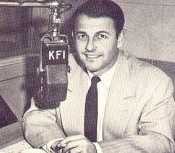
Ben Hunter
19xx-1980
W"
Dead Air happens. Programsmay be interrupted. Errors can bemade in switching. There may bepower failures. Connections may open. Microphones and their cablesdamaged, tapes may break, and speech amplifiers fail.
An unexplained, two second, pause will bring the programdirector into the mixer. Demanding,”What can we do to prevent this from ever happening again?”--------------------
I am on night shift at KFI’s 50,000 Watt RCA transmitternear Buena Park, Ca. when this KFI CATASTROPHE happens. I know of no other to compare with this!
I am on the second floor, seated at the ancient oakoperating desk facing the three walls of metered equipment. I can hear the assuring hum of power, the brush of cooling fans, the highpitched song of the two, man sized, water cooled, tubes as they feel thechanging load of the modulated program. Iam listening to the ‘on air’ monitor for program continuity.
I can see the oscilloscope showing the depth of themodulation. The large deviation monitor shows how well we keep to our 640 kHz.Frequency. (Only12 + cycles of deviation. )My desktop holds the large recessed remote start/stopswitch. A VU meter reads the program input level. It is nearly time to mark the half hour log.
Then IT happens!Circuitbreakers drop out and the high voltage rectifier’s 17,000 DC volts, quits,cold! The six, glowing, mercury vapor tubes go dark. It’s D. C. voltmeter dropsto zero.
KFI is off the air. Thishuge, Earle C. Anthony flagship, moored to the 750-foot tower, is deadinthe water!……………SILENCEis suddenly everywhere.
I check to see if we have Edison power. The fault must bewithin the rectifier circuit itself. (The ‘smoothing’ reactor and powertransformers are too large to be in this room. )I hurry down the metal stairway to the ground floor and remove thepadlock and chain from the iron door that closes off the bricked-in High Voltagetransformer vault.
This long narrow High Voltage room with its high ceilingalso contains the bank of h. v. Filter capacitors. (They arestill dangerously, holding their high voltage charge!)I am too warm inhere. Itsfrom the radiated heat, fed by the Power Loss in the heavy units.
The transformer windings are protected in oil filledhousings as large as bathtubs standing on end. ¾ inch copper tubing connects these units and carries the power, throughthe ceiling, to the rectifier upstairs.
These are the connections that we check weekly and theinsulators we have wiped so many times.
Now, with a wrench I am disconnecting a huge transformerthat has been in place ever since 1928! Myohmmeter stands at (inf. ) infinity! (Nothing) Open Circuit.
---------------------------------
This winding, down in its hot oil bath, must have separatedfrom its terminal! I check themeter and its leads again. I re-measure the winding, making certain that mycontacts are in place. (It isdifficult to measurenothing. ) Butthat is what we have. I………………I measure the winding once more!
Time (dead air time) moves fast! There are phone calls that put our 5,000watt stand-bytransmitter on the air, that find a replacement transformer. We can “borrow” one from theS. C. E. Co. (It will be several days before a new one can be shipped tothe La Mirada siding. )
My shift is over, and my relief is here. The Sun is up and I can see several more Edisonmen. There is a largeflat bed truck and a small crane in the side yard. The Edison electrician re-measures thetransformer. (By now it has hadtime to cool down. The contracting oil and metal have moved to temporarily closethe break in the winding) It measuresGOOD! He asks me, “Did it measure open?”
AsI leave, the men are taking down part of the brick vault, enough to drive asmall car through!Without proof, they are trusting the meter and me! The cool morning is welcome on my face and now, itsway past bedtime.
-30-
My most unpleasant duty at the KFI transmitter was doing just that!
The following story details how this 750 foot, tower was protected most of its 57 years. Conditions have changed since this story was written: The double Edison, power feed to the Buena Park site is now underground. The KFI main tower is gone. There is a 200-foot, auxiliary, tower near the building. Most noticed, is the Industrial Park that now covers the property around the tower site. This carefully avoids underground transmission lines to the tower, the guy wire anchors and the tower site itself.
Less noticed, no one lives here anymore. The three shift, crew that took care of the guard dogs, has been replaced by a 100% standby 50,000-watt transmitter KFI
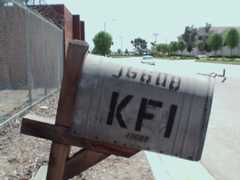
The rural mailbox looks out of place and forgotten. The circular stairway to the second floor, front door, is rust stained and condemned, barred against use. The Nation’s flag is no longer raised at dawn and lowered at sunset. No searchlights, guns or guard–dogs patrol the property. Nor could they have secured this tall, Landmark Tower from the dangers overhead!
After the Battle of the Bulge was won, the Armed Services found themselves with too many men and too much material. - A carpet of new B24’s covered Reading’s Army Air Field. New ones were still arriving daily.- We older men were given Honorable Discharges “At the convenience of the Government.” And convenient for me, KFI found my old application and hired me as a vacation relief man.**(I retired 33 years later!)
Some of the marks of the War still show at the 50,000- watt transmitter. The masonry wall enclosing the double, Edison power feed, was to stop small arms fire, (at insulators and transformers.)
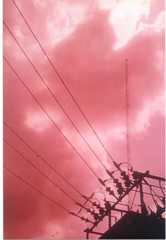
The ‘storeroom’ half of the four car garage was enclosed and given windows and a wooden floor. This was KFI’s accommodation as a small barracks for the detail of riflemen that the Govt. assigned to stand watch over the station and its equipment. The men were gone then, but the built-in rifle racks are still there! At least one or two 30-06 rifles were still kept in the tube locker upstairs. (I never fired one while working at KFI.)
After Dec 7,1941
Airport-type searchlights were mounted on the roof. These illuminated theantenna bases and guy wire anchors. (One L.A. station had its tower felled by saboteurs.) Civilian guards replaced the soldiers, and in turn, guard dogs replaced them.
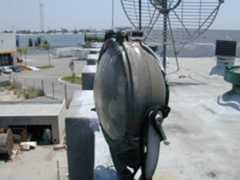
Engineer Bill Pardee made friends with one of the dogs. He would take him upstairs to the transmitter room while on shift. But when Bill climbed on top of the operating desk, to change a light bulb, the dog would not let him get down again! When the shift changed they found Bill still there, guarded by his faithful friend!
I was sorry for both, the dogs and myself. They had to accept food from a stranger they were trained to eliminate. I had to feed these killers behind a chain linkfence.* They repeatedly charged the fabric, hitting the fence as high as my head. Their loud barking forced their hot breath into my face.
I had to retrieve the dog dish. Fishing it out with a long stick pushed under the gate. They bit at the stick, because I held it. My ears rang while I pushed the filled dish back under the fence. They bit at the dish instead of the food They would watch me while they gulped down food and turn to attack me again. They really wouldbite the hand that fed them! I still can see the long, gleaming teeth only inches away from my eyes. They were the dogs of war, but their war wasn’t over.
After about five years with KFI, at my request, I was again vacation relief for the transmitter engineers.
The Country was settling down to normal. There was a diminished threat to the station. The attack dogs were gone. There continued to be a level of surveillance then and now. Visitors are screened and things are locked down at night.
It was then, at night that a person or persons scaled the security fence, crossed the darkened field to the base of our tower. With hazard to themselves, they or he jumped up over the base insulator and grabbed on to the hot tower. Carrying tools and an airport-sized wind-sock and mounting clamps, they climbed up the 750 feet to the top. There they secured the wind-sock to the mast. (For a day or two, our tower was 755+ feet high!)
Just as carefully, they climbed down and re-traced their steps and disappeared before sun up!
KFI. had the sock removed promptly. We kept it for a while in the men’s room. It was well made, with ball bearing pivots. It was dirty from use. Perhaps it had been stolen in the same manner that it was installed here.
Some considered it a prank. However it was trespass and interference as well as a hazard. This activity could have included sabotage! Perhaps the attack dogs earned their keep during a troubled time. Nothing like this happened while they ranged unleashed during the night!
*This fence enclosed several acres around the antenna.
** As a temporary vacation engineer, I was never accepted by the KFI guard dogs.
| We wish to express our thanks to Newcomb Weisenberger for sharing his memories and pictures with us. Long retired from KFI, | 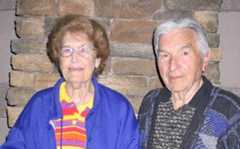 |