Movatterモバイル変換


[0]ホーム

URL:


Skip to main content
A man wearing a police vest looms over another man.
A federal agent takes a man into custody at 26 Federal Plaza. Dozens of people have hearings in New York’s immigration courts each day, and now face the possibility of being arrested just by showing up, regardless of the status of their cases.Redux

Since the spring, at the federal courthouses in downtown Manhattan, hundreds of officers fromICE and other government agencies have lined the hallways and lobbies, waiting to detain some migrants as they leave their immigration hearings. Many of the agents are masked and armed, and they are dressed in tactical gear, even though all visitors to the buildings must pass through airport-­level security.

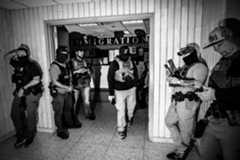
A group of people in a hallway. Some of them are masked and armed.
Groups of agents, mostly masked men, wait for hearings to let out on the fourteenth floor of 26 Federal Plaza.

Dozens of observers, migrant advocates, and members of the press show up each day to witness the arrests, which often take place with little regard for due process. It might not even matter how a judge rules in someone’s case. Migrants seem to be in shock as agents approach; family members might scream or sob as their loved one is taken away.
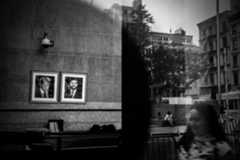
Portraits of President Donald Trump and VicePresident J. D. Vance hang on a wall.
Portraits of President Donald Trump and Vice-President J. D. Vance hang in the lobby of 290 Broadway.
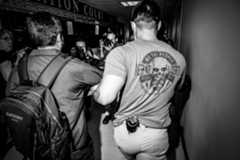
People take photos of a federal agent leading a man down a hallway.
AnICE agent wearing a “Defend Liberty” T-shirt takes into custody a man who has just walked out of his court hearing at 26 Federal Plaza. Photo and video journalists can work only in the hallways outside the courtrooms.

The photographer Mark Peterson spent several weeks this summer documenting such scenes at Federal Plaza. “It’s an image that I imagine the Administration wants out there—these guys, fully armed and masked and with body armor, arresting people,” he said. “The government is obviously looking at what pictures people are making.” Peterson has come to understand the rhythms of the place. Sometimes the agents make small talk while waiting for hearings to let out. One asked Peterson about the type of camera he uses. Others nicknamed one of his colleagues thegoat after they learned that she had won a prestigious photography award.
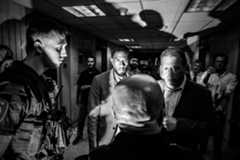
Two men speak to federal agents while spectators watch.
Jumaane Williams, the city’s public advocate, and Brad Lander, the city’s comptroller, talk to a D.H.S. agent at 26 Federal Plaza. Lander, an unsuccessful candidate for mayor in this year’s Democratic primary, was detained in June after escorting a migrant out of his hearing and refusing to let go of the man’s arm when agents tried to take him away.
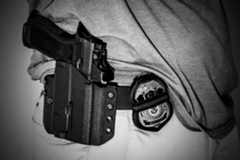
A person wears a holster belt with a gun.
ICE agents at the courthouses tend to be armed. The halls and waiting rooms are eerily quiet as the agents survey the migrants in attendance.
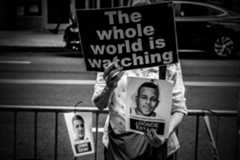
A protester holding a sign.
A protester outside holds posters of detainees bearing the question, in Spanish, “WHERE ARE THEY?

Caught in the middle are the ordinary people—the single men, the young couples, the little children made to walk through this state-sponsored spectacle of intimidation. Peterson’s black-and-white images, heavy with flash and shadows, evoke film noir and the urban-crime photography of the nineteen-thirties and forties. “If someone is doing everything right, and then they still get detained, it’s a crime scene,” Peterson said. A growing number of migrants are now skipping their court dates altogether—and setting themselves up for deportation—because they would rather go into hiding than face the danger and humiliation that Federal Plaza may bring. One can only imagine that this, too, is part of the point.

Jordan Salama

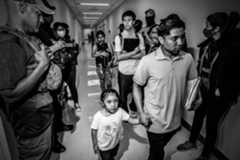
People walk down a hallway. They are surrounded by federal agents.
Immigration advocates and lawyers are increasingly advising migrants with young children to bring them to the courthouse, knowing that the majority of people arrested are single adults, mostly men.

New Yorker Favorites

Sign up for our daily newsletter to receive the best stories fromThe New Yorker.

Read More
Inverted
A Minneapolis Winter Like No Other
A new series of photographs documents residents’ evolving resistance to the surge ofICE agents in their city.
Photo Booth
Seydou Keïta Captured a Nation on the Cusp of Independence
At the Brooklyn Museum, the Malian photographer’s elaborately patterned studio portraits picture a society in flux.
The Lede
Miami’s Haitian Community Braces for Deportations
The Trump Administration’s plan to end Temporary Protected Status for immigrants from Haiti puts hundreds of thousands at risk of returning to a country in crisis.
New York Journal
The People Who Will Actually Make Universal Child Care Happen
Zohran Mamdani delivered a political victory—but making his plans a reality will require the help of a workforce that’s already struggling.
Letter from Trump’s Washington
Donald Trump Already Knows the 2026 Election Is “Rigged”
The question is not if he will undermine confidence in the midterms but how.
The Lede
Why the D.H.S. Disaster in Minneapolis Was Predictable
For decades, ICE and Border Patrol have operated with fewer constraints than typical law-enforcement agencies.
Letter from Trump’s Washington
Operation Trump Rehab
After a wave of public revulsion over the President’s immigration crackdown in Minnesota, he offers a familiar playbook: distraction, disinformation, denial, delay.
Minneapolis Postcard
The Schoolchildren of Minneapolis
As thousands ofICE agents arrived, kids started staying home from school. A local principal, teachers, and parent volunteers have banded together to keep the families safe.
The Lede
ICE’s Assault on a Minnesota School District
Liam Ramos, whose photo became a symbol of Operation Metro Surge, is one of several students in Columbia Heights who are now in federal custody.
The Weekend Essay
A Bridge to Venezuela
The Colombian border city of Cúcuta braces for more turmoil.
The Lede
From Selma to Minneapolis
On M.L.K. Day, the death of Renee Good calls to mind another woman who died protesting for the rights of others.
The Lede
The Movie That Inspired Gregory Bovino to Join Border Patrol
Years before he led the Trump Administration’s immigration-enforcement effort in Minneapolis, Bovino saw the 1982 Jack Nicholson film “The Border.”

[8]ページ先頭

©2009-2026 Movatter.jp