Louisiana Purchase
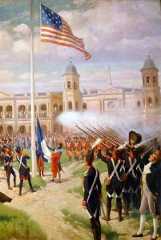
Hoisting of American Colors over Louisiana, by Thure de Thulstrup
In1803, theUnited States purchased around 828,000 square miles of land fromFrance for less than three cents peracre. Called theLouisiana Purchase, this sale doubled the size of theUnited States and paved the way forwestward expansion.
Background
In the early 1700s,Francecontrolled the majority of what would become theUnited States. During the Seven Years’ War,Francegave theLouisiana Territory west of the Mississippi River to Spain, and most remaining French holdings in North America went to Great Britain in 1763.
In 1800,Napoleon Bonaparteconvinced Spain to retrocede theLouisiana Territory back toFrance. Wary thatFrancewould restrict access to the Mississippi River and the strategically vital port ofNew Orleans,President Thomas Jefferson asked U.S. minister Robert R. Livingston to negotiate for the purchase of New Orleans with French minister Charles-Maurice de Talleyrand.
Purchase
Revolution in the French colony of Saint-Domingue and impending war with Great Britainlikely contributed toNapoleon’s decision to sell not only New Orleans, but the entireLouisiana Territory. James Monroe joined Livingston inFrance, and thetwo U.S. ministers closed quickly on the deal. TheUnited States would pay$11,250,000 outright andassume the claims of its citizens against France in theamountof $3,750,000. Authority of the territory was officially transferred to the United States in 1803.
Thepurchasedterritory stretched south to the Gulf of Mexico and northward to Canada, with the Mississippi River and the Rocky Mountains as naturalboundarieson the east and west, respectively. Exactboundariesof thepurchase werenot decided until the later half of the 1810s, following years of negotiation with Spain and Great Britain.
Legacy
The bargainprice purchaseis considered to be one ofJefferson’s most notable presidential achievements. TheLewis and Clark Expedition wascommissioned to explore the new land beginning in 1804, and eventually fifteen states would be all or partly formed from theterritorygained in thepurchase.
Learn more about the Louisiana Purchase through historical newspapers from our archives. Explore newspaper articles, headlines, images, and other primary sources below.
Articles and Clippings about the Louisiana Purchase
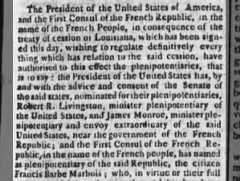 Robert R. Livingston, James Monroe, Francis Barbe Marbois elected to negotiate Louisiana Treaty Mon, Oct 24, 1803 – Page 3 ·The Evening Post (New York, New York) · Newspapers.com
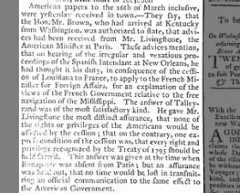 Talks between Livingstone and Talleyrand indicate Mississippi rights to be kept open Mon, May 2, 1803 – 2 ·The Leeds Intelligencer and Yorkshire General Advertiser (Leeds, West Yorkshire, England) · Newspapers.com
 Editorial article on France's troubles with St. Domingo and Great Britain aiding Louisiana Purchase Tue, Jul 5, 1803 – Page 2 ·The Evening Post (New York, New York) · Newspapers.com
 Details of the Louisiana Treaty, signed by Robert Livingston, James Monroe, Barbe Marbois Tue, Nov 1, 1803 – 2 ·Lancaster Intelligencer and Journal (Lancaster, Pennsylvania) · Newspapers.com
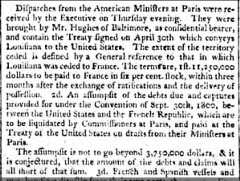 News reprinted in Ireland papers details cost of Louisiana Purchase as 11,250,000 plus French debts Mon, Aug 29, 1803 – Page 2 ·Cork Mercantile Chronicle (Cork, Cork, Ireland) · Newspapers.com
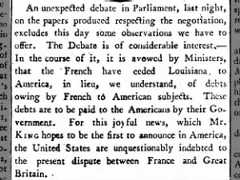 Price of Louisiana Purchase to cover debts owed by French to American subjects, May 20 1803 Fri, May 20, 1803 – 3 ·The Morning Post (London, Greater London, England) · Newspapers.com
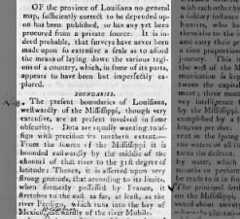 Boundaries of Louisiana Purchase uncertain according to tract communicated to Congress by Jefferson Wed, Dec 7, 1803 – 1 ·Carlisle Weekly Herald (Carlisle, Pennsylvania) · Newspapers.com
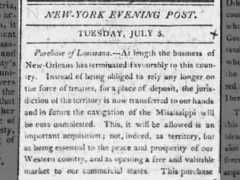 Excerpt from editorial article detailing the success of the Louisiana Purchase, July 5, 1803 Tue, Jul 5, 1803 – Page 2 ·The Evening Post (New York, New York) · Newspapers.com
![Federalist opinion piece in favor of the Louisiana Treaty arranged by Munroe [sic] and Livingston](/image.pl?url=https%3a%2f%2fimg.newspapers.com%2fimg%2fthumbnail%2f41055570%2f300%2f225%2f2057_3422_829_1824.jpg&f=jpg&w=240) Federalist opinion piece in favor of the Louisiana Treaty arranged by Munroe [sic] and Livingston Sat, Dec 24, 1803 – Page 2 ·The Evening Post (New York, New York) · Newspapers.com
Federalist opinion piece in favor of the Louisiana Treaty arranged by Munroe [sic] and Livingston Sat, Dec 24, 1803 – Page 2 ·The Evening Post (New York, New York) · Newspapers.com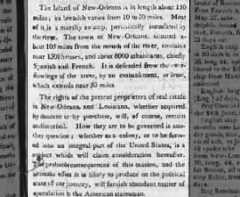 An editorial description of New Orleans and questions as to its future governance after purchase Tue, Jul 5, 1803 – Page 3 ·The Evening Post (New York, New York) · Newspapers.com
 Description of the province of Louisiana, including boundaries, cities, and settlements, Dec 1803 Wed, Dec 7, 1803 – 1 ·Carlisle Weekly Herald (Carlisle, Pennsylvania) · Newspapers.com
 Letter on behalf of King George III in regards to Louisiana Purchase and Great Britain, 1803 Sat, Sep 3, 1803 – 3 ·Weekly Wanderer (Randolph, Vermont) · Newspapers.com
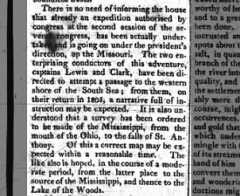 Lewis and Clark expedition through Louisiana authorized on President Jefferson's direction, 1804 Mon, May 21, 1804 – Page 1 ·The Raleigh Minerva (Raleigh, North Carolina) · Newspapers.com
"Louisiana Purchase,"Newspapers.com Topics (https://www.newspapers.com/topics/westward-expansion/louisiana-purchase/ : accessed February 15, 2026)