Great Depression
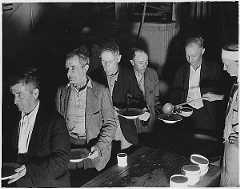
Unemployed men at a soup kitchen during the Great Depression, 1936
TheGreat Depressionwas aglobal economic depressionthat in the United Stateslasted from1929 to roughly 1939. Itstarted in the United States and spread to other countries around the world, particularly inEurope.
The “Black Tuesday”stock market crash of October 29,1929, marked the beginning of theGreat Depression. But there were other contributingcauses as well, such as a decline in consumer spending,bank failuresand panics, Federal Reserve policies, maintenance of thegold standard, and protectionist trade policies.
During theGreat Depression,unemployment in the United States reached roughly 25 percent, and those who kept theirjobs saw incomes decrease by about a third. On the Great Plains, the depression was compounded by theDust Bowl, adrought that forced thousands of families off their farms.
Despite measures taken byPresidentHerbert Hoover, the depression worsened over the course of his term, leading to thelandslide election ofFranklin D. Rooseveltin1932.PresidentRoosevelt introduced a variety ofprograms, regulations, reforms, and agencies collectively known as theNew Deal. Some of the best known of these include theWorks Progress Administration (WPA), the Civilian Conservation Corps (CCC), the Tennessee Valley Authority (TVA), the National Recovery Administration (NRA), the Federal Deposit Insurance Corporation (FDIC), the Securities and Exchange Commission (SEC), and the Social Security Administration (SSA).
The Americaneconomy began recovering in 1933, but a second downturn in1937 negated some of the gains. However, byWorld War II, when America began ramping up industrial production, theGreat Depression hadended.
Learn more about the Great Depression through historical newspapers from our archives. Explore newspaper articles, headlines, images, and other primary sources below.
Articles and Clippings about the Great Depression
 Newspaper headlines about the "Black Tuesday" stock market crash of 1929 Wed, Oct 30, 1929 – 1 ·The Los Angeles Times (Los Angeles, California) · Newspapers.com
 Bank closes following bank run, 1930 Thu, Nov 6, 1930 – Page 1 ·Lenox Time Table (Lenox, Iowa) · Newspapers.com
 Photo of local merchants making deposits at bank to try to stem bank run, 1930 Wed, Dec 24, 1930 – 1 ·Daily News (New York, New York) · Newspapers.com
 Unemployment rate statistics for November 1931 Fri, Nov 27, 1931 – 33 ·The Dayton Herald (Dayton, Ohio) · Newspapers.com
 Newspaper coverage of Franklin D. Roosevelt's 1932 landslide presidential election victory Wed, Nov 9, 1932 – Page 1 ·The Indianapolis Star (Indianapolis, Indiana) · Newspapers.com
 1933 newspaper article about what the gold standard is and how it operates Fri, Apr 21, 1933 – 3 ·Chicago Tribune (Chicago, Illinois) · Newspapers.com
 1934 editorial about Great Depression-era bread lines Fri, Jul 20, 1934 – 6 ·The Tampa Tribune (Tampa, Florida) · Newspapers.com
 Newspaper article about a St. Louis "Hooverville" in 1935 Sun, Dec 22, 1935 – Page 56 ·The Cincinnati Enquirer (Cincinnati, Ohio) · Newspapers.com
 Works Progress Administration (WPA) project to provide jobs in Pennsylvania, 1935 Sun, Aug 11, 1935 – Page 1 ·The Pittsburgh Press (Pittsburgh, Pennsylvania) · Newspapers.com
 1935 editorial arguing that all of President Roosevelt's "3 R's" should be given equal importance Mon, Feb 25, 1935 – Page 6 ·The Burlington Free Press (Burlington, Vermont) · Newspapers.com
 Firsthand accounts of farmers living through the Dust Bowl in 1937 Tue, May 4, 1937 – Page 4 ·The Des Moines Register (Des Moines, Iowa) · Newspapers.com
 Text of President Roosevelt's Fireside Chat in April 1938 explaining new recovery program Fri, Apr 15, 1938 – Page 12 ·The St. Louis Star and Times (St. Louis, Missouri) · Newspapers.com
 Former farmers now migrants in California need aid in 1938 Fri, Apr 8, 1938 – Page 21 ·Oakland Tribune (Oakland, California) · Newspapers.com
 1939 editorial: "War Not Solution for Unemployment" Thu, Nov 30, 1939 – 10 ·The Morning Call (Allentown, Pennsylvania) · Newspapers.com
"Great Depression,"Newspapers.com Topics (https://www.newspapers.com/topics/great-depression/great-depression/ : accessed February 17, 2026)