



Three-dimensional modelling, disparity and ecology of the first Cambrian apex predators
Giacinto De Vivo
Stephan Lautenschlager
Jakob Vinther
Electronic supplementary material is available online athttps://doi.org/10.6084/m9.figshare.c.5508016.
Corresponding author.
Roles
Received 2021 May 24; Accepted 2021 Jul 1; Issue date 2021 Jul 28.
Abstract
Radiodonts evolved to become the largest nektonic predators in the Cambrian period, persisting into the Ordovician and perhaps up until the Devonian period. They used a pair of large frontal appendages together with a radial mouth apparatus to capture and manipulate their prey, and had evolved a range of species with distinct appendage morphologies by the Early Cambrian (approx. 521 Ma). However, since their discovery, there has been a lack of understanding about their basic functional anatomy, and thus their ecology. To explore radiodont modes of feeding, we have digitally modelled different appendage morphologies represented byAnomalocaris canadensis,Hurdia victoria,Peytoia nathorsti, Amplectobelua stephenensis andCambroraster falcatus from the Burgess Shale. Our results corroborate ideas that there was probably a significant (functional and hence behavioural) diversity among different radiodont species with adaptations for feeding on differently sized prey (0.07 cm up to 10 cm). We argue here thatCambroraster falcatus appendages were suited for feeding on suspended particles rather than filtering sediment. Given the limited dexterity and lack of accessory feeding appendages as seen in modern arthropods, feeding must have been inefficient and ‘messy’, which may explain their subsequent replacement by crown-group arthropods, cephalopods and jawed vertebrates.
Keywords: disparity, ecology, Cambrian, apex, predator
1. Introduction
Radiodonts were among the first large predators in metazoan-dominated ecosystems that suddenly flourished near the onset of the Cambrian Series 2 (approx. 521 Ma). Their fossil record extends to the Ordovician and potentially to the Lower Devonian (from approx. 419 Ma to approx. 393 Ma) [1–11]. Members of this group exhibit a relatively large size, hydrodynamic body outline with elaborated natatory flaps, well-developed stalked compound eyes and massive frontal raptorial appendages, which is evidence for them having been nektonic apex predators [2,12–14].
Radiodonts are a clade of stem-euarthropods (Radiodonta) and comprise four main families (Amplectobeluidae, Anomalocaridae, Tamisiocaridae and Hurdiidae) [11,15–20]. Their frontal appendages comprise a series of hard elements (podomeres) intercalated by a soft and flexible region (arthrodial membrane). Two lateral articulating joints are placed between each podomere, dividing the arthrodial membrane into two parts, a ventral and dorsal [1,2]. Each podomere may bear spines. In the past, researchers recognized two principal types of appendages among radiodonts: the Anomalocaridae-like appendages, showing a pair of endites or ventral spines, projecting to form an inverted V-shape, and the Hurdiidae-like type (or F-type) appendages, bearing one single long endite [1]. Recent discoveries have revealed intermediate morphologies and other morphotypes of which the pincer-like frontal appendage of Amplectobeluidae is the most distinct [16,20–22].
The diverse appendage morphologies among different radiodont species already established by the early stages of the Cambrian period is indicative of an adaptive radiation [16], reflecting diversification and partitioning into different feeding strategies, including filter-feeding. Filter-feeding has evolved many times throughout history among nektonic top predators (tertiary/quaternary consumers) [11,16,23–26].
Adaptive radiations occur in the presence of new ecological opportunities [27]. Those may be offered by morphological innovation, colonizing new ecospace or the ecosystem vacuum post-dating a major extinction event [27]. The Cambrian was both a time of innovation and ecological vacuums as a result of the emerging body plans. Different animal phyla colonized the water column as predators to create the first complexly tiered metazoan food web [28,29]. Arthropods were dominant throughout most of the Palaeozoic and occupied several tiers in the food chain up until jawed vertebrates displaced the higher tiers in marine ecosystems [30]. Radiodonts pioneered this trend as one of the first groups of nektonic predators with large body size and diverse feeding structures.
Various hypotheses have been proposed to explain the functional roles radiodont feeding structures may have served (frontal appendages and mouth apparatus), but none have been tested.Anomalocaris canadensis is generally thought to have been a stealthy macro predator [2,13,20,21,31] that grasped large prey, while the appendages ofHurdia victoria andPeytoia nathorsti have been proposed to have worked as a jaw or sieve to prior shift sediment [21,32,33]. The amplectobeluid appendage is posed to have functioned as grasping/cutting pincers andCambroraster falcatus has been interpreted as sediment sifter as well [20,21,31–36], while the delicate accessory spines/bristles in members of the tamisiocaridae andAegirocassis andPahvantia served in filter-feeding. Radiodonts lack compelling modern analogues as they possess only a single pair of feeding appendages. By contrast, extant arthropods typically possess a series of appendages with specialized and differentiated elements for food manipulation. Furthermore, the radiodont mouth apparatus otherwise found in other ecdysozoan phyla and the panarthropod total group was lost.
Therefore, a new method is proposed, comprising the reconstruction of three-dimensional models of radiodont appendages to explore their range of movement. We use this method to test and reconstruct differences in feeding and prey partitioning among the Burgess Shale radiodontsAnomalocaris canadensis,Hurdia victoria,Peytoia nathorsti, Amplectobelua stephenensis andCambroraster falcatus. We have chosen the Burgess Shale as a case study due to the diverse number of well-studied and illustrated taxa of which many likely coexisted. Understanding how radiodonts evolved to occupy a set of distinct trophic niches will improve our understanding of the complexity of Cambrian ecosystems and their role in shaping them [37–40].
2. Material and methods
(a) . Museum abbreviations
The following prefixes are used: Royal Ontario Museum, Toronto (ROMIP); National Museum of Natural History, Washington (USNM); Mineralogisk Museum, Copenhagen (MMK); Geological Survey of Canada (GSC).
(b) . Species analysed
Three-dimensional models of the frontal appendage ofAnomalocaris canadensis,Amplectobelua stephenensis,Cambroraster falcatus, Hurdia victoria andPeytoia nathorsti (five spine morphology) were constructed from measurements taken from the following specimens.Anomalocaris canadensis: ROMIP 51211, ROMIP 51212, ROMIP 51215, ROMIP 5124, ROMIP 62542, ROMIP 61040, ROMIP 61655, ROMIP 62543, USNM 57555, USNM 57490, USNM80487, GSC 45308, MMK 1925.87, USNM 213687;Amplectobelua stephenensis: ROMIP 59492, ROMIP 5493, ROMIP 59495;Hurdia victoria: ROMIP 60026, ROMIP 60048, ROMIP 60020, ROMIP 59259;Cambroraster falcatus: ROMIP 65084, ROMIP 65080, ROMIP 65085, ROMIP 65087;Peytoia nathorsti: USNM 240989. USNM 139709, USNM 57490, ROMIP 60052, ROMIP 60036, ROMIP 60044.
(c) . Measurements
The following measurements were taken of the appendage for each species using ImageJ 1.38e [41]: the dorsal and the ventral length, the proximal height, the length of the proximal margin of the endite, the height of the articulating joint, the minimal and maximal length of auxiliary spines, the maximal space between spines and the diameter of the mouth (see electronic supplementary material, figure S1). The ratios between the ventral and dorsal length, the dorsal length and proximal height, and the proximal height and the proximal margin of the endite length were also calculated for each podomere. Average values for each measurement/ratio were also calculated to aid in the construction of models.
(d) . Model creation and range-of-motion reconstruction
A representative fossil specimen of a frontal appendage with proportions closest to average values were selected and used to produce an interpretative drawing.
The interpretative drawing was then imported as a background image in Blender 2.81 (a professional open-source three-dimensional computer graphics software programme) and used as a template to build the three-dimensional model through ‘box modelling’ [42–44]. Podomeres and endites were shaped by modifying (scaling, rotating, translating) in-built meshes (cube, cones). Where necessary, the dimensions of the podomere elements were adjusted to the average values taken in the previous step and other anatomical details, such as auxiliary spines, were added.
Once completed, the model was articulated by a Blender armature using interconnected elements (referred to as ‘bones’) to control the movement of the model. Each bone of the armature was set as parent to the respective podomere and manually moved into different configurations (e.g. fully extended, fully contracted) using forward kinematics. The model was then compared to the positions shown in different fossils preserved at an angle to estimate the lateral depth of the appendages following Briggs & Williams's observations for the reconstruction of flattened fossils [45], showing that a compression fossil is a two-dimensional representation of the specimen in three dimensions. In other words, the lack of lateral distortion during compaction means that differently angled views allow for inferring the thickness of the fossil (see electronic supplementary material, §S1 a,b). Some species are not collected with sufficient variation in burial mode to expose different viewing angles other than lateral (as inAmplectobelua stephenensis), meaning that the appendage depth is poorly understood, including potential lateral curvature of spines.
The lateral articulation points between the appendage podomeres result in dorsoventral flexibility in a two-dimensional plane. The reconstructed range of movement was achieved by rotating the podomeres around the axis connecting the two articulating joints between adjacent podomeres, hence reducing the arthrodial membrane area until podomeres abut. By comparing fossils showing different grades of contraction and, in some cases, podomere overlap, we have also allowed some models to hyperextend/flex if deemed likely that the podomeres could allow for some degree of telescoping inferred when modelling the range of movement. The range of movement reported here should therefore be considered a minimum estimate of maximum extension/flection. It was not possible to infer a range of movement confidently in the most distal podomeres.
Once the model was articulated, an animated video and pictures of the model in different poses were rendered (see electronic supplementary material, videoes S1–S5). From these, measurements of the contraction and extension angles were obtained between podomeres.
The position of the appendages relative to the body in articulated specimens suggests a degree of movement beyond a two-dimensional plane in the junction between the limb and body. The membrane connecting the limb to the body is often termed the ‘cormus’. A similar degree of dexterity is common among modern arthropods, where the cormus typically allows for the appendage to perform both dorsoventral and lateral movements to different degrees [27,46]. We therefore assume that radiodont appendages had a higher degree of freedom of movement in the connection to the body. This degree of freedom, however, remains to be fully assessed (see electronic supplementary material, §S1c).
3. Results
Our findings indicate significant variation in the range of movements between the species analysed (see electronic supplementary material, §S2 and table S1 for more details).
Anomalocaris canadensis (figure 1) possessed very dextrous appendages with a high degree of flexibility (213° ± 6° total and on average approx. 18° flection between podomeres). The articulating joints are placed at approximately 80% of the proximal height of the podomere. In articulated specimens, appendages are occasionally found with the ventral surface facing the other appendage. This might indicate synchronized movements, although a single appendage might have been sufficient to firmly grab prey (see electronic supplementary material, video S1) [31]. The internal diameter of the space created by a minimally flexed appendage able to grab an object is 20–28% of the total appendage dorsal length.
Figure 1.
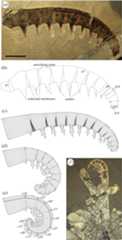
Frontal appendage ofAnomalocaris canadensis (a) specimen ROMIP 61040, with (b) interpretative drawing and the (c) reconstructed appendage model. (d,e) Comparison between the model showing the degree of flection based on (d) the sole arthrodial membrane and (e) the contact between the ventral spines, as shown in (f) the specimen ROMIP 51212. The bars in (e) indicate the bones of the Blender armature with their relative articulation joints and the computed angles of flection between each podomere. p, podomere. Scale bar, 20 mm. (Online version in colour.)
The appendages ofPeytoia nathorsti (figure 2a–d) are here inferred to have exhibited less dexterity thanA. canadensis, evidenced by the articulating joints placed more medially, at approximately 70% of the podomere proximal height, offering a lower contractibility. There is also a lower inferred extension angle (192°± 3° of total and on average approx. 22° extension between podomeres). The proximal five podomeres show higher extension angles (average approx. 27°) than the distal ones (average approx. 17°). Based on the range of movement between each podomere and the mesial orientation of the auxiliary spines, a single appendage might not have been sufficient to grab prey. The appendages might have been used in concert, surrounding the prey while extended and capturing it during contraction (see electronic supplementary material, video S2). These observations can also be extended to the seven-spined appendages of otherLaggania species [21] andHurdia victoria (see electronic supplementary material, video S3).
Figure 2.

Radiodont frontal appendage reconstructions. (a–d)Peytoia nathorsti (a) specimen USNM 240984, (b) interpretative drawing, and (c) the flexed and (d) extended model of the appendage; (e–h)Hurdia victoria, (e) specimen ROMIP 59259, (f) interpretative drawing, and (g) the flexed and (h) extended model of the appendage; (i–k)Amplectobelua stephenensis, (i) specimen ROMIP 59495, (j) interpretative drawing, and (k) the flexed and (l) extended model of the appendage. Scale bars in (a) 10 mm, in (e,i) 5 mm. The bars in (c,g,l) indicate the bones of the Blender armature with their relative articulation joints and the computed angles of extension (c,g) or flection (l) between each podomere. Am, arthrodial membrane; As, auxiliary spine; Ds, dorsal spine; e, endite; p, podomere; Vs, ventral spines. Picture in (a) from [22]. (Online version in colour.)
In comparison toP. nathorsti, the frontal appendages ofHurdia victoria (figure 2e–h) show a degree of extension that is considerably lower (106° ± 3° in total and on average approx. 10° extension between podomers) and possessed only one spine-free distal podomere. The articulation joints are at approximately 70% of the distal height. The higher extension angle occurs between podomeres six and seven (approx. 25°).
Amplectobelua stephenensis (figure 2i–l) exhibited articulating joints at approximately 80% of the proximal height and a low degree of flection (40° ± 4° in total and on average approximately 3° flection between podomers). This is compensated by their pincer-like shape, which makes these appendages suited for grasping prey of small size (see electronic supplementary material, video S4). Based on the distance between the elongated endites and the appendage body, the maximum prey diameter is estimated to be 30% of the total appendage length.
In macropredatory taxa, there is overall a strong correspondence between the estimated prey size and the oral cone diameter.
Cambroraster falcatus appendages show articulating joints placed at approximately 85% of the proximal height and a degree of extension of approximately 7° between podomere two to three and 10° between podomere three to five could be allowed (figure 3a–c). This degree of extension, together with the strong curvature of the endites, enabled the creation of a well-developed feeding basket surrounding the mouth (figure 3d–f; electronic supplementary material, video S5).
Figure 3.

Reconstruction ofCambroraster falcatus (a) specimen ROMIP 605084, with (b) interpretative drawing and (c) the reconstructed model of the appendage. (d–f) Extended model forming a feeding basket in (d) lateral, (e) ventral and (f) frontal view surrounding the mouth apparatus (represented by the toroid). (g,h) Comparison between the gill rakers of (g) the filter-feeder cichlidChaetobranchopsis australis and the (h) deposit feederSatanoperca pappaterra, with the first being more elongated and presenting interstitial space, similarly to the auxiliary spines ofCambroraster falcatus. Scale bar, 10 mm. The bars in (c) indicate the bones of the Blender armature with their relative articulation joints and the computed angles of extension (c) between each podomere. Am, arthrodial membrane; As, auxiliary spine; Ds, dorsal spine; p, podomere; Vs, ventral spine. Images in (g) and (h) modified from [47]. (Online version in colour.)
4. Discussion
(a) . Functional differences in radiodont appendages
(i) . Ecological niche partitioning in the burgess shale community
The Burgess Shale ecosystem included at least five roughly contemporaneous radiodonts [34].Anomalocaris,Peytoia andHurdia fossils are widely distributed in the Burgess Shale (e.g. the Mouth Stephen locality, Raymond Quarry and Tulip beds) [48],Amplectobelua was found at the Mount Stephen locality [21] andCambroraster comes from the Marble Canyon Site [34], which hosts a diverse assemblage of radiodonts comprising 11% of the fauna and are yet to be documented [21,34,48]. Daley & Budd [21] argued that the coexistence of such a variety of radiodonts in the Burges Shale biota required niche partitioning and that the evolution of different appendage morphologies reflects different feeding strategies. The analyses conducted in this study support this claim (figure 4).
Figure 4.

Reconstruction of radiodont feeding modes and inferred maximum prey size (represented by the violet sphere) compared to the mouth apparatus (represented by the dark grey toroid). (a–h)Anomalocaris canadensis andAmplectobelua stephenensis capturing its prey using a single appendage in (a,g) lateral and (b,h) dorsal view;Peythoia nathorsti andHurdia victoria capturing its prey using both appendages in conjunction, in (c,e) lateral and (d,f) dorsal view. (i) Niche partitioning among different Burgess Shale radiodont species, arrows indicate the energy flow through the food chain.Anomalocaris canadensis was able to catch medium-size, or maybe larger, agile pelagic prey, whereas hurdiids such asHurdia victoria andPeytoia nathorsti were more specialized to feed on benthic prey.Peytoia may have consumed pelagic prey also. Smaller benthic animals and the medium members of the nekton were captured byAmbectobelua stephenensis. Silhouettes from @Phylopic (Joanna Wolfe) and modified from illustrations made by Marianne Collins and Jun (https://twpf.jp/ni075). (Online version in colour.)
With the appendages of presumed adultAnomalocaris canadensis specimens ranging from 100 to 180 mm in length, our model infers average prey size to be 20–50 mm in diameter (figure 4a,b). Since the oral cone is inferred to have been unable to process hard food, prey could have been soft-bodied or lightly sclerotized [12]. Based on the position and dexterity of the appendages, a flexible and hydrodynamic body [13],A. canadensis's prey may have been predominantly nektonic (e.g. vetulicolians, nectocaridids or swimming arthropods) and occasionally benthic (such as benthic unmineralized arthropods;figure 4a,b). Coprolites have been described in China and Australia, mainly composed of the remains of non-mineralized organisms, such as waptiid arthropods orIsoxys, which exhibit dimensions compatible withAnomalocaris orAmplectobelua as the defecator [49,50]. Some of these coprolites also contain the cuticles of trilobites as a minor component, indicating occasional predation on hard-shelled organisms [49,50].
Several studies have hypothesized thatPeytoia nathorsti formed a net-like structure with its appendages to trap food and could be used together with either as sieves or as jaws to capture larger prey [1,2,21,32]. The first hypothesis is unlikely due to the shape and position of the auxiliary spines, which are present only on the distal side, facing those of the opposite appendage, and are too small, irregularly spaced and sized to form an effective food trap. The second hypothesis is supported by the fact that spines with an alternating length are usually observed in extant arthropod appendages specialized in capturing large prey, such as those found on mantids or giant isopods [47,51]. A similar pattern is present on the teeth and beaks of vertebrates [52,53]. By using both the appendages in concert the captured prey ofP. nathorsti the same length of the appendages (around 60–100 mm). The most distal, spine-free podomeres may have helped trap and manipulate prey. The feeding appendages were also closer to the body than inAnomalocaris [2]. Based on these observations along with the configuration of the appendages on the body, we inferP. nathorsti to have captured less agile and benthic prey, but probably of larger size thanA. canadensis (figure 4c,d). These interpretations are also consistent with the more rigid and presumably less hydrodynamic body compared toA. canadensis.
Similarly to those ofP. nathorsti,Hurdia victoria the frontal appendages might have worked in conjunction. They are comparatively smaller (around 20–40 mm) and less dextrous. These characteristics indicate that they were probably better suited to capture small epibenthic mobile and sessile organisms such as trilobites, lobopodians, and perhaps endobenthic priapulids (figure 4e,f). The frontal appendages ofH. victoria show a degree of extension that is considerably smaller than inP. nathorsti, thereby diminishing the length of the extension, making them less suitable for capturing agile prey [17,32]. This interpretation is consistent with the trunk anatomyof H. victoria, such as the presence of vertically displaced lateral flaps, which would probably prevent rapid swimming [17,32].
A singleAmplectobelua stephenensis appendage was able to grab prey with a diameter of around 20 mm [21]. The smaller ventral spines along every other podomere distally to the hypertrophied spine might have been used to hold and retain prey by adding more friction. The multi-segmented nature of the appendage might suggest they were mechanically less stable than appendages with fewer segments, such as the common arthropod cheliped and hence unlikely to be used for crushing, slicing or cutting larger prey. By contrast, these appendages could be well suited to performing precise and well-controlled movements to firmly grasp and manipulate prey to the mouth or tearing off pieces from larges carcasses (figure 4g,h).
(ii) .Cambroraster falcatus may have been a filter-feeder
Filter-feeding is a particular feeding mode in which food particles in suspension are collected from the water column by passing through a specialized filtering structure. Filter-feeding can be active or passive. Whale sharks and mysticete whales are examples of a particular active filter-feeding mode in which the water is engulfed and forced to pass through filtering structures (e.g. baleen in cetaceans) when expelled [54]. Several teleost fishes and chondrichthyans use gill rakers [23,55]. In arthropods, suspension-feeding involves specialized appendages with fine setae and spines. Among nektonic suspension-feeders, several strategies exist, such as lunge feeding (like in rorqual mysticetes), skimming/ram-feeding (e.g. balaenid whales, paddlefish or basking sharks) or through more active pumping of water through the filter apparatus by suction currents in fishes or mechanical pumping of water (e.g. krill and mysids) [56]. Passive suspension-feeding also exists among arthropods in which filter appendages form a fan-like net that is held up against the water current (porcelain crab, atyopsid shrimps and barnacles) [57,58]. Among radiodonts,Tamisiocaris borealis (Early Cambrian, Sirius Passet) was described as a sweep net filter-feeder [16], resembling mysids while the giantAegirocassis benmoulae (Early Ordovician, Fezouata) and smaller, but similarPahvantia hastata (Middle Cambrian, Utah) shows adaptations for skim/ram-feeding [11,26].
General observations, which serve to identify fossil and recent filter-feeders, show that the feeding structures consist of elongated and slender, equally spaced structures forming a net with a regular mesh size [11,16]. Furthermore, the filter-feeding apparatus needs to create a closed compartment, so that water is forced through the filter apparatus and not around it.
Despite being previously described as sediment sifter [33,34], our analysis suggests thatCambroraster were better suited for filter-feeding given their long auxiliary spines, which is not encountered among extant taxa processing sediment, which have shorter and more robust structures. Exemplified in feeding strategies among modern teleost fishes and their gill raker apparatus (figure 3g,h) [55], the suspension-feeding cichlidChaetobranchopsis australis exhibits elongated, regularly spaced gill rakers (figure 3g). By contrast, the cichlidSatanoperca pappaterra, which sifts sediment, possesses gill rakers that are shorter and wider (figure 3h) [55,59,60]. Long and slender filter elements do not appear suitable for sediment manipulation as sifting more dense and viscous sediment necessitates a more robust apparatus.
Based on extant comparisons,Cambroraster falcatus, with its long and delicate spine apparatus, does not appear suited for sediment processing. The spines are facing anteriorly, which would cause much strain if ploughed into a substrate. While it is possible that sediment was brought into suspension by other means, such as the head shield, we argue that feeding must have been in suspension and by filtering rather than direct manipulation of sediment by the frontal appendages.
Corroborating the filter-feeding ecology, we observe that with the configuration of the frontal appendages anterior to the mouth and pointing in a ventral direction, the long ventral spines with the inwards curvature could form a feeding basket by the juxtaposition of the two appendages while extended (figure 3d–f; electronic supplementary material, video S5). Using the observed relationship between filter mesh size and prey diameter [16,34], we estimate a minimum prey size of 0.7–2 mm. The head shield elements may have facilitated and enhanced the capability of filter-feeding by the off channelling water into and through the filter-feeding appendages. The horseshoe-shaped head shield, the reduced number of vertically displaced flaps and the dorsally positioned eyes indicate a nekto-benthic lifestyle [33,34].
(b) . Prey size, mouth apparatus and radiodont feeding efficacy
The oral cone of radiodonts is homologous to that of deeper stem-arthropods, such as the gilled lobopodians and the introvert apparatus seen in other ecdysozoans [38]. Yet, it shows higher structural integrity as revealed by the coherent assembly of its elements into a unit often found in isolation after moulting or decay [35]; it is composed of a series of plates arranged in a circle with each plate displaying a series of denticle-like structures facing orally with bigger plates overlapping smaller ones slightly. An elastic non-sclerotized region was present between each oral plate [12]. The total number of plates, their distribution and their proportions are variable depending on the species and the taxonomic group (e.g. inAnomalocaris it is triradial and in hurdiids tetraradial) [12,35]. Whether the mouth apparatus could exert any degree of biting force is unclear [2,12,49]. It has been proposed that the oral cone functioned as a suction apparatus, like how many fish consume and ingest prey [34,61]. By everting the external plates, a partial vacuum would have formed that would pull the captured prey into the mouth, which would mean that the maximal diameter of prey to be ingested should be less than the outer diameter of the oral cone. Pharyngeal teeth observed in some taxa [12] may have been used in mastication food upon ingestion.
Unlike euarthropods, radiodonts lack specialized head appendages that would enable them to process and transport prey. Gnathobase-like structures recently described fromAmplectobelua from Chengjiang may have been used in food intake, but their wider distribution in other taxa remains to be shown. While we surmise some processing could have been possible in radiodonts it may have been limited compared to most living arthropods [62].
As such the feeding mechanisms of radiodonts must have been relatively inefficient in comparison to living arthropods. In predatory taxa, feeding consisted of prey capture, transport to the mouth and then ingestion via suction and subsequent mastication performed by the pharyngeal teeth and perhaps the outer tooth plates as well [12,21,34,49]. The lack of specialized appendages to process the food prior to ingestion, a condition often found in modern arthropod, and the poor masticatory efficiency of the oral cone might have resulted in a lower energy intake. Therefore, the subsequent evolution of predators better able to effectively slice and cut prey, for improved digestive rate, such as jawed vertebrates, cephalopods and modern arthropod clades, might explain the turnover and ultimate demise of the once successful radiodonts.
5. Conclusion and further research
Our results confirm previous hypotheses that little trophic overlap between different radiodont species may have existed in the Burgess Shale biota. Anomalocaris canadensis may have been a fast and agile predator with highly dextrous feeding appendages, capable of catching pelagic prey. By contrast, the hurdiidsPeytoia nathorsti andHurdia victoria appear more suited to capturing proportionally larger, but less agile prey and with a near-benthic foraging strategy. The claw-like appendages ofAmbectobelua stephenensis, on the other hand, may have facilitated well-controlled grasping for catching smaller animals (figure 4i).Cambroraster is here interpreted as a suspension-feeder as the apparatus does not conform to sediment-ingesting anatomy.
The inferred prey size ofAnomalocaris canadensis,Hurdia victoria andPeytoia nathorsti is slightly inferior to the mouth diameters. This suggests prey was swallowed whole and corroborates that the mouth mainly served for ingestion through the creation of a suction current, as observed in spiders, and unlike most crown-euarthropods, which process their prey by extensive mastication prior to ingestion or pre-digestion.
Supplementary Material
Acknowledgements
We are thankful to Imran Rahman for his help and technical advice. Jean-Bernard Caron, Allison Daley and Stephen Pates generously shared high-resolution images. Our gratitude goes also to Russell Garwood and two anonymous referees for their comments and suggestions, which were crucial to improving the quality of the manuscript.
Data accessibility
The datasets supporting this article can be obtained from the University of Bristol Data repository:https://doi.org/10.5523/bris.1anaxh0xxbeg22o1gfsgl50ukh.
The data are provided in electronic supplementary material [63].
Authors' contributions
G.D.V.: conceptualization, data curation, formal analysis, investigation, methodology, visualization, writing-original draft; J.V.: conceptualization, data curation, methodology, project administration, supervision, writing-review and editing; S.L.: software, supervision, validation.
All authors gave final approval for publication and agreed to be held accountable for the work performed therein.
Competing interests
We declare we have no competing interests.
Funding
We received no funding for this study.
References
- 1.Briggs DEG. 1979.Anomalocaris, the largest known Cambrian arthropod. Paleontology22, 631-664. [Google Scholar]
- 2.Whittington HB, Briggs DEG. 1985. The largest Cambrian animal,Anomalocaris, Burgess Shale, British-Columbia. Phil. Trans. R. Soc. Lond. B309, 569-609. ( 10.1098/rstb.1985.0096) [DOI] [Google Scholar]
- 3.Chen J-Y, Ramsköld L, Zhou G-Q. 1994. Evidence for monophyly and arthropod affinity of Cambrian giant predators. Science264, 1304-1308. ( 10.1126/science.264.5163.1304) [DOI] [PubMed] [Google Scholar]
- 4.Montgomery DR, Panfil MS, Hayes SK. 1999. Channel-bed mobility response to extreme sediment loading at Mount Pinatubo. Geology27, 271-274. () [DOI] [Google Scholar]
- 5.Briggs DE, Lieberman BS, Hendricks JR, Halgedahl SL, Jarrard RD. 2008. Middle Cambrian arthropods from Utah. J. Paleontol.82, 238-254. ( 10.1666/06-086.1) [DOI] [Google Scholar]
- 6.Kühl G, Briggs DEG, Rust J. 2009. A great-appendage arthropod with a radial mouth from the Lower Devonian Hunsrück Slate, Germany. Science323, 771-773. ( 10.1126/science.1166586) [DOI] [PubMed] [Google Scholar]
- 7.Daley AC, Peel JS. 2010. A possible anomalocaridid from the Cambrian Sirius Passet lagersätte, North Greenland. J. Paleontol.84, 352-355. ( 10.1666/09-136r1.1) [DOI] [Google Scholar]
- 8.Ponomarenko AG. 2010. First record of dinocarida from Russia. Paleontol. J.44, 503-504. ( 10.1134/S0031030110050047) [DOI] [Google Scholar]
- 9.Van Roy P, Briggs DEG. 2011. A giant Ordovician anomalocaridid. Nature473, 510-513. ( 10.1038/nature09920) [DOI] [PubMed] [Google Scholar]
- 10.Daley AC, Legg DA. 2015. A morphological and taxonomic appraisal of the oldest anomalocaridid from the Lower Cambrian of Poland. Geol. Mag.152, 949-955. ( 10.1017/s0016756815000412) [DOI] [Google Scholar]
- 11.Van Roy P, Daley AC, Briggs DEG. 2015. Anomalocaridid trunk limb homology revealed by a giant filter-feeder with paired flaps. Nature522, 77-80. ( 10.1038/nature14256) [DOI] [PubMed] [Google Scholar]
- 12.Daley AC, Bergström J. 2012. The oral cone ofAnomalocaris is not a classic ‘peytoia’. Naturwissenschaften99, 501-504. ( 10.1007/s00114-012-0910-8) [DOI] [PubMed] [Google Scholar]
- 13.Usami Y. 2006. Theoretical study on the body form and swimming pattern ofAnomalocaris based on hydrodynamic simulation. J. Theor. Biol.238, 11-17. ( 10.1016/j.jtbi.2005.05.008) [DOI] [PubMed] [Google Scholar]
- 14.Paterson JR, Edgecombe GD, García-Bellido DC. 2020. Disparate compound eyes of Cambrian radiodonts reveal their developmental growth mode and diverse visual ecology. Sci. Adv.6, eabc6721. ( 10.1126/sciadv.abc6721) [DOI] [PMC free article] [PubMed] [Google Scholar]
- 15.Collins D. 1996. The ‘evolution’ ofAnomalocaris and its classification in the arthropod class Dinocarida (nov.) and order Radiodonta (nov.). J. Paleontol.70, 280-293. ( 10.1017/S0022336000023362) [DOI] [Google Scholar]
- 16.Vinther J, Stein M, Longrich NR, Harper DAT. 2014. A suspension-feeding anomalocarid from the Early Cambrian. Nature507, 496-499. ( 10.1038/nature13010) [DOI] [PubMed] [Google Scholar]
- 17.Daley AC, Budd GE, Caron J-B, Edgecombe GD, Collins D. 2009. The Burgess Shale AnomalocarididHurdia and its significance for early Euarthropod evolution. Science323, 1597-1600. ( 10.1126/science.1169514) [DOI] [PubMed] [Google Scholar]
- 18.Budd GE, Telford MJ. 2009. The origin and evolution of arthropods. Nature457, 812-817. ( 10.1038/nature07890) [DOI] [PubMed] [Google Scholar]
- 19.Cong P, Ma X, Hou X, Edgecombe GD, Strausfeld NJ. 2014. Brain structure resolves the segmental affinity of anomalocaridid appendages. Nature513, 538-542. ( 10.1038/nature13486) [DOI] [PubMed] [Google Scholar]
- 20.Pates S, Daley AC. 2019. The Kinzers Formation (Pennsylvania, USA): the most diverse assemblage of Cambrian Stage 4 radiodonts. Geol. Mag.156, 1233-1246. ( 10.1017/S0016756818000547) [DOI] [Google Scholar]
- 21.Daley AC, Budd GE. 2010. New anomalocaridid appendages from the Burgess Shale, Canada. Palaeontology53, 721-738. ( 10.1111/j.1475-4983.2010.00955.x) [DOI] [Google Scholar]
- 22.Pates S, Daley AC, Butterfield NJ. 2019. First report of paired ventral endites in a hurdiid radiodont. Zool. Lett.5, 18. ( 10.1186/s40851-019-0132-4) [DOI] [PMC free article] [PubMed] [Google Scholar]
- 23.Friedman M. 2012. Parallel evolutionary trajectories underlie the origin of giant suspension-feeding whales and bony fishes. Proc. R. Soc. B279, 944-951. ( 10.1098/rspb.2011.1381) [DOI] [PMC free article] [PubMed] [Google Scholar]
- 24.Sims DW, Southall EJ, Tarling GA, Metcalfe JD. 2005. Habitat-specific normal and reverse diel vertical migration in the plankton-feeding basking shark. J. Anim. Ecol.74, 755-761. ( 10.1111/j.1365-2656.2005.00971.x) [DOI] [Google Scholar]
- 25.Motani R, Chen X-H, Jiang D-Y, Cheng L, Tintori A, Rieppel O. 2015. Lunge feeding in early marine reptiles and fast evolution of marine tetrapod feeding guilds. Sci. Rep.5, 8900. ( 10.1038/srep08900) [DOI] [PMC free article] [PubMed] [Google Scholar]
- 26.Lerosey-Aubril R, Pates S. 2018. New suspension-feeding radiodont suggests evolution of microplanktivory in Cambrian macronekton. Nat. Commun.9, 3774. ( 10.1038/s41467-018-06229-7) [DOI] [PMC free article] [PubMed] [Google Scholar]
- 27.Garwood R, Dunlop J. 2014. The walking dead: Blender as a tool for paleontologists with a case study on extinct arachnids. J. Paleontol.88, 735-746. ( 10.1666/13-088) [DOI] [Google Scholar]
- 28.Erwin DH, Valentine JW. 2013.The Cambrian explosion. Greenwood Village, CO: Roberts and Company Publishers.
- 29.Losos JB. 2010. Adaptive radiation, ecological opportunity, and evolutionary determinism. Am. Nat.175, 623-639. ( 10.1086/652433) [DOI] [PubMed] [Google Scholar]
- 30.Klug C, Kröger B, Kiessling W, Mullins GL, Servais T, Frýda J, Korn D, Turner S. 2010. The Devonian nekton revolution. Lethaia43, 465-477. ( 10.1111/j.1502-3931.2009.00206.x) [DOI] [Google Scholar]
- 31.Daley AC, Edgecombe GD. 2014. Morphology ofAnomalocaris canadensis from the Burgess Shale. J. Paleontol.88, 68-91. ( 10.1666/13-067) [DOI] [Google Scholar]
- 32.Daley AC, Budd GE, Caron J-B. 2013. Morphology and systematics of the anomalocaridid arthropod Hurdia from the Middle Cambrian of British Columbia and Utah. J. Syst. Paleontol.11, 743-787. ( 10.1080/14772019.2012.732723) [DOI] [Google Scholar]
- 33.Liu Y, Lerosey-Aubril R, Audo D, Zhai D, Mai H, Ortega-Hernández J. 2020. Occurrence of the eudemersal radiodontCambroraster in the early Cambrian Chengjiang Lagerstätte and the diversity of hurdiid ecomorphotypes. Geol. Mag.157, 1200-1206. ( 10.1017/S0016756820000187) [DOI] [Google Scholar]
- 34.Moysiuk J, Caron J-B. 2019. A new hurdiid radiodont from the Burgess Shale evinces the exploitation of Cambrian infaunal food sources. Proc. R. Soc. B286, 20191079. ( 10.1098/rspb.2019.1079) [DOI] [PMC free article] [PubMed] [Google Scholar]
- 35.Liu J, Lerosey-Aubril R, Steiner M, Dunlop JA, Shu D, Paterson JR. 2018. Origin of raptorial feeding in juvenile euarthropods revealed by a Cambrian radiodontan. Natl Sci. Rev.5, 863-869. ( 10.1093/nsr/nwy057) [DOI] [Google Scholar]
- 36.Guo J, Pates S, Cong P, Daley AC, Edgecombe GD, Chen T, Hou X. 2019. A new radiodont (stem Euarthropoda) frontal appendage with a mosaic of characters from the Cambrian (Series 2 Stage 3) Chengjiang biota. Papers Palaeontol.5, 99-110. ( 10.1002/spp2.1231) [DOI] [Google Scholar]
- 37.Vannier J, Liu J, Lerosey-Aubril R, Vinther J, Daley AC. 2014. Sophisticated digestive systems in early arthropods. Nat. Commun.5, 3641. ( 10.1038/ncomms4641) [DOI] [PubMed] [Google Scholar]
- 38.Vinther J, Porras L, Young FJ, Budd GE, Edgecombe GD. 2016. The mouth apparatus of the Cambrian gilled lobopodianPambdelurion whittingtoni. Palaeontology59, 841-849. ( 10.1111/pala.12256) [DOI] [Google Scholar]
- 39.Whittington HB. 1975. The enigmatic animalOpabinia regalis, middle Cambrian, Burgess Shale, British Columbia. Phil. Trans. R. Soc. Lond. B271, 1-43. ( 10.1098/rstb.1975.0033) [DOI] [PMC free article] [PubMed] [Google Scholar]
- 40.Budd GE. 1998. The morphology and phylogenetic significance ofKerygmachela kierkegaardi Budd (Buen Formation, Lower Cambrian, N Greenland). Earth Environ. Sci. Trans. R. Soc. Edinb.89, 249-290. ( 10.1017/S0263593300002418) [DOI] [Google Scholar]
- 41.Sheffield JB. 2007. ImageJ, a useful tool for biological image processing and analysis. Microsc. Microanal.13, 200-201. ( 10.1017/S1431927607076611) [DOI] [Google Scholar]
- 42.Hess R. 2007. The essential blender: guide to 3D creation with the open source suite blender. San Francisco, CA: No Starch Press. [Google Scholar]
- 43.Rahman I, Lautenschlager S. 2017. Applications of three-dimensional box modeling to paleontological functional analysis. Paleontol. Soc. Pap.22, 119-132. ( 10.1017/scs.2017.11) [DOI] [Google Scholar]
- 44.Lautenschlager S. 2015. Estimating cranial musculoskeletal constraints in theropod dinosaurs. R. Soc. Open Sci.2, 150495. ( 10.1098/rsos.150495). [DOI] [PMC free article] [PubMed] [Google Scholar]
- 45.Briggs DEG, Williams SH. 1981. The restoration of flattened fossils. Lethaia14, 157-164. ( 10.1111/j.1502-3931.1981.tb01918.x) [DOI] [Google Scholar]
- 46.Hou XJ, Bergstrom. 1997. Arthropods of the lower Cambrian chengjiang fauna, southest China. Oslo, Norway: Scandinavian University Press. [Google Scholar]
- 47.Van Roy P, Tetlie OE. 2006. A spinose appendage fragment of a problematic arthropod from the Early Ordovician of Morocco. Acta Palaeontol. Pol.51, 239-246. [Google Scholar]
- 48.Nanglu K, Caron J-B, Gaines RR. 2020. The Burgess Shale paleocommunity with new insights from Marble Canyon, British Columbia. Paleobiology46, 58-81. ( 10.1017/pab.2019.42) [DOI] [Google Scholar]
- 49.Nedin C. 1999.Anomalocaris predation on nonmineralized and mineralized trilobites. Geology27, 987-990. () [DOI] [Google Scholar]
- 50.Vannier J, Chen J. 2005. Early cambrian food chain: new evidence from fossil aggregates in the Maotianshan Shale Biota, SW China. Palaios20, 3-26. ( 10.2110/palo.2003.p03-40) [DOI] [Google Scholar]
- 51.Brannoch SK, Wieland F, Rivera J, Klass K-D, Béthoux O, Svenson GJ. 2017. Manual of praying mantis morphology, nomenclature, and practices (Insecta, Mantodea). ZooKeys696, 100. ( 10.3897/zookeys.696.12542) [DOI] [PMC free article] [PubMed] [Google Scholar]
- 52.Wainwright PC, Bellwood DR, Westneat MW, Grubich JR, Hoey AS. 2004. A functional morphospace for the skull of labrid fishes: patterns of diversity in a complex biomechanical system. Biol. J. Linnean Soc.82, 1-25. ( 10.1111/j.1095-8312.2004.00313.x) [DOI] [Google Scholar]
- 53.Louchart A, Sire J-Y, Mourer-Chauviré C, Geraads D, Viriot L, de Buffrénil V. 2013. Structure and growth pattern of Pseudoteeth inPelagornis mauretanicus (Aves, Odontopterygiformes, Pelagornithidae). PLoS ONE8, e80372. ( 10.1371/journal.pone.0080372) [DOI] [PMC free article] [PubMed] [Google Scholar]
- 54.Croll DA, Tershy BR, Newton KM, de Vos A, Hazen E, Goldbogen JA. 2018. Filter feeding. In Encyclopedia of marine mammals (third edition) (eds Würsig B., Thewissen JGM, Kovacs KM), pp. 363-368. New York, NY: Academic Press. [Google Scholar]
- 55.Collard F, Gilbert B, Eppe G, Roos L, Compère P, Das K, Parmentier E. 2017. Morphology of the filtration apparatus of three planktivorous fishes and relation with ingested anthropogenic particles. Mar. Pollut. Bull.116, 182-191. ( 10.1016/j.marpolbul.2016.12.067) [DOI] [PubMed] [Google Scholar]
- 56.Anderson DT. 1981. Cirral activity and feeding in the barnacleBalanus perforatus Bruguiére (Balanidae), with comments on the evolution of feeding mechanisms in thoracican cirripedes. Phil. Trans. R. Soc. Lond. B291, 411-449. ( 10.1098/rstb.1981.0004) [DOI] [Google Scholar]
- 57.Gabaldon DJ. 1979. Observation of a possible alternate mode of feeding in a porcellanid crab (Petrolisthes Cabrilloi Glassell, 1945) (Decapoda, Anomura). Crustaceana36, 110-112. ( 10.1163/156854079X00285) [DOI] [Google Scholar]
- 58.Hamner WM. 1988. Biomechanics of filter feeding in the antarctic krillEuphausia Superba: review of past work and new observations. J. Crustacean Biol.8, 149-163. ( 10.2307/1548308) [DOI] [Google Scholar]
- 59.Khalaf-Allah H, Azab A, Mohamed A. 2016. Morphological differences of gill rakers in some sparid fish species (Family: Sparidae), Egypt. Int. J. Environ. Sci. Eng.7, 63-72. [Google Scholar]
- 60.Novakowski GC, Cassemiro FAS, Hahn NS. 2016. Diet and ecomorphological relationships of four cichlid species from the Cuiabá River basin. Neotropical Ichthyol.14, e150151. ( 10.1590/1982-0224-20150151) [DOI] [Google Scholar]
- 61.Gibb AC, Ferry-Graham L. 2005. Cranial movements during suction feeding in teleost fishes: are they modified to enhance suction production?Zoology108, 141-153. ( 10.1016/j.zool.2005.03.004) [DOI] [PubMed] [Google Scholar]
- 62.Cong P, Daley AC, Edgecombe GD, Hou X. 2017. The functional head of the Cambrian radiodontan (stem-group Euarthropoda)Amplectobelua symbrachiata. BMC Evol. Biol.17, 208. ( 10.1186/s12862-017-1049-1) [DOI] [PMC free article] [PubMed] [Google Scholar]
- 63.De Vivo G, Lautenschlager S, Vinther J. 2021. 3-D Modelling, disparity, and ecology of the first Cambrian apex predators.FigShare. [DOI] [PMC free article] [PubMed]
Associated Data
This section collects any data citations, data availability statements, or supplementary materials included in this article.
Data Citations
- De Vivo G, Lautenschlager S, Vinther J. 2021. 3-D Modelling, disparity, and ecology of the first Cambrian apex predators.FigShare. [DOI] [PMC free article] [PubMed]
Supplementary Materials
Data Availability Statement
The datasets supporting this article can be obtained from the University of Bristol Data repository:https://doi.org/10.5523/bris.1anaxh0xxbeg22o1gfsgl50ukh.
The data are provided in electronic supplementary material [63].