



Seeking (and Finding) Biased Ligands of the KappaOpioid Receptor
Laura M Bohn
Jeffrey Aubé
E-mail:lbohn@scripps.edu.
E-mail:jaube@unc.edu.
Received 2017 May 29; Accepted 2017 Jun 14; Collection date 2017 Jul 13.
Abstract
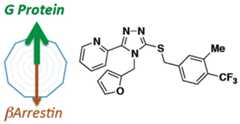
Thediscovery and characterization of two classes of kappa opioidreceptor agonists that are biased for G protein over βarrestinsignaling are described.
Keywords: βArrestin, biased ligands, functionalselectivity, G protein-coupled receptors, kappaopioid receptor agonists
G protein-coupled receptors(GPCRs) are the single largest classof therapeutic targets, impinging on nearly every therapeutic areafrom cancer to neuroscience.1 This is inpart due to their dominant role among cell-surface receptors in thebody; their genes compose ca. 2% of the entire human genome. Moreover,many are eminently druggable, thanks to readily accessible bindingpockets that evolved to accommodate small molecule ligands in thefirst place. As of now, more than half of all approved therapeuticsfunction through a GPCR, with efforts to create new GPCR-targetedtherapeutics continuing apace.2
Theclassical view of GPCR function as taught in introductory biochemistrycourses begins with engagement of the receptor with an agonist andthe subsequent loading of an attendant G protein with a molecule ofGTP in exchange for GDP at its α subunit. Thus, activated, theGα and combined Gβ/Gγ subunits separate and actupon downstream second messenger(s) associated with that GPCR.
As is often the case, reality turns out to be considerably morecomplicated than this elegant but incomplete picture. Originally identifiedas important mediators of receptor desensitization in response tosustained agonist exposure (along with G protein receptor kinases),a class of proteins known as βarrestins was also found to mediatealternative signaling pathways in response to receptor activation.3 βArrestins, so named because they oftenoppose the primary activation pathways associated with numerous GPCRs,are now considered to be a critical component of overall GPCR signaling.4
The existence of multiple pathways thatcan follow activation ofa single GPCR, each of which will have unique pharmacological outcomes,leads to a fascinating proposition: what if it were possible to activatea given GPCR such that the “normal” G protein pathwayand the βarrestin effects could be separated? And more importantly,what if different pathways are responsible for distinct physiologicalresponses? An early demonstration that profound differences can arisefrom separating G protein and βarrestin function was the discoverythat opioid antinociceptive tolerance and mu opioid receptor desensitizationwas significantly reduced in knockout mice lacking βarrestin.5
It is now appreciated that numerous GPCRtargets may benefit fromsuch separation.6−9 The concept has become known as “functional selectivity”or “ligand bias”, and compounds are being discoveredthat range from fully “balanced” (i.e., that activateeach pathway with comparable efficiency) to highly “biased,”displaying preference for engaging one signaling pathway over another.
Our laboratories have been working toward the discovery of biasedagonists of the kappa opioid receptor (KOR). A suitable compound wouldbe able to function as a nociceptive agent or for the treatment ofintractable itch (as of this writing, an unmet medical need) withoutthe dysphoria, sedation and other side effects typically associatedwith this target (Figure1
Figure 1.
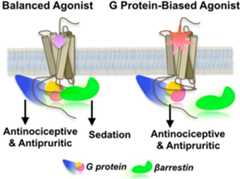
Model depicting functional selectivity of GPCR signaling. A balancedagonist would be predicted to activate multiple signaling cascadesmediated by the effectors that associate with the receptor, whilea biased agonist would preferentially engage with certain effectorsover others to activate distinct signaling pathways.
At its outset, we were not specifically focusedon finding biasedcompounds but rather concerned with developing chemically fresh KORscaffolds for exploring general opioid pharmacology. As the projectevolved, the focus rapidly shifted, however, and it is our hope thatsome of the lessons we have learned (and are still learning) willbe of use to medicinal chemists broadly interested in GPCRs. As reflectedby its title, this Innovations article is a follow-up to a 2010 prospectivearticle coauthored by one of us (L.M.B.).10
Lookingfor Clues
A prerequisite for biased GPCR agonistsis having high quality GPCR agonists in the first place.11 In our KOR program, we had identified appropriatechemical matter during the course of two separate projects. In one,an exploratory library of 72 isoquinolinones prepared as a part ofthe KU Chemical Methodology and Library Development program12 was screened in the UNC Psychoactive Drug ScreeningProgram directed by Bryan Roth, which uses radioligand displacementassays to identify receptor binders. Remarkably, this screen directlyafforded a highly potent and selective KOR agonist (Ki = 5 nM for KOR, 3550 nM for MOR, and >10 μMforDOR; seeFigure2 foran isoquinolinone hit).13−15
Figure 2.

Structures and G protein/βarrestindata for selected compounds.(a) Standard balanced agonists. (b) Initial probe structures and advancedanalogues generated in these studies.
Several years later, as part of the Molecular Libraries Initiative(MLI), we became aware of a screening project wherein the NIH SmallMolecule Repository was to be examined for novel KOR ligands. Thisproject was originally set up between the Conrad Prebys Center forChemical Genomics at the Sanford–Burnham Medical Research Instituteand a team of pharmacologists comprising Lawrence S. Barak and MarcG. Caron (both at Duke) and one of the current coauthors (L.M.B.).Upon hearing about this project, for which the screening was doneand was about to enter the chemistry phase, theother coauthor of the present article (J.A., then at the University ofKansas (KU)) lobbied the Sanford–Burnham scientists to allowhim and his colleagues to serve as the chemistry team on the project.Generously, the Sanford–Burnham chemistry team of Gregory Rothand Nicholas Cosford blessed the swap and the project was transferredto J.A. and the Specialized Chemistry Center team at KU (see dedication).
The screening used the now-ubiquitous DiscoveRx PathHunter assayexpressing human KOR in U2OS (human osteosarcoma) cells.10 This enzyme fragment complementation (EFC) assayproduces a chemiluminescence readout resulting from recombinationof two portions of galactosidase (one on the receptor, one on theβarrestin) in the presence of the substrate. It provides a directmeasure of βarrestin recruitment and can be used to identifyreceptor agonists or antagonists. Of a number of hits obtained inthis screen, four were subjected to initial medicinal chemistry optimizationand follow-up pharmacological characterization. These were presentedto the scientific community as MLI probes, two agonists16 and two antagonists.17 These initial communications were followed up with a 2012 full paperthat detailed the overall project and an amount of postprobe potencyand selectivity enhancement.18
Asthe MLI KOR project wound to a close in about 2010, we decidedto shift our interest to the discovery of biased KOR agonists. Atthe time, most investigators concentrated on a relatively conciseset of accepted KOR agonists as tool compounds or for drug development:naturally occurring or synthetic morphinoids, fentanyl-type compounds,peptide analogues of dynorphin,19 the valuableheterocyclic compounds discovered at Upjohn (U69,593 (U69) or U50,488H(U50)),20 and the non-nitrogenous naturalproduct salvinorin A.21,22 Although exceptions would soonemerge, compounds in these classes were balanced for comparable activationof the G protein cascade or βarrestin recruitment. Given thiscontext, we chose to focus on our trove of new kappa chemotypes forsigns of bias.
We began by measuring the relative potenciesof a given agent toactivate two proximal outcomes of receptor activation: coupling toG proteins and recruitment of βarrestin2. The βarrestin2data was already in hand for many examples thanks to the screeningefforts, although most were repeated to obtain more accurate datawith freshly synthesized compounds. The classical way of measuringG protein signaling is through monitoring the extent of GDP–GTPexchange by using radiolabeled, hydrolysis-resistant [35S]-GTPγS for binding to agonist-stimulated membranes. Thiswas readily adapted to 96-well plate format using Chinese hamsterovary (CHO) cells stably expressing the human KOR. To a first approximation,bias was optimized by seeking compounds with the highest ratios of[35S]-GTPγS recruitment/βarrestin recruitment.Although a more rigorous quantification of bias is required for validationof advanced compounds (see below), this straightforward analysis workedwell for the initial stages of compound optimization.
We cameto the project with numerous analogues already in hand.The original KOR structure–activity relationship (SAR) studieshad focused mainly on the easily modified phenyl groups in both series.Figure2b show data fromthe first probes published in each series and the compounds that wereultimately selected for in-depth investigation. An essential featurewas the selection of an unbiased standard as a comparator; here, weused U69 or U50 for this purpose (Figure2a).
One does not often have cause tocelebrate irony in research, buthere is a clear opportunity to do so: in at least one series, we wereable to identify aG protein-biased agent througha screen based onβarrestin recruitment!
One Way or Another
Although a simple comparison ofIC50 values allows for a general sense of potential bias,it can be misleading in assays that are contextually hard to compare.For example, a compound may have a potency (EC50) of 10nM in one assay and a potency of 100 nM in another assay. At firstglance, one might conclude: the agonist is biased for assay 1 overassay 2. However, this fails to consider the overall efficiency ofthe assay systems being considered. In a cell based signaling systemthat has a highly amplified response, an agonist may appear to bemore potent than in a system that has a much more reserved windowof response. Therefore, one can conclude little about biased agonismby simply comparing its performance between two assays. In order toaccount for the efficiency of the system, the performance of the agonistmust be compared to the performance of a “known” agonistthat can reveal the full potential of the assay system to generatea response. The “known” agonist is called the “referenceagonist” and must produce the maximum response the system iscapable of producing. Then the performance of the test compound canbe compared to the reference, allowing for a normalization of itsperformance and accounting for the limitations of the system context.
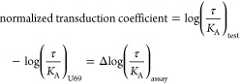
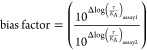
A useful operational model that allows one to make valid comparisonsacross series is based on the models proposed by Black and Leff.23−26 A simplified version entails the calculation of normalized transductioncoefficients to compare the action of a given test compound with thebalanced standard (here, U69) in each assay (eq1, where τ is agonist efficacy andKA is the equilibrium affinity constant). Thisbeing done, one can now calculate a bias factor for a given agonistacross any two assays of choice (eq2); the balanced standard by definition has a bias factorof 1.
While it is attractive to assign a number to a compound,it isimportant to keep in mind that bias is a comparison that depends onthe reference ligand and circumstances that include the cell line,the species of the receptor, the coexpressed proteins, the modificationsto the receptor, and the assay conditions. While it is attractiveto assign a number to a compound, it should be kept in mind that biasis dependent upon a comparison. However, the assignment of bias canstill provide useful in determining SAR; particularly when a desirablevs an undesirable signaling pathway has been determined.
 | 1 |
 | 2 |
Using the operational model, isoquinolinone 2.1 and triazole1.1have bias factors of 31.4 and 61.2 for the [35S]GTPγSvs βarrestin2 recruitment (using the EFC method), respectively.They are clearly biased by this measure.
Contemporarily, otherlaboratories have published biased KOR ligandsbased on previously known structural classes. In separate work, theJavitz27 and Bohn28 laboratories reported that 6′-guanidinonaltrindole (6′-GNTI),a synthetic derivative of morphine first reported in 2001,29 has a complex pharmacology that includes “extremebias” as partial agonist toward G protein and against the βarrestinpathway. One calculation of the bias factor for 6′-GNTI was9.8.28 Another previously known morphinederivative, nalfurafine, was first synthesized in 199830 and approved in Japan for the treatment of pruritisin 2009.31 In 2017, Chavkin and co-workersreported that nalfurafine is highly biased toward the G protein pathway(measuring p38 phosphorylation vs extracellular signal-regulated kinases1/2 (ERK1/2) phosphorylation, using U50 as the standard ligand).32 In 2013, the Roth group reported that the salvinorinA derivative 22-thiocyanatosalvinorin A, RB-64, was biased towardthe G protein pathway (bias factor 25 at hKOR, using salvinorin Aas the reference ligand33 or 96 at themouse KOR34). The fact that RB-64 differsstructurally at a single position from the nonbiased salvinorin Asupports the view that ligand bias is a property susceptible to traditionalSAR optimization.
Another aspect of SAR examined in our laboratorieswas the effectof the triazole ligand class on the downstream phosphorylation ofERK1/2 kinase (Figure3).35 At the outset, we had no expectationshow biased agents would affect this MAP kinase because ERK1/2 is involvedin both G protein36−38 and βarrestin pathways.39,40 When additional structural modification was carried out in the triazoleseries, we learned that the nature of the aromatic ring attached tothe N-4 position of the triazole centroid dramatically affected thedegree of bias toward G protein activation over ERK1/2 in this series.
Figure 3.

Effectof N-4 substitution on G protein/ERK1/2 bias in a seriesof triazoles.35
Additional verification of bias was sought through the examinationof other cellular measurements.41 A vividdemonstration of βarrestin recruitment is obtained from confocalimaging of βarrestin tagged with green fluorescent protein (GFP;Figure4a). Upon βarrestinrecruitment, the βarrestin–GFP construct, which is normallydistributed throughout the cytosol, localizes at the nucleus (cf.the effect of 10 μM U50 at a high concentration to that fromthe biased isoquinolinone 2.1 at the same concentration). In addition,independent measurements of ligand binding in the presence of thecell permeant saponin and cellular impedance provided additional verificationof strong bias for both isoquinolinone 2.1 and triazole 1.1. Thisis evident from the spider graph profiles for U69 versus our biasedexemplars inFigure4b.
Figure 4.
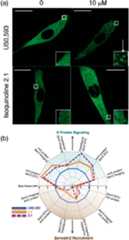
Additional assay and bias data for triazole 1.1 and isoquinolinone2.1. (a) Confocal imaging of the effect of U69 or isoquinolinone 2.1on βarrestin recruitment. (b) Bias trend across various measurementpairs for U69, triazole 1.1, and isoquinolinone 2.1. Adapted with permission from ref (41)
The primary cellular pathway of KOR signaling in the brainis thestriatum, which is also a major regulator of dopamine activity. Accordingly,an important step toward verifying the action of KOR ligands is toexamine their pharmacology in striatal membrane preparations fromwild-type mice as well as from mice with knockouts of the KOR and,as a control, MOR. Such studies were carried out using endogenousagonistic dynorphin peptides, the literature antagonists norBNI and5′-GNTI, and an example of the sulfonamide class discoveredin the course of our MLI work.18,42 Besides showing thatthe activity of these agents could be reproduced in this closer-to-realisticcellular environment (as opposed to transfected CHO cells), the useof parallel knockout models enabled the insight that some ligandsgenerally considered to be selective in fact operate though both theKOR and MOR pathways.
Mice
We approached the criticalphase of testing ourcompounds in animal models with a combination of expectation and curiosity.The expectation was that our agonists, pending appropriate vettingfor suitable pharmacokinetic (PK) properties, would be active nociceptiveagents based on their in vitro potencies. Although slightly less certain,if only because there is less guidance from previous literature, itseemed reasonable to expect that we might see good anti-itch activityas well. Thus, the critical question was how functionally selectiveKOR agonists would differ physiologically and behaviorally comparedto classical agents. A related question, for which we had no clueat the time, was how much bias would be needed to translate into anymeaningful differences in biological outcomes.
The pharmacokineticproperties of KOR ligands have been a subject of particular concern.Specifically, the antagonists norBNI and JDTic have been reportedto have an extended duration of action (over 2 weeks), a pragmaticconcern with therapeutic usage (and leading to some controversy asto the origin of the effect).43−45 Cognizant of this history, weperformed preliminary PK studies at an early stage of the presentproject, finding that parenterally delivered isoquinolinones and triazolesdid indeed penetrate the blood–brain barrier and were clearedwith reasonable (ca. 2 h) half-lives.41
Moving forward, our efforts mainly used triazole 1.1. Sincemanyof the in vivo studies used U50 as the standard molecule, we repeatedthe bias measurements for 1.1 against U50 using the EFC assay to measureβarrestin recruitment and the [35S]-GTPγS bindingassay for G protein pathway engagement. It remains a highly biasedmolecule under these circumstances, with a calculated bias factorof 28.46
Triazole 1.1 was found tohave excellent antinociceptive activityin the mouse tail-flick model and suppressed chloroquine phosphate-inducedscratching, with activity close to that of U50 in each assay. A seriesof experiments showed that the effects were due to on-target activity.Thus, the above effects were blocked by the KOR antagonist norBNI,and the antinociceptive effects were absent in KOR knockout mice.Moreover, the penetrance of the compounds to the striatum was confirmedby HPLC of homogenized brain extracts and pretreatment with eithertriazole 1.1 or U50 in vivo prevented subsequent binding of [3H]U69 in dissected striata.
But just as it was evidentthat the in vitro pharmacology translatednicely to the in vivo setting, it quickly became clear that thesewere not traditional KOR agonists. In general, KOR activation leadsto down-regulation of dopamine release and therefore sedation. Thiscan be observed in mice through opioid-induced changes in locomotion,a readily measurable parameter. Indeed, triazole 1.1 was found toresult in essentially no change in ambulatory behavior in test miceunder doses and conditions when U50 would lead to dramatically loweredmovement.
At this stage, we teamed up with Professors Sara Jonesand ThomasJ. Martin at Wake Forest University for advanced brain physiologyand behavioral studies. In the former, we wished to address the centralquestion of whether there are differences in dopamine tone arisingfrom treatment of a biased KOR agonist relative to a classical one.Remarkable differences were observed when voltammetry analysis ofex vivo slices from the nucleus accumbens cores or shells was carriedout using U50 vs triazole 1.1.46 At most,only a modest dip in dopamine levels were observed in the latter caseat the very highest doses for the triazole 1.1, which stands in strongcontrast to the continuous dose-dependent changes typical of a classicalKOR agonist (and seen here for U50;Figure5).
Figure 5.
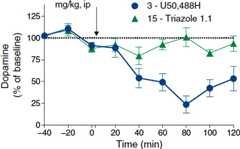
Effect of dopamine levels in vivo followingadministration of U50v. triazole 1.1. Reproduced by permission from ref (46). Copyright 2016 AAAS.
The dysphoria associated withKOR activation and hypothesized toresult from βarrestin involvement is notoriously hard to measure.It would be nice if mice were able to fill out questionnaires pertainingto mood on tiny clipboards, but this ability is currently lacking,despite our best efforts. Moreover, “aversion” is acomplex phenomenon that may reflect anything from changes in fundamentalbrain chemistry, which is what we hope to measure here, to GI distresscaused by a drug molecule. Of the various indirect ways of assessingaversion available, we looked for changes in intracranial self-stimulation(ICSS) behavior in rats with ventral tegmental area (VTA)-implantedbrain electrodes that are trained to press a lever for self-stimulationin response to a light cue. The suppression of a VTA ICSS responseis interpreted to mean that the animal is less “interested”in pleasure due to decreased dopamine levels.
Once again, significantdifferences were observed following treatmentof the rats with triazole 1.1 under conditions when substantial changescould be observed with U50.46 While U50decreased ICSS as expected consistent with its known dysphoric andsedating properties, 1.1 had no effect in this assay consistent withits lack of effects on forebrain DA. More interesting, these samedoses of 1.1 were able to inhibit the ability of abdominal inflammationto decrease ICSS, an effect shared by clinically useful analgesicssuch as ketoprofen and morphine. These data indicate that the biasedsignaling of 1.1 found in vitro translated to the desired effectsin vivo, namely, a preservation of the analgesic properties with nosigns of the sedating or dysphoric effects of typical balanced KORagonists that have limited their development as therapeutics. A similarseparation of desired/undesired effects was observed by the Roth groupusing the biased salvinorin A-derivative RB-64.34
Where Do We Go From Here?
To date,the results areconsistent with the primary premise that KOR G protein pathway activationover βarrestin recruitment will enhance therapeutic activityand reduce unfavorable side effects. However, as always, it is advisableto modulate one’s expectations for advancement of any translationalcandidate, and we are still in the early going here.
We expectthat future efforts toward GPCR targeted therapeutics will increasinglytake bias into account. From the perspective of a working medicinalchemist, this pragmatically means adding just one more optimizationparameter to the already-daunting list facing drug discovery aspirants(albeit a parameter that can morph dependent on the experimental context).For GRCRs with information about the relative roles of different intracellularpathways, this represents an appealing hypothesis driver for research.Conversely, new tools able to differentiate between pathways may enablenew understanding of less-explored GPCR targets.
Of course,any journey toward a new drug starts with a single stepor, more literally, a single molecule. Although determining “whereto begin” is always challenging, there is no reason to thinkthat there is anything particularly difficult about finding a suitablestarting point for developing a biased agonist for GPCR drug discovery.In our case, we were seeking new ligands for an extremely well establisheddrug target for which essentially all chemotypes led to balanced activationof the receptor. By deliberately setting out to find structurallynovel ligands, and with the benefit of a little luck (for which wethink no apology is necessary), we found multiple biased classes thatwe could optimize using standard medicinal chemistry. Similarly, successfulefforts to create new chemotypes for the KOR47 vs the MOR48 from de novo in silico designhave been reported.
Such stories will only become more common,particularly as thescientific community learns more about the molecular origins of GPCRbias through structural biology49,50 and with the aid ofnovel chemical tools. We hope to continue to contribute to this renaissanceof GPCR biology through the development of our biased agents for translationalwork and further discovery and functional elucidation in other settings.
Acknowledgments
We gratefully acknowledge the dedication and efforts of ourmany collaborators and co-workers named in the text and references.We particularly thank Kevin Frankowski, who has made extensive contributionsto this project from its outset to the present. We also thank ThomasJ. Martin for his contributions to this manuscript.
Glossary
ABBREVIATIONS
- EFC
enzyme fragment complementation
- GFP
green fluorescentprotein
- 6′-GNTI
6′-guanidinonaltrindole
- GPCR
G protein-coupled receptor
- GTP
guanosine triphosphate
- ICSS
intracranial self-stimulation
- KOR
kappa opioid receptor
- MOR
mu opioid receptor
- norBNI
nor-binaltorphimine
- PK
pharmacokinetics
- SAR
structure–activityrelationship
- U50
U50,488H
- U69
U69,683
- VTA
ventral tegmentalarea
Author Contributions
The manuscriptwas written by both authors.
Two NIH centerprograms enabled our discovery of isoquinolinones (the KU ChemicalMethodology and Library Development center, funded by NIGMS 5P50GM069663,to J.A., PI) and the triazoles (the MLI, which was a collaborationbetween the KU Specialized Chemistry Center (5U54HG005031, to J.A.,PI), the Conrad Prebys Center for Chemical Genomics at the Sanford-BurnhamMedical Research Institute (5U54HG005033 (John Reed, PI), and screeninggrants awarded by the National Institute on Drug Abuse (NIDA) to LawrenceS. Barak (1X01DA026208) and Marc G. Caron (5U01DA022950)). Initialscreening and ongoing characterization were also carried out by thePsychoactive Drug Screening Program at the University of North Carolina,Chapel Hill (National Institute of Mental Health contract # HHSN-271-2008-00025-C,Bryan Roth, PI). We gratefully acknowledge NIDA for continuing supportthrough 5R01DA031927 (to L.M.B. and J.A., co-PIs).
The authors declare thefollowing competing financial interest(s): The coauthors are co-inventorson several patents that are related to the studies described in thisarticle.
Dedication
We dedicate this paperto the memory of Greg Roth.
References
- Rosenbaum D. M.; Rasmussen S. G. F.; Kobilka B. K.The Structure and Function of G-Protein-CoupledReceptors. Nature2009, 459, 356–363. 10.1038/nature08144. [DOI] [PMC free article] [PubMed] [Google Scholar]
- Overington J. P.; Al-Lazikani B.; Hopkins A. L.How Many Drug Targets Are There?. Nat. Rev. Drug Discovery2006, 5, 993–996. 10.1038/nrd2199. [DOI] [PubMed] [Google Scholar]
- Lefkowitz R. J.; Shenoy S. K.Transduction of Receptor Signals by β-Arrestins. Science2005, 308, 512–517. 10.1126/science.1109237. [DOI] [PubMed] [Google Scholar]
- Smith J. S.; Rajagopal S.The β-Arrestins: Multifunctional Regulators ofG Protein-coupled Receptors. J. Biol. Chem.2016, 291, 8969–8977. 10.1074/jbc.R115.713313. [DOI] [PMC free article] [PubMed] [Google Scholar]
- Bohn L. M.; Lefkowitz R. J.; Gainetdinov R. R.; Peppel K.; Caron M. G.; Lin F.-T.EnhancedMorphine Analgesia in Mice Lacking β-Arrestin2. Science1999, 286, 2495–2498. 10.1126/science.286.5449.2495. [DOI] [PubMed] [Google Scholar]
- Jacobson K. A.New Paradigmsin GPCR Drug Discovery. Biochem. Pharmacol.(Amsterdam, Neth.)2015, 98, 541–555. 10.1016/j.bcp.2015.08.085. [DOI] [PMC free article] [PubMed] [Google Scholar]
- Luttrell L. M.; Maudsley S.; Bohn L. M.Fulfilling the Promiseof ″Biased″G Protein-Coupled Receptor Agonism. Mol. Pharmacol.2015, 88, 579–588. 10.1124/mol.115.099630. [DOI] [PMC free article] [PubMed] [Google Scholar]
- Rankovic Z.; Brust T. F.; Bohn L. M.BiasedAgonism: An Emerging Paradigmin GPCR Drug Discovery. Bioorg. Med. Chem. Lett.2016, 26, 241–250. 10.1016/j.bmcl.2015.12.024. [DOI] [PMC free article] [PubMed] [Google Scholar]
- Wootten D.; Miller L. J.; Koole C.; Christopoulos A.; Sexton P. M.Allostery and Biased Agonism at ClassB G Protein-CoupledReceptors. Chem. Rev. (Washington, DC, U. S.)2017, 117, 111–138. 10.1021/acs.chemrev.6b00049. [DOI] [PubMed] [Google Scholar]
- Bohn L. M.; McDonald P. H.Seeking Ligand Bias:Assessing GPCR Coupling to β-ArrestinsFor Drug Discovery. Drug Discovery Today: Technol.2010, 7, e37–e42. 10.1016/j.ddtec.2010.06.005. [DOI] [PMC free article] [PubMed] [Google Scholar]
- Frye S. V.The Artof the Chemical Probe. Nat. Chem. Biol.2010, 6, 159–161. 10.1038/nchembio.296. [DOI] [PubMed] [Google Scholar]
- Frankowski K. J.; Hirt E. E.; Zeng Y.; Neuenswander B.; Fowler D.; Schoenen F.; Aubé J.Synthesisof N-Alkyl-octahydroisoquinolin-1-one-8-carboxamide Libraries Usinga Tandem Diels–Alder/Acylation Sequence. J. Comb. Chem.2007, 9, 1188–1192. 10.1021/cc700127f. [DOI] [PubMed] [Google Scholar]
- Frankowski K. J.; Ghosh P.; Setola V.; Tran T. B.; Roth B. L.; Aubé J.N-Alkyl-octahydroisoquinolin-1-one-8-carboxamides:Selective and Nonbasic kappa-Opioid Receptor Ligands. ACS Med. Chem. Lett.2010, 1, 189–193. 10.1021/ml100040t. [DOI] [PMC free article] [PubMed] [Google Scholar]
- Ghosh P.; Aubé J.Resolution of Carboxylic Acids Using Copper(I)-PromotedRemoval of Propargylic Esters under Neutral Conditions. J. Org. Chem.2011, 76, 4168–4172. 10.1021/jo200433w. [DOI] [PMC free article] [PubMed] [Google Scholar]
- Slauson S. R.; Pemberton R.; Ghosh P.; Tantillo D. J.; Aubé J.Domino Acylation/Diels–AlderSynthesis of N-Alkyl-octahydroisoquinolin-1-one-8-carboxylic Acidsunder Low-Solvent Conditions. J. Org. Chem.2015, 80, 5260–5271. 10.1021/acs.joc.5b00804. [DOI] [PubMed] [Google Scholar]
- Hedrick M. P.; Gosalia P.; Frankowski K.; Shi S.; Prisinzano T. E.; Schoenen F.; Aubé J.; Su Y.; Vasile S.; Sergienko E.; Gray W.; Hariharan S.; Ghosh P.; Milan L.; Heynen-Genel S.; Chung T. D. Y.; Dad S.; Caron M.; Bohn L. M.; Barak L. S.. Selective KOP Receptor Agonists:Probe 1 & Probe 2. In Probe Reports fromthe NIH Molecular Libraries Program; NationalCenter for Biotechnology Information (US): Bethesda, MD, 2010. [PubMed] [Google Scholar]
- Hedrick M. P.; Gosalia P.; Frankowski K.; Whipple D. A.; Shi S.; Prisinzano T. E.; Schoenen F.; Aubé J.; Su Y.; Vasile S.; Sergienko E.; Gray W.; Hariharan S.; Milan L.; Heynen-Genel S.; Chung T. D. Y.; Dad S.; Caron M.; Bohn L. M.; Barak L. S.. Selective KOP Receptor Antagonists: Probe 1. In Probe Reports from the NIH Molecular Libraries Program; National Center for Biotechnology Information (US): Bethesda, MD, 2010. [PubMed] [Google Scholar]
- Frankowski K. J.; Hedrick M. P.; Gosalia P.; Li K.; Shi S.; Whipple D.; Ghosh P.; Prisinzano T. E.; Schoenen F. J.; Su Y.; Vasile S.; Sergienko E.; Gray W.; Hariharan S.; Milan L.; Heynen-Genel S.; Mangravita-Novo A.; Vicchiarelli M.; Smith L. H.; Streicher J. M.; Caron M. G.; Barak L. S.; Bohn L. M.; Chung T. D.; Aubé J.Discovery of Small Molecule Kappa Opioid Receptor Agonistand Antagonist Chemotypes through a HTS and Hit Refinement Strategy. ACS Chem. Neurosci.2012, 3, 221–236. 10.1021/cn200128x. [DOI] [PMC free article] [PubMed] [Google Scholar]
- Udenfriend S.; Meienhofer J.. Opioid Peptides:Biology, Chemistry, and Genetics: The Peptides: Analysis, Synthesis,Biology; Elsevier: 2014; Vol. 6. [Google Scholar]
- Szmuszkovicz J., U-50,488and the κ Receptor: A Personalized Account Covering the Period1973 to 1990. In Progress in Drug Research; Springer: 1999; pp 167–195. [DOI] [PubMed] [Google Scholar]
- Roth B. L.; Baner K.; Westkaemper R.; Siebert D.; Rice K. C.; Steinberg S.; Ernsberger P.; Rothman R. B.Salvinorin A: APotent Naturally Occurring Nonnitrogenous Kappa Opioid Selective Agonist. Proc. Natl. Acad. Sci. U. S. A.2002, 99, 11934–11939. 10.1073/pnas.182234399. [DOI] [PMC free article] [PubMed] [Google Scholar]
- Harding W. W.; Tidgewell K.; Byrd N.; Cobb H.; Dersch C. M.; Butelman E. R.; Rothman R. B.; Prisinzano T. E.NeoclerodaneDiterpenes as a Novel Scaffold for Opioid Receptor Ligands. J. Med. Chem.2005, 48, 4765–4771. 10.1021/jm048963m. [DOI] [PubMed] [Google Scholar]
- Black J. W.; Leff P.Operational Models of Pharmacological Agonism. Proc. R. Soc. London, Ser. B1983, 220, 141. 10.1098/rspb.1983.0093. [DOI] [PubMed] [Google Scholar]
- Kenakin T.; Watson C.; Muniz-Medina V.; Christopoulos A.; Novick S.A Simple Method For Quantifying Functional Selectivityand Agonist Bias. ACS Chem. Neurosci.2012, 3, 193–203. 10.1021/cn200111m. [DOI] [PMC free article] [PubMed] [Google Scholar]
- Kenakin T.; Christopoulos A.SignallingBias in New Drug Discovery: Detection, Quantificationand Therapeutic Impact. Nat. Rev. Drug Discovery2013, 12, 205–216. 10.1038/nrd3954. [DOI] [PubMed] [Google Scholar]
- Stahl E. L.; Zhou L.; Ehlert F. J.; Bohn L. M.A Novel Method forAnalyzing Extremely Biased Agonism at G Protein-Coupled Receptors. Mol. Pharmacol.2015, 87, 866–877. 10.1124/mol.114.096503. [DOI] [PMC free article] [PubMed] [Google Scholar]
- Rives M.-L.; Rossillo M.; Liu-Chen L.-Y.; Javitch J. A.6′-Guanidinonaltrindole(6′-GNTI) Is A G Protein-Biased κ-Opioid Receptor AgonistThat Inhibits Arrestin Recruitment. J. Biol.Chem.2012, 287, 27050–27054. 10.1074/jbc.C112.387332. [DOI] [PMC free article] [PubMed] [Google Scholar]
- Schmid C. L.; Streicher J. M.; Groer C. E.; Munro T. A.; Zhou L.; Bohn L. M.Functional Selectivity Of 6′-Guanidinonaltrindole(6′-GNTI) at κ-Opioid Receptors in Striatal Neurons. J. Biol. Chem.2013, 288, 22387–22398. 10.1074/jbc.M113.476234. [DOI] [PMC free article] [PubMed] [Google Scholar]
- Sharma S. K.; Jones R. M.; Metzger T. G.; Ferguson D. M.; Portoghese P. S.Transformationof a κ-Opioid Receptor Antagonist to a κ-Agonist by Transferof a Guanidinium Group from the 5‘- to 6‘-Position ofNaltrindole. J. Med. Chem.2001, 44, 2073–2079. 10.1021/jm010095v. [DOI] [PubMed] [Google Scholar]
- Nagase H.; Hayakawa J.; Kawamura K.; Kawai K.; Takezawa Y.; Matsuura H.; Tajima C.; Endo T.Discovery of a StructurallyNovel Opioid Kappa-Agonist Derived from 4,5-Epoxymorphinan. Chem. Pharm. Bull.1998, 46, 366–369. 10.1248/cpb.46.366. [DOI] [PubMed] [Google Scholar]
- Inui S.NalfurafineHydrochloride to Treat Pruritus: A Review. Clin.,Cosmet. Invest. Dermatol.2015, 8, 249–255. 10.2147/CCID.S55942. [DOI] [PMC free article] [PubMed] [Google Scholar]
- Schattauer S. S.; Kuhar J. R.; Song A.; Chavkin C.Nalfurafine is a G-ProteinBiased Agonist Having Significantly Greater Bias at the Human thanRodent Form of the Kappa Opioid Receptor. Cell.Signalling2017, 32, 59–65. 10.1016/j.cellsig.2017.01.016. [DOI] [PMC free article] [PubMed] [Google Scholar]
- White K. L.; Scopton A. P.; Rives M. L.; Bikbulatov R. V.; Polepally P. R.; Brown P. J.; Kenakin T.; Javitch J. A.; Zjawiony J. K.; Roth B. L.Identification of Novel FunctionallySelective Kappa-Opioid Receptor Scaffolds. Mol.Pharmacol.2014, 85, 83–90. 10.1124/mol.113.089649. [DOI] [PMC free article] [PubMed] [Google Scholar]
- White K. L.; Robinson J. E.; Zhu H.; DiBerto J. F.; Polepally P. R.; Zjawiony J. K.; Nichols D. E.; Malanga C. J.; Roth B. L.The G Protein-BiasedKappa-Opioid Receptor Agonist RB-64 Is Analgesic with a Unique Spectrumof Activities In Vivo. J. Pharmacol. Exp. Ther.2015, 352, 98–109. 10.1124/jpet.114.216820. [DOI] [PMC free article] [PubMed] [Google Scholar]
- Lovell K. M.; Frankowski K. J.; Stahl E. L.; Slauson S. R.; Yoo E.; Prisinzano T. E.; Aubé J.; Bohn L. M.Structure–ActivityRelationship Studies of Functionally Selective Kappa Opioid ReceptorAgonists that Modulate ERK 1/2 Phosphorylation While Preserving GProtein Over βArrestin2 Signaling Bias. ACS Chem. Neurosci.2015, 6, 1411–1419. 10.1021/acschemneuro.5b00092. [DOI] [PMC free article] [PubMed] [Google Scholar]
- Bohn L. M.; Belcheva M. M.; Coscia C. J.Mitogenic Signalingvia Endogenousκ-Opioid Receptors in C6 Glioma Cells. J. Neurochem.2000, 74, 564–573. 10.1046/j.1471-4159.2000.740564.x. [DOI] [PMC free article] [PubMed] [Google Scholar]
- Belcheva M. M.; Clark A. L.; Haas P. D.; Serna J. S.; Hahn J. W.; Kiss A.; Coscia C. J.μand κ Opioid ReceptorsActivate ERK/MAPK Via Different Protein Kinase C Isoforms and SecondaryMessengers in Astrocytes. J. Biol. Chem.2005, 280, 27662–27669. 10.1074/jbc.M502593200. [DOI] [PMC free article] [PubMed] [Google Scholar]
- McLennan G. P.; Kiss A.; Miyatake M.; Belcheva M. M.; Chambers K. T.; Pozek J. J.; Mohabbat Y.; Moyer R. A.; Bohn L. M.; Coscia C. J.Kappa Opioids PromoteThe Proliferation Of AstrocytesVia Gβγ and β-Arrestin 2-Dependent MAPK-MediatedPathways. J. Neurochem.2008, 107, 1753–1765. 10.1111/j.1471-4159.2008.05745.x. [DOI] [PMC free article] [PubMed] [Google Scholar]
- Bruchas M. R.; Macey T. A.; Lowe J. D.; Chavkin C.Kappa Opioid ReceptorActivation of p38 MAPK is GRK3-and Arrestin-Dependent in Neurons andAstrocytes. J. Biol. Chem.2006, 281, 18081–18089. 10.1074/jbc.M513640200. [DOI] [PMC free article] [PubMed] [Google Scholar]
- Bruchas M. R.; Land B. B.; Aita M.; Xu M.; Barot S. K.; Li S.; Chavkin C.Stress-Induced p38Mitogen-Activated Protein KinaseActivation Mediates κ-Opioid-Dependent Dysphoria. J. Neurosci.2007, 27, 11614–11623. 10.1523/JNEUROSCI.3769-07.2007. [DOI] [PMC free article] [PubMed] [Google Scholar]
- Zhou L.; Lovell K. M.; Frankowski K. J.; Slauson S. R.; Phillips A. M.; Streicher J. M.; Stahl E.; Schmid C. L.; Hodder P.; Madoux F.; Cameron M. D.; Prisinzano T. E.; Aubé J.; Bohn L. M.Development of Functionally Selective,Small Molecule Agonists at Kappa Opioid Receptors. J. Biol. Chem.2013, 288, 36703–36716. 10.1074/jbc.M113.504381. [DOI] [PMC free article] [PubMed] [Google Scholar]
- Frankowski K. J.; Slauson S. R.; Lovell K. M.; Phillips A. M.; Streicher J. M.; Zhou L.; Whipple D. A.; Schoenen F. J.; Prisinzano T. E.; Bohn L. M.; Aubé J.Potency Enhancement of the KappaOpioid Receptor Antagonist Probe ML140 Through Sulfonamide ConstraintUtilizing a Tetrahydroisoquinoline Motif. Bioorg.Med. Chem.2015, 23, 3948–3956. 10.1016/j.bmc.2014.12.033. [DOI] [PMC free article] [PubMed] [Google Scholar]
- Bruchas M. R.; Yang T.; Schreiber S.; DeFino M.; Kwan S. C.; Li S.; Chavkin C.Long-Acting κ Opioid Antagonists Disrupt ReceptorSignaling and Produce Noncompetitive Effects By Activating C-Jun N-TerminalKinase. J. Biol. Chem.2007, 282, 29803–29811. 10.1074/jbc.M705540200. [DOI] [PMC free article] [PubMed] [Google Scholar]
- Kishioka S.; Kiguchi N.; Kobayashi Y.; Yamamoto C.; Saika F.; Wakida N.; Ko M.-C.; Woods J. H.PharmacokineticEvidence for the Long-Lasting Effect of nor-Binaltorphimine, a PotentKappa Opioid Receptor Antagonist, In Mice. Neurosci.Lett.2013, 552, 98–102. 10.1016/j.neulet.2013.07.040. [DOI] [PubMed] [Google Scholar]
- Patkar K. A.; Wu J.; Ganno M. L.; Singh H. D.; Ross N. C.; Rasakham K.; Toll L.; McLaughlin J. P.Physical Presence of Nor-Binaltorphiminein Mouse Brain over 21 Days after a Single Administration Correspondsto Its Long-Lasting Antagonistic Effect on κ-Opioid Receptors. J. Pharmacol. Exp. Ther.2013, 346, 545. 10.1124/jpet.113.206086. [DOI] [PubMed] [Google Scholar]
- Brust T. F.; Morgenweck J.; Kim S. A.; Rose J. H.; Locke J. L.; Schmid C. L.; Zhou L.; Stahl E. L.; Cameron M. D.; Scarry S. M.; Aubé J.; Jones S. R.; Martin T. J.; Bohn L. M.Biased Agonists of the Kappa Opioid Receptor SuppressPain and Itch Without Causing Sedation or Dysphoria. Sci. Signaling2016, 9, ra117. 10.1126/scisignal.aai8441. [DOI] [PMC free article] [PubMed] [Google Scholar]
- Zheng Z.; Huang X.-P.; Mangano T. J.; Zou R.; Chen X.; Zaidi S. A.; Roth B. L.; Stevens R. C.; Katritch V.Structure-BasedDiscovery of New Antagonist and Biased Agonist Chemotypes for theKappa Opioid Receptor. J. Med. Chem.2017, 60, 3070–3081. 10.1021/acs.jmedchem.7b00109. [DOI] [PMC free article] [PubMed] [Google Scholar]
- Manglik A.; Lin H.; Aryal D. K.; McCorvy J. D.; Dengler D.; Corder G.; Levit A.; Kling R. C.; Bernat V.; Hübner H.; Huang X.-P.; Sassano M. F.; Giguère P. M.; Löber S.; Da D.; Scherrer G.; Kobilka B. K.; Gmeiner P.; Roth B. L.; Shoichet B. K.Structure-BasedDiscovery of Opioid Analgesics with Reduced Side Effects. Nature2016, 537, 185–190. 10.1038/nature19112. [DOI] [PMC free article] [PubMed] [Google Scholar]
- Park J. Y.; Lee S. Y.; Kim H. R.; Seo M.-D.; Chung K. Y.Structuralmechanism of GPCR-Arrestin Interaction: Recent Breakthroughs. Arch. Pharmacal Res.2016, 39, 293–301. 10.1007/s12272-016-0712-1. [DOI] [PubMed] [Google Scholar]
- Latorraca N. R.; Venkatakrishnan A. J.; Dror R. O.GPCR Dynamics: Structuresin Motion. Chem. Rev. (Washington, DC, U. S.)2017, 117, 139–155. 10.1021/acs.chemrev.6b00177. [DOI] [PubMed] [Google Scholar]