



Eobowenia gen. nov. from the Early Cretaceous of Patagonia: indication for an early divergence ofBowenia?
Mario Coiro
Christian Pott
Corresponding author.
Received 2016 Sep 2; Accepted 2017 Mar 21; Collection date 2017.
Open AccessThis article is distributed under the terms of the Creative Commons Attribution 4.0 International License (http://creativecommons.org/licenses/by/4.0/), which permits unrestricted use, distribution, and reproduction in any medium, provided you give appropriate credit to the original author(s) and the source, provide a link to the Creative Commons license, and indicate if changes were made. The Creative Commons Public Domain Dedication waiver (http://creativecommons.org/publicdomain/zero/1.0/) applies to the data made available in this article, unless otherwise stated.
Abstract
Background
Even if they are considered the quintessential “living fossils”, the fossil record of the extant genera of the Cycadales is quite poor, and only extends as far back as the Cenozoic. This lack of data represents a huge hindrance for the reconstruction of the recent history of this important group. Among extant genera,Bowenia (or cuticles resembling those of extantBowenia) has been recorded in sediments from the Late Cretaceous and the Eocene of Australia, but its phylogenetic placement and the inference from molecular dating still imply a long ghost lineage for this genus.
Results
We re-examine the fossil foliageAlmargemia incrassata from the Lower Cretaceous Anfiteatro de Ticó Formation in Patagonia, Argentina, in the light of a comparative cuticular analysis of extant Zamiaceae. We identify important differences with the other member of the genus, viz.A. dentata, and bring to light some interesting characters shared exclusively betweenA. incrassata and extantBowenia. We interpret our results to necessitate the erection of the new genusEobowenia to accommodate the fossil leaf earlier assigned asAlmargemia incrassata. We then perfom phylogenetic analyses, including the first combined morphological and molecular analysis of the Cycadales, that indicate that the newly erected genus could be related to extantBowenia.
Conclusion
Eobowenia incrassata could represent an important clue for the understanding of evolution and biogeography of the extant genusBowenia, as the presence ofEobowenia in Patagonia is yet another piece of the biogeographic puzzle that links southern South America with Australasia.
Electronic supplementary material
The online version of this article (doi:10.1186/s12862-017-0943-x) contains supplementary material, which is available to authorized users.
Keywords: Cycadales, stomata, cuticle, biogeography
Background
The Cycadales have been regarded for their phylogenetic position and their number of plesiomorphic characters as the only group of pteridosperms that survived up to the present [1,2]. They consequently play a crucial role in our understanding of the evolution of seed plants [1,3]. The extant diversity of the cycads comprises ten genera and 346 species [4], traditionally distributed in the three families Cycadaceae, Stangeriaceae and Zamiaceae [5,6]. However, more recent evidence based on molecular data tends to identify two main lineages, i.e. Cycadaceae and Zamiaceae, with the members of the Stangeriaceae sensu Stevenson [6] nested within Zamiaceae [7].
The Cycadales have long been considered to be a group with a rich fossil history, reaching its peak in diversity during the Mesozoic and declining up to the present [8], resulting in the Mesozoic being erroneously called the “Age of the Cycads”. In fact, cycads are commonly considered a member of the informal entity called “cycadophytes” that constitute several plant groups (Cycadales, Bennettitales, Nilssoniales) whose members resemble each other but are not closely related [9]. In contrast to the common perception, the dominant plant groups in mid-Mesozoic floras were in fact the Bennettitales and Nilssoniales (e.g. [9–15]), while Cycadales constituted only a minor portion of the vegetation. In addition, the results of recent molecular dating seem to indicate that most of the extant species diversity in cycads originated during the Late Miocene and Pliocene [16–18], and thus well after the Mesozoic.
Different hypotheses have been advanced to explain the apparently recent origin of the extant species of cycads. Some authors have interpreted these recent speciation events as a radiation triggered by increased aridification [17] or as the rebound after a mass extinction caused by the inception of an icehouse earth [16]. The resolution of this conundrum is hindered by our insufficient understanding of the relationships between fossil and extant diversity in cycads, which would allow us to independently test the trajectories of diversity through time [19], to validate the dates retrieved by the molecular analyses [20], and to fully understand the impact of climatic changes and tectonic events on the diversity of the group.
The fossil record of the ten extant genera of the Cycadales is indeed limited to a few Tertiary occurrences. Records considered to be reliable here include leaves and cuticle fragments assigned toCycas from the Eocene of China [21],Macrozamia from the Oligocene of Australia [22],Lepidozamia from the Eocene of Australia ([23,24], but see [25]), andCeratozamia from the Oligocene–Miocene of Central Europe [26–28].
One of the best represented genera in the Tertiary record isBowenia with two fossil species described from the Eocene of Australia [29] and Tasmania [30] as well as cuticular fragments withBowenia-like morphology identified in the Eocene of Tasmania [31] and the Late Cretaceous of Central Australia [32]. A few other fossils are awaiting to be formally described [33].Bowenia presents an interesting combination of characters that are uncommon in the other genera of the Cycadales (i.e. bipinnate leaves, stomata with non-sunken guard cells, a circularly arranged vascular bundle in the rachis; [6,34,35]). For this reason, the systematic classification and the phylogenetic placement ofBowenia are currently under debate. Some authors have identifiedBowenia as a separate lineage in the Zamiaceae [5], others as the only member of a separate family (i.e. Boweniaceae; [35]) or as a close relative ofStangeria in the Stangeriaceae [6]. More recently, studies using molecular data [7] have tried to resolve the relationships betweenBowenia and the rest of the cycads, with the placement ofBowenia as a close relative ofStangeria almost invariably rejected [7]. Instead, its placement as sister to the Ceratozamieae [17], Encephalarteae [16] or a clade comprising Ceratozamieae and Encephalarteae [7] is currently debated. In either case,Bowenia appears to be somewhat isolated from the other genera of the Cycadales, being separated by a relatively long branch from all other major clades [7,17]. Despite the relatively good fossil record ofBowenia, the date of divergence from its sister group inferred from molecular data may imply a potentially long ghost lineage [16]. The phylogenetic isolation ofBowenia combined with its endemic distribution in Australia also complicates the resolution of its biogeographical history, with different methods yielding varying reconstructions [7].
Among Mesozoic taxa, only a few have been tentatively linked to extant groups. Some of the most interesting fossils come from the Lower Cretaceous Baquero Group in Patagonia, Argentina, which also yielded one of the highest diversities in cycad leaf taxa [36]. Among these are the leaf taxaMesodescolea [37] andRestrepophyllum [38], which have been provisionally linked with extantStangeria andZamia (includingChigua), respectively. Other cycadalean taxa from the Baquero Group, such asPseudoctenis ornata A.Archang., R.Andreis, S.Archang. et A.Artabe [39], present interesting morphological similarities with members of extant Cycadales, but their relationships with any extant genus are controversial [40,41].
In this contribution, we report our analyses of the leaf fossilAlmargemia incrassata S.Archang. from the Anfiteatro de Ticó Formation of the Baquero Group, undertaken in the context of ongoing comparative studies of the cycadalean epidermis. Our results revealed that the fossils are different from the type ofAlmargemia, necessitating us to erect the new genusEobowenia to accommodate leaves that share some important characters with extantBowenia. We then test the placement ofEobowenia in the phylogeny of the Cycadales using an updated morphological matrix in combination with molecular data. Based on the results of the phylogenetic analyses, we discuss the implications ofEobowenia for the biogeographical history ofBowenia.
Methods
Specimens investigated
The fossil specimens examined for this study were first described by Florin [42] and later by Archangelsky [43]. The specimens examined forAlmargemia incrassata are stored in the Natural History Museum (NHM), London, UK, to which they were donated as duplicates by Sergio Archangelsky in 1960, under accession numbers v52264 (macrofossil) and v52265 (cuticle slide). The specimens examined forA. dentata Florin are stored in the Swedish Museum of Natural History (NRM), Stockholm, Sweden, under accession numbers S085614–S085619. Two of the original specimens examined by Heer [44] and Florin [42] could be traced down at the Museu Geológico, Lisbon, Portugal (accession numbers 23,213 and 23,217). Sources of the samples from extant species are listed in Additional file1: Table S1. The slides produced from the latter are stored at the Department of Systematic and Evolutionary Botany of the University of Zurich, Zurich, Switzerland.
Extant material preparation
Whole leaves were fixed in 50% Ethanol. Sections of a leaf ofBowenia serrulata (W.Bull) Chamb. were stained and mounted according to Coiro and Truernit [45]. Cuticles were isolated by immersing leaf fragments in a 2:1 mixture of 30% hydrogen peroxide and 85% ethanol, warmed up to 60 °C until the leaf fragments turned transparent. Cuticles were then rinsed in distilled water and cleaned using a fine brush. Cuticles ofMacrozamia plurinervia (L.Johnson) D.L.Jones were isolated using overnight maceration in 10% Cr2O3. Cuticles were then stained in Auramine O (Sigma; 0.01%w/v in 0.05 M Tris/HCl, pH 7.2) for 10–15 min (see [46]). They were then rinsed with water and mounted in glycerol. All extant samples used for our comparative analyses are listed in Additional file1: Table S1.
Microscopy and image analysis
For light and epifluorescence microscopy, slides with fossil cuticles were observed using a Nikon Eclipse LV100ND microscope (Almargemia incrassata) or an Olympus BX-51 light microscope, which was modified for epifluorescence microscopy, and photographed with an Olympus DP-71 digital camera (A. dentata). Cuticles of extant cycads and whole-mount leaf samples were observed using a Zeiss Axioscope fitted with a Zeiss 38 HE fluorescence filter.
Confocal observations of fossil samples were made using a Nikon A1-Si laser-scanning confocal microscope, with two excitation lines: 488-nm line of 50-mW sapphire laser and 561-nm line of 50-mW sapphire laser (Coherent Inc., Santa Clara, California, USA). The autofluorescence signal was collected with two different photomultiplier detectors with the following wavelength emission windows: 500–550 nm for the 488-nm laser, 570–620 nm for the 561-nm laser. PS-PI stained samples and Auramine O stained cuticles ofBowenia spectabilis were observed using a Leica TCS SP8 microscope. Excitation was obtained using a 488 nm laser for the PI and a 405 nm diode laser for the Auramine O. Raw images were analysed and measured using the software FiJi [47]. Brightness and contrast were adjusted using the “auto” option in the software. Confocal stacks were combined using a Maximum Intensity projection. Scans of freshly cut leaves of extant cycads were taken at 1200 dpi using an Epson Perfection V600 Photo J252A scanner.
Phylogenetic analyses
To test the placement ofEobowenia in the phylogeny of the Cycadales, we codedEobowenia andAlmargemia by incorporating the new data from our investigation in a modified version of the morphological matrix from Martinez et al. [48]. We removed the taxa that had no character overlap with our foliage taxa from the matrix. We then changed some of the character states in the light of our comparative data. In detail, we codedBowenia andStangeria as having hypostomatic leaflets (character 49) and oblong stomata (character 51),Stangeria as having one accessory cell layer (character 53),Bowenia as having longitudinally-oriented stomata (character 52) and Bennettitales as having both flush and sunken stomata (character 50). We also added a character for the substomatal complex thickenings, coded as present inEobowenia, Encephalartos, Macrozamia andBowenia, and absent in the other extant Cycadales exceptLepidozamia. The state for such character in other fossil cycads as well as in the outgroups was coded as unknown.Eobowenia was coded conservatively regarding the architecture of the leaf, with leaf dissection coded as pinnate (character 24) and midrib coded as absent (character 32).
Two different sets of analyses were performed: first, we analyzed the morphological matrix separately, and secondly we combined the morphological matrix with the molecular matrix from Salas-Leiva et al. [7]. All analyses were conducted using both Maximum Parsimony (MP) as implemented in PAUP* ver 4.0b10 [49] and Bayesian Inference (BI) as implemented in MrBayes ver 3.2.6 [50]. Search for the MP trees was performed using heuristic search with 1000 addition replicates and random addition sequence of taxa, and the bootstrap analysis was conducted for 1000 replicates using 10 searches per replicate and keeping only one tree per replicate. We also ran an analysis with the relationships between the extant cycad genera from Salas-Leiva et al. [7] forced as a backbone constraint. The BI analyses were executed using two runs of four chains (one cold and three hot chains), with 1 million generations for the morphology-only analysis and 5 million generations for the combined morphological-molecular analysis. In the morphology-only analyses, we used the mkinf model [51] with gamma-distributed rate variation. In the morphological-molecular analyses, we set one partition for each of the markers plus one morphological partition. For all molecular markers we used a GTR plus gamma model, and for the morphological partition we used a mkinf plus gamma model. After discarding 25% of the trees as burn-in, trees were summarized as consensus trees including all compatible splits. Characters were then reconstructed on the trees using Maximum Parsimony as implement in Mesquite ver 3.03 [52] to identify synapomorphies.
We also used the modified morphological matrix to test the different placements ofEobowenia in relation to the extant genera of the Cycadales using Mesquite ver 3.03 [52]. We edited a tree of the extant genera according to the topology of Salas-Leiva et al. [7], and counted the length of the trees obtained by moving the placement ofEobowenia by hand.
Results
Systematic Palaeontology
Order – Cycadales Pers. ex Bercht. et J.Presl.
Family – Zamiaceae Miq.
Subfamily – Bowenioideae Pilg. in H.G.A.Engler et K.A.E.Prantl.
Genus – Eobowenia M.Coiro et C.Pott gen. nov.
Type: Eobowenia incrassata (S.Archang.) M.Coiro et C.Pott comb. nov., from the Aptian (Lower Cretaceous) of Patagonia, Argentina.
Diagnosis: Emended from Archangelsky [43]. Leaves pinnate. Midrib delicate. Leaflets subopposite, insertion more acute towards the apex, oblong. Leaflet base broad. Leaflets with serrate margin. Veins parallel to the margin, converging at the base of the leaflet. Leaflets hypostomatic. Stomata with guard cell poles raised with respect to the aperture. Guard cells at same level with the epidermis, arranged longitudinally with respect to the leaflet axis. Stomatal complex monocyclic. Subsidiary cells with differentiated cuticle. Polar subsidiary cells sometimes differentiated from the lateral ones. Substomatal cells with thickened secondary cell walls. Epidermal cells elongated parallel to the leaflet axis, with darker-staining short cell distributed in rows of short cells. Anticlinal cell walls slightly wavy or concave.
Etymology: From Greek Ἕως, dawn, and the name of the extant cycadBowenia.
Remarks: Based on the new characters identified and a re-evaluation of the epidermal anatomy of extantBowenia and fossilAlmargemia dentata (Fig.1) andA. incrassata, we erect the new genusEobowenia. In our opinion, the leaflets ofA. incrassata share interesting characters withBowenia, but are distinct enough to deserve the institution of a new genus.Eobowenia is distinguished fromAlmargemia by the leaflets with serrate margin, the veins converging at the base of the leaflets, the guard cells at the same level of the epidermis arranged longitudinally with respect to the leaflet axis, and the monocyclic stomatal complexes. FromBowenia, it is distinguished by the presence of darker-staining cells arranged in rows, the broad attachment of the leaflets, and the smaller size of the leaflets.
Fig. 1.
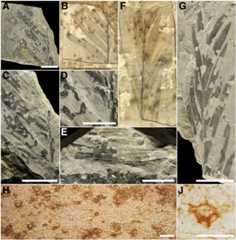
Almargemia dentata from the Lower Cretaceous of Portugal.a-e Several leaflets of the middle portion of a leaf, note the lobe-like teeth on the basiscopic margin of the leaflets, specimen 23,217;f-g More apical portion of a leaf where leaflets are inserted in much lower angles, specimen 23,213, both specimens stored in the Museu Geológico, Lisbon, Portugal;h Overview of lower epidermis, note the intercostal fields separated by a costal field (horizontal, middle of image), specimen S085620;j Close-up of a stoma, specimen S085620, stored in the Swedish Museum of Natural History, Stockholm, Sweden. Scale bars:a,c,g 1 cm;d,e 5 mm;h 100 μm;j 25 μm
Eobowenia incrassata (S.Archang.) M.Coiro et C.Pott comb. nov.
1966Almargemia incrassata – Archangelsky, p. 267; pl. I, Figs. 3, 4; pl. III, Figs. 13, 14; Text-Figs. 6–10, 13.
Diagnosis: As for the genus, with the following additions: Leaflet base with constricted acroscopic margin and decurrent basiscopic margin. Striations are visible in between the veins.
Holotype: LP6255, Museo de Ciencias Naturales, La Plata, Argentina.
Remark on types: Specimen LP6255, published by Archangelsky [43], automatically becomes the holotype of the new combination and the new genus. However, we chose specimen v52265 (a cuticle slide obtained from LP6255) as epitype; it serves as interpretative type because it perfectly presents the combination of characters necessitating the erection of the new genus.
Type locality: Estancia Bajo Grande, Santa Cruz Province, Argentina (not Bajo Tigre as erroneously reported by Archangeslky [43], see [53]).
Type unit and age: Baquero Group, Anfiteatro de Ticó Formation,Auracarites Bed. Lower Cretaceous (Aptian).
Description: Eobowenia incrassata (Fig.2) is represented by two fragmentary specimens [43]. The three (probably terminal) leaflets on specimen v52264 clearly show the serrate margin, the attachment of the leaflets, and the fine striations present between the veins on the leaflets (Fig.2 a). These characters were already identified as diagnostic for the species by Archangelsky [43]. The preserved portions of the leaflets are 7.4–9.3 mm long and up to 3.5 mm wide.
Fig. 2.
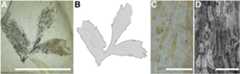
Eobowenia incrassata gen. nov., comb. nov., from the Aptian (Lower Cretaceous) of Patagonia, Argentina.a Overview of an apical leaf fragment (specimen v52264).b Interpretative drawing of the specimen, showing potentially dichotomizing veins.c Light microscopy image of the adaxial cuticle, note the short rows of more heavily cutinised epidermal cells (specimen v52265).d CLSM image of the abaxial cuticle, note the darker staining epidermal cells (specimen v52265). Scale bars:a 10 mm, b 1 mm,c 100 μm
The cuticle fragments examined show that the leaflets are hypostomatic with epidermal pavement cells longitudinally elongated parallel to the leaflet axis (Fig.2 c, d). Ordinary epidermal cells are elongate and moderately cutinised. On the adaxial side, rows of cells with thicker cuticle than the ordinary pavement cells can be observed (darker staining; equivalent to the thin-walled cells of most Zamiaceae (see [54])), which seem to be arranged preferably in rows of short cells. The anticlinal walls of these dark-staining cells tend to be slightly concave. On the abaxial side, rows of darker staining cells as well as single darker staining cells are present. The stomata are confined to the abaxial side and are distributed uniformly in broad intercostal bands on the leaflet surface, with the guard cells oriented longitudinally (Fig.3a,c). Guard cells are in average 38.63 (35.53–42.30) μm long and 17.90 (16.86–19.71) μm wide, with an aperture that is 20.89 (14.78–23.98) μm long. The stomatal complexes are monocyclic, with four to six subsidiary cells that have a thicker, darker staining cuticle than the ordinary pavement cells. The cuticle of the guard cells presents a ventral thickening in the correspondence of the aperture as well as ridges that run parallel to the dorsal wall (Fig.2 d; Fig.3 c, e; Fig.4 a). In some stomatal complexes, is possible to observe differentially thickened or perforated cell walls, which are similar to the cell wall of the substomatal complex in extantBowenia (Fig.2 d; Fig.3 e).
Fig. 3.
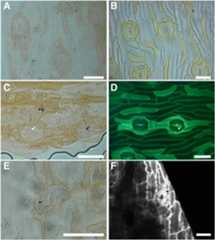
Comparison between the cuticle ofEobowenia incrassata (a,c,e, specimen v52265) andBowenia spectabilis (b,d,f).a Stomata on the abaxial cuticle ofEobowenia incrassata, showing the monocyclic architecture and the darker-staining pavement cells. The thickenings of the substomatal complexes are preserved under some stomata.b Stomata on the abaxial cuticle ofBowenia spectabilis, showing similar monocyclic stomatal architecture and the darker-staining (thickly cutinised) pavement cells.c Detail of two stomatal complexes inEobowenia incrassata. The distal thickening (blue arrow) and the marginal ridge (white arrow) are clearly shown.d Detail of the stomatal complex inBowenia spectabilis. Distal thickening (blue arrow) and the marginal ridge (white arrow) are present in the cuticle of the guard cells.e Detail of a stomatal complex inEobowenia incrassata showing the partially preserved substomatal complex with secondary thickenings (black arrow).f The substomatal complex shown in a confocal stack of PI-stained leaflets ofBowenia spectabilis. Thickenings are indicated by the black arrow.b andd are light micrographs (b) or fluorescence pictures (d) of the cleared cuticle ofBowenia spectabilis. Scale bars: 50 μm
Fig. 4.

Comparison between the stomatal complexes ofEobowenia incrassata (a, specimen v52265),Bowenia spectabilis (b),Almargemia dentata (c, specimen S085614) andMacrozamia plurinervia (d).a Stomatal complex inEobowenia incrassata with flush guard cells, thickening of the apertural cuticle of the guard cells and cuticular ridge.b Stomatal complex inBowenia spectabilis, showing similarities toEobowenia.c Stomatal complex inAlmargemia dentata, showing the sunken guard cells.d Stomatal complex inMacrozamia heteromera, showing similarly sunken guard cells.a andb are maximum intensity projections of confocal stacks,c a light micrograph andd a fluorescence micrograph. Scale bars: 50 μm
Remarks: The characters that separate the fossils assigned toAlmargemia incrassata from those assigned toA. dentata and link the former withBowenia are depicted in Table1. The allocation ofA. incrassata to the new genusEobowenia retainsA. dentata as the only representative ofAlmargemia.
Table 1.
Summary of the characters distinguishingAlmargemia dentata, Eobowenia incrassata andBowenia
| Species | Venation | Teeth | Guard cells | Stomatal apparatus | Stomatal orientation |
|---|---|---|---|---|---|
| Almargemia dentata (Heer) Florin | Parallel | Lobe-like | Sunken | Dicyclic | Random |
| Eobowenia incrassata (S.Archang.) M.Coiro et C.Pott | Convergent at the base | Simple, glandular? | Level with epidermis | Monocyclic | Longitudinal |
| Bowenia serrulata (W.Bull) Chamb. | Convergent at the base | Simple | Level with epidermis | Monocyclic | Longitudinal |
| Bowenia spectabilis Hook. ex Hook.f. | Convergent at the base | Absent-simple | Level with epidermis | Monocyclic | Longitudinal |
| Bowenia papillosa R.S.Hill | ? | ? | Level with epidermis | Monocyclic | Longitudinal |
| Bowenia eocenica R.S.Hill | Convergent at the base | Simple | Level with epidermis | Monocyclic | Longitudinal |
Phylogenetic analyses
The MP analysis of the modified morphological matrix of Martinez et al. [48] resulted in 242 equally parsimonious trees of 196 steps. In the strict consensus tree,Bowenia andEobowenia are in a polytomy with most of the other fossil taxa. This is due to the uncertainty in the placement ofStangeria andMesodescolea, which could be equally parsimoniously placed as sister toEobowenia plusBowenia, sister toBowenia alone withEobowenia as sister to this clade, or in a clade with other fossil taxa (Kurtziana,Pseudoctenis,Sueria,Mesosingeria). In the bootstrap analysis, a sister group includingEobowenia andBowenia does not receive support, being retrieved in only 50% of the bootstrap replicates. Forcing the molecular backbone constraint from Salas-Leiva et al. [7] on the modified morphological matrix of Martinez et al. [48] results in 594 trees of 222 steps. In the consensus tree, only a few relationships are resolved, butBowenia andEobowenia result sister taxa. In the Bayesian consensus tree of the morphology-only analysis, a clade includingEobowenia as sister toBowenia,Stangeria andMesodescolea receives a weak support (0.62 posterior probability).
The MP analysis of the combined matrix resulted in 368 trees of 2925 steps. The consensus tree is poorly resolved, butEobowenia results sister group to the twoBowenia species. In the bootstrap analysis, this relationship is weakly supported (55% of the bootstrap replicates). The BI analysis of the combined morphological-molecular matrix strongly supports a placement ofEobowenia as sister of the two species ofBowenia (0.91 posterior probability) (Fig.5 b). The presence of flush guard cells (char 50) and the absence of encircling cells (char 53) represent synapomorphies of theEobowenia andBowenia clade in this topology, whereas the presence of a thickened substomatal apparatus (char 89) is ambiguously resolved as either synapomorphic forEbowenia andBowenia or plesiomorphic for all Zamiaceae exceptDioon (Additional file2: Figure S1).
Fig. 5.
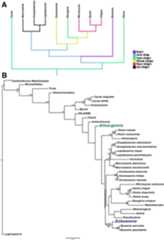
Phylogenetic placement ofEobowenia.a Number of steps necessary to placeEobowenia on a tree based on Salas-Leiva et al. [7] using the modified Martinez et al. [48] matrix. Placement as sister toBowenia results in the shortest trees, but other placements are only marginally less parsimonious.b Consensus with all compatible split from the Bayesian analysis of the modified modified Martinez et al. [48] matrix combined with the Salas-Leiva et al. [7] molecular matrix. Posterior probability more than 0.5 are shown above the branches, and Maximum Parsimony bootstrap support over 50% is shown below the branches
Using the topology from Salas-Leiva et al. [7] as a backbone and movingEobowenia by hand, the shortest tree is obtained withEobowenia as sister toBowenia (131 steps). A placement ofEobowenia as sister toBowenia plus Ceratozaminae and Encephalartinae, sister to Ceratozaminae plus Encephalartinae, or sister to either Encephalartinae or Ceratozaminae is one step longer. Placement as sister toDioon, Cycas, Zamiaceae orStangeria requires two more steps. Placement as sister toCeratozamia, sister toStangeria plusMicrocycas plusZamia plusChigua or sister toMicrocycas plusZamia plusChigua requires three more steps. Placement in any position in theMicrocycas-Zamia clade requires four more steps, and placement in any positions in theMacrozamia-Encephalartos-Lepidozamia clade requires six more steps (Fig.5 a).
Discussion
Our reinvestigation of the original specimens ofAlmargemia incrassata andA. dentata revealed remarkable differences between the two species. These differences necessitated the transfer ofA. incrassata to a different genus, viz.Eobowenia gen. nov.
Comparison of Almargemia dentataand Eobowenia incrassata
The leaves from the Lower Cretaceous of Portugal later referred to by Florin [42] asAlmargemia dentata were first described by Heer [44] asCtenidium dentatum Heer andC. integerrimum Heer. In the generic diagnosis, Heer [44] distinguishedCtenidium fromPtilophyllum andPtilozamites by the decurrent leaf bases and fromCtenis by the absence of vein anastomoses. Florin [42] investigated the epidermal anatomy of the specimens described by Heer [44] in detail and, as a consequence, transferred both species in the new combinationAlmargemia dentata, correctly recognizing that the genus name selected by Heer [44] was pre-occupied by a genus of extant mosses. The main diagnostic epidermal characters ofAlmargemia according to Florin [42] were the predominantly incompletely amphicyclic haplocheilic stomata, arranged irregularly in stomatal bands running between the veins on the abaxial surface of the leaflets, the sunken guard cells and the presence of both weakly and strongly cutinised pavement cells. Macromorphologically, the diagnostic characters included slightly contracted leaflet bases, parallel (rarely dichotomizing) venation and the presence of lobe-like teeth (Fig.1 a, b, e).
When Archangelsky [43] describedEobowenia incrassata (asAlmargemia incrassata), he decided to assign such specimens toAlmargemia on the base of the serrate margin of the leaves (erroneously identified as ‘dentate’ by Archangelsky [43]) and the differently thickened cutinization of the epidermal cells. However, most of the other diagnostic characters ofA. dentata are absent inE. incrassata (Table1). The stomatal characters are strikingly different (Fig.4), withE. incrassata having guard cells at the same level of the epidermal cells, monocyclic stomatal complexes and longitudinally oriented guard cells, whileAlmargemia dentata has stomata sunken below the epidermal level, as in most extant Zamiaceae, incompletely amphicyclic stomatal complexes and randomly oriented guard cells. To use only the differentially thickened cutinisation of the epidermal cells is, in our opinion, too weak a character to assign the fossils in question (viz.Eobowenia incrassata) toAlmargemia, because of their common presence in most members of extant Zamiaceae [34,41,54]. Moreover, the dentation of the margin in the two species is quite different, withE. incrassata having relatively small, acute teeth andA. dentata having larger, lobe-like teeth. For these reasons, we reconsider the allocation made by Archangelsky [43] by erecting a new genus because a new generic definition is needed for this fossil taxon.
Comparison of Eobowenia incrassatawith other fossil cycadophytes
The leaves ofEobowenia incrassata are easily distinguishable from all other cycadalean leaf taxa described from the Baquero Group (i.e.Ticoa,Mesosingeria,Mesodescolea,Sueria; [40,43]) by their leaf shape and epidermal anatomy (see [40,43]). Among other Mesozoic cycadophyte leaves with parallel venation,E. incrassata differs fromPseudoctenis [55] by its basally converging veins, the serrate margin and by epidermal characters (i.e. guard cells at the same level as the epidermal cells, darker-staining pavement cells, longitudinally elongated pavement cells), and fromCtenis [55] by the absence of vein anastomoses as well as the very different cuticle. It differs from segmentedNilssonia leaves [55] by the lateral attachment of the leaflets and the anatomy of the cuticle and fromEncephalartites by the leaf base that is contracted only on the acroscopic side, and by the oblong leaflets.Eobowenia incrassata is distinguished from any segmented bennettitalean leaf by the haplocheilic architecture of the stomata in contrast to the syndetocheilic architecture characterising bennettitalean leaves [19,14].
A similar combination of differentially thickened epidermal cells, monocyclic stomatal complexes and guard cells at the same level with the aperture is present in some species assigned to the tentative pteridosperm genusStenopteris. Monocyclic stomatal complexes with differentiated subsidiaries are present inS. nana T.M.Harris from the Bajocian of Yorkshire [55], but the overall morphology of the leaf easily distinguishes this species fromEobowenia incrassata. Another interesting species isS. cyclostoma K.Saiki, T.Kimura et J.Horiuchi, from the Lower Cretaceous Choshi Group of Japan [56]. The cuticle of this species presents many similarities withE. incrassata including the rows of dark staining cells [56], but presents a very dissimilar morphology of the leaf. However, there are differences even at the cuticular level, withS. cyclostoma being clearly amphistomatic and having an external vestibulum. Moreover, we were not able to identify the peculiar perforations of the substomatal complexes in the illustrations of Saiki et al. [56]. The cycad-like characters ofS. cyclostoma are definitely interesting, but a more thorough discussion would include a revision of the morphology of the entire genus, and falls outside the scope of the present investigation.
Comparison of Eoboweniaand Bowenia
Our reinvestigation pinpoints numerous similarities betweenEobowenia incrassata and the extant cycad genusBowenia (Table1). Among the most interesting characters are the flush guard cells, which clearly separateEobowenia fromAlmargemia dentata as well as from all Zamiaceae and Cycadaceae sensu Stevenson [6] (Fig4, Additional file3: Figure S2; Additional file4: Figure S3; Additional file5: Figure S4; Additional file6: Figure S5; Additional file7: Figure S6). The cuticle of the guard cells also presents cuticular thickenings both on the dorsal and ventral surfaces, and single cuticular ridges running parallel to the dorsal wall of the guard cells (Fig.3 c, d; Fig.4 a, b), the monocyclic stomatal complexes (Fig.3 a, c), and the presence of substomatal cell complexes with secondarily thickened walls (Fig.3 e). The first set of characters is present among extant cycads inBowenia andStangeria, with some differences between the two genera [34]. Monocyclic stomatal complexes with stomata at the same level with the epidermis are restricted in extant Zamiaceae toBowenia [41,57,58] (Additional file6: Fig. S4). The perforations associated with some of the stomatal complexes inEobowenia incrassata presents some striking similarities to the substomatal complex inBowenia, which present secondarily thickened cell walls. This structure was interpreted by Greguss [34] as a perforation of the subsidiary cells, not dissimilar to the condition present inCycas [54], where all epidermal cells present perforations of the inner periclinal wall. The structures inEobowenia incrassata more closely resemble the structures inBowenia (which also occur but are less developed in some species ofEncephalartos andMacrozamia; see Additional file7: Figure S6) in being mostly restricted to the substomatal complexes (Fig.3 e, f). The main difference between the epidermis/cuticles ofEobowenia incrassata andBowenia is the presence of files of short cells with thickened cuticle in the former. This character has been compared to the state present inCeratozamia [57] by Kvaček [28], where files of short, dark-staining cells are present on both surfaces of the leaflets. However, the slightly concave and sometimes wavy anticlinal cell walls of the dark-staining cells is closer to the cuticle of the cell files present inDioon (Additional file3: Figure S2 C, D) [41]. Darker staining cells are present inBowenia, but they are organised as single or small groups of cells, commonly of the same length as the other epidermal cells (Fig.3 b, d).
Eobowenia andBowenia not only share significant and interesting characters in epidermal and cuticular anatomy, but also share commonalities at the macromorphological level, one being the serrate leaflet margin, which occurs in many extant cycads, such as some species ofZamia andStangeria (Fig.6). Marginal teeth are also present in a few species ofEncephalartos (Fig.6 b). InBowenia, a serrate margin is present in bothB. serrulata (Fig.6 a) and individuals ofB. spectabilis Hook. ex Hook.f. growing in more open environments [59], as well as in the fossilB. eocenica R.S.Hill [29] and other fossil members of the genus that have not yet been formally described [33]. The thickened, almost glandular-like aspect of the teeth inEobowenia is compatible with the situation present in extant (Fig.6) as well as fossil cycads (i.e.Restrepophyllum, [38]). In extant cycads, the thickened aspect of the tooth is given by a concentration of marginal fibres. The teeth inAlmargemia dentata, on the other hand (Fig.1) remind more closely of the lobe-like teeth present in some species ofEncephalartos (Fig.6 e). The basally converging veins in the leaflets are another character shared betweenEobowenia incrassata andBowenia. This character is also present in members ofZamia, butZamia has articulated leaflets in contrast to the decurrent insertion of the leaflets inBowenia andEobowenia. The striations on the leaflets ofEobowenia remind of similar striations present in fossil representatives ofBowenia (described by [29] as “veinlets”), which correspond to interspersed fibres in the leaflets of extantBowenia.
Fig. 6.
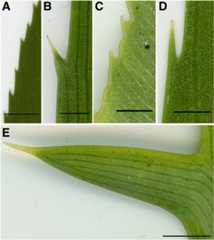
Details of teeth in different species of Zamiaceae, showing the “capped” appearance of the teeth and the difference between serrated margins, dentate margins and lobe-like teeth.a Leaf margin ofBowenia serrulata.b Leaf margin ofEncephalartos manikensis.c Leaf margin ofStangeria eriopus.d Leaf margin ofZamia neurophyllidia.d Leaf margin ofEncephalartos horridus, showing the lobe-like tooth. Scale bars:a,e 1 cm;b,c,d 0.25 cm
However,Bowenia andEobowenia also differ in details that are mainly restricted to the morphology of their leaflets. All extant and extinct species ofBowenia are characterised by dichotomous venation, with veins ending at the margin. In the species with serrate leaflet margin, the veins commonly end in the teeth. InEobowenia, the details of the venation are not clear from the material available, even if some dichotomies are potentially present on the specimen (Fig.2 a, b).
Another striking difference betweenEobowenia andBowenia lies in the size of the leaflets. The two extant species ofBowenia have leaflets with length varying from 9 to 14 cm [59], which are markedly larger than the 0.6–1.0 cm long leaflets ofEobowenia. However, fossil leaves assigned toBowenia commonly have rather short leaflets (e.g.B. eocenica andB. papillosa R.S.Hill: 3–4 cm; [33]). ExtantBowenia is characterised by bipinnate leaves, which are an autapomorphy of the genus, while the fragmentary nature of the leaflets ofE. incrassata does not allow us to evaluate the character in this taxon.
Despite the striking similarities presented betweenEobowenia incrassata andBowenia, we refrain from assigning the specimens toBowenia, mainly in the light of the differences outlined above, and considering the institution of the new genusEobowenia to represent the best solution for the accommodation of this fossil taxon.
On the other hand, the differences and uncertainties in macromorphological characters do not preclude a relationship between the two genera. Regarding, for example, leaflet size, size variation is not uncommon among extant and fossil Cycadales. For example, in extantZamia, leaflet length can vary from 1 to 8 cm inZ. pygmaea Sims [60] to 30–60 cm inZ. wallisii A.Braun. In the fossil genusCtenis, leaflet length can vary from 1.5–3.5 cm inC. nathorstii Moeller [42] to 15–20 cm inC. kaneharai Yokoyama [55].
Phylogenetic evidence for the placement of Eoboweniaand Almargemia
Our investigation is not the first to hypothesise a link betweenEobowenia (Almargemia) incrassata andBowenia. In their phylogenetic analysis of extant and fossil cycads, Martinez et al. [48] retrieved a maximum parsimony tree withAlmargemia (predominantly coded afterA. incrassata) as sister toBowenia plusStangeria andMesodescolea. However, such relationship does not receive any support from the bootstrap analysis, and it is not retrieved in other analyses of morphology, which considerAlmargemia predominantly coded forA. incrassata [61,62].
Using the topology from Salas-Leiva et al. [7] and the modified matrix from Martinez et al. [48] as a backbone, the best placement forEobowenia is as sister toBowenia (Fig.5 a). However, alternative placements are possible at the cost of only one or two steps more. This could be due to the low number of characters coded forEobowenia (21 characters out of 89), and the few informative epidermal characters linking the different clades of the Zamiaceae. If we consider the placements which are only one step longer, these placements imply that the unique characters of the stomatal complex ofEobowenia (guard cells at level with epidermis and monocyclic stomatal complexes) either evolved independently in this taxon and inBowenia (ifEobowenia is placed as sister to the Ceratozaminae or the Encephalartinae), or represent a potentially plesiomorphic status of all Zamiaceae exceptDioon. This would imply that all the similarities of the stomatal complexes of the Encephalartinae andDioon could represent parallel evolution of sunken, protected guard cells.
Our phylogenetic analyses based on the Martinez et al. [48] matrix retrieve a relationship betweenEobowenia andBowenia in both the MP and BI analyses of the morphological data, withEobowenia being sister to the Stangeriaceae sensu Stevenson [6] but such relationships only receive low support in the BI analysis. In the MP analysis this is partially due to the uncertainties surrounding the relationships betweenBowenia andStangeria and many other fossil taxa with peculiar character combinations, such asKurtziana, Mesosingeria, Sueria andPseudoctenis. When information from the molecular analysis of Salas-Leiva et al. [7] is added, resulting in the breakup of the Stangeriaceae,Eobowenia is preferentially retrieved as sister toBowenia instead ofStangeria. The characters linkingEobowenia andBowenia in these topologies regard the unique structure of the stomatal apparatus, which combines the flush guard cells with the lack of encircling cells. The combined analysis using a Bayesian framework retrieves the strongest support for the sister relationship of the two genera. This is in our knowledge the first attempt of integrating morphology and molecular data in a matrix that includes fossil taxa in the Cycadales, and shows the potential of this practice to resolve some of the uncertainties in the relationships between extant and fossil cycads.
The placement ofAlmargemia, on the other hand, is much more uncertain, with no clear placement in any of the analyses. However, a sister relationship betweenEobowenia andAlmargemia is never retrieved.
Our phylogenetic analyses show that the link betweenEobowenia andBowenia is the best hypothesis to explain the relationship between the fossil taxon and the diversity of the Cycadales, even when adopting a conservative approach to its macromorphological character coding. Such phylogenetic evidence, which is lacking for many fossil cycads that have been linked with extant groups, such asRestrepophyllum [38] andAustrozamia [25], as well as for the many fossil leaves assigned to extant genera [21–24,26–28], makeEobowenia a reliably placed cycad fossil foliage.
Such a placement is also compatible with at least some of the inferred age for the divergence ofBowenia based on molecular dating. The age of the deposition of the Anfiteatro de Ticó Formation, whereEobowenia is found, is very well constrained to 118.23 ± 0.09 Ma [63] or 116.85 ± 0.26 Ma [64] representing an Aptian (Lower Cretaceous) age, which is compatible with the ages inferred for the stem ofBowenia by Nagalingum et al. [17] using a relaxed log-normal clock and by Condamine et al. [16] using the favoured birth-death prior with both the calibration implemented, but is older than the dates retrieved by Salas-Leiva et al. [7] (Table2). This probable early divergence of the genusBowenia is, however, compatible with the phylogenetic placement retrieved by the multilocus analysis of Salas-Leiva et al. [7], which seesBowenia as sister to all the other Zamiaceae apart fromDioon. A Cretaceous stem history ofBowenia/Eobowenia is also compatible with the presence of cuticle indistinguishable from modernBowenia in the Upper Cretaceous of Central Australia [32].
Table 2.
Summary of the dates of divergence betweenBowenia and its sister group in the more recent phylogenetic analyses that included a molecular dating analyses
Eoboweniaand the biogeography of Bowenia
The occurrence of a potential sister ofBowenia in the Early Cretaceous of Patagonia helps to strengthen some of the hypotheses around the biogeography ofBowenia. Until now, the phylogenetic isolation ofBowenia, as well as the presence of fossil records limited to Australia, had complicated the resolution of the biogeography of the genus. Indeed, Salas-Leiva et al. [7] retrieved two different results in their analysis: using S-DIVA, they retrieved an ancestral area including Australia, Africa and Mexico for the stem ofBowenia, while their DEC analysis hypothesises a model of stasis in Australia. The presence ofEobowenia in Patagonia during a period of connectivity between southern America and Australasia supports the hypothesis of a Gondwanan distribution for the stem of the group, with subsequent extinction shaping the current Australian endemic distribution.Bowenia would indeed represent yet another case of eastern survival [65]. Even if we know that some cycads persisted in southern South America until the Palaeocene [25], the identification of the precise timing of the extinction ofEobowenia in South America is hindered by the potential rarity of this fossil leaf type in the record. However, it is clear that this fossil represents another important clue to the biogeography of Gondwana coming from Patagonia [20].
Conclusions
Based on our reinvestigation, we conclude that the leaves assigned by Archangelsky [43] toAlmargemia incrassata are best accommodated in the new genusEobowenia. A phylogenetic analysis indicated thatEobowenia could represent the sister group of extantBowenia. This placement bears interesting implications for the biogeography ofBowenia, which could represent another example of an Australian relict of a previously widespread Gondwanan taxon.
Additional files
List of the species with accession numbers and provenance used as comparative material in this study. MBC: Montgomery Botanical Center; NAP: Orto Botanico di Napoli; Z: Herbarium Zurich. (DOCX 14 kb)
Maximum parsimony reconstruction of character evolution on the combined molecular-morphological Bayesian tree for character 50 (A), 53 (B) and 89 (C). (PDF 97 kb)

Isolated cuticles ofCycas rumphii (A, B) andDioon merolae (C, D) stained with Auramine O. Scale bar: 100 μm. (PNG 2853 kb)

Isolated cuticles ofCeratozamia mexicana (A, B), andStangeria eriopus (C, D),Microcycas calocoma (E, F) andZamia portoricensis (G, H) stained with Auramine O. Scale bar: 100 μm. (PNG 5239 kb)

Isolated cuticles ofMacrozamia plurinervia (A, B),Lepidozamia hopei (C, D), andEncephalaros manikensis (E, F) stained with Auramine O. Scale bar: 100 μm. (PNG 3705 kb)

Stomatal complexes ofStangeria eriopus (A), andBowenia spectabilis (B). Encircling cells (ec) and subsidiary cells (sc) are underlined. Scale bar: 100 μm. (PNG 1008 kb)
Epifluorescence micrograph of partially digested epidermis ofEncephalartos ferox (A) andMacrozamia plurinervia (B), showing the presence of a thickened substomatal apparatus. (TIFF 3701 kb)
Zip file containing matrices and trees. (ZIP 1603 kb)
Acknowledgements
MC acknowledges H. Peter Linder, University of Zurich, Zurich, Switzerland, for his fundamental support to this work. We thank Peta Hayes, NHM, London, UK, for the assistance with the collections at the NHM. Tomasz Goral, ibid., is acknowledged for assistance with confocal microscopy at the NHM. We thank Mario Mendes, Universidade do Algarve, Faro, Portugal, for making the specimens ofAlmargemia dentata available, and Johannes M. Bouchal, NRM, for taking pictures of the hand specimens. We would like to thank Hanna Neuenschwander, University of Zurich, for preparing some of the extant cuticles. Confocal imaging of extant material was performed with equipment maintained by the Centre for Microscopy and Image Analysis, University of Zurich, Zurich, Switzerland. We thank James Mickle, North Carolina State University, Raleigh, NC, USA, Patrick Griffith and Michael Calonje, Montgomery Botanical Garden, Coral Gables, Florida, USA, for providing samples from the Montgomery Botanical Garden, and Paolo Caputo, University of Naples, Naples, Italy, for the permission to access and sample the collections of the Botanical Garden of the University of Naples. Maria Rosaria Barone Lumaga, University of Naples, Naples, Italy, is acknowledged for her support to the project and the discussion about characters in extant cycads. Sergio Archangelsky, Museo Argentino de Ciencias Naturales “Bernardino Rivadavia”, Buenos Aires, Argentina, is thanked for comments on the manuscript. Guy Atchison, University of Zurich, Zurich is thanked for stylistic and linguistic suggestions. We strongly appreciate the constructive suggestions of the editor and two anonymous reviewers that greatly helped to improve the manuscript.
Funding
The visits of MC to NRM and NHM were funded by the European Union’s Seventh Framework Programme (FP7/2007–2013) under grant agreement n 226,506 (SYNTHESYS projects SE-TAF-5774 and GB-TAF-5763). CP acknowledges funding from the Swedish Research Council (Vetenskapsrådet), Stockholm, Sweden, under grant number 621-2012-4375.
Availability of data and materials
All data generated or analysed during this study are included in this published article, its Additional files1,2,3,4,5,6,7,8.
Authors’ contributions
MC designed the study. MC and CP collected data and analysed the specimens and the data, and MC wrote the manuscript with inputs from CP. Both authors read and approved the final manuscript.
Competing interests
The authors declare that they have no competing interests.
Consent for publication
Not applicable.
Ethics approval and consent to participate
Not applicable.
Publisher’s Note
Springer Nature remains neutral with regard to jurisdictional claims in published maps and institutional affiliations.
Abbreviations
- BI
Bayesian Inference
- MP
Maximum parsimony
- NHM
Natural History Museum, London
- NRM
Swedish Museum of Natural History
Contributor Information
Mario Coiro, Email: mario.coiro@systbot.uzh.ch.
Christian Pott, Email: christian.pott@nrm.se.
References
- 1.Bateman RM, Hilton J, Rudall PJ. Morphological and molecular phylogenetic context of the angiosperms: contrasting the ‘top-down’ and ‘bottom-up’ approaches used to infer the likely characteristics of the first flowers. J Exp Bot. 2006;57:3471–3503. doi: 10.1093/jxb/erl128. [DOI] [PubMed] [Google Scholar]
- 2.Brenner ED, Stevenson DW, Twigg RW. Cycads: evolutionary innovations and the role of plant-derived neurotoxins. Trends Plant Sci. 2003;8:446–452. doi: 10.1016/S1360-1385(03)00190-0. [DOI] [PubMed] [Google Scholar]
- 3.Hilton J, Bateman RM. Pteridosperms are the backbone of seed-plant phylogeny. J Torrey Bot Soc. 2006;133:119–168. doi: 10.3159/1095-5674(2006)133[119:PATBOS]2.0.CO;2. [DOI] [Google Scholar]
- 4.Calonje M, Stevenson DW, Stanberg L. The World List of Cycads, online edition [Internet]. 2013–2016.http://www.cycadlist.org. Accessed 24 Jul 2016.
- 5.Johnson LAS. The families of cycads and the Zamiaceae of Australia. Proc Linn Soc NSW. 1959;84:64–117. [Google Scholar]
- 6.Stevenson DW. A formal classification of the extant cycads. Brittonia. 1992;44:220–223. doi: 10.2307/2806837. [DOI] [Google Scholar]
- 7.Salas-Leiva DE, Meerow AW, Calonje M, Griffith MP, Francisco-Ortega J, Nakamura K, Stevenson DW, Lewis CE, Namoff S. Phylogeny of the cycads based on multiple single-copy nuclear genes: congruence of concatenated parsimony, likelihood and species tree inference methods. Ann Bot. 2013;112:1263–1278. doi: 10.1093/aob/mct192. [DOI] [PMC free article] [PubMed] [Google Scholar]
- 8.Harris TM. The fossil cycads. Palaeontology. 1961;4:213–223. [Google Scholar]
- 9.Pott C, McLoughlin S, Lindström A, Wu S, Friis EM. Baikalophyllum lobatum and Rehezamites anisolobus: Two seed plants with “cycadophyte” foliage from the Early Cretaceous of eastern Asia. Int J Plant Sci. 2012;173:192–208. doi: 10.1086/663276. [DOI] [Google Scholar]
- 10.Harris TM. The Yorkshire Jurassic flora: III, Bennettitales. London: British Museum (Natural History); 1969. [Google Scholar]
- 11.McLoughlin S, Pott C. Harvesting the extinct Bennettitales. Deposit Magazine. 2009;19:16–20. [Google Scholar]
- 12.McLoughlin S, Pott C. The Jurassic flora of Western Australia. GFF. 2009;131:113–136. doi: 10.1080/11035890902857846. [DOI] [Google Scholar]
- 13.Bomfleur B, Pott C, Kerp H. Plant assemblages from the Shafer Peak Formation (Lower Jurassic), north Victoria Land, Transantarctic Mountains. Antarct. Sci. 2011;23:118–208. [Google Scholar]
- 14.Pott C, McLoughlin S. Bennettitalean foliage in the Rhaetian–Bajocian (latest Triassic–Middle Jurassic) floras of Scania, southern Sweden. Rev Palaeobot Palynol. 2009;158:117–166. doi: 10.1016/j.revpalbo.2009.08.004. [DOI] [Google Scholar]
- 15.Pott C, McLoughlin S. Divaricate growth habit in Williamsoniaceae (Bennettitales): unravelling the ecology of a key Mesozoic plant group. Palaeobiodiv. Palaeoenviron. 2014;94:307–325. doi: 10.1007/s12549-014-0157-9. [DOI] [Google Scholar]
- 16.Condamine FL, Nagalingum NS, Marshall CR, Morlon H. Origin and diversification of living cycads: a cautionary tale on the impact of the branching process prior in Bayesian molecular dating. BMC Evol Biol. 2015;15:1. doi: 10.1186/s12862-015-0347-8. [DOI] [PMC free article] [PubMed] [Google Scholar]
- 17.Nagalingum NS, Marshall CR, Quental TB, Rai HS, Little DP, Mathews S. Recent synchronous radiation of a living fossil. Science. 2011;334:796–799. doi: 10.1126/science.1209926. [DOI] [PubMed] [Google Scholar]
- 18.Treutlein J, Wink M. Molecular phylogeny of cycads inferred from rbcL sequences. Naturwissenschaften. 2002;89:221–225. doi: 10.1007/s00114-002-0308-0. [DOI] [PubMed] [Google Scholar]
- 19.Xing Y, Onstein RE, Carter RJ, Stadler T, Linder HP. Fossils and a large molecular phylogeny show that the evolution of species richness, generic diversity, and turnover rates are disconnected. Evolution. 2014;68:2821–2832. doi: 10.1111/evo.12489. [DOI] [PubMed] [Google Scholar]
- 20.Wilf P, Escapa IH. Green Web or megabiased clock? Plant fossils from Gondwanan Patagonia speak on evolutionary radiations. New Phytol. 2015;207:283–290. doi: 10.1111/nph.13114. [DOI] [PubMed] [Google Scholar]
- 21.Su K, Quan C, Liu YSC. Cycas fushunensis sp. nov. (Cycadaceae) from the Eocene of northeast China. Rev Palaeobot Palynol. 2014;204:43–49. doi: 10.1016/j.revpalbo.2014.02.008. [DOI] [Google Scholar]
- 22.Carpenter RJ. Macrozamia from the early Tertiary of Tasmania and a study of the cuticles of extant species. Aust Syst Bot. 1991;4:433–444. doi: 10.1071/SB9910433. [DOI] [Google Scholar]
- 23.Cookson IC. On Macrozamia hopeites-an early Tertiary cycad from Australia. Phytomorphology. 1953;3:306–312. [Google Scholar]
- 24.Hill RS. Three new Eocene cycads from eastern Australia. Aust J Bot. 1980;28:105–122. doi: 10.1071/BT9800105. [DOI] [Google Scholar]
- 25.Wilf P, Stevenson DW, Cúneo NR. The last Patagonian cycad, Austrozamia stockeyi gen. et sp. nov., early Eocene of Laguna del Hunco, Chubut, Argentina. Botany. 2016;94:817–829. doi: 10.1139/cjb-2016-0038. [DOI] [Google Scholar]
- 26.Kvaček Z. A new Tertiary Ceratozamia (Zamiaceae, Cycadopsida) from the European Oligocene. Flora. 2002;197:303–316. doi: 10.1078/0367-2530-00044. [DOI] [Google Scholar]
- 27.Kvaček Z. A noteworthy cycad, Ceratozamia hofmannii Ettingshausen 1887, from the Lower Miocene of Austria re-examined. Neues Jahrb Geol Paläontol, Monatshefte. 2004;2:111–118. [Google Scholar]
- 28.Kvaček Z. New fossil records of Ceratozamia (Zamiaceae, Cycadales) from the European Oligocene and lower Miocene. Acta Palaeobot. 2014;54:231–247. [Google Scholar]
- 29.Hill RS. Two new species of Bowenia Hook, ex Hook.f. from the Eocene of eastern Australia. Aust J Bot. 1978;26:837–846. doi: 10.1071/BT9780837. [DOI] [Google Scholar]
- 30.Carpenter RJ, Jordan GJ, Macphail MK, Hill RS. Near-tropical early Eocene terrestrial temperatures at the Australo-Antarctic margin, western Tasmania. Geology. 2012;40:267–270. doi: 10.1130/G32584.1. [DOI] [Google Scholar]
- 31.Pole M. Early Eocene dispersed cuticles and mangrove to rainforest vegetation at Strahan-Regatta Point, Tasmania. Palaeontol Electron. 2007;10:1–66. [Google Scholar]
- 32.Carpenter RJ, Macphail MK, Jordan GJ, Hill RS. Fossil evidence for open, Proteaceae-dominated heathlands and fire in the Late Cretaceous of Australia. Am J Bot. 2015;102:2092–2107. doi: 10.3732/ajb.1500343. [DOI] [PubMed] [Google Scholar]
- 33.Hill KE. Adaptation and acclimation of leaf traits to environmental change in time and space. Australia: University of Adelaide; 2015. [Google Scholar]
- 34.Greguss P. Xylotomy of the living cycads with a description of their leaves and epidermis. Budapest: Akademiai Kiado; 1968. [Google Scholar]
- 35.Stevenson DW. Observations on ptyxis, phenology, and trichomes in the Cycadales and their systematic implications. Am J Bot. 1981;68:1104–1114. doi: 10.2307/2442720. [DOI] [Google Scholar]
- 36.Artabe A, Stevenson D. Fossil Cycadales of Argentina. Bot Rev. 1999;65:219–238. doi: 10.1007/BF02857630. [DOI] [Google Scholar]
- 37.Artabe AE, Archangelsky S. Las Cycadales Mesodescolea Archangelsky emend. Archangelsky y Petriella 1971 (Cretácico) y Stangeria Moore (Actual) Ameghiniana. 1992;29:115–123. [Google Scholar]
- 38.Passalia MG, Del Fueyo G, Archangelsky S. An Early Cretaceous zamiaceous cycad of South West Gondwana: Restrepophyllum nov. gen. from Patagonia, Argentina. Rev Palaeobot Palynol. 2010;161:137–150. doi: 10.1016/j.revpalbo.2010.04.001. [DOI] [Google Scholar]
- 39.Archangelsky A, Andreis RR, Archangelsky S, Artabe A. Cuticular characters adapted to volcanic stress in a new Cretaceous cycad leaf from Patagonia, Argentina. Considerations on the stratigraphy and depositional history of the Baqueró Formation. Rev Palaeobot Palynol. 1995;89:213–233. doi: 10.1016/0034-6667(95)00011-X. [DOI] [Google Scholar]
- 40.Archangelsky S. A new Mesozoic flora from Ticó, Santa Cruz Province, Argentina. Bull Br Mus Nat Hist Geol. 1963;8:45–92. [Google Scholar]
- 41.Barone Lumaga MR, Coiro M, Truernit E, Erdei B, De Luca P. Epidermal micromorphology in Dioon: did volcanism constrain Dioon evolution? Bot J Linn Soc. 2015;179:236–254. doi: 10.1111/boj.12326. [DOI] [Google Scholar]
- 42.Florin R. Studien über die Cycadales des Mesozoikums nebst Erörterungen über die Spaltöffnungsapparate der Bennettitales. Kungl Sven Vetensk Akad Handl. 1933;12:1–134. [Google Scholar]
- 43.Archangelsky S. New gymnosperms from the Tico flora, Santa Cruz province, Argentina. Bull Br Mus Nat Hist Geol. 1966;13:261–295. [Google Scholar]
- 44.Heer O. Contributions à la flore fossile du Portugal. Lisbon: Imprimerie de l’Académie Royale des Sciences; 1881. [Google Scholar]
- 45.Coiro M, Truernit EB. In: Xylem Characterization Using Improved Pseudo-Schiff Propidium Iodide Staining of Whole Mount Samples and Confocal Laser-Scanning Microscopy. Md L, Etchells JP, editors. Xylem: Methods and Protocols; 2017. pp. 127–132. [DOI] [PubMed] [Google Scholar]
- 46.Buda GJ, Isaacson T, Matas AJ, Paolillo DJ, Rose JK. Three-dimensional imaging of plant cuticle architecture using confocal scanning laser microscopy. Plant J. 2009;60:378–385. doi: 10.1111/j.1365-313X.2009.03960.x. [DOI] [PubMed] [Google Scholar]
- 47.Schindelin J, Arganda-Carreras I, Frise E, Kaynig V, Longair M, Pietzsch T, Rueden C, Saalfeld S, Schmid B, Tinevez J-Y, White DJ, Hartenstein V, Eliceiri K, Tomancak P, Cardona A. Fiji: an open-source platform for biological-image analysis. Nat Methods. 2012;9:676–682. doi: 10.1038/nmeth.2019. [DOI] [PMC free article] [PubMed] [Google Scholar]
- 48.Martínez LCA, Artabe AEE, Bodnar J. A new cycad stem from the Cretaceous in Argentina and its phylogenetic relationships with other Cycadales. Bot J Linn Soc. 2012;170:436–458. doi: 10.1111/j.1095-8339.2012.01300.x. [DOI] [Google Scholar]
- 49.Swofford DL. PAUP*4.0b10. Sunderland: Sinauer Associates; 1999. [Google Scholar]
- 50.Ronquist F, Teslenko M, van der Mark P, Ayres DL, Darling A, Höhna S, Larget B, Liu L, Suchard MA, Huelsenbeck JP. MrBayes 3.2: efficient Bayesian phylogenetic inference and model choice across a large model space. Syst Biol. 2012;61:539–542. doi: 10.1093/sysbio/sys029. [DOI] [PMC free article] [PubMed] [Google Scholar]
- 51.Lewis PO. A likelihood approach to estimating phylogeny from discrete morphological character data. Syst Biol. 2001;50:913–925. doi: 10.1080/106351501753462876. [DOI] [PubMed] [Google Scholar]
- 52.Maddison WP, Maddison DR. Mesquite: a modular system for evolutionary analysis. Version 3.03. 2015. [Google Scholar]
- 53.Archangelsky S. Estudio de la formacion Baquero, Cretacico inferior de Santa Cruz, Argentina. Rev Mus La Plata. 1967;5:63–171. [Google Scholar]
- 54.Pant DD, Nautiyal DD. Cuticle and epidermis of recent Cycadales. Leaves, sporangia and seeds. Senckenberg Biol. 1963;44:257–348. [Google Scholar]
- 55.Harris TM. The Yorkshire Jurassic flora: II, Caytoniales, Cycadales & pteridosperms. London: British Museum (Natural History); 1964. [Google Scholar]
- 56.Saiki K, Kimura T, Horiuchi J. Stenopteris cyclostoma Saiki, Kimura et Horiuchi sp. nov.(possible pteridosperm), from the Lower Cretaceous Choshi Group, in the Outer Zone of Japan. Nihon Koseibutsu Gakkai hokoku, kiji. 1991;164:964–972. [Google Scholar]
- 57.Barone Lumaga MR, Moretti A, De Luca P. Morphological aspects of stomata, cuticle and chloroplasts in Ceratozamia kuesteriana Regel (Zamiaceae) Plant Biosyst. 1999;133:47–53. doi: 10.1080/11263509909381531. [DOI] [Google Scholar]
- 58.Thomas HH, Bancroft N. On the cuticles of some recent and fossil cycadean fronds. Trans Linn Soc Lond. 1913;8:155–204. [Google Scholar]
- 59.Wilson GW. The biology and systematics of Bowenia Hook ex. Hook f. (Stangeriaceae: Bowenioideae) Australia: James Cook University; 2004. [Google Scholar]
- 60.Jones DL. Cycads of the World. Washington: Smithsonian; 2002. [Google Scholar]
- 61.Cuneo NR, Escapa I, Villar de Seoane L, Artabe A, Gnaedinger S. Review of the Cycads and Bennettitaleans from the Mesozoic of Argentina. In: Gee CG, editor. Plants in Mesozoic Time. Bloomington: Indiana University Press; 2010. pp. 187–214. [Google Scholar]
- 62.Hermsen EJ, Taylor TN, Taylor EL, Stevenson DW. Cataphylls of the Middle Triassic cycad Antarcticycas schopfii and new insights into cycad evolution. Am J Bot. 2006;93:724–738. doi: 10.3732/ajb.93.5.724. [DOI] [PubMed] [Google Scholar]
- 63.Perez Loinaze VS, Vera EI, Passalia MG, Llorens M, Friedman R, Limarino CO, Césari SN. High-precision U–Pb zircon age from the Anfiteatro de Ticó Formation: Implications for the timing of the early angiosperm diversification in Patagonia. J S Am Earth Sci. 2013;48:97–105. doi: 10.1016/j.jsames.2013.08.005. [DOI] [Google Scholar]
- 64.Passalia MG, Llorens M, Césari SN, Limarino CO, Loinaze VSP, Vera EI. Revised stratigraphic framework of the Cretaceous in the Bajo Grande area (Argentinean Patagonia) inferred from new U–Pb ages and palynology. Cretac Res. 2016;60:152–166. doi: 10.1016/j.cretres.2015.11.004. [DOI] [Google Scholar]
- 65.Wilf P, Cúneo NR, Escapa IH, Pol D, Woodburne MO. Splendid and seldom isolated: the paleobiogeography of Patagonia. Annual Rev Earth Planet Sci. 2013;41:561–603. doi: 10.1146/annurev-earth-050212-124217. [DOI] [Google Scholar]
Associated Data
This section collects any data citations, data availability statements, or supplementary materials included in this article.
Supplementary Materials
List of the species with accession numbers and provenance used as comparative material in this study. MBC: Montgomery Botanical Center; NAP: Orto Botanico di Napoli; Z: Herbarium Zurich. (DOCX 14 kb)
Maximum parsimony reconstruction of character evolution on the combined molecular-morphological Bayesian tree for character 50 (A), 53 (B) and 89 (C). (PDF 97 kb)
Isolated cuticles ofCycas rumphii (A, B) andDioon merolae (C, D) stained with Auramine O. Scale bar: 100 μm. (PNG 2853 kb)
Isolated cuticles ofCeratozamia mexicana (A, B), andStangeria eriopus (C, D),Microcycas calocoma (E, F) andZamia portoricensis (G, H) stained with Auramine O. Scale bar: 100 μm. (PNG 5239 kb)
Isolated cuticles ofMacrozamia plurinervia (A, B),Lepidozamia hopei (C, D), andEncephalaros manikensis (E, F) stained with Auramine O. Scale bar: 100 μm. (PNG 3705 kb)
Stomatal complexes ofStangeria eriopus (A), andBowenia spectabilis (B). Encircling cells (ec) and subsidiary cells (sc) are underlined. Scale bar: 100 μm. (PNG 1008 kb)
Epifluorescence micrograph of partially digested epidermis ofEncephalartos ferox (A) andMacrozamia plurinervia (B), showing the presence of a thickened substomatal apparatus. (TIFF 3701 kb)
Zip file containing matrices and trees. (ZIP 1603 kb)
Data Availability Statement
All data generated or analysed during this study are included in this published article, its Additional files1,2,3,4,5,6,7,8.