



Massive migration from the steppe was a source for Indo-Europeanlanguages in Europe
Wolfgang Haak
Iosif Lazaridis
Nick Patterson
Nadin Rohland
Swapan Mallick
Bastien Llamas
Guido Brandt
Susanne Nordenfelt
Eadaoin Harney
Kristin Stewardson
Qiaomei Fu
Alissa Mittnik
Eszter Bánffy
Christos Economou
Michael Francken
Susanne Friederich
Rafael Garrido Pena
Fredrik Hallgren
Valery Khartanovich
Aleksandr Khokhlov
Michael Kunst
Pavel Kuznetsov
Harald Meller
Oleg Mochalov
Vayacheslav Moiseyev
Nicole Nicklisch
Sandra L Pichler
Roberto Risch
Manuel A Rojo Guerra
Christina Roth
Anna Szécsényi-Nagy
Joachim Wahl
Matthias Meyer
Johannes Krause
Alan Cooper
Kurt Werner Alt
David Reich
To whom correspondence should be addressed: David Reich(reich@genetics.med.harvard.edu)
Contributed equally to this work
Issue date 2015 Jun 11.
Reprints and permissions information is available atwww.nature.com/reprints.
Abstract
We generated genome-wide data from 69 Europeans who lived between8,000–3,000 years ago by enriching ancient DNA libraries for a targetset of almost 400,000 polymorphisms. Enrichment of these positions decreases thesequencing required for genome-wide ancient DNA analysis by a median of around250-fold, allowing us to study an order of magnitude more individuals thanprevious studies1–8 and to obtain new insights aboutthe past. We show that the populations of Western and Far Eastern Europefollowed opposite trajectories between 8,000–5,000 years ago. At thebeginning of the Neolithic period in Europe, 8,000–7,000 years ago,closely related groups of early farmers appeared in Germany, Hungary and Spain,different from indigenous hunter-gatherers, whereas Russia was inhabited by adistinctive population of hunter-gatherers with high affinity to a24,000-year-old Siberian6. By6,000–5,000 years ago, farmers throughout much of Europe had morehunter-gatherer ancestry than their predecessors, but in Russia, the Yamnayasteppe herders of this time were descended not only from the preceding easternEuropean hunter-gatherers, but also from a population of Near Eastern ancestry.Western and Eastern Europe came into contact 4,500 years ago, as the LateNeolithic Corded Ware people from Germany traced 75% of their ancestryto the Yamnaya, documenting a massive migration into the heartland of Europefrom its eastern periphery. This steppe ancestry persisted in all sampledcentral Europeans until at least 3,000 years ago, and is ubiquitous inpresent-day Europeans. These results provide support for a steppeorigin9 of at leastsome of the Indo-European languages of Europe.
Genome-wide analysis of ancient DNA has emerged as a transformative technologyfor studying prehistory, providing information that is comparable in power toarchaeology and linguistics. Realizing its promise, however, requires collectinggenome-wide data from an adequate number of individuals to characterize populationchanges over time, which means not only sampling a succession of archaeologicalcultures2, but also multipleindividuals per culture. To make analysis of large numbers of ancient DNA samplespractical, we used in-solution hybridization capture10,11 to enrich nextgeneration sequencing libraries for a target set of 394,577 single nucleotidepolymorphisms (SNPs) (‘390k capture’), 354,212 of which are autosomalSNPs that have also been genotyped using the Affymetrix Human Origins array in 2,345humans from 203 populations4,12. This reduces the amount of sequencing requiredto obtain genome-wide data by a minimum of 45-fold and a median of 262-fold (Supplementary Data 1). Thisstrategy allows us to report genomic scale data on more than twice the number of ancientEurasians as has been presented in the entire preceding literature1–8(Extended Data Table 1).
We used this technology to study population transformations in Europe. We beganby preparing 212 DNA libraries from 119 ancient samples in dedicated clean rooms, andtesting these by light shotgun sequencing and mitochondrial genome capture (Supplementary Information section 1,Supplementary Data 1). We restricted the analysis to libraries with molecularsignatures of authentic ancient DNA (elevated damage in the terminal nucleotide),negligible evidence of contamination based on mismatches to the mitochondrialconsensus13 and, whereavailable, a mitochondrial DNA haplogroup that matched previous results usingPCR4,14,15 (Supplementary Information section 2). For123 libraries prepared in the presence of uracil-DNA-glycosylase16 to reduce errors due to ancient DNAdamage17, we performed 390kcapture, carried out paired-end sequencing and mapped the data to the human genome. Werestricted analysis to 94 libraries from 69 samples that had at least 0.06-fold averagetarget coverage (average of 3.8-fold) and used majority rule to call an allele at eachSNP covered at least once (Supplementary Data 1). After combining our data (Supplementary Information section 3) with25 ancient samples from the literature — three Upper Paleolithic samples fromRussia1,6,7, sevenpeople of European hunter gatherer ancestry2,4,5,8, and fifteen Europeanfarmers2,3,4,8—we had data from 94 ancient Europeans.Geographically, these came from Germany (n=41), Spain (n=10), Russia(n=14), Sweden (n=12), Hungary (n=15), Italy (n=1) andLuxembourg (n=1) (Extended Data Table 2).Following the central European chronology, these included 19 hunter gatherers(∼43,000–2,600 BC), 28 Early Neolithic farmers(∼6,000–4,000 BC), 11 Middle Neolithic farmers(∼4,000–3,000 BC) including the Tyrolean Iceman3, 9 Late Copper/Early Bronze Age individuals(Yamnaya:∼3,300–2,700 BC), 15 Late Neolithic individuals(∼2,500– 2,200 BC), 9 Early Bronze Age individuals(∼2,200–1,500 BC), two Late Bronze Age individuals(∼1,200–1,100 BC) and one Iron Age individual (∼900 BC). Twoindividuals were excluded from analyses as they were related to others from the samepopulation. The average number of SNPs covered at least once was 212,375 and the minimumwas 22,869 (Fig. 1). We determined that 34 of the69 newly analysed individuals were male and used 2,258 Y chromosome SNPs targetsincluded in the capture to obtain high resolution Y chromosome haplogroup calls (Supplementary Information section4). Outside Russia, and before the Late Neolithic period, only a single R1b individualwas found (early Neolithic Spain) in the combined literature (n=70). Bycontrast, haplogroups R1a and R1b were found in 60% of Late Neolithic/Bronze AgeEuropeans outside Russia (n=10), and in 100% of the samples fromEuropean Russia from all periods (7,500–2,700 BC; n=9). R1a and R1b arethe most common haplogroups in many European populations today18,19, andour results suggest that they spread into Europe from the East after 3,000 BC. Twohunter-gatherers from Russia included in our study belonged to R1a (Karelia) and R1b(Samara), the earliest documented ancient samples of either haplogroup discovered todate. These two hunter gatherers did not belong to the derived lineages M417 within R1aand M269 within R1b that are predominant in Europeans today18,19, butall 7 Yamnaya males did belong to the M269 subclade18 of haplogroup R1b. Principal components analysis (PCA) of allancient individuals along with 777 present-day West Eurasians4 (Fig. 2a,Supplementary Informationsection 5) replicates the positioning of present-day Europeans between the Near East andEuropean hunter-gatherers4,20, and the clustering of early farmers from acrossEurope with present day Sardinians3,4, suggesting that farming expansionsacross the Mediterranean to Spain and via the Danubian route to Hungary and Germanydescended from a common stock. By adding samples from later periods and additionallocations, we also observe several new patterns. All samples from Russia have affinityto the ∼24,000-year-old MA1(ref. 6), thetype specimen for the Ancient North Eurasians (ANE) who contributed to bothEuropeans4 and NativeAmericans4,6,8. The twohunter-gatherers from Russia (Karelia in the northwest of the country and Samara on thesteppe near the Urals) form an ‘eastern European hunter-gatherer’ (EHG)cluster at one end of a hunter-gatherer cline across Europe; people of hunter-gathererancestry from Luxembourg, Spain, and Hungary sit at the opposite ‘westernEuropean hunter-gatherer’4(WHG) end, while the hunter-gatherers from Sweden4,8 (SHG) are intermediate.Against this background of differentiated European hunter-gatherers and homogeneousearly farmers, multiple population turnovers transpired in all parts of Europe includedin our study. Middle Neolithic Europeans from Germany, Spain, Hungary, and Sweden fromthe period, ∼4,000–3,000 BC are intermediate between the earlier farmersand the WHG, suggesting an increase of WHG ancestry throughout much of Europe. Bycontrast, in Russia, the later Yamnaya steppe herders of ∼3,000 BC plot betweenthe EHG and the present-day Near East/Caucasus, suggesting a decrease of EHG ancestryduring the same time period. The Late Neolithic and Bronze Age samples from Germany andHungary2 are distinct from thepreceding Middle Neolithic and plot between them and the Yamnaya. This pattern is alsoseen in ADMIXTURE analysis (Fig. 2b,Supplementary Information section6), which implies that the Yamnaya have ancestry from populations related to theCaucasus and South Asia that is largely absent in 38 Early or Middle Neolithic farmersbut present in all 25 Late Neolithic or Bronze Age individuals. This ancestry appears inCentral Europe for the first time in our series with the Corded Ware around 2,500 BC(Supplementary Informationsection 6,Fig. 2b). The Corded Ware sharedelements of material culture with steppe groups such as the Yamnaya although whetherthis reflects movements of people has been contentious21. Our genetic data provide direct evidence ofmigration and suggest that it was relatively sudden. The Corded Ware are geneticallyclosest to the Yamnaya ∼2,600km away, as inferred both from PCA and ADMIXTURE(Fig. 2) and FST(0.011±0.002) (Extended Data Table 3). Ifcontinuous gene flow from the east, rather than migration, had occurred, we would expectsuccessive cultures in Europe to become increasingly differentiated from the MiddleNeolithic, but instead, the Corded Ware are both the earliest and most stronglydifferentiated from the Middle Neolithic population. ‘Outgroup’f3 statistics6 (Supplementary Information section7),which measure shared genetic drift between a pair of populations (Extended Data Fig. 1), support the clustering ofhunter-gatherers, Early/Middle Neolithic, and Late Neolithic/Bronze Age populations intodifferent groups as in the PCA (Fig. 2a).We alsoanalysed f4 statistics, which allow us to test whether pairs of populationsare consistent with descent from common ancestral populations, and to assesssignificance using a normally distributed Z score. Early European farmers from the Earlyand Middle Neolithic were closely related but not identical. This is reflected in thefact that Loschbour, a WHG individual fromLuxembourg4, shared more alleles with post-4,000 BC European farmers fromGermany, Spain, Hungary, Sweden and Italy than with early farmers of Germany, Spain, andHungary, documenting an increase of hunter-gatherer ancestry in multiple regions ofEurope during the course of the Neolithic. The two EHG form a clade with respect to allother present-day and ancient populations (|Z|<1.9), and MA1shares more alleles with them (|Z|>4.7) than with other ancientor modern populations, suggesting that they may be a source for the ANE ancestry inpresent Europeans4,12,22 asthey are geographically and temporally more proximate than Upper Paleolithic Siberians.The Yamnaya differ from the EHG by sharing fewer alleles with MA1(|Z|=6.7) suggesting a dilution of ANE ancestry between5,000–3,000 BC on the European steppe. This was likely due to admixture of EHGwith a population related to present-day Near Easterners, as the most negativef3 statistic in the Yamnaya (giving unambiguous evidence of admixture) isobserved when we model them as a mixture of EHG and present-day Near Eastern populationslike Armenians (Z=-6.3);Supplementary Information section 7). The Late Neolithic/Bronze Age groupsof central Europe share more alleles with Yamnaya than the Middle Neolithic populationsdo (|Z|=12.4) and more alleles with the Middle Neolithic thanthe Yamnaya do (|Z|=12.5), and have a negative f3statistic with the Middle Neolithic and Yamnaya as references (Z=-20.7),indicating that they were descended from a mixture of the local European populations andnew migrants from the east. Moreover, the Yamnaya share more alleles with the CordedWare(|Z|≥3.6) than with any other Late Neolithic/Early Bronze Agegroup with at least two individuals (Supplementary Information section 7), indicating that they had more easternancestry, consistent with the PCA and ADMIXTURE patterns (Fig. 2). Modelling of the ancient samples shows that while Karelia isgenetically intermediate between Loschbour and MA1, the topology that considers Kareliaas a mixture of these two elements is not the only one that can fit the data (Supplementary Information section8). To avoid biasing our inferences by fitting an incorrect model, we developed newstatistical methods that are substantial extensions of a previously reportedapproach4, which allow us toobtain precise estimates of the proportion of mixture in later Europeans withoutrequiring a formal model for the relationship among the ancestral populations. Themethod (SupplementaryInformation section 9) is based on the idea that if a Test population hasancestry related to reference populations Ref1, Ref2 , …,RefN in proportionsα1,α2,…,αN, and thereferences are themselves differentially related to a triple of outgroup populations A,B, C, then:
Figure 1. Location and SNP coverage of samples included in this study.

(a) Geographic location and time-scale (central European chronology)of the 69 newly typed ancient individuals from this study (black outline) and 25from the literature for which shotgun sequencing data was available (nooutline). (b) Number of SNPs covered at least once in the analysisdataset of 94 individuals.
Figure 2. Population transformations in Europe.

(a) PCA analysis, (b) ADMIXTURE analysis. The fullADMIXTURE analysis including present-day humans is shown inSupplementary Information section6.
By using a large number of outgroup populations we can fit the admixturecoefficients αi and estimate mixture proportions (Supplementary Information section 9,Extended Data Fig. 2). Using 15 outgroups fromAfrica, Asia, Oceania and the Americas, we obtain good fits as assessed by a formal test(Supplementary Informationsection 10), and estimate that the Middle Neolithic populations of Germany and Spainhave ∼18–34% more WHG-related ancestry than Early Neolithicpopulations and that the Late Neolithic and Early Bronze Age populations of Germany have∼22–39% more EHG-related ancestry than the Middle Neolithic ones(Supplementary Informationsection 9). If we model them as mixtures of Yamnaya-related and Middle Neolithicpopulations, the inferred degree of population turnover is doubled to48–80% (SupplementaryInformation sections 9 and 10). To distinguish whether a Yamnaya or an EHGsource fits the data better, we added ancient samples as outgroups (Supplementary Information section 9).Adding any Early or Middle Neolithic farmer results in EHG-related genetic input intoLate Neolithic populations being a poor fit to the data (Supplementary Information section 9); thus,Late Neolithic populations have ancestry that cannot be explained by a mixture of EHGand Middle Neolithic. When using Yamnaya instead of EHG, however, we obtain a good fit(Supplementary Informationsections 9 and 10). These results can be explained if the new genetic material thatarrived in Germany was a composite of two elements: EHG and a type of Near Easternancestry different from that which was introduced by early farmers (also suggested byPCA and ADMIXTURE;Fig. 2,Supplementary Information sections 5 and6). We estimate that these two elements each contributed about half the ancestry of theYamnaya (SupplementaryInformation sections 6 and 9), explaining why the population turnoverinferred using Yamnaya as a source is about twice as high compared to the undiluted EHG.The estimate of Yamnaya related ancestry in the Corded Ware is consistent when usingeither present populations or ancient Europeans as outgroups (Supplementary Information sections 9 and10), and is 73.1±2.2% when both sets are combined (Supplementary Information section 10). Thebest proxies for ANE ancestry in Europe4 were initially Native Americans12,22, and then theSiberian MA1 (ref. 6), but both are geographicallyand temporally too remote for what appears to be a recent migration intoEurope4. We can now add threenew pieces to the puzzle of how ANE ancestry was transmitted to Europe: first by theEHG, then the Yamnaya formed by mixture between EHG and a Near Eastern relatedpopulation, and then the Corded Ware who were formed by a mixture of the Yamnaya withMiddle Neolithic Europeans. We caution that the sampled Yamnaya individuals from Samaramight not be directly ancestral to Corded Ware individuals from Germany. It is possiblethat a more western Yamnaya population, or an earlier (pre-Yamnaya) steppe populationmay have migrated into central Europe, and future work may uncover more missing links inthe chain of transmission of steppe ancestry. By extending our model to a three-waymixture of WHG, Early Neolithic and Yamnaya, we estimate that the ancestry of the CordedWare was 79% Yamnaya-like, 4% WHG, and 17% Early Neolithic(Fig. 3). A small contribution of the firstfarmers is also consistent with uniparentally inherited DNA: for example, mitochondrialDNA haplogroup N1a and Y chromosome haplogroup G2a, common in early central Europeanfarmers14,23, almost disappear during the Late Neolithic andBronze Age, when they are largely replaced by Y haplogroups R1a and R1b (Supplementary Information section 4)andmtDNA haplogroups I,T1,U2,U4, U5a,W, and subtypes of H14,23,24 (Supplementary Information section2). The uniparental data not only confirm a link to the steppe populations but alsosuggest that both sexes participated in the migrations (Supplementary Information sections 2 and 4andExtended Data Table 2). The magnitude of thepopulation turnover that occurred becomes even more evident if one considers the factthat the steppe migrants may well have mixed with eastern European agriculturalists ontheir way to central Europe. Thus, we cannot exclude a scenario in which the Corded Warearriving in today's Germany had no ancestry at all from local populations.
Figure 3. Admixture proportions.

We estimate mixture proportions using a method that gives unbiased estimates evenwithout an accurate model for the relationships between the test populations andthe outgroup populations (Supplementary Information section 9). Population samples are groupedaccording to chronology (ancient) and Yamnaya ancestry (present-day humans).
Our results support a view of European pre-history punctuated by two majormigrations: first, the arrival of the first farmers during the Early Neolithic from theNear East, and second, the arrival of Yamnaya pastoralists during the Late Neolithicfrom the steppe. Our data further show that both migrations were followed by resurgencesof the previous inhabitants: first, during the Middle Neolithic, when hunter-gathererancestry rose again after its Early Neolithic decline, and then between the LateNeolithic and the present, when farmer and hunter-gatherer ancestry rose after its LateNeolithic decline. This second resurgence must have started during the LateNeolithic/Bronze Age period itself, as the Bell Beaker and Unetice groups had reducedYamnaya ancestry compared to the earlier Corded Ware, and comparable levels to that insome present-day Europeans (Fig. 3). Today, Yamnayarelated ancestry is lower in southern Europe and higher in northern Europe, and allEuropean populations can be modelled as a three-way mixture of WHG, Early Neolithic, andYamnaya, whereas some outlier populations show evidence for additional admixture withpopulations from Siberia and the Near East (Extended DataFig. 3,SupplementaryInformation section 9). Further data are needed to determine whether thesteppe ancestry arrived in southern Europe at the time of the Late Neolithic/Bronze Age,or is due to migrations in later times from northern Europe25,26. Ourresults provide new data relevant to debates on the origin and expansion ofIndo-European languages in Europe (Supplementary Information section 11). Although the findings from ancientDNA are silent on the question of the languages spoken by preliterate populations, theydo carry evidence about processes of migration which are invoked by theories onIndo-European language dispersals. Such theories make predictions about movements ofpeople to account for the spread of languages and material culture (Extended Data Fig. 4). The technology of ancient DNA makes itpossible to reject or confirm the proposed migratory movements, as well as to identifynew movements that were not previously known. The best argument for the‘Anatolian hypothesis’27 that Indo-European languages arrived in Europe from Anatolia∼8,500 years ago is that major language replacements are thought to requiremajor migrations, and that after the Early Neolithic when farmers established themselvesin Europe, the population base was likely to have been so large that later migrationswould not have made much of an impact27,28. However, our studyshows that a later major turnover did occur, and that steppe migrants replaced∼75% of the ancestry of central Europeans. An alternative theory is the‘steppe hypothesis’, which proposes that early Indo-European speakerswere pastoralists of the grasslands north of the Black and Caspian Seas, and that theirlanguages spread into Europe after the invention of wheeled vehicles9. Our results make a compelling case for thesteppe as a source of at least some of the Indo-European languages in Europe bydocumenting a massive migration ∼4,500 years ago associated with the Yamnaya andCorded Ware cultures, which are identified by proponents of the steppe hypothesis asvectors for the spread of Indo-European languages into Europe. These results challengethe Anatolian hypothesis by showing that not all Indo-European languages in Europe canplausibly derive from the first farmer migrations thousands of years earlier (Supplementary Information section11). We caution that the location of the proto-Indo-European9,27,29,30 homeland that also gave rise to the Indo-European languages ofAsia, as well as the Indo-European languages of southeastern Europe, cannot bedetermined from the data reported here (Supplementary Information section 11).Studying the mixture in the Yamnaya themselves, and understanding the geneticrelationships among a broader set of ancient and present-day Indo- European speakers,may lead to new insight about the shared homeland.
Online Methods
Screening of libraries (shotgun sequencing and mitochondrial capture)
The 212 libraries screened in this study (Supplementary Information section1) from a total of 119 samples (Supplementary Information section3) were produced at Adelaide (n=151), Tübingen (n=16),and Boston (n=45) (Online Table 1).
The libraries from Adelaide and Boston had internal barcodes directlyattached to both sides of the molecules from the DNA extract so that eachsequence begins with the barcode10. The Adelaide libraries had 5 base pair (bp) barcodes onboth sides, while the Boston libraries had 7 bp barcodes. Libraries fromTübingen had no internal barcodes, but were differentiated by thesequence of the indexing primer31.
We adapted a reported protocol for enriching for mitochondrialDNA10, with thedifference that we adjusted the blocking oligonucleotides and PCR primers to fitour libraries with shorter adapters. Over the course of this project, we alsolowered the hybridization temperature from 65°C to 60°C andperformed stringent washes at 55°C instead of 60°C32.
We used an aliquot of approximately 500ng of each library for targetenrichment of the complete mitochondrial genome in two consecutiverounds32, using a baitset for human mtDNA32. Weperformed enrichment in 96-well plates with one library per well, and used aliquid handler (Evolution P3, Perkin Elmer) for the capture and washingsteps33. We usedblocking oligonucleotides in hybridization appropriate to the adapters of thetruncated libraries. After either of the two enrichment rounds, we amplified theenriched library molecules with the primer pair that keeps the adapters short(PreHyb) using Herculase Fusion II PCR Polymerase. We performed an indexing PCRof the final capture product using one or two indexing primers31. We cleaned up allPCR's using SPRI technology34 and the liquid handler. Libraries from Tübingenwere amplified with the primer pair IS5/IS631.
For libraries from Boston and Adelaide, we used a second aliquot of eachlibrary for shotgun sequencing after performing an indexing PCR31. We used unique indexcombinations for each library and experiment, allowing us to distinguish shotgunsequencing and mitochondrial DNA capture data, even if both experiments were inthe same sequencing run. We sequenced shotgun libraries and mtDNA capturedlibraries from Tübingen in independent sequencing runs since the indexwas already attached at the library preparation stage.
We quantified the sequencing pool with the BioAnalyzer (Agilent) and/orthe KAPA Library Quantification kit (KAPA biosystems) and sequenced on IlluminaMiSeq, HiSeq2500 or NextSeq500 instruments for 2×75, 2×100 or2×150 cycles along with the indexing read(s).
Enrichment for 394,577 SNP targets (“390k capture”)
The protocol for enrichment for SNP targets was similar to themitochondrial DNA capture, with the exception that we used another bait set(390k) and about twice as much library (up to 1000ng) compared to the mtDNAcapture.
The specific capture reagent used in this study is described for thefirst time here. To target each SNP, we used a different oligonucleotide probedesign compared toref. 1. We used four 52base pair probes for each SNP target. One probe ends just before the SNP, andone starts just after.
Two probes are centered on the SNP, and are identical except for havingthe alternate alleles. This probe design avoids systematic bias toward one SNPallele or another. For the template sequence for designing the San and Yorubapanels baits, we used the sequence that was submitted for these same SNPs duringthe design of the Affymetrix Human Origins SNP array12. For SNPs that were both in the San andYoruba panels, we used the Yoruba template sequence in preference. For all otherSNPs, we used the human genome reference sequence as a template.Online Table 2 gives the list ofSNPs that we targeted, along with details of the probes used. The breakdown ofSNPs into different classes is:
| 124,106 | “Yoruba SNPs”: AllSNPs in “Panel 5” of the Affymetrix HumanOrigins array (discovered as heterozygous in a Yoruba male:HGDP00927)12 that passed the probe design criteriaspecified inref.11. |
| 146,135 | “San SNPs”: All SNPsin “Panel 4” of the Affymetrix Human Originsarray (discovered as heterozygous in a San male:HGDP01029)12 that passed probe design criteria11. The fullAffymetrix Human Origins array Panel 4 contains several tens ofthousands of additional SNPs overlapping those from Panel 5, butwe did not wish to redundantly capture Panel 5 SNPs. |
| 98,166 | “Compatibility SNPs”:SNPs that overlap between the Affymetrix Human Origins theAffymetrix 6.0, and the Illumina 610 Quad arrays, which are notalready included in the “Yoruba SNPs” or“San SNPs” lists12 and that also passed theprobe design design criteria11. |
| 26,170 | “Miscellaneous SNPs”:SNPs that did not overlap the Human Origins array. The subsetanalyzed in this study were 2,258 Y chromosome SNPs (http://isogg.org/tree/ISOGG_YDNA_SNP_Index.html)that we used for Y haplogroup determination. |
Processing of sequencing data
We restricted analysis to read pairs that passed quality controlaccording to the Illumina software (“PF reads”).
We assigned read pairs to libraries by searching for matches to theexpected index and barcode sequences (if present, as for the Adelaide and Bostonlibraries). We allowed no more than 1 mismatch per index or barcode, and zeromismatches if there was ambiguity in sequence assignment or if barcodes of 5 bplength were used (Adelaide libraries).
We used Seqprep (https://github.com/jstjohn/SeqPrep) to search for overlappingsequence between the forward and reverse read, and restricted to molecules wherewe could identify a minimum of 15 bp of overlap. We collapsed the two reads intoa single sequence, using the consensus nucleotide if both reads agreed, and theread with higher base quality in the case of disagreement. For each mergednucleotide, we assigned the base quality to be the higher of the two reads. Wefurther used Seqprep to search for the expected adapter sequences at either endsof the merged sequence, and to produce a trimmed sequence for alignment.
We mapped all sequences using BWA-0.6.135. For mitochondrial analysis we mapped tothe mitochondrial genome RSRS36. For whole genome analysis we mapped to the human referencegenomehg19. We restricted all analyses to sequences that had amapping quality of MAPQ≥37.
We sorted all mapped sequences by position, and used a custom script tosearch for mapped sequences that had the same orientation and start and stoppositions. We stripped all but one of these sequences (keeping the best qualityone) as duplicates.
Mitochondrial sequence analysis and assessment of ancient DNAauthenticity
For each library for which we had average coverage of the mitochondrialgenome of at least 10-fold after removal of duplicated molecules, we built amitochondrial consensus sequence, assigning haplogroups for each library asdescribed inSupplementaryInformation section 2.
We used contamMix-1.0.9 to search for evidence of contamination in themitochondrial DNA13. Thissoftware estimates the fraction of mitochondrial DNA sequences that match theconsensus more closely than a comparison set of 311 worldwide mitochondrialgenomes. This is done by taking the consensus sequence of reads aligning to theRSRS mitochondrial genome, and requiring a minimum coverage of 5 after filteringbases where the quality was <30. Raw reads are then realigned to thisconsensus. In addition, the consensus is multiply aligned with the other 311mitochondrial genomes using kalign (2.0.4)37 to build the necessary inputs for contamMix, trimmingthe first and last 5 bases of every read to mitigate against the confoundingfactor of ancient damage. This software had difficulty running on datasets withhigher coverage, and for these datasets, we down-sampled to 50,000 reads, whichwe found produced adequate contamination estimation.
For all sequences mapping to the mitochondrial DNA that had a cytosineat the terminal nucleotide, we measured the proportion of sequences with athymine at that position. For population genetic analysis, we only usedpartially UDG-treated libraries with a minimum of 3% C→Tsubstitutions as recommended by ref.33. In cases where we used a fully UDG-treated library for390k analysis, we examined mitochondrial capture data from a non-UDG-treatedlibrary made from the same extract, and verified that the non-UDG library had aminimum of 10% C→T at the first nucleotide as recommended byref.38. Metrics for themitochondrial DNA analysis on each library are given inOnline Table 1.
390k capture, sequence analysis and quality control
For 390k analysis, we restricted to reads that not only mapped to thehuman reference genomehg19 but that also overlapped the354,212 autosomal SNPs genotyped on the Human Origins array4. We trimmed the last two nucleotides fromeach sequence because we found that these are highly enriched in ancient DNAdamage even for UDG-treated libraries. We further restricted analyses to siteswith base quality≥30.
We made no attempt to determine a diploid genotype at each SNP in eachsample. Instead, we used a single allele – randomly drawn from the twoalleles in the individual – to represent the individual at thatsite20,39. Specifically, we made an allele call ateach target SNP using majority rule over all sequences overlapping the SNP. Wheneach of the possible alleles was supported by an equal number of sequences, wepicked an allele at random. We set the allele to “no call” forSNPs at which there was no read coverage.
We restricted population genetic analysis to libraries with a minimum of0.06-fold average coverage on the 390k SNP targets, and for which there was anunambiguous sex determination based on the ratio of X to Y chromosome reads(SI4) (Online Table 1).For individuals for whom there were multiple libraries per sample, we performeda series of quality control analysis. First, we used the ADMIXTUREsoftware40,41 in supervised mode, using Kharia, Onge,Karitiana, Han, French, Mbuti, Ulchi and Eskimo as reference populations. Wevisually inspected the inferred ancestry components in each individual, andremoved individuals with evidence of heterogeneity in inferred ancestrycomponents across libraries. For all possible pairs of libraries for eachsample, we also computed statistics of the formD(Library1,Library2; Probe, Mbuti), whereProbe is any of a panel of the same set of eight referencepopulations), to determine whether there was significant evidence of theProbe population being more closely related to one libraryfrom an ancient individual than another library from that same individual. Noneof the individuals that we used had strong evidence of ancestry heterogeneityacross libraries. For samples passing quality control for which there weremultiple libraries per sample, we merged the sequences into a single BAM.
We called alleles on each merged BAM using the same procedure as for theindividual libraries. We used ADMIXTURE41 as well as PCA as implemented in EIGENSOFT42 (using thelsqproject:YES option to project the ancient samples) to visualize the geneticrelationships of each set of samples with the same culture label with respect to777 diverse present-day West Eurasians4. We visually identified outlier individuals, and renamedthem for analysis either as outliers or by the name of the site at which theywere sampled (Extended Data Table 1). Wealso identified two pairs of related individuals based on the proportion ofsites covered in pairs of ancient samples from the same population that hadidentical allele calls using PLINK43. From each pair of related individuals, we kept the onewith the most SNPs.
Population genetic analyses
We determined genetic sex using the ratio of X and Y chromosomealignments44 (SI4),and mitochondrial haplogroup for all samples (Supplementary Information section2), and Y chromosome haplogroup for the male samples (Supplementary Information section4). We studied population structure (Supplementary Information section 5,Supplementary Information section 6). We usedf-statistics to carry out formal tests of populationrelationships (SupplementaryInformation section 6) and built explicit models of populationhistory consistent with the data (Supplementary Information section7). We estimated mixture proportions in a way that was robust to uncertaintyabout the exact population history that applied (Supplementary Information section8). We estimated the minimum number of streams of migration into Europe neededto explain the data (Supplementary Information section 9, Supplementary Information section10). The estimated mixture proportions shown inFig. 3 were obtained using thelsqlinfunction of Matlab and the optimization method described inSupplementary Information section 9with 15 world outgroups.
Extended Data
Extended Data Figure 1.

Outgroup f3 statistic f3(Dinka; X, Y),measuring the degree of shared drift among pairs of ancient individuals.
Extended Data Figure 2.

Modelling Corded Ware as a mixture of N=1, 2, or 3 ancestralpopulations. (a) The left column shows a histogram of raw f4statistic residuals and on the right Z-scores for the best-fitting (lowestsquared 2-norm of the residuals, or resnorm) model at each N. (b), The dataon the left show resnorm and on the right show the maximum|Z| score change for different N. (c) resnorm of differentN=2 models. The set of outgroups used in this analysis in theterminology ofSupplementary Information section 9 is ‘World Foci 15+ Ancients’.
Extended Data Figure 3. Modeling Europeans as mixtures of increasing complexity:N=1 (EN),N=2 (EN,WHG),N=3 (EN, WHG, Yamnaya),N=4 (EN, WHG, Yamnaya, Nganasan),N=5 (EN, WHG, Yamnaya, Nganasan,BedouinB).

The residual norm of the fitted model (Supplementary Informationsection 9) and its changes are indicated.
Extended Data Figure 4. Geographic distribution of archaeological cultures and graphicillustration of proposed population movements / turnovers discussed in themain text (symbols of samples are identical toFigure 1).
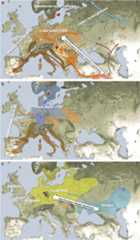
(a) proposed routes of migration by early farmers into Europe∼9,000-7000 years ago, (b) resurgence of hunter-gatherer ancestryduring the Middle Neolithic 7,000-5,000 years ago, (c) arrival of steppeancestry in central Europe during the Late Neolithic ∼4,500 yearsago. White arrows indicate the two possible scenarios of the arrival ofIndo-European language groups.
Extended Data Table 1. Number of ancient Eurasian modern human samples screened in genome-widestudies to date.
Only studies that produced at least one sample at≥0.05× coverage are listed.
| First author | Description | No. samples at ≥0.05×coverage (enough for Procrustes analysis) | No. samples at >0.25×coverage (enough to analyze in pairs) |
|---|---|---|---|
| Keller3 | Tyrolean Iceman | 1 | 1 |
| Raghavan6 | Upper Paleolithic Siberians | 2 | 1 |
| Olalde5 | Mesolithic Iberian from LaBrana | 1 | 1 |
| Skoglund8 | Farmers and hunter-gatherers fromSweden | 5 | 2 |
| Lazaridis4 | Early European farmer from Germany& Mesolithic hunter-gatherers from Luxembourg andSweden | 7 | 4 |
| Gamba2 | Neolithic, Bronze Age, Iron AgeHungary | 13 | 9 |
| Fu1 | Upper Paleolithic Siberian fromUst-Ishim | 1 | 1 |
| Seguin-Orlando7 | Upper Paleolithic European fromKostenki | 1 | 1 |
| Total before study | 31 | 20 | |
| This study | Hunter-gatherers and pastoralists fromRussia, Mesolithic hunter-gatherers from Sweden, Early Neolithicfrom Germany, Hungary, and Spain, Middle Neolithic from Germany& Spain, Late Neolithic / Bronze Age from Germany | 69 | 58 |
Supplementary Material
Acknowledgments
We thank Peter Bellwood, Joachim Burger, Paul Heggarty, Mark Lipson, Colin Renfrew,Jared Diamond, Svante Pääbo, Ron Pinhasi and Pontus Skoglund forcritical comments. We thank Svante Pääbo for support forestablishing the ancient DNA facilities in Boston, and Pontus Skoglund for detectingthe presence of two related individuals in our dataset. We thank Ludovic Orlando,Thorfinn S. Korneliussen, and Cristina Gamba for help in obtaining data. We thankAgilent Technologies and Götz Frommer for help in developing the capturereagents. We thank Clio Der Sarkissian, Guido Valverde, Luka Papac, and BirgitNickel for wet lab support. We thank archaeologists Veit Dresely, Robert Ganslmeier,Oleg Balanvosky, José Ignacio Royo Guillén, Anett Osztás,Vera Majerik, Tibor Paluch, Krisztina Somogyi and Vanda Voicsek for sharing samplesand discussion about archaeological context. This research was supported by anAustralian Research Council grant to W.H. and B.L. (DP130102158), and GermanResearch Foundation grants to K.W.A. (Al 287/7-1 and 7-3, Al 287/10-1 and Al287/14-1) and to H.M. (Me 3245/1-1 and 1-3). D.R. was supported by U.S. NationalScience Foundation HOMINID grant BCS-1032255, U.S. National Institutes of Healthgrant GM100233, and the Howard Hughes Medical Institute.
Footnotes
Author contributions: WH, NP, NR, JK, KWA and DR supervised thestudy. WH, EB, CE, MF, SF, RGP, FH, VK, AK, MK, PK, HM, OM, VM, NN, SP, RR,MARG, CR, ASN, JW, JKr, DB, DA, AC, KWA and DR assembled archaeologicalmaterial, WH, IL, NP, NR, SM, AM and DR analyzed genetic data. IL, NP and DRdeveloped methods usingf-statistics for inferring admixtureproportions. WH, NR, BL, GB, SN, EH, KS and AM performed wet laboratory ancientDNA work. NR, QF, MM and DR developed the 390k capture reagent. WH, IL and DRwrote the manuscript with help from all co-authors.
Author information: The aligned sequences are available through theEuropean Nucleotide Archive under accession number PRJEB8448. The Human Originsgenotype dataset including ancient individuals can be found at (http://genetics.med.harvard.edu/reichlab/Reich_Lab/Datasets.html).
The authors declare no competing financial interests.
References
- 1.Fu Q, et al. Genome sequence of a 45,000-year-old modern human from westernSiberia. Nature. 2014;514:445–449. doi: 10.1038/nature13810. [DOI] [PMC free article] [PubMed] [Google Scholar]
- 2.Gamba C, et al. Genome flux and stasis in a five millennium transect of Europeanprehistory. Nat Commun. 2014;5:5257. doi: 10.1038/ncomms6257. [DOI] [PMC free article] [PubMed] [Google Scholar]
- 3.Keller A, et al. New insights into the Tyrolean Iceman's origin andphenotype as inferred by whole-genome sequencing. Nat Commun. 2012;3:698. doi: 10.1038/ncomms1701. [DOI] [PubMed] [Google Scholar]
- 4.Lazaridis I, et al. Ancient human genomes suggest three ancestral populations forpresent-day Europeans. Nature. 2014;513:409–413. doi: 10.1038/nature13673. [DOI] [PMC free article] [PubMed] [Google Scholar]
- 5.Olalde I, et al. Derived immune and ancestral pigmentation alleles in a7,000-year-old Mesolithic European. Nature. 2014;507:225–228. doi: 10.1038/nature12960. [DOI] [PMC free article] [PubMed] [Google Scholar]
- 6.Raghavan M, et al. Upper Palaeolithic Siberian genome reveals dual ancestry ofNative Americans. Nature. 2014;505:87–91. doi: 10.1038/nature12736. [DOI] [PMC free article] [PubMed] [Google Scholar]
- 7.Seguin-Orlando A, et al. Genomic structure in Europeans dating back at least 36,200years. Science. 2014;346:1113–1118. doi: 10.1126/science.aaa0114. [DOI] [PubMed] [Google Scholar]
- 8.Skoglund P, et al. Genomic Diversity and Admixture Differs for Stone-AgeScandinavian Foragers and Farmers. Science. 2014;344:747–750. doi: 10.1126/science.1253448. [DOI] [PubMed] [Google Scholar]
- 9.Anthony DW. The Horse, the Wheel, and Language: How Bronze-Age Riders from theEurasian Steppes Shaped the Modern World. Princeton University Press; 2007. [Google Scholar]
- 10.Fu Q, et al. DNA analysis of an early modern human from Tianyuan Cave,China. Proc Natl Acad Sci USA. 2013;110:2223–2227. doi: 10.1073/pnas.1221359110. [DOI] [PMC free article] [PubMed] [Google Scholar]
- 11.Rohland N, Harney E, Mallick S, Nordenfelt S, Reich D. Partial uracil–DNA–glycosylase treatment forscreening of ancient DNA. Philosophical Transactions of the Royal Society of London B: BiologicalSciences. 2014;370 doi: 10.1098/rstb.2013.0624. [DOI] [PMC free article] [PubMed] [Google Scholar]
- 12.Patterson N, et al. Ancient admixture in human history. Genetics. 2012;192:1065–1093. doi: 10.1534/genetics.112.145037. [DOI] [PMC free article] [PubMed] [Google Scholar]
- 13.Fu Q, et al. A Revised Timescale for Human Evolution Based on AncientMitochondrial Genomes. Curr Biol. 2013;23:553–559. doi: 10.1016/j.cub.2013.02.044. [DOI] [PMC free article] [PubMed] [Google Scholar]
- 14.Brandt G, et al. Ancient DNA reveals key stages in the formation of centralEuropean mitochondrial genetic diversity. Science. 2013;342:257–261. doi: 10.1126/science.1241844. [DOI] [PMC free article] [PubMed] [Google Scholar]
- 15.Der Sarkissian C, et al. Ancient DNA reveals prehistoric gene-flow from Siberia in thecomplex human population history of North East Europe. PLoS Genet. 2013;9:e1003296. doi: 10.1371/journal.pgen.1003296. [DOI] [PMC free article] [PubMed] [Google Scholar]
- 16.Briggs AW, et al. Removal of deaminated cytosines and detection of in vivomethylation in ancient DNA. Nucleic Acids Res. 2010;38:e87–e87. doi: 10.1093/nar/gkp1163. [DOI] [PMC free article] [PubMed] [Google Scholar]
- 17.Briggs AW, et al. Patterns of damage in genomic DNA sequences from aNeandertal. Proceedings of the National Academy of Sciences. 2007;104:14616–14621. doi: 10.1073/pnas.0704665104. [DOI] [PMC free article] [PubMed] [Google Scholar]
- 18.Myres NM, et al. A major Y-chromosome haplogroup R1b Holocene era founder effectin Central and Western Europe. Eur J Hum Genet. 2011;19:95–101. doi: 10.1038/ejhg.2010.146. [DOI] [PMC free article] [PubMed] [Google Scholar]
- 19.Underhill PA, et al. The phylogenetic and geographic structure of Y-chromosomehaplogroup R1a. Eur J Hum Genet. 2014 doi: 10.1038/ejhg.2014.50. [DOI] [PMC free article] [PubMed] [Google Scholar]
- 20.Skoglund P, et al. Origins and genetic legacy of Neolithic farmers andhunter-gatherers in Europe. Science. 2012;336:466–469. doi: 10.1126/science.1216304. [DOI] [PubMed] [Google Scholar]
- 21.Czebreszuk J. In: Ancient Europe, 8000 BC to AD 1000: Encyclopedia of the BarbarianWorld. Bogucki PI, Crabtree PJ, editors. Charles Scribners & Sons; 2003. pp. 467–475. [Google Scholar]
- 22.Lipson M, et al. Efficient moment-based inference of admixture parameters andsources of gene flow. Mol Biol Evol. 2013;30:1788–1802. doi: 10.1093/molbev/mst099. [DOI] [PMC free article] [PubMed] [Google Scholar]
- 23.Szécsényi-Nagy A, et al. Tracing the genetic origin of Europe's first farmersreveals insights into their social organization. bioRxiv. 2014 doi: 10.1101/008664. [DOI] [PMC free article] [PubMed] [Google Scholar]
- 24.Haak W, et al. Ancient DNA from European early Neolithic farmers reveals theirNear Eastern affinities. PLoS Biol. 2010;8:e1000536. doi: 10.1371/journal.pbio.1000536. [DOI] [PMC free article] [PubMed] [Google Scholar]
- 25.Hellenthal G, et al. A genetic atlas of human admixture history. Science. 2014;343:747–751. doi: 10.1126/science.1243518. [DOI] [PMC free article] [PubMed] [Google Scholar]
- 26.Ralph P, Coop G. The geography of recent genetic ancestry acrossEurope. PLoS Biol. 2013;11:e1001555. doi: 10.1371/journal.pbio.1001555. [DOI] [PMC free article] [PubMed] [Google Scholar]
- 27.Renfrew C. Archaeology and Language: The Puzzle of Indo-European Origins. Pimlico: 1987. [Google Scholar]
- 28.Bellwood P. First Farmers: The Origins of Agricultural Societies. Wiley-Blackwell; 2004. [Google Scholar]
- 29.Gamkrelidze TV, Ivanov VV. The Early History of Indo-European Languages. Sci Am. 1990;262:110–116. [Google Scholar]
- 30.Mallory JP. In Search of the Indo-Europeans: Language, Archaeology and Myth. Thames and Hudson: 1991. [Google Scholar]
- 31.Kircher M, Sawyer S, Meyer M. Double indexing overcomes inaccuracies in multiplex sequencing onthe Illumina platform. Nucleic Acids Res. 2012;40:e3–e3. doi: 10.1093/nar/gkr771. [DOI] [PMC free article] [PubMed] [Google Scholar]
- 32.Meyer M, et al. A mitochondrial genome sequence of a hominin from Sima de losHuesos. Nature. 2014;505:403–406. doi: 10.1038/nature12788. [DOI] [PubMed] [Google Scholar]
- 33.Rohland N, Harney E, Mallick S, Nordenfelt S, Reich D. Partial uracil–DNA–glycosylase treatment forscreening of ancient DNA. Philosophical Transactions of the Royal Society of London B: BiologicalSciences. 2014;370 doi: 10.1098/rstb.2013.0624. [DOI] [PMC free article] [PubMed] [Google Scholar]
- 34.Rohland N, Reich D. Cost-effective, high-throughput DNA sequencing libraries formultiplexed target capture. Genome Res. 2012;22:939–946. doi: 10.1101/gr.128124.111. [DOI] [PMC free article] [PubMed] [Google Scholar]
- 35.Li H, Durbin R. Fast and accurate short read alignment withBurrows–Wheeler transform. Bioinformatics. 2009;25:1754–1760. doi: 10.1093/bioinformatics/btp324. [DOI] [PMC free article] [PubMed] [Google Scholar]
- 36.Behar DM, et al. A “Copernican” Reassessment of the HumanMitochondrial DNA Tree from its Root. Am J Hum Genet. 2012;90:675–684. doi: 10.1016/j.ajhg.2012.03.002. [DOI] [PMC free article] [PubMed] [Google Scholar]
- 37.Lassmann T, Sonnhammer ELL. Kalign – an accurate and fast multiple sequence alignmentalgorithm. BMC Bioinformatics. 2005;6:298–298. doi: 10.1186/1471-2105-6-298. [DOI] [PMC free article] [PubMed] [Google Scholar]
- 38.Sawyer S, Krause J, Guschanski K, Savolainen V, Pääbo S. Temporal patterns of nucleotide misincorporations and DNAfragmentation in ancient DNA. PLoS ONE. 2012;7:e34131. doi: 10.1371/journal.pone.0034131. [DOI] [PMC free article] [PubMed] [Google Scholar]
- 39.Green RE, et al. A Draft Sequence of the Neandertal Genome. Science. 2010;328:710–722. doi: 10.1126/science.1188021. [DOI] [PMC free article] [PubMed] [Google Scholar]
- 40.Alexander D, Lange K. Enhancements to the ADMIXTURE algorithm for individual ancestryestimation. BMC Bioinformatics. 2011;12:246. doi: 10.1186/1471-2105-12-246. [DOI] [PMC free article] [PubMed] [Google Scholar]
- 41.Alexander DH, Novembre J, Lange K. Fast model-based estimation of ancestry in unrelatedindividuals. Genome Res. 2009;19:1655–1664. doi: 10.1101/gr.094052.109. [DOI] [PMC free article] [PubMed] [Google Scholar]
- 42.Reich D, Price AL, Patterson N. Principal component analysis of genetic data. Nat Genet. 2008;40:491–492. doi: 10.1038/ng0508-491. [DOI] [PubMed] [Google Scholar]
- 43.Purcell S, et al. PLINK: a tool set for whole-genome association andpopulation-based linkage analyses. Am J Hum Genet. 2007;81:559–575. doi: 10.1086/519795. [DOI] [PMC free article] [PubMed] [Google Scholar]
- 44.Skoglund P, Storå J, Götherström A, Jakobsson M. Accurate sex identification of ancient human remains using DNAshotgun sequencing. J Archaeol Sci. 2013;40:4477–4482. [Google Scholar]
Associated Data
This section collects any data citations, data availability statements, or supplementary materials included in this article.