



Discovery and Characterization of ML398, a Potentand Selective Antagonist of the D4 Receptor within Vivo Activity
CynthiaB Berry
Michael Bubser
Carrie K Jones
John P Hayes
James A Wepy
Charles W Locuson
J Scott Daniels
Craig W Lindsley
Corey R Hopkins
(C.R.H.)Phone: 1 615-936-6892. Fax: 1 615-936-4381. E-mail:corey.r.hopkins@vanderbilt.edu.
Received 2014 Jun 27; Accepted 2014 Jul 9; Collection date 2014 Sep 11.
Abstract

Herein,we report the structure–activity relationship ofa chiral morpholine-based scaffold, which led to the identificationof a potent and selective dopamine 4 (D4) receptor antagonist.The 4-chlorobenzyl moiety was identified, and the compound was designatedan MLPCN probe molecule, ML398. ML398 is potent against the D4 receptor with IC50 = 130 nM andKi = 36 nM and shows no activity against the other dopaminereceptors tested (>20 μM against D1, D2S, D2L, D3, and D5). Furtherin vivo studies showed that ML398 reversed cocaine-inducedhyperlocomotion at 10 mg/kg.
Keywords: Dopamine 4 receptor antagonist, ML398, addiction, MLPCN
Dopamine receptors are membersof the Class A G-protein coupled receptors (GPCRs) superfamily. GPCRs,also known as seven-transmembrane domain receptors (7TM receptors),are protein receptors that mediate most of the physiological responsesto many hormones, neurotransmitters, etc., and constitute the largestclass of drug targets. The dopamine receptors are further dividedinto five subtypes, included in two families. The D1-likefamily of receptors contains D1 and D5, whilethe D2-like family contains D2, D3, and D4.1,2 The dopamine receptors are associatedwith numerous neurological processes including memory, learning, motivation,pleasure, and cognition; and as such, they are familiar drug targets.2 Included in the list of disorders linked to dysfunctionof dopaminergic signaling is schizophrenia,3−5 attention-deficithyperactivity disorder (ADHD),6−8 Parkinson’s disease,9,10 and drug2,11 and alcohol12,13 dependence.Recently there has been mounting evidence linking elevations in synapticdopamine levels with the reinforcing effects of cocaine and henceits abuse potential.14−16
Cocaine is a powerful stimulant made from theleaves of the cocaplant and produces short-term euphoria and energy bursts. Accordingto the National Survey on Drug Use and Health (NSDUH), there are ∼2M current cocaine users in the US with young adults (18–25years old) representing the largest population of users. Unfortunately,there are no approved treatments for cocaine dependence.17 Cocaine does not directly bind to the D1 and D2 receptors, but rather binds to the dopaminetransporter, thereby increasing synaptic levels of dopamine and itsdownstream effects on D1 and D2 receptors thatenables the cocaine reinforcement effects. The involvement of D4 receptors as another potential target for cocaine reinforcement/dependenceis due to its tissue distribution in the limbic and cortical brainregions implicated in cocaine addiction.3,18 In fact, thedopamine D4 receptor has been coined the “adventuregene” due to the higher novelty seeking scores in individualsgrouped by the long, polymorphic repeat region in exon III of theD4DR (L-D4DR) gene.19,20 Although the notion of the adventuregene has been questioned,21,22 further data has suggestedthat D4 has a role in severity of dependence.23 While there have been numerous studies on the role of dopamine D4,the field has been hampered by the lack of selective D4 receptor antagonists.2 Herein, we reportthe discovery and characterization of a potent and selective dopamineD4 receptor antagonist, ML398.
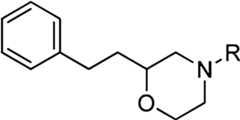
Recently we reportedan enantioselective synthesis of a chiralmorpholine analogue via an organocatalytic α-chlorination ofaldehydes followed by cyclization to form the morpholine scaffold.24 As part of the previous report, we synthesizeda known dopamine D4 antagonist,1, in orderto confirm the stereochemistry of the active enantiomer (Figure1).25 Biological evaluationof1 revealed the (R)-enantiomer wasthe active isomer with a D4 IC50 = 180 nM andKi = 70 nM. (R)-1 was inactive against dopamine D1 and D2 (>100μM) and weakly active against D3 (IC50 = 46.2 μM andKi = 15.7 μM).The (S)-1 was inactive against D4 (>100 μM), and the racemic-1 was lessactive (IC50 = 360 nM andKi = 140 nM). On the basis of the activity and binding of (R)-1, we embarked on a medicinal chemistrycampaign to explore the structure–activity relationship (SAR)around the benzimidazole portion of the molecule.
Figure 1.

Structure and activityof initial hit, (R)-1.Ki and IC50 valuesare in μM.
In an effort to evaluatea number of compounds, the racemic phenethylmorpholine was synthesized and then rapidly analogued and assayedat D4. Active compounds would then be assayed in enantiopureform. The racemic synthesis of the initial analogues for the SAR evaluationis outlined in Scheme1 and is identical tothe previous work, except for the organocatalyst.24 The racemic synthesis utilizesdl-proline as thecatalyst to obtain the racemic α-chloro aldehyde,3. Next, the alcohol was activated (Tf2O, lutidine) anddisplaced with the amino alcohol to yield4. Next, themorpholine ring was formed via an intramolecular cyclization and thenthe benzyl protecting group was removed to yield the common intermediate,5. The benzylic analogues in Table1 were synthesized by alkylation of the morpholine nitrogen (R-Br,K2CO3). The amide analogues were synthesizedvia the corresponding acid chloride (DIPEA, DMF, rt, 1 h), the directaryl compounds were synthesized via a palladium catalyzed cross-coupling(Pd2(dba)3, XANTPHOS, Cs2CO3, and 1,4-dioxane), the urea analogues were made via the aryl isocyanate(THF, rt, 1 h), and the sulfonamides were made via reaction with theappropriate sulfonyl chloride (DIPEA, DMF, 40 °C, 1 h).
Scheme 1. Synthesisof Racemic Morpholine D4 Receptor Antagonists,24.

Reagentsand conditions: (a)dl-proline (10 mol %), NCS, CH2CI2, 0°C; (b) NaBH4, MeOH; 86%; (c) Tf2O, lutidine,DCM, −78 °C; (d) BnNHCH2CH2OH, DCM,−78 °C → rt; 78%; (e) KOfBu, CH3CN,−20 °C; 54%; (f) H2, Pd/C, MeOH; (g) R-Br,K2CO3, CH3CN, rt; (h) DIPEA, acidchloride, DMF, rt, 1 h; (i) Pd2(dba)3, XANTPHOS,Cs2CO3, aryl bromide, 1,4-dioxane, 100 °C,18 h; (j) aryl isocyanate, THF, rt, 1 h; (k) DIPEA, sulfonyl chloride,DMF, 40 °C, 1 h
Table 1. SAR Evaluationof theN-Morpholine Substituenta.
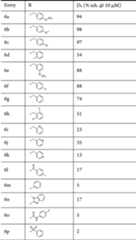
All assayswere performed on thehuman D4 receptor.26
The first set of analogues weresubstituted benzyl analogues (6a–6h), which all showed varying degreesof dopamine D4 receptor inhibition (51–98% at 10μM) (Table1). Interestingly, the pyridylanalogues (2-, 3-, and 4-pyridylmethyl) were all inactive (6i–6k). Introduction of an amide group (thus changingthe linker group from a methylene to a carbonyl) was not toleratedand led to inactive compounds (6l). Deletion of the linkergroup (direct arylation of the morpholine) was also not tolerated(6m and6n). Lastly, the urea analogue (6o) and sulfonamides (6p) were also inactive,potentially suggesting the need for a flexible or rotatable bond betweenthe morpholine and the right-hand substituent (SeeSupplemental Table 1 for full SAR).
Next, the activebenzyl analogues were progressed into the IC50 andKi determinations, and clearSAR trends emerged (Table2). First, orthosubstituents were less tolerated than themeta- andpara-substituents (even the small fluorine analogues) (6d and6h). Second, thepara-fluoro (6f) and unsubstituted benzyl (6g) were less active. Lastly, the most potent compounds contained ameta- orpara-trifluoromethoxybenzyl group(6a,6e), apara-methoxybenzylgroup (6b), or apara-chlorobenzyl group(6c). On the basis of these results, both enantiomersof6a–c were synthesized using thepreviously published route.24 Both the(R)- and (S)-enantiomers were evaluated,and as previously determined, the (S)-enantiomerswere inactive. All three of the compounds tested were potent antagonistsof the dopamine D4 receptor with high binding affinities((R)-6a, IC50 = 230 nM,Ki = 65 nM; (R)-6b, IC50 = 100 nM,Ki = 28 nM;(R)-6c, IC50 = 130 nM,Ki = 36 nM). On the basis of these results, wefurther profiled (R)-6b and (R)-6c for their selectivity against the otherdopamine receptors, and (R)-6c was inactive(>20 μM) against all of the dopamine receptors tested. Thus,on the basis of potency, binding, and selectivity profile, (R)-6c was declared an MLPCN probe (ML398).
Table 2. IC50 andKi Evaluation of the Racemic and Enantiomerically PureBenzyl Analogues.
| compd | D4 (% inh. @ 10 μM)a | IC50 (μM) | Ki (μM) |
|---|---|---|---|
| (±)-6a | 94 | 0.16 | 0.043 |
| (R)-6a | 96 | 0.23 | 0.065 |
| (±)-6b | 98 | 0.17 | 0.046 |
| (R)-6b | 86 | 0.10 | 0.028 |
| Selectivity Profilea: >20 μM againstD1, D2S, and D5 | |||
| D2L, IC50 = 16.5 μM; Ki = 5.5 μM | |||
| D3, IC50 = 8.17 μM; Ki = 2.77 μM | |||
| (±)-6c | 97 | 0.29 | 0.081 |
| (R)-6c | 96 | 0.13 | 0.036 |
| Selectivity Profilea: >20 μM againstD1, D2S, D2L, D3, andD5 | |||
| (±)-6d | 54 | 3.68 | 1.02 |
| (±)-6e | 88 | 0.39 | 0.11 |
| (±)-6f | 88 | 1.14 | 0.32 |
| (±)-6g | 74 | 1.48 | 0.41 |
| (±)-6h | 51 | 3.88 | 1.07 |
All assays wereperformed on thehuman receptor.26
ML398 was further profiled in a battery of Tier 1in vitro DMPK assays (Table3). Theintrinsic clearancewas assessed in hepatic microsomes (rat and human), and ML398 wasshown to be unstable to oxidative metabolism and predicted to displayhigh clearance in both species. In addition, using an equilibriumdialysis approach, the protein binding of ML398 was evaluated, andit was shown to have good free fraction in both species (6.1% in humanand 3.9% in rat). ML398 was evaluated for its inhibition of the cytochromeP450 (CYP) enzymes using a cocktail approach in human liver microsomesas a screen for potential drug–drug interaction liability.ML398 displayed no significant activity against the panel of CYPs.ML398 was also profiled in anin vivo tissue distributionstudy (plasma and brain levels). Because of the predicted high clearance,ML398 was dosed at a single dose via intraperitoneal (IP) route ofadministration with a suspension formulation and then evaluated ata single time point. ML398 readily crosses the blood–brainbarrier with a B/P ratio of ∼2 and total brain concentrationsof ∼1 μM. Lastly, ML398 was tested using EuroFins LeadProfiling screen (radioligand binding assay panel of 68 GPCRs, ionchannels, and transporters screened at 10 μM). ML398 was foundto not significantly interact with 63 of the 68 assays performed (<50%binding at 10 μM) (SeeSupporting Information). ML398 did have activity against five targets (adrenergic, α1A (77%); histamine, H1 (93%); sigma, σ1 (99%); dopamine transporter, DAT (72%); norepinephrine transporter,NET (68%).
Table 3.In Vitro andinVivo PK Properties of ML398.
| ML398 | (R)-1 | |
|---|---|---|
| In Vitro PK Properties | ||
| microsomepredicted hepatic clearance (mL/min/kg) | ||
| ratCLHEP | 67.5 | 65.1 |
| human CLHEP | 15.7 | 17.9 |
| plasma unbound fraction(Fu) | ||
| human | 0.061 | 0.012 |
| rat | 0.039 | 0.133 |
| CYP inhibition (IC50, μM) | ||
| 1A2 | >30 | 13.1 |
| 2C9 | >30 | 4.8 |
| 2D6 | 18.0 | 12.0 |
| 3A4 | >30 | 15.6 |
| plasmaexposure in SD Rat | ||
| 10 mg/kg, intraperitoneal, 0.25hr sample | ||
| plasma (nM) | 482 | 1935 |
| brain (nM) | 987 | 3558 |
| Brain:Plasma | 2.0 | 1.8 |
Having identified a potent, selective, and brain penetrantD4 antagonist, we wanted to test its ability to reversehyperlocomotioninduced by cocaine. It is believed that cocaine increases locomotoractivity by increasing synaptic concentrations of dopamine by blockingdopamine reuptake or by enhancing the release of dopamine. This, inturn, increases stimulation of postsynaptic dopamine receptors. Theincreased locomotor activity can be blocked by selective dopamineantagonists as well as haloperidol.27 Thecocaine-induced hyperlocomotion assay is used to establish PK/PD relationship.The effects of both (R)-1 and ML398were evaluated in this assay, and the results are shown in Figure2. Cocaine was shown to significantly induce hyperactivityin rats, which is characterized by an increase in the number of beambreaks using the SmartFrame open field activity chambers. Both testcompounds were dosed via IP administration at doses of 3 mg/kg and10 mg/kg. Although (R)-1 showed a lineartrend of reversal, the data was not significant. However, ML398 didshow a statistically significant reversal of cocaine-induced hyperlocomotionat the highest dose tested (10 mg/kg).
Figure 2.
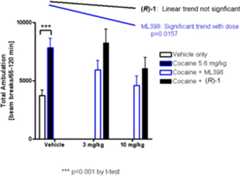
Effects of ML398 and(R)-1 on reversingcocaine-induced hyperlocomotion in rats.
In conclusion, we have identified a new, potent, and selectivedopamine D4 antagonist based on a chiral morpholine scaffold.As many of the previous D4 antagonists contain a piperidinemoiety, the reduced basicity of the morpholine may help contributeto the unprecedented selectivity. The SAR studies showed that thebenzylic substitution is optimal as the amides, ureas, and arylationanalogues were all inactive. In addition, the (R)-enantiomerwas confirmed as the active isomer within this series. ML398 is >100-foldselective versus the other dopamine receptors and is highly brainpenetrant. ML398 also was shown to reverse cocaine-induced hyperlocomotionin rats. Further optimization studies are ongoing in an effort todiscover an improved molecular probe for biological study as welland development of a radioligand for the D4 receptor.
Acknowledgments
The authors would like to thank Mr. Frank Byers for technicalassistance with thein vivo PK experiement and Mr.David Myers for help with the statistical evaluations.
Glossary
Abbreviations
- DIPEA
diisopropyl ethyl amine
- DMF
dimethylformamide
- THF
tetrahydrofuran
- NCS
N-chlorosuccinimide
- DCM
dichloromethane
Supporting Information Available
General methods for the synthesisand characterization of all compounds. General methods for thein vitro andin vivo DMPK protocols andin vivo pharmacology. This material is available free ofcharge via the Internet athttp://pubs.acs.org.
Author Contributions
⊥ J.P.H. and J.A.W. contributed equally tothis work. C.B.B., M.B.,C.K.J., C.W.L., J.S.D., and C.R.H. drafted/corrected the manuscript.C.B.B., J.P.H., and J.A.W. performed the chemical synthesis. C.W.L.and C.R.H. oversaw the target selection and interpreted the biologicaldata. C.W.L. and J.S.D. performed thein vitro DMPKexperiments. M.B. and C.K.J. performed thein vivo experiments. All authors have given approval to the final versionof the manuscript.
Vanderbilt isa member of the MLPCN and houses the Vanderbilt Specialized ChemistryCenter for Accelerated Probe Development. This work was generouslysupported by the NIH/MLPCN Grant U54MH084659 (to C.W.L.).
The authorsdeclare nocompeting financial interest.
This paper was publishedASAP on July 15, 2014. The abstract graphic was corrected and therevised version was reposted on July 16, 2014.
Funding Statement
National Institutes of Health, United States
Supplementary Material
References
- Girault J.-A.; Greengard P.The neurobiologyof dopamine signaling. Arch. Neurol.2004, 61, 641–644. [DOI] [PubMed] [Google Scholar]
- Ye N.; Neumeyer J. L.; Baldessarini R. J.; Zhen X.; Zhang A.Update 1 of:Recent progress in development of dopamine receptor subtype-selectiveagents: potential therapeutics for neurological and psychiatric disorders. Chem. Rev.2013, 113, PR123–PR178. [DOI] [PubMed] [Google Scholar]
- Lahti R. A.; Roberts R. C.; Cochrane E. V.; Primus R. J.; Gallager D. W.; Conley R. R.; Tamminga C. A.Direct determination of dopamineD4 receptors in normal and schizophrenic postmortem brain tissue:a [3H]NGD-94-1 study. Mol. Psychiatry1998, 3, 528–533. [DOI] [PubMed] [Google Scholar]
- Sanyal S.; Van Tol H. H. M.Review the roleof dopamine D4 receptors in schizophreniaand antipsychotic action. J. Psychiat. Res.1997, 31, 219–232. [DOI] [PubMed] [Google Scholar]
- Bristow L. J.; Kramer M. S.; Kulagowski J.; Patel S.; Ragan C. I.; Seabrook G. R.Schizophrenia andL-745,870, a novel dopamine D4 receptorantagonist. Trends Pharmacol. Sci.1997, 18, 186–188. [DOI] [PubMed] [Google Scholar]
- Woolley M. L.; Waters K. A.; Reavill C.; Bull S.; Lacroix L. P.; Martyn A. J.; Hutcheson D. M.; Valerio E.; Bate S.; Jones D. N. C.; Dawson L. A.Selectivedopamine D4 receptor agonist(A-412997) improves cognitive performance and stimulates motor activitywithout influencing reward-related behaviour in rat. Behav. Pharmacol.2008, 19, 765–776. [DOI] [PubMed] [Google Scholar]
- Tarazi F. I.; Zhang K.; Baldessarini R. J.Dopamine D4 receptors:beyond schizophrenia. J. Recept. Signal TransductionRes.2004, 24, 131–147. [DOI] [PubMed] [Google Scholar]
- Rubinstein M.; Cepeda C.; Hurst R. S.; Flores-Hernandez J.; Ariano M. A.; Falzone T. L.; Kozell L. B.; Meshul C. K.; Bunzow J. R.; Low M. J.; Levine M. S.; Grandy D. K.DopamineD4 receptor-deficient mice display cortical hyperexcitability. J. Neurosci.2001, 21, 3756–3763. [DOI] [PMC free article] [PubMed] [Google Scholar]
- Huot P.; Johnston T. H.; Koprich J. B.; Aman A.; Fox S. H.; Brotchie J. M.L-745,870reduces L-DOPA-induced dyskinesia in the1-methyl-4-phenyl-1,2,3,6-tetrahydropyridine-lesioned macaque modelof Parkinson’s disease. J. Pharmacol.Exp. Ther.2012, 342, 576–585. [DOI] [PubMed] [Google Scholar]
- Marin C.; Aguilar E.; Rodriguez-Oroz M. C.; Bartoszyk G. D.; Obeso J. A.Local administration of sarizotaninto the subthalmicnucleus attenuates levodopa-induced dyskinesias in 6-OHDA-lesionedrats. Psychopharmacology2009, 204, 241–250. [DOI] [PubMed] [Google Scholar]
- Kotler M.; Cohen H.; Segman R.; Gritsenko I.; Nemanov L.; Lerer B.; Kramer I.; Zer-Zion M.; Kletz I.; Ebstein R. P.Excess dopamine D4 receptor (D4DR)exon III seven repeat allele in opioid-dependent subjects. Mol. Psychiatry1997, 2, 251–254. [DOI] [PubMed] [Google Scholar]
- George S. R.; Cheng R.; Nguyen T.; Israel Y.; O’Dowd B. F.Polymorphismsof the D4 dopamine receptor alleles in chronic alcoholism. Biochem. Biophys. Res. Commun.1993, 196, 107–114. [DOI] [PubMed] [Google Scholar]
- Rubinstein M.; Phillips T. J.; Bunzow J. R.; Falzone T. L.; Dziewczapolski G.; Zhang G.; Fang Y.; Larson J. L.; McDougall J. A.; Chester J. A.; Saez C.; Pugsley T. A.; Gershanik O.; Low M. J.; Grandy D. K.Mice lacking dopamine D4 receptorsare supersensitive to ethanol, cocaine, and methamphetamine. Cell1997, 90, 991–1001. [DOI] [PubMed] [Google Scholar]
- Bergman J.; Roof R. A.; Furman C. A.; Conroy J. L.; Mello N. K.; Sibley D. R.; Skolnick P.Modificationof cocaine self-administrationby buspirone (buspar): potential involvement of D3 andD4 dopamine receptors. Int. J. Neuropsychopharm.2013, 16, 445–458. [DOI] [PMC free article] [PubMed] [Google Scholar]
- Costanza R. M.; Terry P.The dopamine D4 receptorantagonist L-745,870: effects in rats discriminatingcocaine from saline. Eur. J. Pharmacol.1998, 345, 129–132. [DOI] [PubMed] [Google Scholar]
- Caine S. B.; Negus S. S.; Mello N. K.; Patel S.; Bristow L.; Kulagowski J.; Vallone D.; Saiardi A.; Borrelli E.Role of dopamineD2-like receptors in cocaine self-administration: studies with D2receptor mutant mice and novel D2 receptor antagonists. J. Neurosci.2002, 22, 2977–2988. [DOI] [PMC free article] [PubMed] [Google Scholar]
- WhatIs the Scope of Cocaine Use in the United States?http://www.drugabuse.gov/publications/research-reports/cocaine/what-scope-cocaine-use-in-united-states.
- Primus R. J.; Thurkauf A.; Xu J.; Yevich E.; McInerney S.; Shaw K.; Tallman J. F.; Gallager D. W.II. Localizationand characterization of dopamine D4 binding sites in ratsand human brain by use of the novel, D4 receptor-selectiveligand [3H]NGD 94-1. J. Pharmacol.Exp. Ther.1997, 282, 1020–1027. [PubMed] [Google Scholar]
- Ebstein R.P.; Novick O.; Umansky R.; Priel B.; Osher Y.; Blaine D.; Bennett E. R.; Nemanov L.; Katz M.; Belmaker R. H.DopamineD4 receptor (D4DR) exon III polymorphism associatedwith the human personality trait of novelty seeking. Nat. Genet.1996, 12, 78–80. [DOI] [PubMed] [Google Scholar]
- Ebstein R. P.; Herzog S.Saga of an adventure gene: novelty seeking, substanceabuse and the dopamine D4 receptor (D4DR) exon IIIrepeat polymorphism. Mol. Psychiatry1997, 2, 381–384. [DOI] [PubMed] [Google Scholar]
- Baron M.Mapping genesfor personality: is the saga sagging?. Mol.Psychiatry1998, 3, 106–108. [DOI] [PubMed] [Google Scholar]
- Lusher J.M.; Chandler C.; Ball D.Dopamine D4 receptor gene (DRD4)is associated with novelty seeking (NS) and substance abuse: the sagacontinues. Mol. Psychiatry2001, 6, 497–499. [DOI] [PubMed] [Google Scholar]
- Lusher J.; Ebersole L.; Ball D.Dopamine D4 receptorgene and severityof dependence. Addict. Biol.2000, 5, 469–472. [DOI] [PubMed] [Google Scholar]
- O’Reilly M. C.; Lindsley C. W.A general, enantioselective synthesisof protectedmorpholines and piperazines. Org. Lett.2012, 14, 2910–2913. [DOI] [PMC free article] [PubMed] [Google Scholar]
- Showell G. A.; Emms F.; Marwood R.; O’Connor D.; Patel S.; Leeson P. D.Binding of 2,4-disubstitutedmorpholinesat human D4 dopamine receptors. Bioorg.Med. Chem.1998, 6, 1–8. [DOI] [PubMed] [Google Scholar]
- EurofinsScientific.http://www.eurofins.com/en.aspx.
- O’Neill M. F.; Shaw G. S.Comparison of dopamine receptor antagonists on hyperlocomotioninduced by cocaine, amphetamine, MK-801 and the dopamine D1 agonist C-APB in mice. Psychopharmacology1999, 145, 237–250. [DOI] [PubMed] [Google Scholar]
Associated Data
This section collects any data citations, data availability statements, or supplementary materials included in this article.