



A time-calibrated species-level phylogeny of bats (Chiroptera, Mammalia)
Ingi Agnarsson
Carlos M Zambrana-Torrelio
Nadia Paola Flores-Saldana
Laura J May-Collado
Accepted 2011 Feb 2.
This is an open-access article distributed under the terms of the Creative Commons Attribution License, which permits unrestricted use, distribution, and reproduction in any medium, provided the original author and source are properly credited.
Abstract
Despite their obvious utility, detailed species-level phylogenies are lacking for many groups, including several major mammalian lineages such as bats. Here we provide a cytochrome b genealogy of over 50% of bat species (648 terminal taxa). Based on prior analyzes of related mammal groups, cytb emerges as a particularly reliable phylogenetic marker, and given that our results are broadly congruent with prior knowledge, the phylogeny should be a useful tool for comparative analyzes. Nevertheless, we stress that a single-gene analysis of such a large and old group cannot be interpreted as more than a crude estimate of the bat species tree. Analysis of the full dataset supports the traditional division of bats into macro- and microchiroptera, but not the recently proposed division into Yinpterochiroptera and Yangochiroptera. However, our results only weakly reject the former and strongly support the latter group, and furthermore, a time calibrated analysis of a pruned dataset where most included taxa have the entire 1140bp cytb sequence finds monophyletic Yinpterochiroptera. Most bat families and many higher level groups are supported, however, relationships among families are in general weakly supported, as are many of the deeper nodes of the tree. The exceptions are in most cases apparently due to the misplacement of species with little available data, while in a few cases the results suggest putative problems with current classification, such as the non-monophyly of Mormoopidae. We provide this phylogenetic hypothesis, and an analysis of divergence times, as tools for evolutionary and ecological studies that will be useful until more inclusive studies using multiple loci become available.
Introduction
Phylogenies form the backbone of evolutionary biology and represent tools that underlie a broad spectrum of evolutionary and ecological studies[1][2]. Phylogenetic work on any given group often first focuses on the ‘big picture’, that is the placement of, and relationship among, major groups, long before species level phylogenies become available. One simple reason for this focus is that general interest questions, such as where and how the major divisions of life fit together, can be answered through sampling relatively few taxa, in a relatively cost and time effective manner. Yet, more detailed species-level phylogenies, often lagging far behind, are the most useful tools for evolutionary and ecological analyses. The above is certainly true for mammalian phylogenetics, where higher level phylogenetics are intensely studied, with the few detailed species level studies for major groups lagging far behind (see e.g.[3][4][5][6]).
The ultimate goal of phylogenetics must be detailed species level phylogenies of all of life, based on many data. However, achieving this goal will take much time and effort. In the meantime, species level phylogenies may be rapidly reconstructed with already available data using several approaches. One is the construction of phylogenetic supertrees where available trees and taxonomies are united into a summary cladogram[7]. Another is the creation of supermatrices based on available character data. Both approaches make available useful research tools, which may have different strengths.
The bats (Chiroptera) are one such group where many phylogenetic studies have focused either on understanding higher-level bat relationships (e.g.[8][9]) or species-level relationships within specific groups (e.g.[10][11][12]). Available phylogenies have then been summarized in a supertree[13]. Here, we provide cytochrome b gene tree for over 50% of bat species (648 total taxa). Cytb not only is the most widely available marker for most mammals, but also has been shown to be a particularly reliable phylogenetic marker (e.g.[14]). Thus according with prior analyses of other mammal groups[3][4][5][6], the cytb gene tree can be expected to at least roughly approximate the species-level phylogeny of Chiroptera. We provide this phylogeny simply as an alternative tool to super-tree phylogenies, until more detailed studies become available.
Methods
Cytochrome b sequences were downloaded from GenBank for 648 bats, including nearly 550 named species, and the remaining terminal taxa being subspecies or unidentified/undescribed species. As outgroups we selected 10 species representing other Pegasoferae[15]: Cetartidoactyla, Perissodactyla, Carnivora, Pholidota (pangolins), and Erinaceomorpha as the primary outgroup. Because many of the taxa have incomplete Cytb sequences, and missing data can cause problems in phylogenetic reconstruction (e.g.[16]), we also created a ‘pruned’ dataset where taxa with less than 30% of the full sequence were removed (‘pruned’ matrix), and another set where only 2 representatives of each family were retained (‘time’ matrix). The latter was used for analysis of divergence times. The sequences were aligned in Mesquite[17], a trivial task given that it is a protein-coding gene with no implied gaps. The appropriate model for the Bayesian analysis was selected with jModeltest[18] using the AIC criterion[19]. The best model was GTR+Γ+I[20][21]. Bayesian analysis was performed using MrBayes V3.1.2[22] with settings as in[3][4] with separate model estimation for first, second, and third codon positions. The MCMC was run with one cold and three heated chains for 30,000,000 generations, sampling trees every 1,000 generations. The first 15,000,000 were then discarded as burnin, after which stationarity was reached. The data matrix and trees are available from the first author and data and trees will be submitted to Treebase (http://www.treebase.org). Genbank accession numbers are listed in Table 1 (see Appendices).
The ‘time’ matrix was used to estimate divergence times using relaxed clock methods in BEAST 1.6.1.[23][24]. For Emballonuridae we additionally retained twoTaphozous species as these did not group with the other Emballonuridae in the full analysis. The analysis was calibrated using normally distributed priors reflecting: (1) the minimal age of 37 my for the split between Rhinolophidae and Hipposiderids based on the estimated age of the oldest rhinolophid and hipposiderid fossils[25][26]; (2) the estimated age of Carnivora (split of cat plus dog) of 54 my (the age of Carnivora as estimated by[27]); the estimated age of Chiroptera as a normally distributed prior with mean of 54 my, also based on[27]; and (4) the minimal age of Emballonuridae of 48 my based on the oldest fossils that are with some certainty placed within that family[28]. Prior to the divergence time analysisErinaceus (Erinaceomorpha) andTalpa (Eulipotyphla) were set as primary outgroups by enforcing the monophyly of the remaining taxa, and the monophyly of Rhinolopidae plus Hipposideridae was furthermore enforced. The resulting age estimates were then compared to the above mentioned fossil data in addition to the age of other known fossil bats[28].
Results and Discussion
Phylogenetics
The analysis of the full dataset supports the monophyly of bats, and the major division of Chiroptera into Megachiroptera (Pteropodidae) and Microchiroptera with Yangochiroptera contained within the latter group (Figures 1-2).
Figure 1. Relationships among bat families according with the analysis of all data. Numbers are posterior probabilities, above branches from the full analysis, below branches support from the pruned analysis.

Figure 2. Relationship among bat species with major clade names. Numbers are posterior probabilities. The results are detailed in Figure 4, see Appendices.

The analysis of the ‘time’ matrix, however, supports the now rather generally accepted split into Yinpterochiroptera and Yangochiroptera (see below) (e.g.[29][30][31][32][33][34]).
The Macrochiroptera, or fruitbats (Pteropodidae), are in the main analysis sister to the remaining bats (Figures 2, 4a). Within Pteropodidae most genera are monophyletic, with the exception ofRousettus angolensis (synonymLissonycterisangolensis) nests withMyonycteris. Overall, these results are similar to results of previous studies on macrochiroptera phylogenetics (e.g.[10]).
The Microchiroptera is divided in two major clades, one is the Yangochiroptera including the families Emballonuridae, Furipteridae, Miniopteridae, Molossidae, Mormoopidae, Mystacinidae, Myzopodidae, Natalidae Noctilionidae, Phyllostomidae, Thyropteridae, and Vespertilionidae. The other major group, which we refer to as a modified “Rhinolophoidea” (Figures 1-2, 4), contains the remaining microbat families Craseonycteridae, Hipposideridae, Megadermatidae, Rhinolophidae, and Rhinopomatidae. Hipposideridae and Rhinolophidae are sister families as supported by previous studies (e.g.,[13][31][34]). Only Hipposideridae here contains more than a single genus, and within that familyHipposiderus is paraphyletic, containing several small genera.
Overall most microchiropteran superfamilies are not supported as monophyletic, except Rhinopomatoidea (Figure 2). A modified Rhinolophoidea that contains Rhinopomatoidea is also supported, and the superfamily Vespertilionioidea is monophyletic except for containing a couple of apparently misplaced species (Figures 2, 4b). The relationships among the families, however, in general are poorly supported and differ among analyses (see Figures 1, 3-4). Taxonomic families are generally recovered either as strictly monophyletic, or approximately, as paraphyletic groups due to one or a couple of ‘misplaced’ taxa. In the full analysis, families that are strictly supported (i.e. monophyletic, or in the case of families represented by single species, not nesting within another family) are: Craseonycteridae, Furipteridae, Hipposideridae, Megadermatidae, Miniopteridae, Molossidae, Mystacinidae, Myzopodidae, Natalidae, Noctilionidae, Rhinolophidae, Rhinopomatidae, and Thyropteridae. Not monophyletic families are Phyllostomidae due to the placement of onePlatalina species nesting within Vestpertilionidae, Emballonuridae is rendered polyphyletic by the placement of the genusTaphozous (2 species) and one species ofEmballonura outside it. Vespertilionidae is paraphyletic in that within it are placed the above mentionedPlatalina andEmballonura. Finally Mormoopidae forms two clades that are not sister, one including the genusMormoops, the other the genusPteronotus. These ‘minor’ deviations from family monophyly in most cases probably do not represent refutation of family clades; rather this seems to be mostly an issue of missing data. For example, when species with less than 30% of the sequence are removed, all families are recovered monophyletic, with two exceptions that may be taxonomically informative :(1) The genusTaphozous still groups outside Emballonuridae which contradicts previous studies (e.g.,[32][34][35]) and (2) the Mormoopidae family still forms two separate clades, which agrees with Kennedy et al[36] (for contrasting topologies see e.g.,[13][31]).
Finally, several genera of the family Phyllostomidae are not monophyletic, includingMimon,Mycronycteris,Rousettus,Vampyressa, andArtibeus. Within MolossidaeTadarida,Mops,Chaerephon are not monophyletic. Within Natalidae,Chilonatalus is non-monophyletic, and within Vespertilionidae, the large generaPipistrellus andMyotis are not monophyletic.
Many taxa in the full analysis only have available a partial Cytb sequence, and notably clade support is low for many of the deeper clades of the phylogeny. Low support is unsurprising given missing data, and the use of only a single locus for both very many taxa and old divergences. Further, any given gene tree can be expected to differ from the species tree due to various processes including incomplete lineage sorting, introgression, and others. Thus, future effort should focus on resolving the species-level phylogeny of bats with a multi-locus approach. Nevertheless, the phylogeny, especially when the taxa with the highest % missing data are removed, is broadly congruent with prior knowledge, and should thus be a useful tool.
Divergence times
The analysis of divergence times (Figure 3) generally agrees with prior studies[27][35][37], though the estimated ages are rather lower in general than those estimated by Jones et al.[38].
Figure 3. A calibrated phylogeny of bat families. Numbers are in million years, and gray bars are 95% confidence intervals
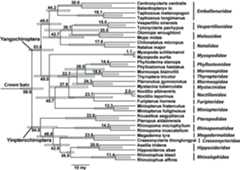
In part this may relate to the different suggested relationships among bat families across these studies, though the error margins of many nodes estimated are rather wide and nearly always include age estimates found by prior studies. The results also in most cases are consistent with the available bat fossil record[28]. The age of crown bats, i.e. the split between Yinpterochiroptera and Yangochiroptera is estimated at 58.9 my, a value lying in between the estimates of Cao et al.[27], and Jones et al.[38] and Arnason et al.[37]. Other dates that were included as priors, as expected, also are consistent with the fossil record. The split between Hipposideridae and Rhinolophidae is estimated at 36.9 my, consistent with the oldest known Hipposideridae fossil dated at close to 40 my. Similarly the age of Molossidae estimated at 36.1 my is close to the oldest Molossidae fossil at near 40 my[28]. The split between Emballonuridae and its sister lineage is estimated at 49 my, right around the age of the oldest emballonurid fossil. Most other dates are also consistent with the fossil record. The genusTaphozoushas a fossil record going up to 20.4 my, a date in between the estimated split between crownTaphozous (18.1 my) and the split betweenTaphozous and other Emballonuridae (44.2 my). The oldest Mystacinidae fossil dates from around 20 my[28] and the estimated split here between Mystacinidae and its sister lineage is 24.3 my. The oldest Phyllostomidae fossil dates from around 16 my[28], a date in between the split between crownPhyllostoma (14.4 my) and the split between Phyllostomidae and its sister lineage (28.5 my). In a few cases the estimates are younger than possible given current understanding the fossil record, e.g. the age of Megadermatidae at 23.6 my while the oldest fossil is at least 37 my. However, 95% confidence interval of this node estimate reaches over 40 my. The age of Natalidae, estimated at around 43 my, is younger than the oldest fossil thought to belong to that family, at over 50 my. Similarly one putative Vespertilionidae genus,Stehlinia, has a fossil record older (up to 48 my) than the estimated age of the family at 36.1 my. These mismatches may reflect simply erroneous age estimates, or could possibly indicate that some fossil bats are taxonomically misplaced. In most other cases the estimated ages are older than the oldest available fossils, which may reflect the incompleteness of the fossil record.
In sum, we provide acytochrome b genealogy for Chiroptera, which we expect to crudely approximate the bat species tree. Until more detailed species-level phylogenies become available, this offers an alternative phylogenetic tool to super-tree phylogenies, for comparative evolutionary, ecological analyzes, and phylogenetic conservation assessment.
Acknowledgments
Thanks to PLoS Currents: Tree of Life board of reviewers, the editor, and two anonymous reviewers for comments that improved this manuscript.
Funding information
This research was funded, in part, by the University of Puerto Rico. Competing interests The authors have declared that no competing interests exist.
Appendices
Figure 4.Results from Fig. 2 in standard tree format.
Figure 4a. Results from Figure 2, Pteropodidae. Numbers are posterior probabilities
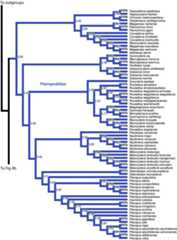
Figure 4b. Results from Figure 2, Megadermatidae, Craseonycteridae, Rhinopomatidae, Hipposideridae, and Rhinolophidae. Numbers are posterior probabilities.
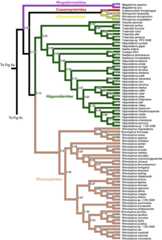
Figure 4c. Results from Figure 2, Miniopteridae, Noctilionidae, Mormoopidae, Mystacinidae, Thyropteridae, Furipteridae, and Phyllostomidae in part. Numbers are posterior probabilities
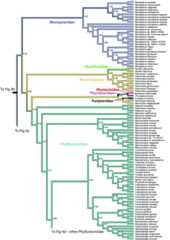
Figure 4d. Results from Figure 2, Phyllostomidae, in part. Numbers are posterior probabilities
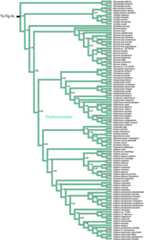
Figure 4e. Results from Figure 2, Molossidae,Emballonuridae, Myzopodidae, Natalidae, and Vespertilionidae in part. Numbers are posterior probabilities
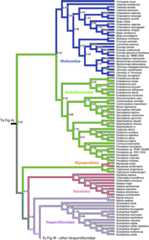
Figure 4f. Results from Figure 2, Vespertilionidae in part. Numbers are posterior probabilities
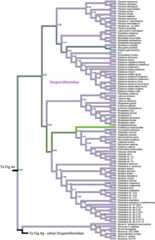
Figure 4g. Results from Figure 2, Vespertilionidae in part. Numbers are posterior probabilities
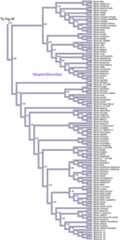
Table 1.
Species included and Genbank accession numbers
| Genus | Species | sub sp or voucher | Accession Number | |
| Acerodon | jubatus | EU330962 | ||
| Aethalops | alecto | AY629006 | ||
| Ametrida | centurio | AY604446 | ||
| Anoura | caudifer | L19506 | ||
| Anoura | geoffroyi | FJ155495 | ||
| Antrozous | dubiaquercus | EF222381 | ||
| Antrozous | pallidus | EF222382 | ||
| Ardops | nichollsi | AY572337 | ||
| Ariteus | flavescens | AY604436 | ||
| Artibeus | amplus | EU160947 | ||
| Artibeus | anderseni | U66509 | ||
| Artibeus | aztecus | U66510 | ||
| Artibeus | cf.jamaicensis | DQ985486 | ||
| Artibeus | cf.obscurus | DQ903818 | ||
| Artibeus | cinereus | EU805599 | ||
| Artibeus | concolor | U66519 | ||
| Artibeus | fimbriatus | U66498 | ||
| Artibeus | fraterculus | U66499 | ||
| Artibeus | fuliginosus | L19505 | ||
| Artibeus | glaucus | watsoni | FJ179259 | |
| Artibeus | glaucus | U66512 | ||
| Artibeus | glaucus | bogotensis | EU805596 | |
| Artibeus | glaucus | gnomus | EU805594 | |
| Artibeus | hartii | EU160972 | ||
| Artibeus | hirsutus | U66500 | ||
| Artibeus | inopinatus | U66501 | ||
| Artibeus | intermedius | FJ179231 | ||
| Artibeus | jamaicensis | aequatorialis | DQ869450 | |
| Artibeus | jamaicensis | jamaicensis | DQ869518 | |
| Artibeus | jamaicensis | parvipes | DQ869474 | |
| Artibeus | jamaicensis | paulus | DQ869456 | |
| Artibeus | jamaicensis | richardsoni | DQ869454 | |
| Artibeus | jamaicensis | trinitatis | DQ003028 | |
| Artibeus | jamaicensis | triomylus | AY382782 | |
| Artibeus | jamaicensis | yucatanicus | DQ869484 | |
| Artibeus | lituratus | EU160813 | ||
| Artibeus | obscurus | U66507 | ||
| Artibeus | phaeotis | FJ376727 | ||
| Artibeus | planirostris | fallax | DQ869426 | |
| Artibeus | planirostris | grenadensis | DQ869439 | |
| Artibeus | planirostris | hercules | DQ869421 | |
| Artibeus | planirostris | planirostris | DQ869396 | |
| Artibeus | planirostris | trinitatis | DQ869433 | |
| Artibeus | schwartzi | DQ869531 | ||
| Artibeus | sp.FURB | DQ985497 | ||
| Artibeus | toltecus | U66515 | ||
| Asellia | tridens | FJ457617 | ||
| Aselliscus | stoliczkanus | EU434954 | ||
| Aselliscus | tricuspidatus | DQ888679 | ||
| Balantiopterys | infusca | EF584151 | ||
| Balantiopterys | io | EF584153 | ||
| Balantiopterys | plicata | EF584154 | ||
| Balionycteris | maculata | AF044636 | ||
| Barbastella | barbastellus | EU360700 | ||
| Barbastella | beijingensis | EF534762 | ||
| Barbastella | leucomelas | EF534766 | ||
| Brachyphylla | cavernarum | AY572383 | ||
| Brachyphylla | nana | EU521680 | ||
| Brachyphylla | pumila | EU521678 | ||
| Carollia | benkeithi | DQ177282 | ||
| Carollia | brevicauda | FJ154120 | ||
| Carollia | castanea | DQ888289 | ||
| Carollia | sowelli | AF511973 | ||
| Carollia | subrufa | AF187024 | ||
| Centronycteris | centralis | EF584155 | ||
| Centronycteris | maximiliani | EF584157 | ||
| Centurio | senex | greenhalli | AY604445 | |
| Centurio | senex | AY604444 | ||
| Chaerephon | ansorgei | AY377967 | ||
| Chaerephon | chapini | AY591329 | ||
| Chaerephon | jobensis | AY591331 | ||
| Chaerephon | leucogaster | EU716041 | ||
| Chaerephon | nigeriae | AY591330 | ||
| Chaerephon | pumila | AY614756 | ||
| Chalinolobus | tuberculatus | NC_002626 | ||
| Chilonatalus | micropus | AY621026 | ||
| Chilonatalus | tumidifrons | AY621028 | ||
| Chiroderma | improvisum | L28938 | ||
| Chiroderma | doriae | AY169958 | ||
| Chiroderma | salvini | L28939 | ||
| Chiroderma | trinitatum | DQ312413 | ||
| Chiroderma | villosum | FJ154121 | ||
| Chironax | melanocephalus | AY629005 | ||
| Chrotopterus | auritus | FJ155481 | ||
| Cloeotis | percivali | FJ457616 | ||
| Coelops | frithii | EU434955 | ||
| Cormura | brevirostris | EF584159 | ||
| Craseonycteris | thonglongyai | EF035012 | ||
| Cynomops | paranus | AY675219 | ||
| Cynopterus | brachyotis | EF201644 | ||
| Cynopterus | horsfieldii | EF201643 | ||
| Cynopterus | sphinx | DQ445703 | ||
| Cyttarops | aleco | EF584162 | ||
| Dermanura | bogotensis | FJ376714 | ||
| Dermanura | rava | FJ179252 | ||
| Dermanura | rosenbergi | FJ179254 | ||
| Dermanura | incomitata | FJ376718 | ||
| Desmalopex | leucopterus | EU330965 | ||
| Desmalopex | microleucopterus | EU330976 | ||
| Desmodus | rotundus | FJ155477 | ||
| Diaemus | youngi | FJ155475 | ||
| Diclidurus | albus | EF584163 | ||
| Diclidurus | ingens | EF584164 | ||
| Diclidurus | isabellus | EF584166 | ||
| Diclidurus | scutatus | EF584167 | ||
| Diphylla | ecaudata | FJ155476 | ||
| Dobsonia | inermis | DQ445704 | ||
| Dobsonia | minor | DQ445705 | ||
| Dobsonia | moluccensis | AF144064 | ||
| Dyacopterus | spadiceus | EF105531 | ||
| Ectophylla | alba | DQ312404 | ||
| Emballonura | alecto | AY426101 | ||
| Emballonura | atrata | DQ178261 | ||
| Emballonura | beccarrii | EF584222 | ||
| Emballonura | monticola | EF584223 | ||
| Emballonura | raffrayana | EF584224 | ||
| Emballonura | semicaudata | EF635553 | ||
| Emballonura | serii | EF635544 | ||
| Emballonura | tiavato | DQ178285 | ||
| Eonycteris | spelaea | AB062476 | ||
| Epomophorus | wahlbergi | DQ445706 | ||
| Epomops | franqueti | DQ445707 | ||
| Eptesicus | andersoni | andersoni | EU786850 | |
| Eptesicus | andersoni | pallescens | EU786841 | |
| Eptesicus | bottae | anatolicus | EU786812 | |
| Eptesicus | bottae | hingstoni | EU786819 | |
| Eptesicus | bottae | innesi | EU786815 | |
| Eptesicus | bottae | ogveni | EU786876 | |
| Eptesicus | bottae | taftanimontis | EU786814 | |
| Eptesicus | diminutus | EU786864 | ||
| Eptesicus | fuscus | EU786866 | ||
| Eptesicus | hottentotus | EU786823 | ||
| Eptesicus | isabellinus | boscai | EU786838 | |
| Eptesicus | isabellinus | isabellinus | EU786831 | |
| Eptesicus | nasutus | EU786840 | ||
| Eptesicus | nilssoni | AF376836 | ||
| Eptesicus | regulus | AY007531 | ||
| Eptesicus | serotinus | mirza | EU786861 | |
| Eptesicus | serotinus | turcomanus | EU786875 | |
| Erophylla | bombifrons | AY620438 | ||
| Erophylla | sezekorni | AY620439 | ||
| Eumops | glaucinus | floridanus | EU350026 | |
| Eumops | perotis | EU349991 | ||
| Eumops | sp. | MMM-2008 | EU349999 | |
| Eumops | underwoodi | EU349989 | ||
| Furipterus | horrens | AY621004 | ||
| Glossophaga | commissarisi | AF382886 | ||
| Glossophaga | leachi | AF382878 | ||
| Glossophaga | longirostris | AF382875 | ||
| Glossophaga | morenoi | AF382882 | ||
| Glossophaga | soricina | FJ392516 | ||
| Glyphonycteris | daviesi | AY380747 | ||
| Glyphonycteris | sylvestris | AY380746 | ||
| Haplonycteris | fischeri | AY817881 | ||
| Harpiocephalus | mordax | AJ841971 | ||
| Harpyionycteris | whiteheadi | DQ445708 | ||
| Hipposideros | abae | EU934448 | ||
| Hipposideros | armiger | EU434946 | ||
| Hipposideros | ater | DQ054807 | ||
| Hipposideros | beatus | FJ347976 | ||
| Hipposideros | bicolor | DQ054808 | ||
| Hipposideros | caffer | FJ347980 | ||
| Hipposideros | calcaratus | DQ054806 | ||
| Hipposideros | cervinus | DQ054805 | ||
| Hipposideros | cineraceus | DQ054809 | ||
| Hipposideros | coxi | EF108148 | ||
| Hipposideros | cyclops | EU934466 | ||
| Hipposideros | diadema | DQ219421 | ||
| Hipposideros | dyacorum | EF108151 | ||
| Hipposideros | fuliginosus | EU934468 | ||
| Hipposideros | gigas | EU934470 | ||
| Hipposideros | jonesi | EU934473 | ||
| Hipposideros | khaokhouayensis | DQ054816 | ||
| Hipposideros | larvatus | EU434949 | ||
| Hipposideros | pomona | EU434950 | ||
| Hipposideros | pratti | EU434952 | ||
| Hipposideros | ridleyi | DQ054812 | ||
| Hipposideros | rotalis | DQ054814 | ||
| Hipposideros | ruber | FJ347996 | ||
| Hipposideros | sp.1KS-2008 | EU434948 | ||
| Hipposideros | speoris | DQ680823 | ||
| Hypsugo | cardonae | DQ318883 | ||
| Hypsugo | savii | DQ120866 | ||
| Hypsugo | sp.C1 | EU360677 | ||
| Hypsugo | sp.C2 | EU360678 | ||
| Hypsugo | sp.C4 | EU360679 | ||
| Ia | io | DQ302094 | ||
| Idionycteris | phyllotis | IINMTCYTB | ||
| Kerivoula | cf.papillosa | AJ841970 | ||
| Laephotis | wintoni | AJ841964 | ||
| Lasionycteris | noctivagans | LSNMTCYTBZ | ||
| Lasiurus | cinereus | DQ421825 | ||
| Lasiurus | ega | DQ421826 | ||
| Lasiurus | xanthinus | AF369549 | ||
| Leptonycteris | curasoae | AF382889 | ||
| Lionycteris | spurrelli | AF423100 | ||
| Lonchophylla | chocoana | AF423092 | ||
| Lonchophylla | handleyi | AF423094 | ||
| Lonchophylla | mordax | AF423095 | ||
| Lonchophylla | robusta | AF423091 | ||
| Lonchophylla | thomasi | AF423086 | ||
| Lonchorhina | aurita | FJ155494 | ||
| Lophostoma | silvicola | FJ155493 | ||
| Lophostoma | brasiliense | FJ155486 | ||
| Lophostoma | evotis | FJ155491 | ||
| Lophostoma | schulzi | FJ155485 | ||
| Macroglossus | minimus | AY926645 | ||
| Macroglossus | sobrinus | FJ226494 | ||
| Macrophyllum | macrophyllum | FJ155484 | ||
| Macrotus | californicus | AY380744 | ||
| Macrotus | waterhousii | AY380745 | ||
| Megaderma | lyra | DQ888678 | ||
| Megaderma | spasma | AY057942 | ||
| Megaerops | ecaudatus | EF201645 | ||
| Megaerops | niphanae | AF044647 | ||
| Megaerops | wetmorei | EF105537 | ||
| Megaloglossus | woermanni | DQ445710 | ||
| Melonycteris | fardoulisi | fardoulisi | AY847251 | |
| Melonycteris | fardoulisi | maccoyi | AY847254 | |
| Melonycteris | fardoulisi | mengermani | AY847241 | |
| Melonycteris | fardoulisi | schouteni | AY847236 | |
| Melonycteris | melanops | AF044645 | ||
| Melonycteris | woodfordi | woodfordi | AY847234 | |
| Mesophylla | macconnelli | FJ154122 | ||
| Micronycteris | brachyotis | AY380748 | ||
| Micronycteris | brosseti | AY380771 | ||
| Micronycteris | cf.schmidtorum | DQ077407 | ||
| Micronycteris | giovanniae | AY380750 | ||
| Micronycteris | hirsuta | DQ077415 | ||
| Micronycteris | homezi | AY380754 | ||
| Micronycteris | matses | DQ077419 | ||
| Micronycteris | megalotis | DQ077429 | ||
| Micronycteris | microtis | AY380756 | ||
| Micronycteris | minuta | DQ077405 | ||
| Micronycteris | schmidtorum | DQ077442 | ||
| Micronycteris | sp.TK136752 | DQ077420 | ||
| Micronycteris | nicefori | AY380749 | ||
| Micropteropus | pusillus | AF044648 | ||
| Mimon | crenulatum | FJ155478 | ||
| Mimon | bennettii | DQ903832 | ||
| Miniopterus | africanus | EF363524 | ||
| Miniopterus | australis | AY614735 | ||
| Miniopterus | fraterculus | AJ841975 | ||
| Miniopterus | fuliginosus | AB085735 | ||
| Miniopterus | gleni | FJ383146 | ||
| Miniopterus | griveaudi | FJ232802 | ||
| Miniopterus | griveaudi | griveaudi | FJ383143 | |
| Miniopterus | inflatus | AY614737 | ||
| Miniopterus | macrocneme | AY614734 | ||
| Miniopterus | magnater | EF517308 | ||
| Miniopterus | majori | DQ899776 | ||
| Miniopterus | manavi | FJ383130 | ||
| Miniopterus | minor | FJ232805 | ||
| Miniopterus | natalensis | AY614744 | ||
| Miniopterus | newtonii | EF363521 | ||
| Miniopterus | petersoni | EU091258 | ||
| Miniopterus | pusillus | DQ837650 | ||
| Miniopterus | schreibersii | EF530348 | ||
| Miniopterus | schreibersii | bassanii | AY614733 | |
| Miniopterus | schreibersii | blepotis | AF217444 | |
| Miniopterus | schreibersii | oceanensis | AF130123 | |
| Miniopterus | schreibersii | orianae | AY614732 | |
| Miniopterus | schreibersii | pallidus | AY614736 | |
| Miniopterus | sp. | BBRA-2009b | FJ383134 | |
| Miniopterus | sp. | Comoros clade 2 | FJ232800 | |
| Miniopterus | sp. | FMNH 167450 | FJ383132 | |
| Miniopterus | sp. | FMNH 172602 | FJ383133 | |
| Miniopterus | sp. | sororculus | DQ899771 | |
| Molossus | molossus | L19724 | ||
| Monophyllus | plethodon | AF382887 | ||
| Monophyllus | redmani | AF382888 | ||
| Mops | condylurus | EF474030 | ||
| Mops | leucostigma | EF474029 | ||
| Mops | midas | EF474049 | ||
| Mormoops | blainvillii | AY604462 | ||
| Mormoops | megalophylla | AF330808 | ||
| Mormopterus | kalinowskii | L19725 | ||
| Mosia | nigrescens | EF635558 | ||
| Murina | cf.cyclotis | AJ841974 | ||
| Murina | leucogaster | AB085733 | ||
| Murina | sp. | GGJ-2006 | DQ435071 | |
| Murina | sp. | hn1151 | EF570883 | |
| Myonycteris | brachycephala | AF044644 | ||
| Myonycteris | relicta | AF044649 | ||
| Myonycteris | torquata | AF044650 | ||
| Myotis | adversus | AB106587 | ||
| Myotis | albescens | AF376839 | ||
| Myotis | alcathoe | AJ841955 | ||
| Myotis | altarium | FJ215677 | ||
| Myotis | annectans | AJ841956 | ||
| Myotis | atacamensis | AM261882 | ||
| Myotis | aurascens | AY665161 | ||
| Myotis | auriculus | AM261884 | ||
| Myotis | austroripari | AM261885 | ||
| Myotis | bechsteinii | AF376843 | ||
| Myotis | blythii | DQ120906 | ||
| Myotis | blythii | ancilla | AM284170 | |
| Myotis | blythii | blythii | AF376840 | |
| Myotis | blythii | omari | DQ288853 | |
| Myotis | blythii | oxygnathus | AF376841 | |
| Myotis | blythii | punicus | AF376842 | |
| Myotis | bocagei | AJ504408 | ||
| Myotis | bombinus | EF555240 | ||
| Myotis | bombinus | amurensis | AM284169 | |
| Myotis | brandtii | AM261886 | ||
| Myotis | californicus | AM261887 | ||
| Myotis | capaccinii | AF376845 | ||
| Myotis | cf.nipalensis | kukunorensis | AY699845 | |
| Myotis | cf.pequinius | AM284173 | ||
| Myotis | cf.punicus | AF246252 | ||
| Myotis | chiloensis | AM261888 | ||
| Myotis | chinensis | AB106588 | ||
| Myotis | ciliolabrum | AM261889 | ||
| Myotis | dasycneme | AF376846 | ||
| Myotis | daubentoni | AY665137 | ||
| Myotis | daubentoni | nathalinae | AF376862 | |
| Myotis | daubentoni | daubentonii | EU153105 | |
| Myotis | davidii | AB106591 | ||
| Myotis | dominicensis | AF376848 | ||
| Myotis | elegans | AM261891 | ||
| Myotis | emarginatus | AF376849 | ||
| Myotis | escalerai | FJ460363 | ||
| Myotis | evotis | AJ841949 | ||
| Myotis | fimbriatus | EF555226 | ||
| Myotis | formosus | AJ841950 | ||
| Myotis | formosus | flavus | EU434932 | |
| Myotis | formosus | watasei | EU434933 | |
| Myotis | frater | AB106593 | ||
| Myotis | goudoti | AJ504451 | ||
| Myotis | gracilis | AB243029 | ||
| Myotis | grisescens | AM261892 | ||
| Myotis | hajastanicus | AY665138 | ||
| Myotis | hasseltii | AF376850 | ||
| Myotis | horsfieldii | AF376851 | ||
| Myotis | ikonnikovi | AB106602 | ||
| Myotis | keaysi | AF376852 | ||
| Myotis | keenii | AM262329 | ||
| Myotis | laniger | EF555229 | ||
| Myotis | latirostris | AM262330 | ||
| Myotis | leibii | AM262331 | ||
| Myotis | lesueuri | AY485687 | ||
| Myotis | levis | AF376853 | ||
| Myotis | longipes | FJ215678 | ||
| Myotis | lucifugus | AF376854 | ||
| Myotis | lucifugus | alascensis | DQ503483 | |
| Myotis | lucifugus | carissima | AF294512 | |
| Myotis | lucifugus | lucifugus | DQ503488 | |
| Myotis | lucifugus | relictus | DQ503558 | |
| Myotis | macrodactylus | EF555238 | ||
| Myotis | macropus | AJ841959 | ||
| Myotis | macrotarsus | AJ841960 | ||
| Myotis | martiniquensis | AM262332 | ||
| Myotis | montivagus | AM262333 | ||
| Myotis | muricola | AY665144 | ||
| Myotis | muricola | browni | AF376859 | |
| Myotis | myotis | AM261883 | ||
| Myotis | myotis | myotis | AF246246 | |
| Myotis | mystacinus | AY665167 | ||
| Myotis | nattereri | AB106606 | ||
| Myotis | nattereri | escalerae | EU360649 | |
| Myotis | nattereri | tschuliensis | AM284171 | |
| Myotis | nigricans | AF376864 | ||
| Myotis | nipalensis | AY699844 | ||
| Myotis | oxyotus | AF376865 | ||
| Myotis | pequinius | AM284172 | ||
| Myotis | petax | EF555236 | ||
| Myotis | pruinosus | AB106607 | ||
| Myotis | punicus | EU360640 | ||
| Myotis | ricketti | AJ504452 | ||
| Myotis | riparius | AF376866 | ||
| Myotis | ruber | AF376867 | ||
| Myotis | schaubi | AF376868 | ||
| Myotis | scotti | AJ841958 | ||
| Myotis | seabrai | AJ841962 | ||
| Myotis | septentrionalis | AM262335 | ||
| Myotis | sicarius | AJ841951 | ||
| Myotis | siligorensis | FJ215679 | ||
| Myotis | simus | AM262336 | ||
| Myotis | sodalis | AM262337 | ||
| Myotis | sp. | 1 ZZ-2009 | FJ215680 | |
| Myotis | sp. | 2 ZZ-2009 | FJ215681 | |
| Myotis | sp. | AM_M15111 | AY007527 | |
| Myotis | sp. | C1 | EU360644 | |
| Myotis | sp. | C2 | EU360645 | |
| Myotis | sp. | C3 | EU360646 | |
| Myotis | sp. | C4 | EU360647 | |
| Myotis | sp. | C5 | EU360648 | |
| Myotis | sp. | KK0005 | AB106609 | |
| Myotis | sp. | PH-2006 | DQ337479 | |
| Myotis | sp. | XT-2007 | EF555233 | |
| Myotis | thysanodes | AF376869 | ||
| Myotis | tricolor | AJ841952 | ||
| Myotis | velifer | AF376870 | ||
| Myotis | vivesi | AJ504406 | ||
| Myotis | volans | AF376871 | ||
| Myotis | welwitschii | AF376874 | ||
| Myotis | yanbarensis | AB106610 | ||
| Myotis | yumanensis | AF376875 | ||
| Mystacina | tuberculata | AY960981 | ||
| Myzopoda | aurita | EF432190 | ||
| Myzopoda | schliemanni | EF432213 | ||
| Natalus | jamaicensis | AY621023 | ||
| Natalus | major | AY621021 | ||
| Natalus | saturatus | AY621014 | ||
| Natalus | stramineus | AY621019 | ||
| Natalus | tumidirostris | AY621008 | ||
| Neoromicia | brunneus | EU786868 | ||
| Neoromicia | capensis | AJ841966 | ||
| Neoromicia | somalicus | EU786869 | ||
| Noctilio | albiventris | AF330806 | ||
| Nyctalus | azoreum | DQ887590 | ||
| Nyctalus | lasiopterus | DQ120871 | ||
| Nyctalus | leisleri | AF376832 | ||
| Nyctalus | noctula | AJ841967 | ||
| Nyctalus | plancyi | DQ435073 | ||
| Nycteris | leporinus | AF330802 | ||
| Nycticeius | humeralis | L19727 | ||
| Nyctiellus | lepidus | AY621007 | ||
| Nyctimene | albiventer | DQ314264 | ||
| Nyctimene | cephalotes | DQ314268 | ||
| Nyctimene | major | AF044652 | ||
| Nyctimene | robinsoni | AF144066 | ||
| Nyctimene | vizcaccia | DQ445711 | ||
| Nyctinomops | aurispinosus | L19728 | ||
| Nyctinomops | laticaudatus | L19729 | ||
| Otomops | cf.formosus | EF504252 | ||
| Otomops | madagascariensis | EF216381 | ||
| Otomops | martiensseni | EF216441 | ||
| Otomops | wroughtoni | EF504251 | ||
| Otopteropus | cartilagonodus | AY974770 | ||
| Penthetor | lucasi | EF105542 | ||
| Peropteryx | kappleri | EF584169 | ||
| Peropteryx | leucoptera | EF584175 | ||
| Peropteryx | macrotis | EF584180 | ||
| Peropteryx | spvoucherROM104396 | EF584170 | ||
| Peropteryx | spvoucherRSV2330 | EF584171 | ||
| Peropteryx | trinitatis | EF584182 | ||
| Phylloderma | stenops | FJ155480 | ||
| Phyllonycteris | aphylla | AF187033 | ||
| Phyllops | falcatus | DQ211651 | ||
| Phyllostomus | hastatus | FJ155479 | ||
| Pipistrellus | abramus | AJ504448 | ||
| Pipistrellus | cf.javanicus | AJ504447 | ||
| Pipistrellus | hesperidus | AJ841968 | ||
| Pipistrellus | hesperus | DQ421823 | ||
| Pipistrellus | kuhli | AJ504444 | ||
| Pipistrellus | maderensis | AJ426632 | ||
| Pipistrellus | nathusii | AJ504446 | ||
| Pipistrellus | pipistrellus | AJ504443 | ||
| Pipistrellus | pygmaeus | DQ120856 | ||
| Pipistrellus | pygmaeusxmediterraneus | AJ504442 | ||
| Pipistrellus | sp. | Be_2136_8 | AY426091 | |
| Pipistrellus | sp. | Be_2137_9 | AY426092 | |
| Pipistrellus | sp. | Be_2142_10 | AY426089 | |
| Pipistrellus | sp. | Be_2145 | AY316334 | |
| Pipistrellus | sp. | Be_2151_13 | AY426090 | |
| Pipistrellus | sp. | Be_2152 | AY316332 | |
| Pipistrellus | sp. | CO1 | EU420890 | |
| Pipistrellus | sp. | CO2 | EU420891 | |
| Pipistrellus | sp. | CO3 | EU420892 | |
| Pipistrellus | sp. | PH-2007 | EF370417 | |
| Pipistrellus | sp. | Be_2129 | AY316333 | |
| Pipistrellus | subflavus | AJ504449 | ||
| Platalina | genovensium | AF423101 | ||
| Platyrrhinus | albericoi | FJ154124 | ||
| Platyrrhinus | helleri | FJ154141 | ||
| Platyrrhinus | helleri | incarum | FJ154146 | |
| Platyrrhinus | masu | FJ154164 | ||
| Platyrrhinus | matapalensis | FJ154168 | ||
| Platyrrhinus | aurarius | FJ154127 | ||
| Platyrrhinus | brachycephalus | FJ154132 | ||
| Platyrrhinus | dorsalis | FJ154139 | ||
| Platyrrhinus | lineatus | FJ154160 | ||
| Platyrrhinus | recifinus | FJ154176 | ||
| Platyrrhinus | vittatus | FJ154178 | ||
| Plecotus | auritus | EF570882 | ||
| Plecotus | austriacus | EU360707 | ||
| Plecotus | balensis | AF513798 | ||
| Plecotus | cf.kolombatovici | AF513783 | ||
| Plecotus | christii | EU743801 | ||
| Plecotus | kolombatovici | AF513785 | ||
| Plecotus | macrobullaris | AF513805 | ||
| Plecotus | mexicanus | AY776038 | ||
| Plecotus | rafinesquii | AY776084 | ||
| Plecotus | sp. | JJJ-2003 | AF513791 | |
| Plecotus | teneriffae | EU360704 | ||
| Promops | centralis | L19732 | ||
| Ptenochirus | jagori | AB046325 | ||
| Ptenochirus | minor | AY974702 | ||
| Pteralopex | acrodonta | FJ561376 | ||
| Pteronotus | davyi | AF338672 | ||
| Pteronotus | gymnonotus | AF338675 | ||
| Pteronotus | macleayii | AY604461 | ||
| Pteronotus | parnellii | AY604456 | ||
| Pteronotus | personatus | AF338680 | ||
| Pteronotus | pusillus | AY604455 | ||
| Pteronotus | quadridens | AY604460 | ||
| Pteronotus | rubiginosus | AY604457 | ||
| Pteropus | rufus | AB085732 | ||
| Pteropus | aldabrensis | FJ561394 | ||
| Pteropus | alecto | AF144065 | ||
| Pteropus | conspicillatus | FJ561380 | ||
| Pteropus | giganteus | FJ561381 | ||
| Pteropus | hypomelanus | FJ561383 | ||
| Pteropus | livingstonii | FJ561384 | ||
| Pteropus | lylei | EF584229 | ||
| Pteropus | niger | FJ561385 | ||
| Pteropus | poliocephalus | FJ561387 | ||
| Pteropus | pumilus | FJ561390 | ||
| Pteropus | rodricensis | FJ561392 | ||
| Pteropus | scapulatus | FJ561377 | ||
| Pteropus | seychellensis | seychellensis | FJ561399 | |
| Pteropus | seychellensis | comoroensis | FJ561398 | |
| Pteropus | speciosus | AB062474 | ||
| Pteropus | tonganus | AF044656 | ||
| Pteropus | vampyrus | FJ561401 | ||
| Pteropus | voeltzkowi | FJ561405 | ||
| Pygoderma | bilabiatum | AY604438 | ||
| Rhinolophus | acumiatus | EF108155 | ||
| Rhinolophus | affinis | EU434934 | ||
| Rhinolophus | blasii | EU436669 | ||
| Rhinolophus | blythi | DQ865344 | ||
| Rhinolophus | borneensis | EF108162 | ||
| Rhinolophus | clivosus | EU436674 | ||
| Rhinolophus | cornutus | DQ297594 | ||
| Rhinolophus | creaghi | EF108164 | ||
| Rhinolophus | darlingi | EU436675 | ||
| Rhinolophus | eloquens | EU436677 | ||
| Rhinolophus | eurvale | EU436671 | ||
| Rhinolophus | ferrumequinum | EU436673 | ||
| Rhinolophus | formosae | NC_011304 | ||
| Rhinolophus | fumigatus | EU436678 | ||
| Rhinolophus | hildebrandti | EU436676 | ||
| Rhinolophus | hipposideros | EU360631 | ||
| Rhinolophus | landeri | FJ457612 | ||
| Rhinolophus | lepidus | AF451338 | ||
| Rhinolophus | luctus | EF544422 | ||
| Rhinolophus | macrotis | EU434957 | ||
| Rhinolophus | marshalli | EU434938 | ||
| Rhinolophus | mehelyi | EU436672 | ||
| Rhinolophus | monocerus | EF555788 | ||
| Rhinolophus | pearsonii | EU434940 | ||
| Rhinolophus | perditus | AY141039 | ||
| Rhinolophus | philippinensis | EF108169 | ||
| Rhinolophus | pumilus | NC_005434 | ||
| Rhinolophus | pusillus | EF217392 | ||
| Rhinolophus | rex | EU075216 | ||
| Rhinolophus | sedulus | EF108174 | ||
| Rhinolophus | simulator | EU436670 | ||
| Rhinolophus | sinicus | EU434941 | ||
| Rhinolophus | sp.1KS-2008 | EU434937 | ||
| Rhinolophus | sp.2KS-2008 | EU434942 | ||
| Rhinolophus | stheno | EF108175 | ||
| Rhinolophus | thomasi | EU434943 | ||
| Rhinolophus | trifoliatus | EF108177 | ||
| Rhinolophus | xinanzhongguoensis | EU750753 | ||
| Rhinophylla | alethina | AF187028 | ||
| Rhinophylla | fischerae | AF187032 | ||
| Rhinophylla | pumilio | AF187031 | ||
| Rhinopoma | hardwickei | AY056462 | ||
| Rhinopoma | microphyllum | AM931063 | ||
| Rhinopoma | muscatellum | DQ337500 | ||
| Rhogeessa | aeneus | EF222359 | ||
| Rhogeessa | genowaysi | EF222326 | ||
| Rhogeessa | gracilis | EF222412 | ||
| Rhogeessa | io | EF222392 | ||
| Rhogeessa | mira | EF222336 | ||
| Rhogeessa | parvula | EF222355 | ||
| Rhogeessa | tumida | EF222367 | ||
| Rhogeessa | velilla | EF222341 | ||
| Rhynchonycteris | naso | EF584192 | ||
| Rousettus | aegyptiacus | EU624124 | ||
| Rousettus | aegyptiacus | aegyptiacus | AF044658 | |
| Rousettus | aegyptiacus | princeps | AF044659 | |
| Rousettus | amplexicaudatus | AB046329 | ||
| Rousettus | angolensis | AF044643 | ||
| Rousettus | lanosus | AF044661 | ||
| Rousettus | leschenaultii | FJ549331 | ||
| Rousettus | madagascariensis | AF044663 | ||
| Rousettus | spinalatus | EF105523 | ||
| Saccopterix | bilineata | EF584202 | ||
| Saccopterix | canescens | EF584206 | ||
| Saccopterix | gymnura | EF584208 | ||
| Saccopterix | leptura | EF584216 | ||
| Scotomanes | ornatus | DQ435069 | ||
| Scotophilus | borbonicus | DQ459067 | ||
| Scotophilus | dinganii | EU750999 | ||
| Scotophilus | heathii | EU750946 | ||
| Scotophilus | kuhlii | EU750931 | ||
| Scotophilus | leucogaster | EU750940 | ||
| Scotophilus | marovaza | EU750943 | ||
| Scotophilus | nigrita | EU750955 | ||
| Scotophilus | nux | EU750939 | ||
| Scotophilus | robustus | EU750948 | ||
| Scotophilus | tandrefana | EU750941 | ||
| Scotophilus | viridis | EU750991 | ||
| Scotophilus | viridis | nigritellus | EU750976 | |
| Sphaeronycteris | toxophyllum | AY604452 | ||
| Stenoderma | rufum | AY604431 | ||
| Sturnira | luisi | serotinus | AF435170 | |
| Sturnira | luisi | thomasi | AF435250 | |
| Sturnira | luisi | vulcanensis | AF435251 | |
| Sturnira | aratathomasi | AF435252 | ||
| Sturnira | bidens | AF435201 | ||
| Sturnira | bogotensis | AF435248 | ||
| Sturnira | erythromos | FJ154179 | ||
| Sturnira | ludovici | AF435235 | ||
| Sturnira | luisi | angeli | AF435158 | |
| Sturnira | luisi | paulsoni | AF435162 | |
| Sturnira | luisi | zygomaticus | AF435159 | |
| Sturnira | magna | AF435180 | ||
| Sturnira | mordax | AF435212 | ||
| Sturnira | nana | AF435253 | ||
| Sturnira | oporaphilum | AF435210 | ||
| Sturnira | sp.CAI-2003A | AF435203 | ||
| Sturnira | sp.CAI-2003B | AF435204 | ||
| Sturnira | lilium | AF187035 | ||
| Sturnira | tildae | AF435185 | ||
| Syconycteris | sp. | AF044665 | ||
| Tadarida | brasiliensis | L19734 | ||
| Tadarida | fulminans | EU760911 | ||
| Tadarida | teniotis | EU360721 | ||
| Taphozous | longimanes | EF584219 | ||
| Taphozous | melanopogon | EF584221 | ||
| Thyroptera | tricolor | AY621005 | ||
| Tomopeas | ravus | L19735 | ||
| Tonatia | bidens | FJ155490 | ||
| Tonatia | saurophila | FJ155488 | ||
| Trachops | cirrhosus | FJ155483 | ||
| Triaenops | afer | EU798750 | ||
| Triaenops | auritus | DQ005794 | ||
| Triaenops | furculus | DQ005845 | ||
| Triaenops | persicus | EU798758 | ||
| Triaenops | rufus | DQ005771 | ||
| Triaenops | sp.PPV-2008 | EU798756 | ||
| Tylonycteris | pachypus | EF517315 | ||
| Uroderma | bilobatum | AY169955 | ||
| Uroderma | magnirostrum | FJ154180 | ||
| Vampyressa | bidens | AY157055 | ||
| Vampyressa | melissa | FJ154185 | ||
| Vampyressa | pusilla | DQ312428 | ||
| Vampyressa | thyone | DQ312431 | ||
| Vampyressa | brocki | DQ312421 | ||
| Vampyressa | nymphaea | DQ312418 | ||
| Vampyrodes | caraccioli | FJ154184 | ||
| Vampyrum | spectrum | FJ155482 | ||
| Vespertilio | murinus | AB287359 | ||
| Vespertilio | sinensis | AB287362 | ||
References
- Felsenstein J. 1985. Phylogneies and the comparative method. American Naturalist 125: 1-15.
- Harvey PH, Pagel MD. 1991. The comparative method in evolutionary biology. New York: Oxford University Press.
- May-Collado L, Agnarsson I. 2006. Cytochrome b and bayesian inference of whale phylogeny. Molecular Phylogenetics and Evolution 38: 344-354. [DOI] [PubMed]
- Agnarsson I, May-Collado LJ. 2008. The phylogeny of Cetartiodactyla: The importance of dense taxon sampling, missing data, and the remarkable promise of cytochrome b to provide reliable species-level phylogenies. Molecular Phylogenetics and Evolution 48: 964-985. [DOI] [PubMed]
- Agnarsson I, Kuntner M, May-Collado LJ. 2010. Dogs, cats, and kin: A molecular species-level phylogeny of Carnivora. Molecular Phylogenetics and Evolution 54: 726-745. [DOI] [PubMed]
- Kuntner M, May-Collado L, Agnarsson I. 2011. Phylogeny and conservation priorities of afrotherian mammals (Afrotheria, Mammalia). Zoologica Scripta 40: 1-15.
- Bininda-Emonds ORP. 2005. Supertree construction in the genomic age. In E. A. Zimmer & E. H. Roalson (Eds) Molecular evolution: Producing the biochemical data, part b, methods in enzymology pp. 745-757. Elsevier. [DOI] [PubMed]
- Lapointe FJ, Kirsch JA, Hutcheon JM. 1999. Total evidence, concensus, and bat phylogeny: a distance-based approach. Molecular Phylogenetics and Evolution 11: 55-66. [DOI] [PubMed]
- Simmons NB, Geisler JH. 2002. Sensitivity analysis of different methods of coding taxonomic polymorphism: an example from higher-level bat phylogeny. Cladistic 18: 571-584.
- Giannini NP, Simmons NB. 2003. A phylogeny of megachiropteran bats (Mammalia: Chiroptera: Pteropodidae) based on direct optimization analysis of one nuclear and four mitochondrial genes. Cladistics 19: 496-511. [DOI] [PubMed]
- Piaggio AJ, Perkins SL. 2005. Molecular phylogeny of North American long-eared bats (Vespertillionidae: Corynorhinus); inter and intraspecific relationships inferred from mitochondrial and nuclear DNA sequences. Molecular Phylogenetics and Evolution 37: 762-775. [DOI] [PubMed]
- Hoffmann FG, Hoofer SR, Baker RJ. 2008. Molecular dating of the diversification of Phyllostominae bats based on nuclear and mitochondrial DNA sequences. Molecular Phylogenetics and Evolution 49: 653-658. [DOI] [PubMed]
- Jones KE, Purvis A, MacLarnon A, Bininda-Emonds ORP, Simmons NB. (2002). A phylogenetic supertree of the bats (Mammalia: Chiroptera). Biological Reviews, 77, 223-259. [DOI] [PubMed]
- Tobe SS, Kitchener AC, Linacre AMT. 2010. Reconstructing mammalian phylogenies: a detailed comparison of the cytochrome b and cytochrome oxidase subunit I mitochondrial genes. PLoS ONE 5(11): e14156. [DOI] [PMC free article] [PubMed]
- Nishihara H, Hasegawa M, Okada N. 2006. Pegasoferae, an unexpected mammalian clade revealed by tracking ancient retroposon insertions. Proceedings of the National Academy of Sciences of the United States of America 103: 9929-9934. [DOI] [PMC free article] [PubMed]
- Maddison WP. 1993. Missing data versus missing characters in phylogenetic analysis. Systematic Biology 42: 576-581.
- Maddison WP, Maddison DR. 2010. Mesquite: A modular system for evolutionary analysis. Ver. 2.74 build 550. Available at: http://mesquiteproject.org.
- Posada D. jModelTest: phylogenetic model averaging. Mol Biol Evol. 2008Jul;25(7):1253-6. Epub 2008 Apr 8. [DOI] [PubMed]
- Posada D, Buckley TR. 2004. Model selection and model averaging in phylogenetics: Advantages of the aic and bayesian approaches over likelihood ratio tests. Systematic Biology 53: 793-808. [DOI] [PubMed]
- Rodríguez F, Oliver JF, Marín A, Medina JR. 1990. The general stochastic model of nucleotide substitution. Journal of Theoretical Biology 142: 485-501. [DOI] [PubMed]
- Yang Z. 1994. Maximum likelihood phylogenetic estimation from DNA sequences with variable rates over sites: approximate methods. Journal of Molecular Evolution 39: 306-314. [DOI] [PubMed]
- Huelsenbeck J P, Ronquist F. 2001. Mrbayes: Bayesian inference of phylogenetic trees. Bioinformatics 17: 754-755. [DOI] [PubMed]
- Drummond AJ, Ho SYW, Phillips MJ, Rambaut A. 2006. Relaxed phylogenetics and dating with confidence. PLoS Biology 4: e88. [DOI] [PMC free article] [PubMed]
- Drummond AJ, Rambaut A. 2007. BEAST: Bayesian evolutionary analysis by sampling trees. BMC Evolutionary Biology 7: 214. [DOI] [PMC free article] [PubMed]
- Revilliod P. 1920. Contribution a L’étude des Chiroptères des terrains tertiaires. Mémoires de la Société Paléontologique Suisse part II 44.
- Stoffberg S, Jacobs DS, Mackie IJ, Matthee CA. 2010. Molecular phylogenetics and historical biogeography of Rhinolophus bats. Molecular Phylogenetics and Evolution 54: 1-9. [DOI] [PubMed]
- Cao Y, Fujiwara M, Nikaido M, Okada N, Hasegawa M. 2000. Interordinal relationships and timescale of eutherian evolution as inferred from mitochondrial genome data. Gene 259: 149-158. [DOI] [PubMed]
- Eiting TP, Gunnell GF. 2009. Global completeness of the bat fossil record. Journal of Mammalian Evolution 16:151–173
- Springer MS, DeBry RW, Douady C, Amrine HM, Madsen O, de Jong WW, Stanhope MJ. 2001. Mitochondrial versus nuclear gene sequences in deep-level mammalian phylogeny reconstruction. Molecular Biology and Evolution 18: 132-143. [DOI] [PubMed]
- Hoofer SR, Reeder SA, Hansen EW, Van den Bussche RA. 2003. Molecular phylogenetics and taxonomic review of noctilionoid and vespertilionoid bats (Chiroptera: Yangochiroptera). Journal of Mammalogy 84: 809-821.
- Van den Bussche RA, Hoofer SR, Simmons NB. 2002. Phylogenetic relationships of mormoopid bats using mitochondrial gene sequence and morphology. Journal of Mammalogy 83: 40-48.
- Teeling EC, Madsen O, Stanhope MJ, de Jong WW, Van Den Bussche R, Springer MS. 2002. Microbat paraphyly and the convergent evolution of a key innovation in Old World rhinolophoid microbats, Proceedings of the National Academy of Sciences USA 99: 1432-1436. [DOI] [PMC free article] [PubMed]
- Teeling EC, Madsen O, Murphy WJ, Springer MS, O’Brien JO. 2003. Nuclear gene sequences confirm an ancient link between New Zealand’s short tailed bat and South American noctilionoid bats. Molecular Phylogenetics and Evolution 28: 308-319. [DOI] [PubMed]
- Teeling EC, Springer MS, Madsen O, Bates P, O’Brien SJ, Murphy WJ. 2005. A molecular phylogeny of bats illuminates biogeography and fossil record. Science 307: 580-584. [DOI] [PubMed]
- Lim BK. 2007. Divergence times and origin of neotropical sheath-tailed bats (Tribe Diclidurini) in Southe America. Molecular Phylogenetics and Evolution 45: 777-791. [DOI] [PubMed]
- Kennedy M, Paterson AM, Morals JC, Parsons S, Winnington AP, Spencer HG. 1999. The long and short of it: branch lengths and the problem of placing the New Zealand short-tailed bat, Mystacina. Molecular Phylogenetics and Evolution 13: 405-416. [DOI] [PubMed]
- Arnason U, Adegoke JA, Gullberg A, Harley EH, Janke A, Kullberg M. 2008. Mitogenomic relationships of placental mammals and molecular estimates of their divergences. Gene 421: 37-51. [DOI] [PubMed]
- Jones KE, Bininda-Emonds ORP, Gittleman JL. 2005. Bats, clocks, and rocks: diversification patterns in Chiroptera. Evolution 59: 2243-2255 [PubMed]
