



Global diversity and energy of animals shaping the Earth’s surface
Gemma L Harvey
Zareena Khan
Lindsey K Albertson
Martin Coombes
Matthew F Johnson
Stephen P Rice
Heather A Viles
To whom correspondence may be addressed. Email:g.l.harvey@qmul.ac.uk.
Edited by James Brown, The University of New Mexico, Morro Bay, CA; received August 18, 2024; accepted January 6, 2025
Received 2024 Aug 18; Accepted 2025 Jan 6; Issue date 2025 Feb 25.
This article is distributed underCreative Commons Attribution-NonCommercial-NoDerivatives License 4.0 (CC BY-NC-ND).
Significance
Animals profoundly influence Earth surface processes and landforms, but their collective significance has not been quantified. Integrating data across freshwater and terrestrial ecosystems, we uncovered over 600 animals with reported geomorphic effects, including five livestock taxa. Many more are doubtless overlooked due to inherent geographical and taxonomic biases in published research. We conservatively estimate that wild animal species collectively contribute ≈76,000 GJ energy or more to geomorphic processes annually, equivalent to the energy expended by hundreds of thousands of extreme floods. Livestock acting as geomorphic agents are estimated to exceed this contribution by three orders of magnitude. Our results reveal that the energy of animal geomorphic agents is a significant and overlooked driver of landscape change at the global level.
Keywords: biogeomorphology, ecosystem engineers, landforms, landscape evolution
Abstract
The collective influence of animals on the processes shaping the Earth’s surface remains largely unknown, with most studies limited to individual species and well-known exemplars. To establish the global geomorphic significance of animals, we systematically reviewed and synthesized evidence across freshwater and terrestrial ecosystems. Over 600 animal taxa had reported geomorphic effects. For the 495 wild animals and 5 livestock identified to species level, we estimated their global abundance, and collective biomass and energy. While our census is global in scope, a lack of research in the tropics and subtropics, and on less visible animals, leaves them underrepresented in analyses. Most reported species are globally widespread, but some are rare, endemic, and/or threatened, leading to risks that key geomorphic processes cease before we fully understand them. We estimate the collective biomass in wild animal geomorphic agents at ≈0.2 Mt Carbon, equating to a biological energy content of ≈7.6 million GJ. If a conservative minimum 1% of this energy contributes to geomorphic work annually, this yields an energy contribution from wild animal geomorphic agents of ≈76,000 GJ—equivalent to the energy of hundreds of thousands of extreme floods. Uncertainties in biomass estimates and energy partitioning mean this value could credibly be an order of magnitude higher, and countless species remain unreported or undiscovered. The livestock estimates exceed the wild animals estimates by three orders of magnitude. The geomorphic energy of animals is far more influential than previously recognized and future losses, dispersal and introductions of zoogeomorphic species may induce substantive landscape changes.
Biological diversity influences landform development and landscape evolution because many species create or modify habitat in ways that both enhance their own survival and provide habitat for other species (1). These “ecosystem engineers” (2) include animals acting as zoogeomorphic agents, modifying soil and sediment dynamics, landforms, and landscape evolution (3). Animals cause landform change both directly, by mixing soils and sediments (bioturbation) and via the displacement of Earth materials (bioerosion and bioconstruction), and indirectly, by conditioning rock, soil, and sediment particles to be more or less susceptible to erosion and transport by geophysical processes. For example, riverbed gravels can become less mobile when bound by caddisfly silk (4) or more mobile when disturbed by benthivorous feeding fish (5).
Animal effects on Earth surface processes are diverse in their nature and significance (3). Freshwater crayfish modify river bank erosion and sediment transport (6–9); ant mound landscapes alter soil erosion and runoff (10); gopher tortoise burrows can initiate cascading effects on soils when they are re-engineered by other fossorial animals (11); the removal or reintroduction of beaver can trigger river-landscape metamorphosis (12,13); and salmon spawning can be responsible for as much sediment movement as annual flooding (14) and might influence river evolution over geological timescales (15). In contrast, the nature and significance of the geomorphic effects of other animals, such as burrowing scorpions (16) and nonsalmonid redd-building fish (17), remain largely unknown despite their abundance in contemporary and past environments. It has been suggested that all ecosystems on Earth are engineered by organisms to some degree (2) and studies estimating the geomorphic power of plants (18) and river macroinvertebrate communities (19) have used total energy (Joules) as an appropriate metric (20). This represents a framework for considering the energy held by animal communities and exchanged with geophysical systems, offering opportunities to unlock insights into biological-geophysical feedbacks and their influence on environmental resilience, restoration, and hazards. Yet there remains no comprehensive global assessment of the number and abundance of zoogeomorphic animals and their collective biomass and energy.
Empirical studies overwhelmingly focus on a single species within a specific environment, but exponential growth in biogeomorphological research over the last 20 y (21) creates a unique opportunity to bring together diverse evidence across species and ecosystem types. Here, we used systematic review to derive an inventory of reported animal geomorphic agents and their effects from 513 peer-reviewed studies (Materials and Methods). We then analyzed global species and biomass inventories (22–26) to estimate the global geomorphic significance of these animals in terms of their taxonomic diversity, their global occurrence, and their collective biomass and biological energy (Materials and Methods). We focus on terrestrial and freshwater ecosystems (excluding marine and coastal ecosystems and ecosystem engineering by humans) and include reported zoogeomorphic effects related to the removal of material (bioerosion), the biological reworking of soils and sediments (bioturbation), and the production and accumulation of materials (bioconstruction), including activities that stabilize materials and reduce erosion (bioprotection) (27). The study was global in scope, but the species inventory is inevitably influenced by well-known biases in research, publication, and the historical concentration of taxonomic resources (Materials and Methods), meaning that data are richest for Northern Hemisphere temperate zones (62% of publications) while areas of known high biodiversity (e.g., the tropics) are doubtless underrepresented (37% of publications). To acknowledge this bias, we use the term “reported” zoogeomorphic agents throughout.
Results
Global Diversity of Reported Animal Geomorphic Agents and their Effects.
We found 608 animal taxa reported as zoogeomorphic agents that were identified to species, genus, or family level using systematic review (Materials and Methods). This included 603 wild animals plus five livestock taxa: cattle, yak, goat, sheep, and feral horse. Of these, 500 animals (including the livestock) were identified to species level, comprising 170 freshwater species and 330 terrestrial species (Fig. 1A andSI Appendix, Fig. S1), meaning freshwaters support 34% of reported zoogeomorphic species despite covering only 2.4% (28) of the nonmarine surface of the globe. Zoogeomorphic taxa include, in order of species-richness: insects, mammals, clitellate worms, crustaceans, ray-finned fishes, molluscs, birds, arachnids, reptiles, and amphibians (Fig. 1A andSI Appendix, Fig. S1). The majority of reported wild animal geomorphic agents were studied solely within their native range (95%), compared to 3% studied in their non-native range and 3% studied in both (Fig. 1B). More than a quarter (28%) of zoogeomorphic species are vulnerable to future population decline or regional or global extinction (Fig. 1C). This includes 57 listed as either threatened (critically endangered, endangered, or vulnerable; 34 species) or near-threatened (23 species) on the International Union for the Conservation of Nature (IUCN) Red List of Threatened Species (Materials and Methods). Future loss of vulnerable zoogeomorphic species and the energy they contribute to geomorphic processes may induce substantive geomorphic changes in the landscapes they occupy. Most types of zoogeomorphic forms and processes were reported in both freshwater and terrestrial environments (Fig. 1D), including bioerosional forms and processes such as burrows and diggings, bioconstructional forms such as mounds and nests and bioturbation processes of soil/ sediment mixing, ingestion, and geomorphic disturbances associated with foraging. Freshwaters host a unique assemblage of bioconstructional landforms (e.g., redds, cases, tubes, nets, and dams). Burrowing and mounding, often interrelated, were associated with the greatest species richness, while dens, wallows, rubs/ scrapes, trails and compaction effects, and dung burial were reported for fewer species. Photographs of some example zoogeomorphic effects are provided inSI Appendix, Fig. S2.
Fig. 1.
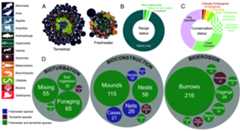
Global diversity, range and conservation status of reported zoogeomorphic species, and types of zoogeomorphic effect. (A) Number of zoogeomorphic species identified from published literature (filled circle = a species) color-coded by taxonomic class, with circles scaled by research attention (number of papers). (B) Proportion of reported wild species studied in native/non-native ranges and (C) conservation status of reported species. (D) Zoogeomorphic landforms and processes identified within terrestrial and freshwater ecosystems, filled circle scaling reflects number of species linked with that effect. Some species may be associated with multiple effect types (e.g., burrows and mounds, or dens and diggings) but each species is only represented once for each type of effect. Classifications are primarily based on descriptions and terminology provided in the original published studies (Materials and Methods).
Global Abundance and Distribution of Reported Geomorphic Agents.
Global occurrence data were available for reported zoogeomorphic species in 289 genera (79% of the total identified) and were used to indicate global abundance (Materials and Methods). Zoogeomorphic species collectively are globally widespread, with over 16 million global occurrence records reported across wild animal species. Freshwater zoogeomorphic species were associated with more occurrence records than terrestrial species, accounting for 70% of occurrence records compared to 34% of the total zoogeomorphic species (Fig. 2A). This reflects the relatively high proportions of widespread genera of ray-finned fishes, waterfowl, and shorebirds in freshwater habitats. Zoogeomorphic animals with intermediate global occurrences (102 to 104 records) were most common and most taxonomically diverse (Fig. 2B). Rare or geographically restricted taxa (<100 occurrence records) accounted for 19% of genera and the majority of these were less visible, small-bodied animals (insects, clitellate worms, small crustaceans, and arachnids) which are likely to be more widespread than global occurrence data suggest. Livestock occurrences are low relative to wild animal occurrences in the datasets (Materials and Methods) and are presented separately inSI Appendix, Fig. S3.
Fig. 2.
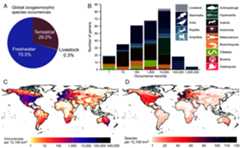
Global distribution, abundance, and richness of reported zoogeomorphic agents. (A) Distribution of occurrence records for terrestrial and freshwater species. (B) Frequency distribution of global occurrence records for reported zoogeomorphic species, grouped by genera, colored by taxonomic class. (C) Global patterns in species abundance (occurrence density) of reported zoogeomorphic agents and (D) global patterns in species richness of reported zoogeomorphic agents. Maps (C) and (D) are based on GBIF occurrence records for wild animal species. Livestock distributions captured in GBIF data are presented inSI Appendix, Fig. S3.
Geomorphic effects of animals were identified in all major freshwater and terrestrial ecosystem functional groups (SI Appendix, Fig. S4). Regional patterns in the characteristic geomorphic agents reported included bears, bison, and salmonids in North America; ants, termites, and shrimp in South America; marsupials in Australia; large herbivores in Africa; termites and ants in Asia; and earthworms, boar, and freshwater insects in Europe, while biogeomorphic effects of rodents were reported more widely (Materials and Methods for discussion of geographical and taxonomic biases). To explore the global distributions of the identified zoogeomorphic species and identify potential hotspots of zoogeomorphic activity, we created raster surfaces using global occurrence records (Materials and Methods). Occurrence density and richness patterns (Fig. 2C andD) indicate the highest co-occurrence of wild zoogeomorphic species (tens of species) in western Europe and North America, followed by Australia, South Africa, and South America where data are richer, in comparison to the tropics and subtropics (Materials and Methods). The distributions for livestock taxa follow a similar pattern (SI Appendix, Fig. S3). As a result of the stated biases in research, publication, and occurrence data, zoogeomorphic species abundance and diversity are likely significantly underestimated in the tropics and subtropics and, hence, the co-occurrence of tens of zoogeomorphic species is likely far more widespread.
Potential for Undiscovered Species.
Since species within a genus share similar traits and behaviors, it is plausible that genera containing reported zoogeomorphic species may also contain undiscovered or unreported geomorphically active species. Hence, we calculated the proportion of described species that were reported as geomorphic agents for each genera using global species inventories (22). Species data were available for 362 genera (99% of the total reported). We grouped genera based on the total number of species they contained (Fig. 3 andSI Appendix, Table S1). A small number of genera were monotypic (containing one extant species), two-thirds of which were mammals. Known extinct species of these genera may have been significant zoogeomorphic agents in the past. Small genera (less than 10 species) contained on average (median) one third zoogeomorphic species including some better-known, “charismatic” and larger-bodied animals such as grizzly bears, beavers, crayfish, and wild boar. There is limited potential for undiscovered species within this group of more visible genera that contain fewer species. In contrast, the species-rich genera have greater potential for overlooked and/or undiscovered zoogeomorphic species and were differentiated into two groups. Large genera containing 10 to 100 species in total and on average 6% zoogeomorphic species were termed “Cinderella” genera (29) since they were typically less visible (e.g., underwater or underground dwelling, smaller-bodied). Combined with a high number of species within the genera, this indicates potential for overlooked species not uncovered by our searches. Very species-rich genera (100 to 1000 species) with a disproportionately small number of geomorphic agents uncovered by our searches (~1%) were predominantly insects, which are generally accepted to have high numbers of undescribed species (26). Together, these characteristics indicate high potential for undiscovered zoogeomorphic agents; hence, we termed these “latent” genera.
Fig. 3.
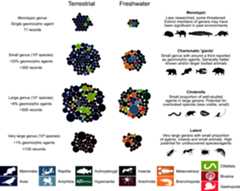
Classification of genera containing zoogeomorphic species based on genus size, proportion of reported zoogeomorphic agents, and taxonomic characteristics. Groups are organized by ecosystem and total genus size: Each filled circle represents a genus (n = 362), scaled by the number of zoogeomorphic species in that genus. Genera are color-coded by taxonomic class. Representative animals are shown by icons.
Global Biomass and Energy of Reported Animal Geomorphic Agents.
To assess the global geomorphic significance of reported zoogeomorphic species, we estimated their collective biomass and converted this to biological energy content to enable comparison with energy from geophysical disturbances. We used existing recent estimates of global biomass for nonmarine animals (24), wild terrestrial mammals (25), and ants (family Formicidae) (26) and estimated the proportion of that biomass associated with species we know to be zoogeomorphic agents (Materials and Methods). Since data availability for global biomass estimates and global species abundance varied across taxonomic groups, we used two approaches to estimate the zoogeomorphic proportion of published global biomass estimates: calculating the percentage of all known species (22,29) that were reported as zoogeomorphic agents and (where possible) the percentage of all global occurrence records (23) associated with zoogeomorphic species (Materials and Methods). Biomass estimates were converted to total energy content using existing calorie per gram relationships (Materials and Methods). Livestock taxa were excluded from the wild animal estimates and their biomass was estimated separately using published livestock biomass data (Materials and Methods). Uncertainty bounds of published biomass estimates (ranging from 2 to 5-fold) and of published calorie per gram values (1.35-fold) were used to represent the uncertainty of biomass and energy estimates.
For different orders of mammals and for ants, estimates of the collective biomass of reported zoogeomorphic agents ranged from ≈10−4 and ≈100 Mt of carbon, equivalent to ≈103 to ≈107 GJ of biological energy (SI Appendix, Tables S2 and S3). Except for Perissodactyla (odd-toed ungulates), estimates based on occurrence data were higher than those based on species richness, generally by an order of magnitude. The estimate range was largest for ants (≈1 million to 97 million GJ), reflecting their ubiquity (26). Larger estimates were also produced for larger-bodied but globally rare animals (elephants, ≈2.4 to 20 million GJ). The total biological energy estimate based on the biomass of all nonmarine wild animal zoogeomorphic species is therefore considered very conservative, and likely a significant underestimate, at ≈7.6 million GJ (range ≈1.1 to 51 million GJ).
The total energy values are maxima and not all this energy will be available to do geomorphic work. A large proportion of energy will be expended on living costs and that fraction of the remainder spent doing geomorphic work will reflect diverse factors including life stage, environmental context and contingency of zoogeomorphic effects (30), time partitioning of behavior (e.g., nocturnal, seasonal), temperature, and invasion status (31). Research quantifying energy partitioning is sparse and hence the magnitude of these influences across all species and environments is unknown, but most animals perform geomorphic work as a survival necessity, for example, as a result of feeding, locomotion, or to construct and maintain shelter that is used throughout lifecycles. Where available, published estimates for energy expenditure on these activities range from <1% to over 40% of an animal’s energy budget, depending on the species and activity type (Materials and Methods). Reflecting this diversity, we adopt a conservative assumption that at least 1% of the maximum available global biological energy of wild zoogeomorphic species is expended on geomorphic work in a year, yielding a global estimate of over ≈76,000 GJ (range: ≈11,000 to 510,000 GJ;Fig. 4). This is approximately equivalent to the total energy of over 500,000 extraordinary river floods or 200,000 monsoon seasons, or the annual energy of 700 periglacial mountain rock glacier systems (Fig. 4 andSI Appendix, Table S4). Based on published estimates of livestock biomass, the potential contribution of livestock taxa to geomorphic processes could exceed wild animals by 450-fold, at 34.5 million GJ.
Fig. 4.
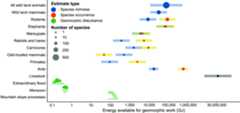
Range of estimates for the energy of zoogeomorphic species available for geomorphic work annually. Values represent an estimated minimum of 1% of total biological energy. Size of each circle reflects the number of zoogeomorphic species in that group. Estimates for different taxonomic groups are compared to example geomorphological disturbances (river floods, monsoons, and total annual energy of mountain slope processes) from the literature (SI Appendix, Table S4). The livestock estimate is shown in gray and was calculated using published biomass estimates for the five reported zoogeomorphic livestock species.
If the energy contribution of wild animal geomorphic agents is evenly distributed across the land surface of the Earth below the treeline, this equates to an average of ≈0.58 J m−2 y−1 (range: ≈0.09 to 3.89 J m−2 y−1) which exceeds published data for large floods, tropical storms, and monsoons by between one and three orders of magnitude (SI Appendix, Table S4). This value will be higher in hotspots of zoogeomorphic species diversity and abundance and lower in areas where geomorphic agents are less diverse and/or abundant. Our species density and richness maps (Fig. 2C andD) indicate that 5% of the nonmarine land surface may host up to 90% of the reported wild zoogeomorphic agents (SI Appendix, Fig. S5). Under this scenario, annual zoogeomorphic energy in these hotspots could exceed ≈10 J m−2 y−1 (range: ≈2 to 70 J m−2 y−1), which is orders of magnitude lower than spatially averaged energy values for annual mountain slope processes but exceeds spatially averaged values for typical hydrologically and meteorologically driven disturbances.
Discussion
Animals acting as geomorphic agents have a profound influence on the processes shaping the Earth’s surface, yet until now, the global diversity and collective biomass and energy of these animals has remained unexplored. Our analysis has shown that the diversity and abundance of freshwater and terrestrial animals shaping the Earth’s surface is extensive. Our searches identified 500 animal species that are reported as geomorphic agents. They range in body size from insects to megafauna, spanning thirteen taxonomic classes and all freshwater and terrestrial ecosystem types. Reporting of zoogeomorphic agents was disproportionately sparse in global biodiversity hotspots such as the tropics and subtropics (32), among insects which likely host undiscovered species numbering millions (26), and among smaller, less visible but potentially impactful “Cinderella” species such as those living underwater or underground (29). Other animal geomorphic agents may also be overlooked or underemphasized because their impacts are not obvious. As a result, it is likely that many more as yet unidentified species will be zoogeomorphic agents, and that the zoogeomorphic agency of many described species is underreported. We therefore consider the species inventory and associated calculations reported in this paper, which are based on systematic review of published studies, to represent a minimum and likely a considerable underestimate. Notably, the scope of this study, and hence calculations, excludes marine and coastal environments where zoogeomorphic effects will also be substantial (33).
We found that terrestrial environments were richer in reported zoogeomorphic species in absolute terms, but that freshwater habitats contained a higher proportion of reported zoogeomorphic species per unit area, and freshwater zoogeomorphic species collectively were more globally abundant based on available occurrence data. Freshwater ecosystems are known to support high biodiversity per unit area overall (34,35) but are subject to multiple stressors (36) and are experiencing exceptionally high rates of population decline (35). This indicates high risks of future decline or loss of important zoogeomorphic processes. The geomorphic processes and landforms associated with other vulnerable taxa such as terrestrial megafauna (37) and marsupials (38) face similar future threats. Indeed, more than a quarter (28%) of all reported zoogeomorphic species were listed as being exposed to current or future threats, meaning that there is a real risk of losing many zoogeomorphic processes from landscapes before we have developed a full understanding of their environmental significance.
Recently published estimates of the global biomass of different taxonomic groups (24–26) enabled estimation of the collective biomass and biological energy of reported wild animal geomorphic agents at ≈0.2 Mt Carbon and ≈7.6 million GJ respectively. Biomass and biological energy for livestock reported as geomorphic agents were estimated at ≈75 Mt Carbon and ≈3.5 billion GJ respectively. Even assuming only 1% of this total energy contributes to geomorphic work in a given year, this yields total and spatially averaged energy estimates for wild animals that exceed those of major geophysical disturbances such as floods by orders of magnitude. Our 1% estimate is a conservative minimum based on available published studies of energy expenditure for a limited number of species which included reported values upward of 10% (Materials and Methods for details), meaning the average contribution across all species could be an order of magnitude higher. Estimates of livestock energy contributions to geomorphic work exceed wild animals by three orders of magnitude due to their global abundance and large body size, but realization of their geomorphic effects will reflect factors such as stocking density, environmental conditions, feeding, and behavior in a domesticated setting (39–41). These impacts remain underexplored (41), with our searches returning only 14 publications addressing the geomorphic effects of livestock relative to 503 on wild animals. Global estimates of biomass are typically associated with high uncertainty (24–26) meaning our energy estimates could reach an order of magnitude higher or lower but the minimum estimate for wild animals is still equivalent to the energy expended by tens of thousands of extraordinary floods.
These estimates are astounding, partly because they challenge the geophysical orthodoxy that has historically overlooked the geomorphic significance of animals (42). Yet, existing documentation of the profound impact of animals on geomorphology provides context and perspective to support the magnitude of these estimates, beginning with Charles Darwin’s recognition of the role of earthworms in soil formation and landscape evolution (43,44). Recent studies have revealed that the energy of macroinvertebrate communities can match or exceed stream power for most of the year in some rivers (19) and Hippopotamus trails can initiate the development of drainage networks (45). Remote sensing has revealed extensive termite mounds in Brazil covering over 100,000 km2 (46) and the global abundance of ants has been estimated at 20 quadrillion (26), many of which are highly effective geomorphic agents (10).
Our uncertainty bounds account for the uncertainty in biomass estimates and in published Calorie per gram estimates. Data are not available to explicitly account for variations in energy partitioning by zoogeomorphic agents and environmental contingency but this is implicitly recognized in our adoption of a conservative estimate of 1% of total energy dedicated to geomorphic work across all species. We do not convert biological energy estimates into sediment flux since this relationship will depend on landscape characteristics and species traits, behaviors, and interactions (5,47–49). Further empirical research is required to understand these relationships for different species, but studies on crustaceans (19) and mammals (50) indicate that animal geomorphic agents alter soil and sediment fluxes efficiently and can move particles at energy levels below those required for geophysical processes (19).
Our analysis has revealed that the energy of zoogeomorphic species represents a significant and overlooked driver of geomorphic change at the global level. Some of their energy will drive changes that are beneficial for ecosystem functioning, but some may also be ecologically destructive, such as the effects of invasive non-native zoogeomorphic agents (31). The nature and significance of these processes will also be altered by the combined effects of climate change on geomorphic systems, species ranges, and trait filtering (51).
Materials and Methods
Systematic Review.
To create a global species inventory of reported animal geomorphic agents, we conducted a systematic review (52) of zoogeomorphological research following the established Preferred Reporting Items for Systematic Reviews and Meta-Analyses guidelines (PRISMA), including the extension proposed for ecology (PRISMA Eco-Evo) (53,54). The approach was a comprehensive search rather than a representative sample. Searches were conducted in Scopus and Web of Knowledge (WOK) using predetermined search strings designed to capture studies using discipline-specific descriptors (e.g., zoogeomorphology, biogeomorphology, ecosystem engineer, geomorphology, bioerosion, bioturbation, etc.) as well as those using more general terms for the same effects (e.g., sediment, soil, grain, etc.). Search strings were applied to title, abstract, and keywords (SI Appendix, Table S5). Searches were first conducted on 6th July 2021 and updated on 14th June 2022 to capture papers published between those dates. References were also extracted from key published reviews and meta-analyses (SI Appendix, Table S6) including systematic reviews focusing on ecosystem engineering by land animals (55) and soil disturbing vertebrates (56), the biotic effects on sediment transport in streams (57), and animal geomorphic effects in mountain streams (58). The searches and reference lists returned 8,312 publications combined (excluding duplicates), which were screened for relevance using the following eligibility criteria: i) contemporary freshwater or terrestrial environments on Earth; ii) animal effects on geomorphology; iii) ecosystem engineering effects that are geomorphological in nature are a primary focus of the paper; and iv) publication is empirical or a quantitative review (SI Appendix, Fig. S6). Two members of the research team independently carried out the screening and data extraction manually and 33% of the extractions (167 out of 513 publications) were validated by researchers assessing the same papers. Where taxonomic data were not provided on the animal responsible for geomorphic effects, the study was excluded from the final dataset. Where species-level taxonomic data were unavailable, the study was excluded from the quantitative analysis. Marine ecosystems and ecosystem engineering by humans were beyond the scope of the research project and were not included in the search terms or inclusion criteria. The final retained dataset contained 493 empirical papers and 20 quantitative reviews (59). Data extractions were checked to ensure no replication was introduced by quantitative review data.
Species Inventories and Occurrence Data.
All returned papers that met eligibility criteria were used to extract information on animal species with reported geomorphic impacts to create the zoogeomorphic species inventory. Our zoogeomorphic species list was derived from publications that undertook quantitative assessment of geomorphic effects using control and treatment design (n = 144 species); or from papers that assessed effects by other means including measuring landform geometry, quantifying processes, observational approaches including photographs, or quantitative reviews (n = 356). Our species inventory is inevitably influenced by known research publication biases, including our exclusion of publications not written in English.Fig. 5 shows the distribution of published studies and illustrates the bias toward temperate Northern Hemisphere environments. Zoogeomorphic research is notably lacking from the high biodiversity tropical and subtropical latitudes where high animal species richness (32) indicates potential for high numbers of geomorphic agents. As a result of these inherent biases, our results doubtless underrepresent geomorphic agents outside of temperate zone (and Northern Hemisphere) environments, and we recognize this by referring to “reported” geomorphic agents throughout. The Catalogue of Life (22) was used to quantify the total numbers of described extant species within different taxonomic groups to calculate the relative proportion of reported zoogeomorphic species within those groups. Data on species range (native, non-native) were derived from the publications reporting zoogeomorphic impacts, and conservation status was assigned based on the IUCN Red List of Threatened Species (60). Since accurate global species abundance data are not available, we used occurrence records as a proxy for global abundance. Species were assigned to one or more zoogeomorphic effect types to explore the diversity of effects. Category designations were primarily based on the descriptions provided in the published studies. Burrows and mounds, while commonly co-occurring, were treated as separate features on the basis of mounds being deliberately constructed to extend subterranean dwellings aboveground, whereas spoil piles or ejecta associated with burrowing are byproducts formed to create void space elsewhere (61). There was inevitably some variation in terminology, and subjectivity in classification of features within the original papers and in our own subdivision of effects into bioturbation, bioconstruction, and bioerosion groupings, which conceptually contain overlap (21,27). However, the purpose was to illustrate the nature and diversity of the effects and relative numbers of species associated with them rather than to provide a rigid classification of effect types. Each species could be assigned to multiple features but is only represented once per feature inFig. 1D.
Fig. 5.
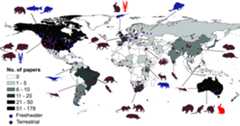
Distribution of research attention (number of publications) by country and study locations for field-based studies (n = 435 papers). Silhouettes of characteristic zoogeomorphic species are shown by region (non-native species are displayed in red).
Occurrence records for all reported zoogeomorphic species were downloaded from The Global Biodiversity Information Facility (GBIF) (23,62–64) where available using thergbif package version 3.7.8 (65) and used to create raster surfaces of global zoogeomorphic species occurrence and richness in R version 4.3.0 (66) for wild and livestock species separately. Prior to mapping, theCoordinateCleaner package version 3.0.1 (67) was used to exclude occurrence data if they were duplicates; absence records; fossils or living specimens; nongeoreferenced or otherwise spatially invalid or uncertain; located in marine areas; recorded prior to the year 1900 (due to data quality); located within 100 m of zoos; or located within 2 km of country or capital centroids. Centroid coordinates are retrospectively assigned by GBIF to occurrence records when only textual location descriptions are provided, so excluding these improved the accuracy of our dataset (66). Where global biomass estimates could be extracted for specific taxonomic groups (see below), we downloaded the GBIF occurrence records for all species in that taxonomic group (68,69) in order to estimate the proportion of occurrence records associated with zoogeomorphic species within that group. GBIF data are derived from a network of participating countries and organizations and bring together information from thousands of different datasets (23). GBIF occurrence data can be used to estimate abundance but are subject to inherent biases associated with the historical concentration of taxonomic resources (70) including the research and publication biases discussed above, changes in data collection practices through time, spatial biases (e.g., landcover), and identification and recording of different taxonomic groups (71,72). Livestock are underrepresented in the database and occurrence data were not used to estimate biomass and energy for this group. Thus, while occurrence data were selected systematically using our species inventory, we acknowledge that the unquantified biases and error margins in these data inevitably influence the analyses. Despite these issues, GBIF remains one of the largest global biodiversity resources available for large-scale analyses of species occurrence and richness.
Zoogeomorphic Biomass Estimates.
We used recent estimates of global biomass for different animal groups according to data availability (all wild animals, wild mammals, specific orders of wild mammals, ants, and livestock) to estimate the total biomass and energy associated with zoogeomorphic species. The proportion of total animal biomass associated with zoogeomorphic species will reflect the species richness, global abundance, and individual biomass of zoogeomorphic species. We assessed the body size distribution of reported zoogeomorphic agents at the genus level to verify that reported zoogeomorphic species encompass a range of body sizes (SI Appendix). Data were available for 302 genera (82% of the total reported). These data show that reported zoogeomorphic agents span a range of body sizes from milligrams to more than 1 tonne (SI Appendix, Fig. S7) and include some of the largest animals on Earth (elephants, bison, hippopotamus, etc.) as well as the smallest (ants, aquatic insect larvae, etc.). In the absence of a global animal biomass frequency distribution, we therefore assumed the distribution for zoogeomorphic species to be broadly similar to the distribution for all wild terrestrial and freshwater animals.
We estimated the proportional contribution of wild zoogeomorphic species to global animal biomass estimates using two methods: (i) by calculating the proportion of all species that are reported zoogeomorphic agents (species richness-based estimates) and (ii) by calculating the proportion of global species occurrence records that are associated with zoogeomorphic species (occurrence-based estimates). These proportions could be calculated for all wild animals combined (24) and for orders of wild mammals (Rodentia, Proboscidea, Lagomorpha, Perissodactyla, Diprotodontia, Carnivora, and Primates) (25) and ants (family: Formicidae) (26). Data are provided inSI Appendix, Tables S2 and S3. Livestock biomass was calculated separately for taxa identified as geomorphic agents (cattle, sheep, goats, yak, and feral horse) using the published biomass estimates for those taxa (24) (SI Appendix, Table S2). We applied the following uncertainty bounds of each type of biomass estimate provided in published biomass inventories: 5-fold for all nonmarine wild animals and for livestock (24), 2-fold for wild mammals (25), and ± 3.1 Mt Carbon for ants (26).
Zoogeomorphic Energy Contributions.
The global biomass estimates used were reported in Mt Carbon, which was converted to dry weight using the standard approach [dry weight = 2 × biomass (carbon)] (24). Dry weight was converted to calories (kcal) using Calorie per gram relationships available within the literature for different taxonomic groups (SI Appendix, Table S7). Relationships were available for some but not all of our taxonomic groups and variation between them was relatively low (3.71 to 5.65 kcal g−1) so we used an average value of 4.831 kcal g−1 for all wild animals with an uncertainty bound of 1.35-fold. We applied a conversion of 5.5 kcal g−1 for livestock, which is the lower of two estimates for cattle and sheep protein (73). Estimates of total calorie content of zoogeomorphic animals globally were computed from biomass dry weight and converted to Joules using the conversion 1 kcal = 4,184 J, to enable comparison with geomorphological disturbances reported in the literature. Total energy calculations for zoogeomorphic species (in Gigajoules; GJ) are included inSI Appendix, Tables S2 and S3. Biological energy available for geomorphic work was conservatively estimated at 1% of the total energy content of animals. While published estimates of energy partitioning and contributions to geomorphic processes are sparse, and variation between species is considerable, the available data confirm that this is a conservative estimate. Energy costs associated with burrowing can be as high as 40 to 70% for earthworms (74) and 14% of daily energy budget for the pocket gopherThomomys bottae (75). Mammals may expend 4 to 35% of their daily energy budget on locomotion (75,76), and estimates of foraging costs include 15 to 22% of daily energy budget for the armored catfishAncistrus triradiatus (77) and 27% and 36% of daily energy expenditure on subsurface and surface foraging, respectively, for the Namib Desert golden moleEremitalpa namibensis (78). Intensive but temporally constrained activities such as redd construction by salmonids may still account for 5 to 30 d of the year; equating to ~1 to 10% of time dedicated to the activity annually (79–81). Energy expenditure estimates for the construction of an individual burrow have been reported at 0.27% of annual energy budget for the rodentCtenomys talarum (82) and 2% of annual energy turnover for the scorpionUrodacus yaschenkoi (83). Estimates of total energy associated with physical geomorphological disturbances (extreme river floods, monsoon seasons, annual energy of periglacial mountain rock glacier systems) were derived from the literature for comparison with biological energy (SI Appendix, Table S4). To obtain average energy values per unit area, we used a nonmarine land surface area of 131,180,000 km2, excluding Antarctica and land above the treeline (84) where animal abundance is very low as a result of the inhospitable conditions.
Supplementary Material
Appendix 01 (PDF)
Acknowledgments
Gemma Harvey and Zareena Khan were supported by the Leverhulme Trust via a Leverhulme Research Fellowship (Grant number RF-2022-284\4). Lindsey Albertson was supported by a NSF Division of Environmental Biology Grant (Grant number 1945941).
Author contributions
G.L.H., Z.K., L.K.A., M.C., M.F.J., S.P.R., and H.A.V. designed research; G.L.H. and Z.K. performed research; G.L.H. and Z.K. analyzed data; and G.L.H., Z.K., L.K.A., M.C., M.J., S.P.R., and H.A.V. wrote the paper.
Competing interests
The authors declare no competing interest.
Footnotes
This article is a PNAS Direct Submission.
Although PNAS asks authors to adhere to United Nations naming conventions for maps (https://www.un.org/geospatial/mapsgeo), our policy is to publish maps as provided by the authors.
Data, Materials, and Software Availability
All data and code have been made publicly available in the Zenodo repository (59). Data: species inventory including all data used to produce figures, and full bibliography of papers derived from systematic review of the literature. Code: code used to produce, download and map GBIF occurrence data, and code used to produce the biomass and energy estimates.
Supporting Information
References
- 1.Reinhardt L., Jerolmack D., Cardinale B. J., Vanacker V., Wright J., Dynamic interactions of life and its landscape: Feedbacks at the interface of geomorphology and ecology. Earth Surf. Process. Landf.35, 78–101 (2010). [Google Scholar]
- 2.Jones C. G., Lawton J. H., Shachak M., Organisms as ecosystem engineers. Oikos69, 373–386 (1994). [Google Scholar]
- 3.Butler D. R., Zoogeomorphology: Animals as Geomorphic Agents (Cambridge University Press, 1995). [Google Scholar]
- 4.Albertson L. K., Sklar L. S., Cooper S. D., Cardinale B. J., Aquatic macroinvertebrates stabilize gravel bed sediment: A test using silk net-spinning caddisflies in semi-natural river channels. PLoS One14, e0209087 (2019). [DOI] [PMC free article] [PubMed] [Google Scholar]
- 5.Rice S. P., Pledger A., Toone J., Mathers J., Zoogeomorphological behaviours in fish and the potential impact of benthic feeding on bed material mobility in fluvial landscapes. Earth Surf. Process. Landf.44, 54–66 (2019). [Google Scholar]
- 6.Harvey G. L., Henshaw A. J., Brasington J., England J., Burrowing invasive species: An unquantified erosion risk at the aquatic-terrestrial interface. Rev. Geophys.57, 1018–1036 (2019). [Google Scholar]
- 7.Sanders H., Rice S. P., Wood P. J., Signal crayfish burrowing, bank retreat and sediment supply to rivers: A biophysical sediment budget. Earth Surf. Process. Landf.46, 837–852 (2021). [Google Scholar]
- 8.Johnson M. F., Rice S. P., Reid I., Increase in coarse sediment transport associated with disturbance of gravel river beds by signal crayfish (Pacifastacus leniusculus). Earth Surf. Process. Landf.36, 1680–1692 (2011). [Google Scholar]
- 9.Harvey G. L., et al. , Invasive crayfish as drivers of fine sediment dynamics in rivers: Field and laboratory evidence. Earth Surf. Process. Landf.39, 259–271 (2014). [Google Scholar]
- 10.Viles H. A., Goudie A. S., Goudie A. M., Ants as geomorphological agents: A global assessment. Earth Sci. Rev.213, 103469 (2021). [Google Scholar]
- 11.Kinlaw A., Grasmueck M., Evidence for and geomorphologic consequences of a reptilian ecosystem engineer: The burrowing cascade initiated by the gopher tortoise. Geomorphology157, 108–121 (2012). [Google Scholar]
- 12.Polvi L. E., Wohl E., The beaver meadow complex revisited–the role of beavers in post-glacial floodplain development. Earth Surf. Process. Landf.37, 332–346 (2012). [Google Scholar]
- 13.Brown A. G., et al. , Natural vs anthropogenic streams in Europe: History, ecology and implications for restoration, river-rewilding and riverine ecosystem services. Earth Sci. Rev.180, 185–205 (2018). [Google Scholar]
- 14.Hassan M. A., et al. , Salmon-driven bed load transport and bed morphology in mountain streams. Geophys. Res. Lett.35, L04405 (2008). [Google Scholar]
- 15.Fremier A. K., Yanites B. J., Yager E. M., Sex that moves mountains: The influence of spawning fish on river profiles over geologic timescales. Geomorphology305, 163–172 (2018). [Google Scholar]
- 16.Hembree D. I., "Large complex burrows of terrestrial invertebrates: Neoichnology ofPandinus imperator (Scorpiones: Scorpionidae)" in Experimental Approaches to Understanding Fossil Organisms: Lessons from the Living, Hembree D. I., Platt B. F., Smith J. J., Eds. (Springer, Dordrecht, 2014), pp. 229–263. [Google Scholar]
- 17.Gutmann Roberts C., Bašić T., Britton J. R., Rice S., Pledger A. G., Quantifying the habitat and zoogeomorphic capabilities of spawning European barbelBarbus barbus, a lithophilous cyprinid. River Res. Appl.36, 259–279 (2020). [Google Scholar]
- 18.Phillips J. D., Biological energy in landscape evolution. Am. J. Sci.309, 271–289 (2006). [Google Scholar]
- 19.Johnson M. F., et al. , Accounting for the power of nature: Comparing the capacities of bio-energy and fluvial energy to move surficial gravel grains. Earth Surf. Process. Landf.49, 2612–2627 (2024). [Google Scholar]
- 20.Lisenby P. E., Croke J., Fryirs K. A., Geomorphic effectiveness: A linear concept in a non-linear world. Earth Surf. Process. Landf.43, 4–20 (2018). [Google Scholar]
- 21.Viles H., Biogeomorphology: Past, present and future. Geomorphology366, 106809 (2020). [Google Scholar]
- 22.Bánki O., et al. , Catalogue of Life Checklist (Version 2023–10-16). Catalogue of Life (2023), 10.48580/df7lv. [DOI]
- 23.GBIF.org, GBIF Home Page. (2023),https://www.gbif.org.
- 24.Bar-On Y. M., Phillips R., Milo R., The biomass distribution on Earth. Proc. Natl. Acad. Sci. U.S.A.115, 6506–6511 (2018). [DOI] [PMC free article] [PubMed] [Google Scholar]
- 25.Greenspoon L., et al. , The global biomass of wild mammals. Proc. Natl. Acad. Sci. U.S.A.120, e2204892120 (2023). [DOI] [PMC free article] [PubMed] [Google Scholar]
- 26.Schultheiss P., et al. , The abundance, biomass, and distribution of ants on Earth. Proc. Natl. Acad. Sci. U.S.A.119, e2201550119 (2022). [DOI] [PMC free article] [PubMed] [Google Scholar]
- 27.Naylor L. A., Viles H. A., Carter N. E. A., Biogeomorphology revisited: Looking towards the future. Geomorphology47, 3–14 (2002). [Google Scholar]
- 28.van Klink R., et al. , Meta-analysis reveals declines in terrestrial but increases in freshwater insect abundances. Science368, 417–420 (2020). [DOI] [PubMed] [Google Scholar]
- 29.Mora C., Tittensor D. P., Adel S., Simpson A. G. B., Worm B., How many species are there on Earth and in the Ocean?PLoS Biol.9, e1001127 (2011). [DOI] [PMC free article] [PubMed] [Google Scholar]
- 30.Phillips J. D., Biogeomorphology and contingent ecosystem engineering in karst landscapes. Prog. Phys. Geogr.40, 503–526 (2016). [Google Scholar]
- 31.Fei S., Phillips J., Shouse M., Biogeomorphic impacts of invasive species. Annu. Rev. Ecol. Evol. Syst.45, 69–87 (2014). [Google Scholar]
- 32.Willig M. R., Kaufman D. M., Stevens R. D., Latitudinal gradients of biodiversity: Pattern, process, scale, and synthesis. Annu. Rev. Ecol. Evol. Syst.34, 273–309 (2003). [Google Scholar]
- 33.Teal L. R., Bulling M. T., Parker E. R., Solan M., Global patterns of bioturbation intensity and mixed depth of marine soft sediments. Aquat. Biol.2, 207–218 (2008). [Google Scholar]
- 34.Dudgeon D., et al. , Freshwater biodiversity: Importance, threats, status and conservation challenges. Biol. Rev. Camb. Philos. Soc.81, 163–182 (2006). [DOI] [PubMed] [Google Scholar]
- 35.Reid A. J., et al. , Emerging threats and persistent conservation challenges for freshwater biodiversity. Biol. Rev. Camb. Philos. Soc.94, 849–873 (2019). [DOI] [PubMed] [Google Scholar]
- 36.He F., Arora R., Mansour I., Multispecies assemblages and multiple stressors: Synthesizing the state of experimental research in freshwaters. WIREs. Water10, e1641 (2023). [Google Scholar]
- 37.Davoli M., et al. , Megafauna diversity and functional declines in Europe from the Last Interglacial to the present. Glob. Ecol. Biogeogr.33, 34–47 (2024). [Google Scholar]
- 38.Fleming P. A., et al. , Is the loss of Australian digging mammals contributing to a deterioration in ecosystem function?. Mamm. Rev.44, 94–108 (2014). [Google Scholar]
- 39.Trimble S. W., Mendel A. C., The cow as a geomorphic agent—a critical review. Geomorphology13, 233–253 (1995). [Google Scholar]
- 40.Evans R., The erosional impacts of grazing animals. Prog. Phys. Geogr.22, 251–268 (1998). [Google Scholar]
- 41.Ries J. B., et al. , Sheep and goat erosion–experimental geomorphology as an approach for the quantification of underestimated processes. Z. Geomorphol.58, 1–23 (2014). [Google Scholar]
- 42.Rice S. P., Why so skeptical? The role of animals in fluvial geomorphologyWIREs. Water8, e1549 (2021). [Google Scholar]
- 43.Darwin C., The formation of vegetable mould, through the action of worms, with observations on their habits (J. Murray, 1892). [Google Scholar]
- 44.Tsikalas S. G., Whitesides C. J., Worm geomorphology: Lessons from Darwin. Prog. Phys. Geogr.37, 270–281 (2013). [Google Scholar]
- 45.Voysey M. D., de Bruyn P. N., Davies A. B., Are hippos Africa’s most influential megaherbivore? A review of ecosystem engineering by the semi-aquatic common hippopotamusBiol. Rev. Camb. Philos. Soc.98, 1509–1529 (2023). [DOI] [PubMed] [Google Scholar]
- 46.Funch R. R., Termite mounds as dominant land forms in semiarid northeastern Brazil. J. Arid Environ.122, 27–29 (2015). [Google Scholar]
- 47.Rice S. P., Johnson M. F., Extence C., Reeds J., Longstaff H., Diel patterns of suspended sediment flux and the zoogeomorphic agency of invasive crayfish. Cuad. Investig. Geogr.40, 7–28 (2014). [Google Scholar]
- 48.Albertson L. K., Cardinale B. J., Sklar L. S., Non-additive increases in sediment stability are generated by macroinvertebrate species interactions in laboratory streams. PLoS One9, e103417 (2014). [DOI] [PMC free article] [PubMed] [Google Scholar]
- 49.Gabet E. J., Gopher bioturbation: Field evidence for non-linear hillslope diffusion. Earth Surf. Process. Landf.25, 1419–1428 (2000). [Google Scholar]
- 50.Yoo K., Amundson R., Heimsath A. M., Dietrich W. E., Process-based model linking pocket gopher (Thomomys bottae) activity to sediment transport and soil thickness. Geology33, 917–920 (2005). [Google Scholar]
- 51.Viles H., Coombes M., Biogeomorphology in the Anthropocene: A hierarchical, traits-based approach. Geomorphology417, 108446 (2022). [Google Scholar]
- 52.James K. L., Randall N. P., Haddaway N. R., A methodology for systematic mapping in environmental sciences. Environ. Evid.5, 1–13 (2016). [Google Scholar]
- 53.Page M. J., et al. , The PRISMA 2020 statement: An updated guideline for reporting systematic reviews. Int. J. Surg.88, 105906 (2021). [DOI] [PubMed] [Google Scholar]
- 54.O’Dea R. E., et al. , Preferred reporting items for systematic reviews and meta-analyses in ecology and evolutionary biology: A PRISMA extension. Biol. Rev. Camb. Philos. Soc.96, 1695–1722 (2021). [DOI] [PMC free article] [PubMed] [Google Scholar]
- 55.Coggan N. V., Hayward M. W., Gibb H., A global database and “state of the field” review of research into ecosystem engineering by land animals. J. Anim. Ecol.87, 974–994 (2018). [DOI] [PubMed] [Google Scholar]
- 56.Mallen-Cooper M., Nakagawa S., Eldridge D. J., Global meta-analysis of soil-disturbing vertebrates reveals strong effects on ecosystem patterns and processes. Glob. Ecol. Biogeogr.28, 661–679 (2018). [Google Scholar]
- 57.Albertson L. K., Allen D. C., Trexler J. C., Meta-analysis: Abundance, behavior, and hydraulic energy shape biotic effects on sediment transport in streams. Ecology96, 1329–1339 (2015). [DOI] [PubMed] [Google Scholar]
- 58.Bylak A., Kukula K., Geomorphological effects of animals in mountain streams: Impact and role. Sci. Total Environ.749, 141283 (2020). [DOI] [PubMed] [Google Scholar]
- 59.Harvey G. L., Khan Z., ZooGeoData: a global census of animal geomorphic agents and their effects [Data set]. Zenodo. 10.5281/zenodo.14289296. Deposited 27 January 2025. [DOI]
- 60.IUCN, The IUCN Red List of Threatened Species, Version 2023–1. (2023),https://www.iucnredlist.org.
- 61.Platt B. F., Kolb D. J., Kunhardt C. G., Milo S. P., New L. G., Burrowing through the literature: The impact of soil-disturbing vertebrates on physical and chemical properties of soil. Soil Sci.181, 175–191 (2016). [Google Scholar]
- 62.GBIF.Org. GBIF Occurrence Download. The Global Biodiversity Information Facility (2023a). 10.15468/dl.jzm72r. [DOI]
- 63.GBIF.Org. GBIF Occurrence Download. The Global Biodiversity Information Facility (2023b). 10.15468/dl.hjrjxj. [DOI]
- 64.GBIF.Org. GBIF Occurrence Download. The Global Biodiversity Information Facility (2024). 10.15468/dl.2mn3e4. [DOI]
- 65.Chamberlain S., et al. , rgbif: Interface to the Global Biodiversity Information Facility API. R package version 3.7.8 (2023),https://CRAN.R-project.org/package=rgbif.
- 66.R Core Team, R: A Language and Environment for Statistical Computing (R Foundation for Statistical Computing, Vienna, Austria, 2023). [Google Scholar]
- 67.Zizka A., et al. , CoordinateCleaner: Standardized cleaning of occurrence records from biological collection databases. Methods Ecol. Evol.10, 744–751 (2019). [Google Scholar]
- 68.GBIF.Org. GBIF Occurrence Download. The Global Biodiversity Information Facility (2023c). 10.15468/dl.3u4mxx. [DOI]
- 69.GBIF.Org. GBIF Occurrence Download. The Global Biodiversity Information Facility (2023d). 10.15468/dl.3mfuxd. [DOI]
- 70.García-Roselló E., González-Dacosta J., Lobo J. M., The biased distribution of existing information on biodiversity hinders its use in conservation, and we need an integrative approach to act urgently. Biol. Conserv.283, 110118 (2023). [Google Scholar]
- 71.Petersen T. K., Speed J. D., Grøtan V., Austrheim G., Species data for understanding biodiversity dynamics: The what, where and when of species occurrence data collection. Ecol. Solut. Evid.2, e12048 (2021). [Google Scholar]
- 72.Cancellario T., et al. , Climate change will redefine taxonomic, functional, and phylogenetic diversity of Odonata in space and time. NPJ Biodivers.1, 1 (2022). [DOI] [PMC free article] [PubMed] [Google Scholar]
- 73.Garrett W. N., Meyer J. H., Lofgreen G. P., The comparative energy requirements of sheep and cattle for maintenance and gain. J. Anim. Sci.18, 528–547 (1959). [Google Scholar]
- 74.Arrázola-Vásquez E. M., et al. , Estimating energy costs of earthworm burrowing using calorimetry. Eur. J. Soil Biol.121, 103619 (2024). [Google Scholar]
- 75.Gettinger R. D., Energy and water metabolism of free-ranging pocket gophers,Thomomys bottae. Ecology65, 740–751 (1984). [Google Scholar]
- 76.Karasov W. H., Daily energy expenditure and the cost of activity in mammals. Am. Zool.32, 238–248 (1992). [Google Scholar]
- 77.Power M. E., The importance of sediment in the grazing ecology and size class interactions of an armored catfish,Ancistrus spinosus. Environ. Biol. Fishes10, 173–181 (1984). [Google Scholar]
- 78.Seymour R. S., Withers P. C., Weathers W. W., Energetics of burrowing, running, and free-living in the Namib Desert golden mole (Eremitalpa namibensis). J. Zool.244, 107–117 (1998). [Google Scholar]
- 79.de Gaudemar B., Schroder S. L., Beall E. P., Nest placement and egg distribution in Atlantic salmon redds. Environ. Biol. Fishes57, 37–47 (2000). [Google Scholar]
- 80.Burner C. J., Characteristics of spawning nests. Fish. Bull.52, 97–110 (1951). [Google Scholar]
- 81.Thurow R. F., King J. G., Attributes of Yellowstone cutthroat trout redds in a tributary of the Snake River, Idaho. Trans. Am. Fish. Soc.123, 37–50 (1994). [Google Scholar]
- 82.Antinuchi C. D., et al. “Energy Budget in Subterranean Rodents: Insights from the Tuco-Tuco Ctenomys Talarum (Rodentia: Ctenomyidae)” in The Quintessential Naturalist: Honoring the Life and Legacy of Oliver. Pearson P., et al., Eds. (University of California Press, 2007), pp. 111–140. [Google Scholar]
- 83.White C. R., The energetics of burrow excavation by the inland robust scorpion,Urodacus yaschenkoi (Birula, 1903). Aust. J. Zool.49, 663–674 (2001). [Google Scholar]
- 84.Testolin R., Attorre F., Jiménez-Alfaro B., Global distribution and bioclimatic characterization of alpine biomes. Ecography43, 779–788 (2020). [Google Scholar]
Associated Data
This section collects any data citations, data availability statements, or supplementary materials included in this article.
Supplementary Materials
Appendix 01 (PDF)
Data Availability Statement
All data and code have been made publicly available in the Zenodo repository (59). Data: species inventory including all data used to produce figures, and full bibliography of papers derived from systematic review of the literature. Code: code used to produce, download and map GBIF occurrence data, and code used to produce the biomass and energy estimates.