


Worms and Flies as Genetically Tractable Animal Models To Study Host-Pathogen Interactions
Eleftherios Mylonakis
Alejandro Aballay
Corresponding author. Mailing address: Department of Molecular Genetics and Microbiology, Duke University Medical Center, Box 3580 DUMC, Durham, NC 27710. Phone: (919) 668-1783. Fax: (919) 684-2790. E-mail:a.aballay@duke.edu.
Flies and worms have been chosen as model genetic organisms based on a number of traits that strike an excellent compromise between complexity and genetic tractability. Although an antibacterial defense system in flies was reported in the early 1970s (11),Drosophila melanogaster actually emerged as a model animal to study innate immunity 20 years later, when the first parallels between mammalian andDrosophila innate immunity were discovered after a NF-κB/Rel protein was found to translocate to the nucleus in response to microbial infection (39,53,76). In addition, in seminal studies Lemaitre et al. demonstrated thatToll andimd genes control the expression of antimicrobial defense inD. melanogaster and showed that mutations in the Toll signaling pathway dramatically reduce survival after fungal infection (52,54).Caenorhabditis elegans emerged a few years later when Tan et al. reported in 1999 that the nematode can be used to modelPseudomonas aeruginosa pathogenesis in mammals (82). Since then, these organisms have been extensively used to study host-pathogen interactions (reviewed in references1,5,14,35,50,69, and78).
As in vertebrates, physical barriers and antimicrobial substances protectD. melanogaster andC. elegans from microbial attacks, but successful microorganisms are capable of overcoming the first line of defense by causing infections that in many cases result in the death of the infected animal. Although the interactions betweenD. melanogaster andC. elegans and a wide variety of microorganisms are somehow artificial, since these animals have not been described to be the natural hosts, they appear to have evolved mechanisms to respond to different microorganisms with some degree of specificity (18,21,22,38,40,55,59).
In the case ofD. melanogaster, growing evidence shows that certain microorganisms are capable of penetrating the exoskeleton or the intestinal epithelium to cause an infection following the so-called “physiological” or “natural” route of infection (85). The physiological infection consists of either (i) feedingD. melanogaster larvae or adult flies with the microorganism of interest distributed in the food or (ii) spraying fungal spores or microorganisms directly onto the fly exoskeleton. Various microorganisms, however, are unable to break the first line of defense and need to be inoculated. This is accomplished by (i) pricking the dorsal part of the fly thorax (or abdomen) body cavity of the insect with a sharp needle that has been dipped into a microbial suspension or (ii) microinjecting a precise dose of microbes directly into the body cavity. The disadvantages of these methods are that the mechanical manipulation itself appears to affect the host defense response to some extent and that there seems to be significant differences in theDrosophila defense response depending on the route of inoculation (7).
In contrast, all theC. elegans pathogens described so far seem to use a relatively more physiological route of infection. Typically,C. elegans animals are propagated in the laboratory on petri dishes containing a lawn of a slow-growing strain ofEscherichia coli OP50. The nematodes, which feed almost constantly during their adult life cycle, use muscle contractions to pump food into the pharynx where the pharyngeal grinder uses specialized cuticular structures to effectively disrupt most bacteria. Thus, essentially no intactE. coli cells can be found in the intestinal lumen. However, whenC. elegans is fed certain human pathogens, the nematodes die and, in many cases, intact microorganisms can be found within the intestine (4,28,41,48,71,82). A specificC. elegans pathogen,Microbacterium nematophilum, has also been isolated. These bacteria adhere to the anal region of the nematodes and induce localized swelling of the underlying hypodermal tissue. Although theC. elegans-M. nematophilum interaction is not lethal to the worm, it has been suggested to be pathogenic due to the morphological changes induced byM. nematophilum and lack of obvious benefits for the host (34).
Studies on theD. melanogaster andC. elegans genomes have yielded new insights into the mechanisms of a variety of human diseases including Alzheimer's disease, stroke, cancer, retinitis pigmentosa, diabetes, and kidney diseases (33,77). Here, we will discuss seminal genetic and functional genomic studies performed withD. melanogaster andC. elegans that have served to identify and characterize a variety of conserved innate immunity-related genes and virulence factors.
IDENTIFICATION OF INNATE IMMUNITY PATHWAYS
Drosophila melanogaster.
TheD. melanogaster immune response against microorganisms lacks adaptive components and relies solely on innate defenses. This, together with its genetic tractability, makesD. melanogaster an excellent animal model to study innate responses without the intervention of adaptive responses. As in many other metazoans, however, innate responses inD. melanogaster involve both cellular and humoral components. The cellular response, which has not been studied as much as the humoral response, comprises three cell lineages (extensively reviewed in reference61). Plasmatocytes are professional phagocytes dedicated to the elimination of invading microorganisms by engulfment. Lamellocytes correspond to a cell type that differentiates and forms a multilayer capsule around parasites. Encapsulation, together with melanization supported by the crystal cells, results in the elimination of the invading parasites. The humoral response involves the secretion of antimicrobial peptides that are synthesized by the fat body and secreted into the hemolymph. As described in the examples provided in the following paragraphs, innate immunity pathways involved in pathogen recognition and expression of antimicrobial substances have been very well dissected inD. melanogaster.
Before the first genetic screen to identify innate immunity-related genes was performed (86), variousD. melanogaster mutants were used to define the Toll and IMD pathways as key regulators of antimicrobial defense in flies (52,54). Subsequent studies demonstrated striking similarities between these pathways, which regulate the expression of most of the defense-related genes in response to fungal and bacterial infection through NF-κB-like transcription factors, and their vertebrate counterparts (reviewed in references14,36, and50).
InD. melanogaster, the Toll pathway has been described as a key defense response against fungi and gram-positive bacteria (Fig.1). Toll is a transmembrane receptor which is part of a leucine-rich repeat subgroup of proteins that also contain Toll-IL-IR (TIR) domains (reviewed in references9,42,74, and80). Following an infection, the Toll pathway is activated by a serine protease cascade that leads to the processing of a Spaetzle. The physical interaction between Spaetzle and Toll initiates an intracellular cascade that involves the adaptor proteins dMyD88 and Tube and the threonine-serine kinase Pelle. This leads to the degradation of Cactus and nuclear translocation of NF-κB-like transcription factors Dorsal and Dif, which ultimately regulate the expression of antimicrobial peptides. The Imd pathway seems to be particularly important against gram-negative bacteria. As in the case of the Toll signaling pathway, this pathway regulates the expression of antimicrobial peptides through the Rel family transcription factor Relish (Fig.1). Two well-defined cascades have been involved in the activation of Relish (14,36,50). A mitogen-activated protein kinase (MAPK) signaling pathway involving TAK1 and IKK has been implicated in the phosphorylation of Relish, and a pathway involving the caspase Dredd has been shown to subsequently proteolytically activate Relish. Recently, the MAPK Jun N-terminal protein kinase has been demonstrated to be both down-regulated by Relish and involved in transient expression of innate immunity-related genes (72).
FIG. 1.

Comparison of theD. melanogaster innate immunity pathway with homolog pathways inC. elegans and mammals. In mammals andD. melanogaster, Toll-like receptors are crucial in the recognition of microbial pathogens prior to the elicitation of innate immune responses. TheC. elegans Tol-1 receptor is apparently not involved in this process. The intracellular TIR domain of Toll interacts with a similar domain contained in the MyD88 conserved protein. In mammals, this leads to the activation of both MAPKs and NF-κB that ultimately activates the innate immune system. Similarly, Toll activation triggers innate immunity inD. melanogaster through the activation of the NF-κB-like transcription factors Dorsal and DIF. Upon the recognition of microbial pathogens, aC. elegans receptor(s) yet to be identified activates innate immunity through a Tir-1/MAPK signaling pathway. As in mammals,C. elegans defense responses involve the activation of microbial killing pathways and apoptotic pathways. Although caspases are required for the activation of innate immunity inD. melanogaster, an apoptotic defense response has not yet been reported.
For one of the first genetic screens, Wu and Anderson used a reporter strain expressing β-galactosidase under the promoter of thediptericin gene, which encodes an antibacterial peptide (86). The rationale for using thediptericin promoter was that the Toll signaling pathway was not involved in the activation of diptericin and that only theimd gene was known to be required for induction ofdiptercin expression (17,52,54). The commonly used chemical mutagen ethyl methane sulfonate (EMS), which randomly induces point mutations, was used to mutagenize homozygous males carrying thedipt::lacZ transgene on chromosome 3. Homozygous flies for both thedipt::lacZ transgene and the mutagenized chromosome 3, obtained after a series of crosses, were assayed for their immune responses (Fig.2).
FIG. 2.

Genetic analysis identified innate immunity pathways required for proper defense responses in flies and nematodes. (A)D. melanogaster F3 male mutagenized larvae carrying the transgenedipt::lacZ were inoculated with a diluted culture ofE. coli. After 2.5 h, the larvae were inspected for melanization at the wound site and then the β-galactosidase activity was evaluated to isolate mutants exhibiting an impaired defense response. (B) An EMS-mutagenized F2 population of worms was transferred to agar plates seeded withP. aeruginosa to identifyC. elegans mutants impaired in defense response. Because wild-type animals infected withP. aeruginosa typically start to die at approximately 34 h, dead mutant animals were isolated during a period of 16 to 30 h. BecauseC. elegans eggs are not infected by bacterial pathogens, the candidate mutants were recovered by transferring individual dead worms containing their brood to plates seeded with nonpathogenicE. coli.
The immune response of 3,627 lines was evaluated by monitoring the induction of thedipt::lacZ reporter gene after the inoculation of a diluted culture ofE. coli. Wu and Anderson identified 57 lines containing mutations in more than 40 different genes that were deficient indipt::lacZ expression. Mutations in six of these genes were namedird (immuneresponsedeficient) and found to affect the nuclear import of the NF-κB-like protein Dif, which translocates to the nucleus in response to infection (39,53,76). The receptor that activates the expression ofdiptericin was not identified in this screen, but welcome information on the events upstream of the activation of antimicrobial peptide expression was obtained. Four years later, three independent studies identified the peptidoglycan recognition protein LC (PGRP-LC) as a crucial receptor involved in the detection of gram-negative bacteria and subsequent activation of antibacterial peptide biosynthesis through theimd gene (16,30,75). The discovery of additional members of the PGRP family of pattern recognition molecules and members of the family of gram-negative binding proteins, as well as their role in the recognition of gram-negative and gram-positive bacteria and fungi, has recently been reviewed (14,50).
Caenorhabditis elegans.
AsD. melanogaster, the nematodeC. elegans seems to rely only on innate immunity to deal with microbial infections. Although several markers of conserved innate immune responses have been recently described forC. elegans, phagocytosis, an important component of innate immunity, does not appear to play a role in microorganism clearance. The hermaphrodite animal has six phagocytic cells in the pseudocoelom, but they are not mobile and do not seem to be involved in the engulfment of microorganisms. The relatively simple innate immune system ofC. elegans and the number of traits that facilitate genetic and genomic analysis using this organism, including a hermaphroditic lifestyle and short 2- to 3-week lifespan, have nurtured rapid advances into the understanding ofC. elegans innate immunity during recent years.
Programmed cell death (PCD) is the first marker of a conserved innate immune response observed in evolutionarily disparate species that was identified inC. elegans. Interestingly, it was found thatSalmonella enterica but notP. aeruginosa elicits programmed cell death in theC. elegans germ line cells. Using a set ofC. elegans mutants in which PCD is blocked, it was shown thatS. enterica-elicited germ line cell death is dependent on the well-characterized CED-9/CED-4/CED-3 pathway, which is homologous to the BCL2/APAF-1/CASPASE pathway in mammalian cells. Moreover,ced-3 andced-4 mutants were found to be hypersensitive toS. enterica-mediated killing, suggesting that PCD (or the CED9/CED4/CED3 signal transduction pathway) may be involved in aC. elegans defense response to pathogen attack (2). In addition, taking advantage of both host and pathogen mutants, it was shown thatS. enterica lipopolysaccharide acts as a pathogen-associated molecular pattern that triggers programmed cell death inC. elegans. Similar to mammals, the pathogen-induced CED-3 pathway inC. elegans appears to lie downstream of a PMK-1/P38 MAPK signaling pathway (3). SinceS. enterica persistently colonizes theC. elegans intestinal lumen, these results suggest thatS. enterica infection triggers somatic signals that induce the CED-3 pathway in the germ line. Induction of the CED-3 pathway may serve a protective role whenC. elegans encounters an adverse environmental stimulus, such as the attack of a potentially pathogenic bacterium, maintaining homeostasis by eliminating the excess germ line cells or sick cells potentially detrimental to the organism. In contrast to somatic cells, germ cells do not have a fixed lineage or population of cells. The CED-3 pathways could also operate in theC. elegans intestine, which is in direct contact with potential bacterial pathogens, to trigger a somatic defense response independent of cell death.
Another genetic approach focused on the characterization of the Toll signaling pathway inC. elegans. AlthoughC. elegans andD. melanogaster have been placed in sister phyla,C. elegans does not appear to have an intact Toll signaling pathway. The nematode genes encoding proteins homologous to several components of the Toll signaling pathway, Toll/TOL-1, dTraf/TRF-1, Pelle/PIK-1, and Cactus/IKB-1, were identified, and the corresponding deletion mutants were generated. However, none of these mutants exhibited enhanced susceptibility to several pathogens compared to a nonpathogenicE. coli control (73).
The Ausubel laboratory performed a pioneering genetic analysis ofC. elegans to identify innate immunity genes required for proper defense response against a bacterial infection (45). An EMS-mutagenized F2 generation was screened to isolate mutants exhibiting anenhancedsusceptibility topathogens (Esp) phenotype according the scheme shown in Fig.2. The pathogen used in this study wasP. aeruginosa strain PA14, which was previously shown to killC. elegans by two mechanisms.P. aeruginosa grown on nematode growth medium accumulates within the lumen of theC. elegans intestine, killing worms relatively slowly over the course of 2 to 3 days (called “slow killing”) (81). In contrast, PA14 grown on rich and high-osmolarity media kills worms quickly by excreting low-molecular-weight toxins (“fast killing”) (58,81). Using the slow-killing conditions, 14,000 lines were screened and 10 mutants were isolated. Mutations in two of these animals,esp-8 andesp-2, were found to correspond to thensy-1 andsek-1 genes, respectively (45). NSY-1 and SEK-1 are components of a conserved PMK-1/p38 MAPK signaling pathway previously shown to mediate asymmetric cell fate decisions during neuronal development (83). Further studies revealed that TOL-1 is not theC. elegans receptor sensing the stimulatory signal for PMK-1 activation (3). The PMK-1/p38 MAPK pathway does not appear to play a role against the naturalC. elegans pathogenM. nematophilum, which, as indicated above, causes a persistent infection that correlates with a swollen tail. However, the extracellular signal-regulated kinase MAPK signaling pathway has been shown to mediate both tail swelling and a protective response againstM. nematophilum attack (68).
The Aroian laboratory also performed an elegant genetic study to understand the mechanism of theBacillus thuringiensis toxin Cry5B. First, it was demonstrated that Cry5B damages theC. elegans intestine, reduces the brood size, and eventually kills the nematodes. Second, an EMS-mutagenized F2 population was used to isolate 10 recessive mutants resistant to the toxin's effects that ultimately defined fiveB. thuringiensis resistance (bre) genes (60). In subsequent studies, thebre-5 gene was cloned and its product was characterized. It was hypothesized that the putative galactosyltransferase BRE-5 is involved in the formation of a carbohydrate structure required at the gut surface for proper toxin binding. Consistent with this hypothesis, the study of mosaic animals revealed that the presence of BRE-5 in the intestine is necessary for Cry5B-mediated toxicity (32). BRE-5 is part of a larger family of proteins involved in glycosylation that function in the intestine and are required for the interaction of Cry5B toxin with the host cells (31).
FUNCTIONAL GENOMICS TO UNDERSTAND DEFENSE RESPONSES
Expression profiling analyses.
Microarray studies have been used not only to assessD. melanogaster andC. elegans innate immune response to microbial challenge (21,40,59) but also to dissect the pathways involved in this response. For example, to study the contribution of the Toll and Imd pathways in defense response, De Gregorio et al. compared the expression profile ofD. melanogaster mutants in the Toll and Imd pathways infected withEscherichia coli orMicrococcus luteus to the expression profile of uninfected andBeauveria bassiana-infected (physiological infection) wild-type flies (22). Most of the genes regulated by microbial infection were found to be regulated by the Toll and Imd pathways. However, since the authors found that the expression profile of some of the pathogen-responsive genes were unaffected in mutant flies in both pathways, they concluded that other undefined pathways regulate a subset of immune-responsive genes. Boutros et al. showed thatD. melanogaster genes induced by microbial challenges are regulated by the Toll and Imd pathways and by the Jun N-terminal protein kinase and JAK/STAT pathways (12). In addition, they demonstrated that the expression of some of these genes is altered by the mechanical manipulation itself and that there is a connection between the pathways that control tissue repair and innate immunity. In a recent whole-genome analysis of innate immunity pathways transcriptionally regulated byP. aeruginosa infection, Apidianakis et al. studied not only the injury effects but also the effects of aP. aeruginosa avirulent strain-induced response. Thus, virulence-related responses specifically elicited by virulentP. aeruginosa were identified (6). Future studies could further dissect the link between the pathways that control tissue repair and innate immunity and lead to the identification of pathogen-specific pathways involved in innate immunity.
In the case ofC. elegans, a microarray approach was also employed to identify effectors of the innate immune system important in defense response against the fungusDrechmeria coniospora (18). Various fungus-inducible genes were identified, but onlynlp-29 and a related gene were also found to be strongly induced by bothD. coniospora andSerratia marcescens infection. TheD. coniospora-responsive genenlp31 was found to encode a 75-amino-acid protein that has antifungal activity comparable to that of drosomycin, a potentD. melanogaster antifungal peptide. Consistent with previous findings that indicate that the TOL-1 signaling pathway is not required for proper defense response inC. elegans (3,73), the expression of fungus-induced antimicrobial peptide NLP-31 was found to be independent of TOL-1. However, the expression of both NLP-29 and NLP-31 was found to be regulated by TIR-1. Independently, Liberati et al. also reported the involvement of TIR-1 inC. elegans innate immunity (56).
Recently published expression profiling analyses also illustrate that stress response, innate immunity, and lifespan are governed by interacting and intersecting pathways inD. melanogaster andC. elegans. To evaluate the role of oxidative damage in aging inD. melanogaster, Landis et al. compared the expression profiles of young, old, and oxygen-stressed flies, defined as flies grown on a 100% oxygen atmosphere for 7 days. Both aging and oxidative stress induce a set of common genes, including innate immunity-related genes (49). Similarly, it has been found withC. elegans that induction of various innate immunity-related genes correlates with an increased lifespan. Several of the induced genes in the long-lived mutantdaf-2 were found to shorten the lifespan of the animals when inhibited using RNA interference (RNAi) (65). In addition, other investigators have shown that long-liveddaf-2 andage-1 mutants are resistant toEnterococcus faecalis,Staphylococcus aureus, andP. aeruginosa (29). In the context of lifespan regulation, it was shown thatdaf-16, which encodes a forkhead transcription factor (57,70), translocates into the nucleus and modulates transcription whendaf-2 signaling is abrogated (51). Thus, strongdaf-16 alleles suppress the long-lived phenotype ofdaf-2 mutants. Garsin et al. showed that adaf-16;daf-2 double mutant exhibits wild-type susceptibility to microorganisms, indicating thatdaf-16 alleles suppress the enhanced resistance to microorganisms ofdaf-2 mutants. Interestingly, althoughdaf-16 alleles suppress the increased resistance to the microorganism phenotype ofdaf-2 animals anddaf-16 mutants show a short lifespan,daf-16 mutants present susceptibility to microorganisms comparable to that of wild-type animals (29). The molecular mechanisms that modulate aging and immune response were recently reviewed (47).
Expression profiling analysis also pinpointed the PMK-1/p38 MAPK as a key component of defense response against the Cry5B toxin and helped identify two of its downstream targets,ttm-1 andttm-2 (38). Although the effect of the PMK-1/p38 MAPK pathway was not as strong as in the case of defense response against Cry5B toxin, the pathway was also shown to be required for proper response to cadmium-induced stress, providing yet another example that pathways involved in innate immunity and stress responses are interconnected.
RNA interference.
Since the development of the RNAi technology, several systematic genome-wide screens have been performed (reviewed in reference15). However, although RNAi has been used inD. melanogaster to study phagocytosis, which led to the identification of PGRP-LC (75), only one laboratory so far has taken advantage of this technology to perform a systematic genome-wide study ofD. melanogaster innate immunity (23) and there are no reports of genome-wide RNAi-based screens to dissectC. elegans innate immunity.
Foley and O'Farrell generated an RNAi library containing 7,216 double-stranded RNAs corresponding to the majority of the phylogenetically conserved genes in theD. melanogaster genome (23). This library was used in a tissue culture system to genetically dissect the Imd pathway. An S2 blood cell line containing thedipt::lacZ reporter transgene was generated and used to identify genes whose inhibition by RNAi resulted in an altered expression of the reporter gene under standard laboratory conditions or when the cells were challenged with lipopolysaccharide. RNAi was also used to carry out epistasis analysis, allowing assignment of a large set of candidate genes into pathways and regulatory hierarchies. Although RNAi mimics loss-of-function mutations instead of null mutations, which are desired to avoid ambiguities in interpreting epistasis data, the investigators succeeded at discovering that Defense repressor 1 (Dnr1) inhibits Dipt::LacZ expression by blocking Dredd signaling. It was also shown that Dnr1 is up-regulated by Dredd in a feedback loop (23). RNAi is a powerful technology that has brought light to various biological processes, including innate immunity. Genome-wide studies ofD. melanogaster andC. elegans should help elucidate the differences and similarities of innate immunity in vertebrates and invertebrates.
GENETIC ANALYSES TO IDENTIFY VIRULENCE FACTORS
The use of genetic techniques to identify microbial virulence factors involved in mammalian pathogenesis is often complicated by the tediousness, expense, and ethical considerations of using large numbers of vertebrate animals to identify mutants exhibiting reduced virulence.D. melanogaster andC. elegans have been adopted as an alternative to vertebrate models for the study of microbial pathogenesis. A broad range of human pathogens has been shown to infect and kill these organisms, and a variety of virulence factors required for full pathogenicity in mammalian systems has also been shown to be required for virulence in flies and worms. As discussed earlier, several human pathogens are unable to penetrateD. melanogaster to cause an infection and need to be artificially inoculated. Although this represents a limitation for large-scale genetic analyses of pathogen virulence factors,D. melanogaster has successfully been used, for example, to identify novelP. aeruginosa virulence factors (20). About 1,500 independent transposon insertion mutants were screened to identify virulence-related genes by isolating mutants exhibiting reduced virulence in inoculated flies. The molecular analysis of 33 candidate strains mapped the mutations to thepilGHIJKL chpABCDE gene cluster. Although these genes are known to be required for twitching and motility, it was demonstrated that lack of twitching and motility itself is not responsible for the reduced virulence of the strains, which is consistent with the involvement of thepil chp genes in the regulation of the expression of additional virulence factors (20).
An experimental advantage of usingC. elegans as a host is that thousands of microbial clones from a mutagenized library can be individually screened for avirulent mutants on separate petri plates seeded with many animals. This has led to numerous genetic studies that have identified many microbial virulence factors required for full virulence inC. elegans and in mammalian systems.
Bacterial pathogens kill the nematode by different mechanisms that involve diffusible low-molecular-weight toxins, finely tuned host-specific strategies to establish pathogenic relationships, and biofilm formation (recently reviewed in reference79). Thus, a large number ofC. elegans-based screens have been used to identify novel bacterial virulence factors by isolating insertion mutants exhibiting reduced virulence in nematodes. These studies involved gram-negative bacteriaP. aeruginosa (26,58,82),Burkholderia pseudomallei (27),Burkholderia cenocepacia (37),S. marcescens (46),S. enterica (84), andYersinia pseudotuberculosis (43) and gram-positive bacteriaS. aureus (8),E. faecalis (28), andEnterococcus faecium (64). Overall, these genetic studies demonstrate that there is a remarkable overlap among bacterial virulence factors required for human and nematode pathogenesis.
Although it was not known whetherC. elegans could feed on yeasts, a recent report shows thatC. elegans can use nonpathogenic fungi, includingCryptococcus laurentii andCryptococcus kuetzingii, as a sole source of food, producing brood sizes similar to those achieved with growth onE. coli. It was found that nematodes grown onC. laurentii have a lifespan similar to that observed for worms fedE. coli, while animals fedC. kuetzingii exhibited a longer lifespan (66). However, the human pathogenic yeastCryptococcus neoformans was found to killC. elegans, and theC. neoformans polysaccharide capsule and severalC. neoformans genes previously shown to be involved in mammalian virulence were also found to play a role inC. elegans killing. As in bacterial pathogens, the exact mechanism of killing ofC. elegans byC. neoformans is not yet clear. Recently, the first screen of fungal pathogens was completed and seven mutants exhibiting reduced virulence inC. elegans were isolated (67). Genetic analysis of one strain revealed an insertion in a gene homologous toSaccharomyces cerevisiae KIN1, which encodes a serine/threonine protein kinase.C. neoformans kin1 mutants exhibit significant defects in virulence in murine inhalation and hematogenous infection models and also increased binding to alveolar and peritoneal macrophages.
USE OF TRANSGENIC ANIMALS TO STUDY THE MECHANISMS OF VIRULENCE FACTORS
Virulence factors such as bacterial toxins, which may be excreted directly into the medium or released only on bacterial lysis, and effector proteins, which are injected into the cytosol of host cells, specifically interfere with host cellular processes to promote pathogen survival in the host. Several approaches have been used to study the mechanisms by which these virulence factors contribute to bacterial pathogenesis, including the direct expression of virulence factors in mammalian cells. Although these methods proved insightful, they mainly provide clues about gross morphological changes at the cellular level and lack genetic tractability. To test the hypothesis thatC. elegans can be used to study the molecular mechanisms of toxins, the well-characterized pertussis toxin (PTX) was expressed in the neurons and muscles of the nematode (19). The rationale to express PTX in neurons and muscles was that its putative target, a G(o/i)alpha protein, is primarily expressed in these cell types. The phenotype conferred by PTX expression was remarkably similar to that observed in nematodes carrying a loss-of-function mutation in the genegoa-1, which encodes the G(o/i)alpha protein presumably targeted by PTX. In addition, PTX expression suppressed the phenotype imposed by the expression of a constitutively active form of GOA-1 inC. elegans (19).
A recentC. elegans-based screen identified a set ofS. enterica virulence-related genes, including genes related to the type three secretion system (TTSS) encoded inSalmonella pathogenicity island 1 (SPI-1). Since the SPI-1 TTSS-exported effector protein SptP was found to contribute toS. enterica-mediated killing ofC. elegans, it was studied whether ectopic expression of SptP inC. elegans intestinal cells would affectC. elegans innate immunity (84). The SptP carboxyl-terminal domain has tyrosine phosphatase activity in vitro and displays amino acid sequence similarity to theYersinia spp. tyrosine phosphatase YopH (10,44,62). The amino-terminal domain of SptP has GTPase-activating protein activity for Cdc42 and Rac and is similar to the bacterial cytotoxins YopE and ExoS (24,25,63). Intestinal expression of SptP rendered transgenic animals more susceptible toS. enterica infection, presumably by down-regulating the PMK-1/p38 MAPK signaling pathway (84) (Fig.3). Further studies will be needed to study which SptP catalytic domain is required for this process or whether both domains are necessary.S. enterica TTSS-exported effector proteins also appear to contribute toS. enterica-mediated killing ofD. melanogaster. It is intriguing that althoughspi-1 andspi-2 mutants are less virulent than wild-type bacteria, they replicate better in flies. It seems that the lack of manipulation of cellular pathways byS. enterica effector proteins is beneficial for both the host and the pathogen (13). It would be interesting to study the effects of ectopic expression of effector proteins inD. melanogaster. Future modifier genetic screens using transgenic animals expressing virulence factors to identify suppressors and enhancers of the phenotype exhibited by the animals should aid in the molecular characterization of host-pathogen interactions.
FIG. 3.
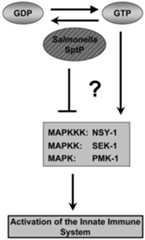
Expression of bacterial virulence factors inC. elegans cells diminishes innate immunity. A genetic analysis indicates thatS. enterica TTSS-related genes are required for full virulence inC. elegans. To confirm that effector proteins secreted through SPI-1 TTSS affectC. elegans innate immunity, SptP was directly expressed in the intestinal cells of nematodes. The intestinal expression of SptP diminishesC. elegans innate immunity apparently by preventing the activation of MAPK PMK-1. It remains unknown whether the SptP GTPase activating protein activity, the tyrosine phosphatase activity, or both are required for the downregulation of MAPK PMK-1.
CONCLUDING REMARKS
In addition toD. melanogaster andC. elegans, a variety of alternative model hosts have been used to study microbial pathogenesis and defense response. Each alternative model system has advantages and disadvantages, which highlights the need to use many models to understand the mechanisms by which pathogens manipulate the innate immune system to cause disease. In the long run, an in-depth understanding of how pathogenic mechanisms and host defense responses interact in evolutionarily diverse hosts should contribute to the understanding of key aspects of the pathogenic process that may help in the design of novel preventive and therapeutic approaches.
There are practical limitations associated with the use ofD. melanogaster andC. elegans as alternative hosts to model mammalian host-pathogen interactions. For example,D. melanogaster andC. elegans cannot survive at 37°C and the administration of exact inocula or antimicrobial substances is technically demanding in these systems. In addition, there are many differences in the innate immune systems of metazoans. For example, one remarkable difference between flies and mammals corresponds to the pathogen recognition mechanism by Toll receptors. While Toll receptors are critical in the recognition of fungal pathogens and gram-positive bacteria in flies, the mammalian counterparts are key in the recognition of gram-negative bacteria. Differences in the role of Toll receptors in the pathogen recognition process are not only found between invertebrates and vertebrates. AlthoughC. elegans andD. melanogaster are two invertebrates that correspond to relatively related phyla, the single Tol-1 receptor does not appear to be involved in the recognition of pathogen-associated molecular patterns. In addition, NF-κB-like molecules or other transcription factors that control the expression of immunity effectors remain unknown.
It is logical to conclude that the use ofD. melanogaster andC. elegans to study host-pathogen interactions may identify interactions specific to pathogens and these invertebrates in addition to interactions that can potentially be translated to mammalian systems. In some cases, these interactions may not have direct relevance to human health but will prove important to understand the pathogenic mechanisms in nonvertebrate hosts that could eventually be translated to improve human health. Despite these disadvantages, the results described here indicate that the highly sophisticatedD. melanogaster andC. elegans genetic systems can be used to collect new information relevant to bacterial and fungal pathogenesis in mammals. There are differences not only between vertebrate and invertebrate innate immunity but also in the innate immune systems ofD. melanogaster andC. elegans. Future work should help answer the key question of to what extent findings inD. melanogaster andC. elegans can be translated to mammalian innate immunity.
Acknowledgments
We thank Yiorgos Apidianakis, Joseph Heitman, and Steven Wasserman for helpful discussions and critical reading of the manuscript.
Funding for E.M. is provided by the Ellison Medical Foundation and a Pfizer fellowship in Medical Mycology from the Infectious Diseases Society of America. A.A. is funded by the Whitehead Scholar Program and NIH grant RO1GM070977.
Editor: J. B. Kaper
REFERENCES
- 1.Aballay, A., and F. M. Ausubel. 2002.Caenorhabditis elegans as a host for the study of host-pathogen interactions. Curr. Opin. Microbiol. 5:97-101. [DOI] [PubMed] [Google Scholar]
- 2.Aballay, A., and F. M. Ausubel. 2001. Programmed cell death mediated byced-3 andced-4 protectsCaenorhabditis elegans fromSalmonella typhimurium-mediated killing. Proc. Natl. Acad. Sci. USA 98:2735-2739. [DOI] [PMC free article] [PubMed] [Google Scholar]
- 3.Aballay, A., E. Drenkard, L. R. Hilbun, and F. M. Ausubel. 2003.Caenorhabditis elegans innate immune response triggered bySalmonella enterica requires intact LPS and is mediated by a MAPK signaling pathway. Curr. Biol. 13:47-52. [DOI] [PubMed] [Google Scholar]
- 4.Aballay, A., P. Yorgey, and F. M. Ausubel. 2000.Salmonella typhimurium proliferates and establishes a persistent infection in the intestine ofCaenorhabditis elegans. Curr. Biol. 10:1539-1542. [DOI] [PubMed] [Google Scholar]
- 5.Alegado, R. A., M. C. Campbell, W. C. Chen, S. S. Slutz, and M. W. Tan. 2003. Characterization of mediators of microbial virulence and innate immunity using theCaenorhabditis elegans host-pathogen model. Cell. Microbiol. 5:435-444. [DOI] [PubMed] [Google Scholar]
- 6.Apidianakis, Y., M. N. Mindrinos, W. Xiao, G. W. Lau, R. L. Baldini, R. W. Davis, and L. G. Rahme. 2005. Profiling early infection responses:Pseudomonas aeruginosa eludes host defenses by suppressing antimicrobial peptide gene expression. Proc. Natl. Acad. Sci. USA 102:2573-2578. [DOI] [PMC free article] [PubMed] [Google Scholar]
- 7.Apidianakis, Y., L. G. Rahme, J. Heitman, F. M. Ausubel, S. B. Calderwood, and E. Mylonakis. 2004. Challenge ofDrosophila melanogaster withCryptococcus neoformans and role of the innate immune response. Eukaryot. Cell 3:413-419. [DOI] [PMC free article] [PubMed] [Google Scholar]
- 8.Bae, T., A. K. Banger, A. Wallace, E. M. Glass, F. Aslund, O. Schneewind, and D. M. Missiakas. 2004.Staphylococcus aureus virulence genes identified bybursa aurealis mutagenesis and nematode killing. Proc. Natl. Acad. Sci. USA 101:12312-12317. [DOI] [PMC free article] [PubMed] [Google Scholar]
- 9.Barton, G. M., and R. Medzhitov. 2003. Toll-like receptor signaling pathways. Science 300:1524-1525. [DOI] [PubMed] [Google Scholar]
- 10.Bolin, I., and H. Wolf-Watz. 1988. The plasmid-encoded Yop2b protein ofYersinia pseudotuberculosis is a virulence determinant regulated by calcium and temperature at the level of transcription. Mol. Microbiol. 2:237-245. [DOI] [PubMed] [Google Scholar]
- 11.Boman, H. G., I. Nilsson, and B. Rasmuson. 1972. Inducible antibacterial defense system inDrosophila. Nature 237:232-235. [DOI] [PubMed] [Google Scholar]
- 12.Boutros, M., H. Agaisse, and N. Perrimon. 2002. Sequential activation of signaling pathways during innate immune responses inDrosophila. Dev. Cell 3:711-722. [DOI] [PubMed] [Google Scholar]
- 13.Brandt, S. M., M. S. Dionne, R. S. Khush, L. N. Pham, T. J. Vigdal, and D. S. Schneider. 2004. Secreted bacterial effectors and host-produced Eiger/TNF drive death in aSalmonella-infected fruit fly. PLoS Biol. 2:e418. [DOI] [PMC free article] [PubMed] [Google Scholar]
- 14.Brennan, C. A., and K. V. Anderson. 2004.Drosophila: the genetics of innate immune recognition and response. Annu. Rev. Immunol. 22:457-483. [DOI] [PubMed] [Google Scholar]
- 15.Carpenter, A. E., and D. M. Sabatini. 2004. Systematic genome-wide screens of gene function. Nat. Rev. Genet. 5:11-22. [DOI] [PubMed] [Google Scholar]
- 16.Choe, K. M., T. Werner, S. Stoven, D. Hultmark, and K. V. Anderson. 2002. Requirement for a peptidoglycan recognition protein (PGRP) in Relish activation and antibacterial immune responses inDrosophila. Science 296:359-362. [DOI] [PubMed] [Google Scholar]
- 17.Corbo, J. C., and M. Levine.1996. Characterization of an immunodeficiency mutant inDrosophila. Mech. Dev. 55:211-220. [DOI] [PubMed] [Google Scholar]
- 18.Couillault, C., N. Pujol, J. Reboul, L. Sabatier, J. F. Guichou, Y. Kohara, and J. J. Ewbank. 2004. TLR-independent control of innate immunity inCaenorhabditis elegans by the TIR domain adaptor protein TIR-1, an ortholog of human SARM. Nat. Immunol. 5:488-494. [DOI] [PubMed] [Google Scholar]
- 19.Darby, C., and S. Falkow. 2001. Mimicry of a G protein mutation by pertussis toxin expression in transgenicCaenorhabditis elegans. Infect. Immun. 69:6271-6275. [DOI] [PMC free article] [PubMed] [Google Scholar]
- 20.D'Argenio, D. A., L. A. Gallagher, C. A. Berg, and C. Manoil. 2001.Drosophila as a model host forPseudomonas aeruginosa infection. J. Bacteriol. 183:1466-1471. [DOI] [PMC free article] [PubMed] [Google Scholar]
- 21.De Gregorio, E., P. T. Spellman, G. M. Rubin, and B. Lemaitre. 2001. Genome-wide analysis of theDrosophila immune response by using oligonucleotide microarrays. Proc. Natl. Acad. Sci. USA 98:12590-12595. [DOI] [PMC free article] [PubMed] [Google Scholar]
- 22.De Gregorio, E., P. T. Spellman, P. Tzou, G. M. Rubin, and B. Lemaitre. 2002. The Toll and Imd pathways are the major regulators of the immune response inDrosophila. EMBO J. 21:2568-2579. [DOI] [PMC free article] [PubMed] [Google Scholar]
- 23.Foley, E., and P. H. O'Farrell. 2004. Functional dissection of an innate immune response by a genome-wide RNAi screen. PLoS Biol. 2:E203. [DOI] [PMC free article] [PubMed] [Google Scholar]
- 24.Forsberg, A., and H. Wolf-Watz. 1990. Genetic analysis of theyopE region ofYersinia spp.: identification of a novel conserved locus,yerA, regulatingyopE expression. J. Bacteriol. 172:1547-1555. [DOI] [PMC free article] [PubMed] [Google Scholar]
- 25.Fu, Y., and J. E. Galan. 1999. ASalmonella protein antagonizes Rac-1 and Cdc42 to mediate host-cell recovery after bacterial invasion. Nature 401:293-297. [DOI] [PubMed] [Google Scholar]
- 26.Gallagher, L. A., and C. Manoil. 2001.Pseudomonas aeruginosa PAO1 killsCaenorhabditis elegans by cyanide poisoning. J. Bacteriol. 183:6207-6214. [DOI] [PMC free article] [PubMed] [Google Scholar]
- 27.Gan, Y. H., K. L. Chua, H. H. Chua, B. Liu, C. S. Hii, H. L. Chong, and P. Tan. 2002. Characterization ofBurkholderia pseudomallei infection and identification of novel virulence factors using aCaenorhabditis elegans host system. Mol. Microbiol. 44:1185-1197. [DOI] [PubMed] [Google Scholar]
- 28.Garsin, D. A., C. D. Sifri, E. Mylonakis, X. Qin, K. V. Singh, B. E. Murray, S. B. Calderwood, and F. M. Ausubel. 2001. A simple model host for identifying gram-positive virulence factors. Proc. Natl. Acad. Sci. USA 98:10892-10897. [DOI] [PMC free article] [PubMed] [Google Scholar]
- 29.Garsin, D. A., J. M. Villanueva, J. Begun, D. H. Kim, C. D. Sifri, S. B. Calderwood, G. Ruvkun, and F. M. Ausubel. 2003. Long-livedC. elegans daf-2 mutants are resistant to bacterial pathogens. Science 300:1921. [DOI] [PubMed] [Google Scholar]
- 30.Gottar, M., V. Gobert, T. Michel, M. Belvin, G. Duyk, J. A. Hoffmann, D. Ferrandon, and J. Royet. 2002. TheDrosophila immune response against gram-negative bacteria is mediated by a peptidoglycan recognition protein. Nature 416:640-644. [DOI] [PubMed] [Google Scholar]
- 31.Griffitts, J. S., D. L. Huffman, J. L. Whitacre, B. D. Barrows, L. D. Marroquin, R. Muller, J. R. Brown, T. Hennet, J. D. Esko, and R. V. Aroian. 2003. Resistance to a bacterial toxin is mediated by removal of a conserved glycosylation pathway required for toxin-host interactions. J. Biol. Chem. 278:45594-45602. [DOI] [PubMed] [Google Scholar]
- 32.Griffitts, J. S., J. L. Whitacre, D. E. Stevens, and R. V. Aroian. 2001. Bt toxin resistance from loss of a putative carbohydrate-modifying enzyme. Science 293:860-864. [DOI] [PubMed] [Google Scholar]
- 33.Hariharan, I. K., and D. A. Haber. 2003. Yeast, flies, worms, and fish in the study of human disease. N. Engl. J. Med. 348:2457-2463. [DOI] [PubMed] [Google Scholar]
- 34.Hodgkin, J., P. E. Kuwabara, and B. Corneliussen. 2000. A novel bacterial pathogen, Microbacterium nematophilum, induces morphological change in the nematodeC. elegans. Curr. Biol. 10:1615-1618. [DOI] [PubMed] [Google Scholar]
- 35.Hoffmann, J. A. 2003. The immune response ofDrosophila. Nature 426:33-38. [DOI] [PubMed] [Google Scholar]
- 36.Hoffmann, J. A., and J. M. Reichhart. 2002.Drosophila innate immunity: an evolutionary perspective. Nat. Immunol. 3:121-126. [DOI] [PubMed] [Google Scholar]
- 37.Huber, B., F. Feldmann, M. Kothe, P. Vandamme, J. Wopperer, K. Riedel, and L. Eberl. 2004. Identification of a novel virulence factor inBurkholderia cenocepacia H111 required for efficient slow killing ofCaenorhabditis elegans. Infect. Immun. 72:7220-7230. [DOI] [PMC free article] [PubMed] [Google Scholar]
- 38.Huffman, D. L., L. Abrami, R. Sasik, J. Corbeil, F. G. van der Goot, and R. V. Aroian. 2004. Mitogen-activated protein kinase pathways defend against bacterial pore-forming toxins. Proc. Natl. Acad. Sci. USA 101:10995-11000. [DOI] [PMC free article] [PubMed] [Google Scholar]
- 39.Ip, Y. T., M. Reach, Y. Engstrom, L. Kadalayil, H. Cai, S. Gonzalez-Crespo, K. Tatei, and M. Levine. 1993. Dif, a dorsal-related gene that mediates an immune response inDrosophila. Cell 75:753-763. [DOI] [PubMed] [Google Scholar]
- 40.Irving, P., L. Troxler, T. S. Heuer, M. Belvin, C. Kopczynski, J. M. Reichhart, J. A. Hoffmann, and C. Hetru. 2001. A genome-wide analysis of immune responses inDrosophila. Proc. Natl. Acad. Sci. USA 98:15119-15124. [DOI] [PMC free article] [PubMed] [Google Scholar]
- 41.Jansen, W. T., M. Bolm, R. Balling, G. S. Chhatwal, and R. Schnabel. 2002. Hydrogen peroxide-mediated killing ofCaenorhabditis elegans byStreptococcus pyogenes. Infect. Immun. 70:5202-5207. [DOI] [PMC free article] [PubMed] [Google Scholar]
- 42.Janssens, S., and R. Beyaert. 2003. Role of Toll-like receptors in pathogen recognition. Clin. Microbiol. Rev. 16:637-646. [DOI] [PMC free article] [PubMed] [Google Scholar]
- 43.Joshua, G. W., A. V. Karlyshev, M. P. Smith, K. E. Isherwood, R. W. Titball, and B. W. Wren. 2003. ACaenorhabditis elegans model ofYersinia infection: biofilm formation on a biotic surface. Microbiology 149:3221-3229. [DOI] [PubMed] [Google Scholar]
- 44.Kaniga, K., J. Uralil, J. B. Bliska, and J. E. Galan. 1996. A secreted protein tyrosine phosphatase with modular effector domains in the bacterial pathogenSalmonella typhimurium. Mol. Microbiol. 21:633-641. [DOI] [PubMed] [Google Scholar]
- 45.Kim, D. H., R. Feinbaum, G. Alloing, F. E. Emerson, D. A. Garsin, H. Inoue, M. Tanaka-Hino, N. Hisamoto, K. Matsumoto, M. W. Tan, and F. M. Ausubel. 2002. A conserved p38 MAP kinase pathway inCaenorhabditis elegans innate immunity. Science 297:623-626. [DOI] [PubMed] [Google Scholar]
- 46.Kurz, C. L., S. Chauvet, E. Andres, M. Aurouze, I. Vallet, G. P. Michel, M. Uh, J. Celli, A. Filloux, S. De Bentzmann, I. Steinmetz, J. A. Hoffmann, B. B. Finlay, J. P. Gorvel, D. Ferrandon, and J. J. Ewbank. 2003. Virulence factors of the human opportunistic pathogenSerratia marcescens identified by in vivo screening. EMBO J. 22:1451-1460. [DOI] [PMC free article] [PubMed] [Google Scholar]
- 47.Kurz, C. L., and M. W. Tan.2004. Regulation of aging and innate immunity inC. elegans. Aging Cell 3:185-193. [DOI] [PubMed] [Google Scholar]
- 48.Labrousse, A., S. Chauvet, C. Couillault, C. L. Kurz, and J. J. Ewbank. 2000.Caenorhabditis elegans is a model host forSalmonella typhimurium. Curr. Biol. 10:1543-1545. [DOI] [PubMed] [Google Scholar]
- 49.Landis, G. N., D. Abdueva, D. Skvortsov, J. Yang, B. E. Rabin, J. Carrick, S. Tavare, and J. Tower. 2004. Similar gene expression patterns characterize aging and oxidative stress inDrosophila melanogaster. Proc. Natl. Acad. Sci. USA 101:7663-7668. [DOI] [PMC free article] [PubMed] [Google Scholar]
- 50.Leclerc, V., and J. M. Reichhart.2004. The immune response ofDrosophila melanogaster. Immunol. Rev. 198:59-71. [DOI] [PubMed] [Google Scholar]
- 51.Lee, R. Y., J. Hench, and G. Ruvkun. 2001. Regulation ofC. elegans DAF-16 and its human ortholog FKHRL1 by the daf-2 insulin-like signaling pathway. Curr. Biol. 11:1950-1957. [DOI] [PubMed] [Google Scholar]
- 52.Lemaitre, B., E. Kromer-Metzger, L. Michaut, E. Nicolas, M. Meister, P. Georgel, J. M. Reichhart, and J. A. Hoffmann. 1995. A recessive mutation, immune deficiency (imd), defines two distinct control pathways in theDrosophila host defense. Proc. Natl. Acad. Sci. USA 92:9465-9469. [DOI] [PMC free article] [PubMed] [Google Scholar]
- 53.Lemaitre, B., M. Meister, S. Govind, P. Georgel, R. Steward, J. M. Reichhart, and J. A. Hoffmann. 1995. Functional analysis and regulation of nuclear import of dorsal during the immune response inDrosophila. EMBO J. 14:536-545. [DOI] [PMC free article] [PubMed] [Google Scholar]
- 54.Lemaitre, B., E. Nicolas, L. Michaut, J. M. Reichhart, and J. A. Hoffmann. 1996. The dorsoventral regulatory gene cassette spatzle/Toll/cactus controls the potent antifungal response inDrosophila adults. Cell 86:973-983. [DOI] [PubMed] [Google Scholar]
- 55.Lemaitre, B., J. M. Reichhart, and J. A. Hoffmann. 1997.Drosophila host defense: differential induction of antimicrobial peptide genes after infection by various classes of microorganisms. Proc. Natl. Acad. Sci. USA 94:14614-14619. [DOI] [PMC free article] [PubMed] [Google Scholar]
- 56.Liberati, N. T., K. A. Fitzgerald, D. H. Kim, R. Feinbaum, D. T. Golenbock, and F. M. Ausubel. 2004. Requirement for a conserved Toll/interleukin-1 resistance domain protein in theCaenorhabditis elegans immune response. Proc. Natl. Acad. Sci. USA 101:6593-6598. [DOI] [PMC free article] [PubMed] [Google Scholar]
- 57.Lin, K., J. B. Dorman, A. Rodan, and C. Kenyon. 1997.daf-16: an HNF-3/forkhead family member that can function to double the life-span ofCaenorhabditis elegans. Science 278:1319-1322. [DOI] [PubMed] [Google Scholar]
- 58.Mahajan-Miklos, S., M. W. Tan, L. G. Rahme, and F. M. Ausubel. 1999. Molecular mechanisms of bacterial virulence elucidated using aPseudomonas aeruginosa-Caenorhabditis elegans pathogenesis model. Cell 96:47-56. [DOI] [PubMed] [Google Scholar]
- 59.Mallo, G. V., C. L. Kurz, C. Couillault, N. Pujol, S. Granjeaud, Y. Kohara, and J. J. Ewbank.2002. Inducible antibacterial defense system inC. elegans. Curr. Biol. 12:1209-1214. [DOI] [PubMed] [Google Scholar]
- 60.Marroquin, L. D., D. Elyassnia, J. S. Griffitts, J. S. Feitelson, and R. V. Aroian. 2000.Bacillus thuringiensis (Bt) toxin susceptibility and isolation of resistance mutants in the nematodeCaenorhabditis elegans. Genetics 155:1693-1699. [DOI] [PMC free article] [PubMed] [Google Scholar]
- 61.Meister, M., and M. Lagueux. 2003.Drosophila blood cells. Cell. Microbiol. 5:573-580. [DOI] [PubMed] [Google Scholar]
- 62.Michiels, T., and G. Cornelis. 1988. Nucleotide sequence and transcription analysis of yop51 fromYersinia enterocolitica W22703. Microb. Pathog. 5:449-459. [DOI] [PubMed] [Google Scholar]
- 63.Michiels, T., P. Wattiau, R. Brasseur, J. M. Ruysschaert, and G. Cornelis. 1990. Secretion of Yop proteins byYersiniae. Infect. Immun. 58:2840-2849. [DOI] [PMC free article] [PubMed] [Google Scholar]
- 64.Moy, T. I., E. Mylonakis, S. B. Calderwood, and F. M. Ausubel. 2004. Cytotoxicity of hydrogen peroxide produced byEnterococcus faecium. Infect. Immun. 72:4512-4520. [DOI] [PMC free article] [PubMed] [Google Scholar]
- 65.Murphy, C. T., S. A. McCarroll, C. I. Bargmann, A. Fraser, R. S. Kamath, J. Ahringer, H. Li, and C. Kenyon. 2003. Genes that act downstream of DAF-16 to influence the lifespan ofCaenorhabditis elegans. Nature 424:277-283. [DOI] [PubMed] [Google Scholar]
- 66.Mylonakis, E., F. M. Ausubel, J. R. Perfect, J. Heitman, and S. B. Calderwood. 2002. Killing ofCaenorhabditis elegans byCryptococcus neoformans as a model of yeast pathogenesis. Proc. Natl. Acad. Sci. USA 99:15675-15680. [DOI] [PMC free article] [PubMed] [Google Scholar]
- 67.Mylonakis, E., A. Idnurm, R. Moreno, J. El Khoury, J. B. Rottman, F. M. Ausubel, J. Heitman, and S. B. Calderwood. 2004.Cryptococcus neoformans Kin1 protein kinase homologue, identified through aCaenorhabditis elegans screen, promotes virulence in mammals. Mol. Microbiol. 54:407-419. [DOI] [PubMed] [Google Scholar]
- 68.Nicholas, H. R., and J. Hodgkin. 2004. The ERK MAP kinase cascade mediates tail swelling and a protective response to rectal infection inC. elegans. Curr. Biol. 14:1256-1261. [DOI] [PubMed] [Google Scholar]
- 69.Nicholas, H. R., and J. Hodgkin. 2004. Responses to infection and possible recognition strategies in the innate immune system ofCaenorhabditis elegans. Mol. Immunol. 41:479-493. [DOI] [PubMed] [Google Scholar]
- 70.Ogg, S., S. Paradis, S. Gottlieb, G. I. Patterson, L. Lee, H. A. Tissenbaum, and G. Ruvkun. 1997. The Fork head transcription factor DAF-16 transduces insulin-like metabolic and longevity signals inC. elegans. Nature 389:994-999. [DOI] [PubMed] [Google Scholar]
- 71.O'Quinn, A. L., E. M. Wiegand, and J. A. Jeddeloh. 2001.Burkholderia pseudomallei kills the nematodeCaenorhabditis elegans using an endotoxin-mediated paralysis. Cell. Microbiol. 3:381-393. [DOI] [PubMed] [Google Scholar]
- 72.Park, J. M., H. Brady, M. G. Ruocco, H. Sun, D. Williams, S. J. Lee, T. Kato, Jr., N. Richards, K. Chan, F. Mercurio, M. Karin, and S. A. Wasserman. 2004. Targeting of TAK1 by the NF-kappa B protein Relish regulates the JNK-mediated immune response inDrosophila. Genes Dev. 18:584-594. [DOI] [PMC free article] [PubMed] [Google Scholar]
- 73.Pujol, N., E. M. Link, L. X. Liu, C. L. Kurz, G. Alloing, M. Tan, K. P. Ray, R. Solari, C. D. Johnson, and J. J. Ewbank. 2001. A reverse genetic analysis of components of the Toll signaling pathway inCaenorhabditis elegans. Curr. Biol. 11:809-821. [DOI] [PubMed] [Google Scholar]
- 74.Qureshi, S. T., and R. Medzhitov. 2003. Toll-like receptors and their role in experimental models of microbial infection. Genes Immun. 4:87-94. [DOI] [PubMed] [Google Scholar]
- 75.Ramet, M., P. Manfruelli, A. Pearson, B. Mathey-Prevot, and R. A. Ezekowitz. 2002. Functional genomic analysis of phagocytosis and identification of aDrosophila receptor for E. coli. Nature 416:644-648. [DOI] [PubMed] [Google Scholar]
- 76.Reichhart, J. M., P. Georgel, M. Meister, B. Lemaitre, C. Kappler, and J. A. Hoffmann. 1993. Expression and nuclear translocation of the rel/NF-kappa B-related morphogen dorsal during the immune response ofDrosophila. C. R. Acad. Sci. Ser. III 316:1218-1224. [PubMed] [Google Scholar]
- 77.Rubin, G. M., M. D. Yandell, J. R. Wortman, G. L. Gabor Miklos, C. R. Nelson, I. K. Hariharan, M. E. Fortini, P. W. Li, R. Apweiler, W. Fleischmann, J. M. Cherry, S. Henikoff, M. P. Skupski, S. Misra, M. Ashburner, E. Birney, M. S. Boguski, T. Brody, P. Brokstein, S. E. Celniker, S. A. Chervitz, D. Coates, A. Cravchik, A. Gabrielian, R. F. Galle, W. M. Gelbart, R. A. George, L. S. Goldstein, F. Gong, P. Guan, N. L. Harris, B. A. Hay, R. A. Hoskins, J. Li, Z. Li, R. O. Hynes, S. J. Jones, P. M. Kuehl, B. Lemaitre, J. T. Littleton, D. K. Morrison, C. Mungall, P. H. O'Farrell, O. K. Pickeral, C. Shue, L. B. Vosshall, J. Zhang, Q. Zhao, X. H. Zheng, and S. Lewis. 2000. Comparative genomics of the eukaryotes. Science 287:2204-2215. [DOI] [PMC free article] [PubMed] [Google Scholar]
- 78.Schulenburg, H., C. L. Kurz, and J. J. Ewbank. 2004. Evolution of the innate immune system: the worm perspective. Immunol. Rev. 198:36-58. [DOI] [PubMed] [Google Scholar]
- 79.Sifri, C. D., J. Begun, and F. M. Ausubel. 2005. The worm has turned—microbial virulence modeled inCaenorhabditis elegans. Trends Microbiol. 13:119-127. [DOI] [PubMed] [Google Scholar]
- 80.Takeda, K., and S. Akira. 2003. Toll receptors and pathogen resistance. Cell. Microbiol. 5:143-153. [DOI] [PubMed] [Google Scholar]
- 81.Tan, M. W., S. Mahajan-Miklos, and F. M. Ausubel. 1999. Killing ofCaenorhabditis elegans byPseudomonas aeruginosa used to model mammalian bacterial pathogenesis. Proc. Natl. Acad. Sci. USA 96:715-720. [DOI] [PMC free article] [PubMed] [Google Scholar]
- 82.Tan, M. W., L. G. Rahme, J. A. Sternberg, R. G. Tompkins, and F. M. Ausubel. 1999.Pseudomonas aeruginosa killing ofCaenorhabditis elegans used to identifyP. aeruginosa virulence factors. Proc. Natl. Acad. Sci. USA 96:2408-2413. [DOI] [PMC free article] [PubMed] [Google Scholar]
- 83.Tanaka-Hino, M., A. Sagasti, N. Hisamoto, M. Kawasaki, S. Nakano, J. Ninomiya-Tsuji, C. I. Bargmann, and K. Matsumoto. 2002. SEK-1 MAPKK mediates Ca2+ signaling to determine neuronal asymmetric development inCaenorhabditis elegans. EMBO Rep. 3:56-62. [DOI] [PMC free article] [PubMed] [Google Scholar]
- 84.Tenor, J. L., B. A. McCormick, F. M. Ausubel, and A. Aballay. 2004.Caenorhabditis elegans-based screen identifiesSalmonella virulence factors required for conserved host-pathogen interactions. Curr. Biol. 14:1018-1024. [DOI] [PubMed] [Google Scholar]
- 85.Tzou, P., E. De Gregorio, and B. Lemaitre. 2002. HowDrosophila combats microbial infection: a model to study innate immunity and host-pathogen interactions. Curr. Opin. Microbiol. 5:102-110. [DOI] [PubMed] [Google Scholar]
- 86.Wu, L. P., and K. V. Anderson. 1998. Regulated nuclear import of Rel proteins in theDrosophila immune response. Nature 392:93-97. [DOI] [PubMed] [Google Scholar]