


Pyramiding of transgenic immune receptors from primary and tertiary wheat gene pools improves powdery mildew resistance in the field
Teresa Koller
Marcela Camenzind
, Esther Jung
Susanne Brunner
Gerhard Herren
Cygni Armbruster
Beat Keller
Correspondence:bkeller@botinst.uzh.ch
Roles
Received 2023 Jun 28; Accepted 2023 Dec 8; Collection date 2024 Mar 27.
This is an Open Access article distributed under the terms of the Creative Commons Attribution License (https://creativecommons.org/licenses/by/4.0/), which permits unrestricted reuse, distribution, and reproduction in any medium, provided the original work is properly cited.
Abstract
Introgression of resistance genes from wild or related species is a common strategy to improve disease resistance of wheat cultivars.Pm17 is a gene that confers powdery mildew resistance in wheat. It encodes an NLR type of immune receptor and was introgressed from rye to wheat as part of the 1RS chromosome arm translocation several decades ago. So far it has not been possible to separatePm17 from its co-introgressed rye genes due to suppressed recombination. Here we tested in the field transgenic Bobwhite wheat overexpressingPm17 without any other rye genes. Four transgenic events showed high levels of PM17 protein accumulation, strong powdery mildew resistance, and no pleiotropic effects during three field seasons. We used a combined approach of transgene insertion and cross-breeding to generate lines co-expressingPm17 andPm3, orPm17 andPm8.Blumeria graminis f. sp.tritici infection tests confirmed additive, race-specific resistance of the two pyramided transgenes in lines Pm17+Pm3b and Pm17+Pm8. Furthermore, pyramided lines showed strong powdery mildew resistance during three field seasons. We conclude that the combination of overexpressedNLR genes from the extended gene pool broadens and diversifies wheat disease resistance.
Keywords: Disease resistance, field trial,Pm17, powdery mildew, tertiary gene pool, transgenic crops, wheat
Powdery mildew resistance genes from the primary and tertiary gene pools of wheat were overexpressed and combined in wheat cultivar Bobwhite. Transgenic plants showed additive race-specific and field resistance.
Introduction
Wheat (Triticum aestivum) is a major staple crop for human consumption and animal feed production. Protecting wheat from diseases is crucial for global food security. Disease resistance breeding is one of the major contributors to preventing crop loss. The identification and informed deployment of disease resistance genes is the basis of sustainable resistance breeding and resistance management. Powdery mildew is an important wheat disease caused by the biotrophic fungusBlumeria graminis f. sp.tritici (Bgt). In conditions favoringBgt growth and propagation, yield losses are in the range of 5–15%, but in severeBgt epidemics, higher yield losses have been reported (reviewed inSinghet al., 2016). InTriticeae species, several powdery mildew resistance genes encode nucleotide-binding leucine-rich repeat receptor (NLR) proteins. In addition, a few non-NLR types of immune receptors conferring powdery mildew resistance have been identified in wheat (Sánchez-Martín and Keller, 2021). NLR-type resistance proteins recognize race-specificBgt effectors and trigger a strong immune response (Bourraset al., 2015,2019;Sánchez-Martínet al., 2016;Wanget al., 2023). Resistance mechanisms of non-NLR types of powdery mildew resistance genes such asPm4 andPm24 are largely unknown (Luet al., 2020;Sánchez-Martínet al., 2021). It is important to understand the molecular function of disease resistance proteins and later to test the concepts developed for resistance improvement in an actual field setting, to optimally deploy disease resistance genes in resistance breeding programs and later in agriculture. In particular the NLR type of immunity is prone to break down after a few years, when the same NLR-encoding resistance gene is deployed as the only active resistance gene in cultivars widely grown in space and time, because pathogen populations evolve to delete or mutate recognized effectors (Jones and Dangl, 2006;Ngouet al., 2022). One strategy to extend the durability of the highly effective NLRs is the combination or stacking, also called pyramiding, of severalNLR-encoding genes in elite cultivars (McDonald and Linde, 2002).
In previous studies we overexpressed alleles of the powdery mildew resistance genePm3 in spring wheat cultivar Bobwhite, by using the maize ubiquitin (ubi) promoter, and tested the transgenic lines in the field (Brunneret al., 2011,2012;Kolleret al., 2019). Furthermore, we pyramided several combinations of twoPm3 alleles by crossing transgenic Bobwhite lines overexpressing singlePm3 alleles (Stirnweiset al., 2014). Pyramided lines were tested in the field and showed improved powdery mildew resistance (Kolleret al., 2018). The improved powdery mildew resistance in the field was attributed to the two effects of enhanced totalPm3 transgene expression levels and allele specificity combinations that act additively (Kolleret al., 2018). Similar studies were performed in transgenic potato where pyramided late blight resistance genes showed improved resistance in the field (Joet al., 2014). The resistance genes originated from the extended gene pool of potato, namely from the crossable speciesSolanum stoloniferum andSolanum venturii (Joet al., 2014).
Wheat breeders use disease resistance genes from the primary, secondary, and tertiary gene pools of wheat to enhance elite cultivars (Walkowiaket al., 2020). Deployment of genes from the tertiary gene pool is often hindered by linkage drag and poor outcome of crosses, and in the case of resistance genes, by genetic suppression (Chaudharyet al., 2014). In this study we focused on the deployment of theNLR-encoding powdery mildew resistance genePm17 from the tertiary gene pool of wheat.Pm17 originates from the short arm of chromosome 1 of rye (1RS) and is localized on the 1RS.1AL translocation in wheat (Singhet al., 2018) (Supplementary Fig. S1).Pm17 is an ortholog of the wheat powdery mildew resistance genePm3, which is localized on 1AS (Yahiaouiet al., 2006;Singhet al., 2018) (Supplementary Fig. S1). Interestingly, there is a third ortholog ofPm17 andPm3, calledPm8 (Hurniet al., 2013).Pm8 is localized on 1RS of 1RS.1BL and also originates from rye (Supplementary Fig. S1).Pm8 provides powdery mildew resistance, but the resistance has broken down in many wheat growing regions worldwide due to adaptation of the recognized AVRPM8 effector (Kunzet al., 2023). As the case ofPm17 andPm8 shows, 1RS from rye was introgressed into wheat several times and integrated into the wheat genome on the short arm of either chromosome 1A or chromosome 1B (Schlegel and Korzun, 1997) (Supplementary Fig. S1). Repressed recombination on 1RS of wheat chromosomes 1RS.1BL and 1RS.1AL makes it difficult to study the effects of single 1RS-localized genes. For example, the contribution ofPm17 to powdery mildew resistance of wheat cultivar Amigo is masked by the presence of a secondPm resistance gene on 1RS.1AL (Mülleret al., 2022). Transgenic wheat events overexpressingPm17 andPm8 as single transgenes were generated using the powdery mildew susceptible spring wheat cultivar Bobwhite (Hurniet al., 2013;Singhet al., 2018). Infection tests on these transgenic Bobwhite events confirmed the race-specific powdery mildew resistance function of thePm17 andPm8 transgenes (Hurniet al., 2013;Singhet al., 2018). Furthermore,Hurniet al., 2014 showed thatPm8 is suppressed by the wheatPm3 gene. Resistance genes from the tertiary gene pool are prone to being suppressed by endogenous resistance genes (Chaudharyet al., 2014).
To elucidate the race-specific powdery mildew resistance mechanisms ofPm3,Pm17, andPm8, the corresponding avirulence effector genes (Avrs) fromBgt were previously identified and namedAvrPm3a,AvrPm3b,AvrPm3d,AvrPm8, andAvrPm17 (Bourraset al., 2015,2019;Mülleret al., 2022;Kunzet al., 2023). TheseAvr genes encode the recognized avirulence effector proteins AVRPM3A, AVRPM3B, AVRPM3D, AVRPM8, and AVRPM17. Furthermore, aBgt suppressor namedSvrPm3 was identified (Bourraset al., 2015;Parlangeet al., 2015).SvrPm3 suppressesPm3–AvrPm3 immune signaling (Bourraset al., 2015,2019).
Here we tested the powdery mildew resistance profile of transgenic Bobwhite wheat plants overexpressing singlePm17 or singlePm8, and combinations of two overexpressed transgenesPm17 andPm3, orPm17 andPm8. We performed both seedling assays usingBgt isolates with specificAvr-gene combinations and field trials where plants are exposed to the natural, local powdery mildew population. This approach allowed us to evaluate the powdery mildew resistance profile of overexpressed and combined powdery mildew resistance genesPm17 andPm8 in wheat, in the absence of co-segregating genes from rye.
Materials and methods
Transgenic wheat lines
Pm17 transgenic events Pm17#110, Pm17#122, Pm17#34, and Pm17#181 and the corresponding sister lines were previously generated and described by (Singhet al., 2018).Pm8 transgenic events Pm8#12, Pm8#59, and sister line Pm8#59-sis were previously generated and described byHurniet al. (2013). Transgenic events Pm3b#64 and Pm3CS#19 were generated using the same spring wheat cultivar Bobwhite SH 98 26, the same plasmid backbones containing the maize ubiquitin (ubi) promoter for transgene overexpression, the same selection marker construct expressingmanA, and the same protocols as for the generation of thePm17 andPm8 events (Hurniet al., 2013;Singhet al., 2018). ThePm17,Pm3b, andPm3CS transgenes were C-terminally fused to a sequence that encodes a hemagglutinin (HA)-tag for protein detection. ThePm8 transgenes were C-terminally fused to a sequence that encodes a c-myc tag (called myc) for protein detection. Pyramided line Pm17+Pm3b was generated by cross-breeding of parental events Pm17#110 and Pm3b#64. Pyramided line Pm17+Pm3CS was generated by cross-breeding of parental events Pm17#110 and Pm3CS#19. Pyramided line Pm17+Pm8 was generated by cross-breeding of parental events Pm17#110 and Pm8#59. After the initial crossing, five generations were generated in the greenhouse and genotyped to select the final three pyramided lines Pm17+Pm3b, Pm17+Pm3CS, and Pm17+Pm8, which are all homozygous for both transgenes,Pm17-HA andPm3b-HA,Pm17-HA andPm3CS-HA, andPm17-HA andPm8-myc, respectively.
Field trial set-up and scoring
Legal permits for field experiments with genetically modified plants were obtained prior to the field trials by the Federal Office for the Environment (permit #B18001). Field trials were carried out during years 2020 (field season 1), 2021 (field season 2), and 2022 (field season 3) at the so called ‘protected site’ (www.protectedsite.ch), an experimental field site for research trials with transgenic crops, which is located at Agroscope in Zurich Reckenholz (Romeiset al., 2013;Brunneret al., 2021). Wheat genotypes were grown in test plots of 1.5 m×1.0 m. Four test plots per genotype were grown in a randomized complete block design. Test plots were flanked by infection rows consisting of the powdery mildew susceptible wheat breeding line FAL94632 and cultivar Kanzler. Pots with susceptible wheat plants pre-infected in the greenhouse with Swiss powdery mildew isolateBgt 96224 were planted into the infection rows as described byKolleret al. (2018). Powdery mildew scoring was performed as described byBrunneret al. (2011). Flag leaf chlorophyll content was measured using a portable chlorophyll meter (SPAD 502; Minolta, Osaka, Japan).
Swiss powdery mildew isolateBgt 96224
The high-quality reference genome sequence ofBgt 96224 (Wickeret al., 2013;Mülleret al., 2019) showed thatBgt 96224 carries a copy of variant A ofAvrPm3b, which encodes an effector recognized by wheat NLR PM3B (Bourraset al., 2019).Bgt 96224 does not carry a functional copy of the suppressor geneSvrPm3. In wheat seedling assays,Bgt 96224 was avirulent on transgenic Bobwhite event Pm3b#64 overexpressingPm3b (Supplementary Fig. S2).Bgt 96224 carries a copy ofAvrPm8F43Y. Mutation F43Y results in an AVRPM8 variant not recognized by wheat NLR PM8 (Kunzet al., 2023).Bgt 96224 is virulent on transgenic Bobwhite event Pm8#59 overexpressingPm8 (Supplementary Fig. S2).Bgt 96224 carries two copies of variant B ofAvrPm17. AVRPM17 variant B triggers a hypersensitive response in the presence of wheat NLR PM17, but the response is not as strong as the one triggered by AVRPM17 variant A (Mülleret al., 2022). In seedling assays,Bgt 96224 was intermediately virulent (i.e. it grows slowly) on transgenic Bobwhite event Pm17#110 overexpressingPm17 (Supplementary Fig. S2).
Field-grown flag leaf sample collection for RNA and protein extraction
For each wheat genotype, plants from four plots were sampled. Per plot, flag leaf samples of three plants were pooled. Fully developed flag leaves were cut at the leaf base, then the first 4 cm was discarded, before cutting a 1 cm long segment for RNA sampling and another 1 cm long segment for protein sampling. The three segments per plot were pooled in a tube and instantly frozen in dry ice. Samples were kept at −80 °C for storage.
Reverse transcription–quantitative polymerase chain reaction
The frozen flag leaf samples collected in the field were weighed and ground with a Geno/Grinder®. RNA extraction was performed using the Dynabeads mRNA DIRECT Purification Kit (Thermo Fisher Scientific). Lysis binding buffer (LBB) 125 μl per 10 mg plant material was added to each sample. For reverse transcription of the eluted mRNA to cDNA, the Maxima H Minus cDNA Synthesis Master Mix Kit (Thermo Fisher Scientific) was used. As a control reaction (RT minus control), a few samples were treated with the DNase digest and reverse transcription step, but without the reverse transcriptase (Maxima H Minus RT). To analyse transgene expression, reverse transcription–quantitative polymerase chain reaction (RT-qPCR) was performed using the KAPA SYBR FAST qPCR Kit (Kapa Biosystems) on the CFX96 Real-Time PCR Detection System (Bio-Rad Laboratories). The reactions were run in technical duplicates of four biological replicates per wheat line. No template control (NTC) reactions were performed using water instead of cDNA.ADP ribosylation factor (ADPRF) was used as the reference gene against which the mRNA expression levels of the target genes were normalized (Giménezet al., 2011). Thermocycling conditions formanA andADPRF were 95 °C for 1 min, followed by 39 cycles of 95 °C for 3 s and then 60 °C for 20 s. ForPm17 thermocycling conditions were 95 °C for 1 min, followed by 39 cycles of 95 °C for 3 s and then 63 °C for 20 s. The following primers (5ʹ–3ʹ sequences) were used:Pm17: GCCCGGTATGAAGTAACAGC and AGTTCCTTGGCTTCTCGACT;manA: GGAAGTGATGGCAAACTCCG and TTCTGCACCTTGTTTCACCG; reference geneADPRF: TCTCATGGTTGGTCTCGATG and GGATGGTGGTGACGATCTCT. Primer efficiencies were analysed by creating a standard curve of a 1: 4 serial dilution and calculating the efficiencies using the CFX Maestro software (Bio-Rad Laboratories). Data were also analysed using the CFX Maestro software (Bio-Rad Laboratories) and graphs were created using R Studio (R version 4.1.3). Statistical analysis was performed using the Tukey’s honestly significant difference test (95% confidence interval) in R Studio (agricolae package v1.3.5;de Mendiburu, 2021).
Protein detection
Proteins from frozen flag leaf samples were extracted using 500 μl protein extraction buffer (15 mM NaCl, 5 mM Tris–HCl pH 7.5, 0.5% Triton X-100; one tablet cOmpleteTM EDTA-free protease inhibitor cocktail (Roche) was added per 25 ml buffer). The total protein concentration of the extract was determined using the Pierce BCA Protein Assay Kit (Thermo Fisher Scientific). All protein samples were adjusted to the same concentration using 1× Laemmli buffer prior to loading. For SDS-PAGE, 8% SDS polyacrylamide separation gels were used. Fifteen microliters of protein sample were loaded per well and 5 μl of the PageRuler Plus Prestained Protein ladder (Thermo Fisher Scientific) as a protein size marker. After separation by gel electrophoresis at 100 V for 90 min, the proteins were transferred to a methanol-activated polyvinylidene difluoride membrane (Immobilon-P Transfer Membrane, Millipore) by wet transfer. The membranes were blocked with 5% non-fat milk powder in 1× Tris-buffered saline–Tween 20 (TBST) buffer for at least 45 min at room temperature. Detection of PM17–HA, PM3b–HA, and PM3CS–HA proteins was performed by incubating the membrane in a 1:1000 dilution of the horseradish peroxidase (HRP)-conjugated antibody (anti-HA–HRP, rat monoclonal, clone 3F10, Roche) for 1 h at room temperature. After incubation, the membrane was washed twice for 5 min and finally once for 10 min with 1× TBST. The WesternBright ECL HRP substrate (Advansta) was used for imaging of the peroxidase chemiluminescence. The signal was detected using the Fusion FX Imaging System together with Evolution Capture software in the chemiluminescence setting. Detection of myc-tagged PM8 protein was achieved as for HA-tagged proteins except for the following specific changes: after blocking, membranes were incubated with the peroxidase-conjugated c-Myc antibody GTX19312 from LubioScience (GeneTex) in a 1:3000 dilution for 90 min at room temperature. Next, membranes were washed twice for 5 min and twice for 10 min in 1× TBST before signal detection.
Bgt infection test
Blumeria graminis f. sp.tritici (Bgt) isolates used in this work were obtained from our group’s powdery mildew collection. The powdery mildew isolates were propagated on the susceptible bread wheat cultivar Kanzler, essentially as described inHurniet al. (2013). Briefly, segments of the first leaf from 12-day-old Kanzler plants were placed with the adaxial side up on plates with 0.5% agar and 0.24 mM benzimidazole (Parlangeet al., 2011). Leaf segments were then infected with the fungal spores and incubated at 20 °C for 7 d with 16 h of light per day to allow for sufficient colony growth. Phenotyping experiments were performed by placing 3 cm-long first leaf segments of the wheat lines of interest on benzimidazole agar plates. The powdery mildew susceptible wheat cultivar Kanzler was used as control. The leaf segments were infected with the fungal spores collected from propagation plates by dusting them homogeneously over the plates with a single-use glass pipette. The infected plates were incubated at 20 °C with 16 h of light per day. Photographs of the plates were taken 7 d after infection and virulence was scored by estimating the percentage of leaf coverage with fungal colonies (LC). The virulence phenotype was categorized into three classes: virulent for LC=70–100%, intermediate for LC=10–70%, and avirulent for LC>10%. Three independent repetitions were performed for each isolate.
Results
FourPm17 events are highly resistant to powdery mildew in three field seasons
The fourPm17 overexpression events Pm17#34, Pm17#110, Pm17#122, and Pm17#181 and the corresponding sister lines Pm17#34-sis, Pm17#110-sis, Pm17#122-sis, and Pm17#181-sis were tested for powdery mildew resistance in the field. These events had been generated and tested previously in the laboratory bySinghet al. (2018). Sister lines are null segregants of the transgene that do not carry thePm17 transgene in the genome but have gone through the same tissue culture procedure. Sister lines are ideal controls to distinguish between pleiotropic effects of the transgene (the sister line does not show the effect) and somaclonal variation (the sister line shows the same effect). The research site where the field trials were performed shows a heavy natural powdery mildew infection every year. To ensure powdery mildew infection in case of an unusual year with little natural infection, we artificially infected the flanking rows of the test plots with Swiss isolateBgt 96224 (Supplementary Fig. S2). During the field seasons, as soon as the powdery mildew infection started, we scored powdery mildew infection every few days for each plot and calculated the area under disease progress curve (AUDPC) score. All fourPm17 events showed strong powdery mildew resistance (AUDPC score 0–22, median=0) in all three field seasons, whereas the non-transformed Bobwhite and all four sister lines were infected with powdery mildew (AUDPC scores up to 138) (Fig. 1A). The three field seasons differed in disease pressure: whereas field seasons 1 and 3 showed high disease pressure, it was low in field season 2. As an additional control in our trials we included wheat cultivar Amigo, which carries an endogenousPm17 under the nativePm17 promoter. Amigo was powdery mildew resistant in the field (Fig. 1A). Amigo likely carries an additional, yet unidentified powdery mildew resistance gene (Mülleret al., 2022) and it is therefore not possible to evaluate with certainty the contribution of naturalPm17 to the observed resistance. Furthermore, cultivar Amigo is a winter wheat and only a few Amigo plants showed a spring wheat type of growth to allow comparison of mildew infection at similar growth stages.
Fig. 1.
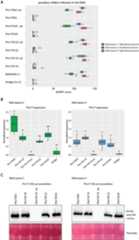
Powdery mildew infection,Pm17 expression and PM17 protein accumulation in field-grown transgenicPm17 Bobwhite events. (A) Powdery mildew infection of field-grown plants. Area under disease progress curve (AUDPC) scores were calculated from four independent plots for each genotype in field seasons 1 (red), 2 (green), and 3 (blue). Non-transformed Bobwhite and wheat cultivar Amigo, which carries endogenousPm17, are included as controls. Powdery mildew disease pressure was high during field seasons 1 and 3, and low during field season 2. Different letters next to the bars denote a significant difference within the same season in the Tukey’s honestly significant difference (HSD) test (α=0.050). (B)Pm17 expression in flag leaves from field seasons 2 and 3. Expression values were normalized to the expression of reference geneADP ribosylation factor (ADPRF) and plotted relative to line Pm17#110. Four biological replicates, each consisting of three pooled flag leaf segments, were used for each genotype in technical duplicates. Different letters above the bars denote a significant difference in expression level (Tukey’s HSD test, α=0.050). (C) PM17–HA protein accumulation in flag leaves from field seasons 2 and 3. Each sample contains three pooled flag leaf segments. Total protein concentration was measured and adjusted to the same concentration prior to loading. Ponceau staining indicates equal loading.
In field seasons 2 and 3 we collected flag leaf samples of the field-grown plants to measure transgene expression and transprotein accumulation. All four events carry a transgene that encodes a C-terminally HA-tagged PM17. All fourPm17 events showed highPm17 gene expression in both field seasons studied (Fig. 1B). In field season 2, event Pm17#34 showed a significantly higherPm17 expression level than events Pm17#110 and Pm17#122. However, in field seasons 3 there was no statistically significant difference inPm17 expression levels between the four events (Fig. 1B).Pm17 expression level in Amigo, which carries endogenousPm17 under the native promoter, showed a significantly lower expression level than the transgenic events (Fig. 1B). In both field seasons, all four events showed similar levels of PM17–HA protein accumulation (Fig. 1C).
PM8 transprotein accumulates in field-grown plants, but provides no powdery mildew resistance
We chose the two highPm8 expression events, Pm8#12 and Pm8#59, and the corresponding sister line, Pm8#59-sis, to test powdery mildew resistance and plant development in the field. The two events were generated previously and tested in the laboratory byHurniet al. (2013). In field seasons 1 and 3 with high disease pressure, bothPm8 events were powdery mildew susceptible (Fig. 2A). They showed similar AUDPC scores to non-transformed Bobwhite, sister line Pm8#59-sis, and wheat cultivar Kavkaz, which carries an endogenousPm8 under the nativePm8 promoter (Fig. 2A). In the low disease pressure field season 2, Pm8#12, Pm8#59, and Kavkaz were still powdery mildew infected, but they had lower AUDPC scores than non-transformed Bobwhite and Pm8#59-sis (Fig. 2A). In field seasons 2 and 3 we collected field-grown flag leaf samples to determine transprotein accumulation. ThePm8 events carry transgenes that encode C-terminally myc-tagged PM8. BothPm8 events showed similar levels of PM8–myc transprotein accumulation in both field seasons 2 and 3 (Fig. 2B).
Fig. 2.
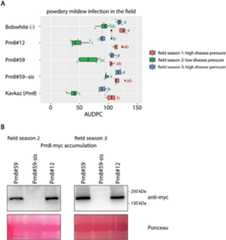
Powdery mildew infection and PM8 protein accumulation in field-grown transgenicPm8 Bobwhite events. (A) Powdery mildew infection of field-grown plants. AUDPC scores were calculated from four independent plots for each genotype in field seasons 1 (red), 2 (green), and 3 (blue). Non-transformed Bobwhite, Pm8#59-sis and wheat cultivar Kavkaz, which carries endogenousPm8, are included as controls. Different letters next to the bars denote a significant difference within the same season in Tukey’s HSD test (α=0.050). (B) PM8–myc protein accumulation in flag leaves from field seasons 2 and 3. Each sample contains three pooled flag leaf segments. Total protein concentration was measured and adjusted to the same concentration prior to loading. Ponceau staining indicates equal loading.
CombiningPm17 withPm3b, andPm17 withPm8 provides additive race-specific powdery mildew resistance in seedling assays
To study compatibility of the overexpressed transgenePm17 with the closely related overexpressed transgenesPm3b andPm8, we used an approach of transgene insertion and cross-breeding. Four transgenic Bobwhite events overexpressing non-epitope-taggedPm3b were previously tested in the field for powdery mildew resistance (Brunneret al., 2011). In this study we generated a new transgenic Bobwhite event overexpressing epitope-taggedPm3b-HA under theubi promoter, called event Pm3b#64. We crossed Pm3b#64 with Pm17#110, and during the subsequent generations selected a plant family homozygous for the two transgenes. This homozygous plant family from crossing Pm17#110×Pm3b#64 we simply named Pm17+Pm3b. To generate the second pyramided line, we crossed Pm17#110 with Pm8#59, and during the subsequent generations selected a plant family homozygous for the two transgenes. This homozygous plant family from cross Pm17#110×Pm8#58 we named Pm17+Pm8.
To test whether the two pyramided transgenes provide additive race-specific powdery mildew resistance, we performed seedling assays under controlled conditions usingBgt isolates with a specific genetic makeup ofAvr effector gene haplotypes. In ourBgt isolate collection we identified six isolates with the desired combinations ofAvr haplotypes. The threeBgt isolates CHN_2-5, CHN_36-70, and CHN_SC-12, which were avirulent (or intermediate) on parental event Pm17#110 but virulent on parental event Pm3b#64, showed an avirulent phenotype on Pm17+Pm3b (data of representative isolate CHN_36-70:Fig. 3A). The threeBgt isolates CHN_GZ-6, CHN_49-1, and CHN_36-3, which were avirulent (or intermediate) on parental event Pm3b#64 but virulent on parental event Pm17#110, showed an avirulent phenotype on Pm17+Pm3b (data of representative isolate CHN_49-1:Fig. 3B). These results demonstrate an additive race-specific resistance mediated byPm17 andPm3b in pyramided line Pm17+Pm3b and the activity of both genes when combined.
Fig. 3.
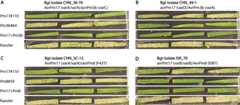
Bgt infection tests on pyramided lines Pm17+Pm3b and Pm17+Pm8 and their corresponding parental events. Three biologically independent leaf segments of 10-day-old transgenic Bobwhite wheat seedlings were infected with the indicatedBgt isolates. The relevantAvr effector gene haplotypes are indicated (Bourraset al., 2019;Mülleret al., 2022;Kunzet al., 2023). Wheat cultivar Kanzler was included as a susceptible control. (A)Pm17 mediated resistance againstBgt isolate CHN_36-70 in pyramided line Pm17+Pm3b. (B)Pm3b mediated resistance againstBgt isolate CHN_49-1 in pyramided line Pm17+Pm3b. (C)Pm17 mediated resistance againstBgt isolate CHN_SC-12 in pyramided line Pm17+Pm8. (D)Pm8 mediated resistance againstBgt isolate ISR_17 in pyramided line Pm17+Pm8.
Next, we performed the same assay on pyramided line Pm17+Pm8. In ourBgt isolate collection we found nine isolates with the desired combinations ofAvr haplotypes. The fiveBgt isolates CHN_SD-3, CHN_2-5, CHN_36-70, CHN_SC-12, and CHE_96224 showed an avirulent or intermediate phenotype on parental event Pm17#110 and a virulent phenotype on parental event Pm8#59. On pyramided line Pm17+Pm8, the five isolates showed the same avirulent or intermediate phenotype as on parental event Pm17#110 (data of representative isolate CHN_SC-12:Fig. 3C). Reciprocally, the fourBgt isolates ISR_70, ISR_103, USA_7, and USA_85063, avirulent on parental event Pm8#59 but with intermediate virulence on parental event Pm17#110, were avirulent on pyramided line Pm17+Pm8 (data of representative isolate ISR_17:Fig. 3D). This shows thatPm17 andPm8 confer additive powdery mildew resistance when combined in pyramided line Pm17+Pm8.
Pyramided lines Pm17+Pm3b and Pm17+Pm8 are highly resistant to powdery mildew in three field seasons
We tested the two pyramided lines Pm17+Pm3b and Pm17+Pm8 in the field for powdery mildew resistance. As controls we included parental events Pm17#110, Pm3b#64, and Pm8#59. Pm17+Pm3b and Pm17+Pm8 showed strong powdery mildew resistance during the three field seasons (Fig. 4A). We collected flag leaf samples of the field-grown plants during field seasons 2 and 3 to measure transprotein accumulation. Pyramided line Pm17+Pm3b showed high levels of HA-tagged protein accumulation (PM17–HA and PM3B–HA) during both field seasons. The strong bands in the western blots suggested an additive protein level of PM17–HA and PM3B–HA, comparable to the sum of PM17–HA and PM3B–HA from parental events Pm17#110 and Pm3b#64 (Fig. 4B). Pyramided line Pm17+Pm8 also showed an additive protein level of the two transproteins PM17–HA and PM8–myc: the protein level of PM17–HA from Pm17+Pm18 was similar to the protein level of parental event Pm17#110, and the protein level of PM8–myc from Pm17+Pm8 was similar to the protein level of parental event Pm8#64 (Fig. 4B).
Fig. 4.
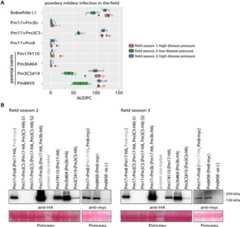
Powdery mildew infection and transprotein accumulation in field-grown transgenic pyramided wheat lines. (A) Powdery mildew infection of field-grown plants. AUDPC scores were calculated from four independent plots for each genotype in field seasons 1 (red), 2 (green), and 3 (blue). Different letters next to the bars denote a significant difference within the same season in Tukey’s HSD test (α=0.050). (B) Transprotein accumulation in flag leaves from field seasons 2 and 3. Each sample contains three pooled flag leaf segments. Total protein concentration was measured and adjusted to the same concentration prior to loading. Ponceau staining indicates equal loading. For pyramided line Pm17+Pm3CS two independent samples (S1 and S2) are included.
Transgene promoter silencing in pyramided line Pm17+Pm3CS leads to powdery mildew susceptibility
Previous studies showed thatPm8-mediated powdery mildew resistance is suppressed byPm3CS (Hurniet al., 2014). Since the protein sequences of PM17 and PM8 are 82.9% identical, andPm17 andPm8 are orthologs both originating from rye, we assumed thatPm17-mediated resistance could be suppressed byPm3CS as well.Pm3CS is a non-functional allele ofPm3 (Yahiaouiet al., 2006). We expected that, in case of suppression, the non-functionalPm3CS together with a suppressedPm17 would result in powdery mildew susceptibility. We generated a transgenic Bobwhite event overexpressing epitope-taggedPm3CS-HA under control of theubi promoter, called event Pm3CS#19. We crossed Pm3CS#19 with Pm17#110 and during subsequent generations we selected a plant family homozygous for the two transgenes. The homozygous plant line from cross Pm17#110×Pm3CS#19 we named Pm17+Pm3CS. We grew pyramided lines Pm17+Pm3CS in the field together with parental lines Pm3CS#19 and Pm17#110. Pm17+Pm3CS was powdery mildew susceptible during three field seasons with AUDPC scores similar to non-transformed Bobwhite (Fig. 4A). Parental event Pm3CS#19 was powdery mildew susceptible during the two field seasons 1 and 3 with high disease pressure but showed an intermediate powdery mildew resistance phenotype in field season 2 with low disease pressure (Fig. 4A). We collected flag leaf samples of the field-grown plants during field seasons 2 and 3 to measure transprotein accumulation. Parental event Pm3CS#19 showed a low amount of PM3CS transprotein accumulation, and surprisingly, there was no accumulation of either PM17 or PM3CS in pyramided line Pm17+Pm3CS (Fig. 4B). We measured transgene expression levels in RT-qPCR assays using respectivePm17- andPm3-specific primers, and confirmed the results obtained from western blots: there was no transgene expression in pyramided line Pm17+Pm3CS (Supplementary Fig. S3). We confirmed the presence of both full-length error-free transgene sequencesPm17-HA andPm3CS-HA in field-grown pyramided line Pm17+Pm3CS by PCR followed by Sanger sequencing. We concluded that both transgenesPm17-HA andPm3CS-HA are present in pyramided line Pm17+Pm3CS, but in contrast to the transgenes in parental lines Pm17#110 and Pm3CS#19, transgenes in pyramided line Pm17+Pm3CS do not produce proteins. We assumed that either the transgenes or the transgene promoters are silenced in pyramided line Pm17+Pm3CS. To test this hypothesis, we took advantage of the presence of the third transgene, the sequence-unrelated selectable marker genemanA, in pyramided lines Pm17+Pm3CS and Pm17+Pm3b.ManA encodes phosphomannose isomerase, which metabolizes mannose into fructose, a trait used for selection of transformed cells during tissue culture (Wrightet al., 2001).ManA is expressed under theubi promoter, the same promoter we used for allPm transgenes. Using primers in theubi promoter andnos terminator sequences (Fig. 5A) we confirmed the presence of allPm transgenes andmanA in pyramided lines Pm17+Pm3CS and Pm17+Pm3b, as well as in the corresponding parental events (Fig. 5B). Using RT-qPCR we tested formanA expression and found thatmanA was expressed in pyramided line Pm17+Pm3b as well as in parental events Pm17#110 and Pm3b#64 (Fig. 5C). Pyramided line Pm17+Pm3CS did not expressmanA and parental event Pm3CS#19 showed a 12-fold lowermanA expression level compared with Pm17#110 (Fig. 5C). From these results we concluded that transgenesPm17-HA,Pm3CS-HA, as well asmanA were silenced in pyramided line Pm17+Pm3CS. PM17–HA protein accumulation was much higher in parental event Pm17#110 compared with PM3CS–HA protein accumulation in parental event Pm3CS#19 (Fig. 4B). Thus, there might already be an incomplete transgene silencing in parental event Pm3CS#19, which increased in progeny line Pm17+Pm3CS. We testedmanA presence andmanA expression in a second Pm17+Pm3CS plant family from an independent cross of Pm17#110 and Pm3CS#19 where likewisemanA was not expressed (Supplementary Fig. S4). Thus, a differentPm3CS event needs to be used in future crossing experiments. We conclude thatubi promoter silencing is the reason for the powdery mildew susceptibility of field-grown Pm17+Pm3CS.
Fig. 5.
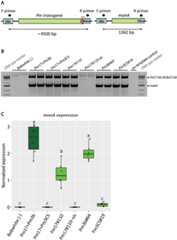
Selection marker genemanA genotyping and expression analyses in pyramided lines Pm17+Pm3b and Pm17+Pm3CS. (A) Primer annealing sites inubi promoter andnos terminator sequences for genotyping of full-length transgenes. (B) Duplex PCR on genomic DNA using primers shown in (A) for detection of full-length transgenes. (C) RT-qPCR data ofmanA expression in pyramided lines and parental events. Non-transformed Bobwhite and Pm17#110-sis were included as negative controls. Expression values were normalized to expression of reference geneADPRF. Six biological replicates were used for each genotype in technical duplicates. Letters above the bars denote a significant difference in expression level (Tukey’s HSD test, α=0.050).
No pleiotropic or somaclonal variation effects in four field-grownPm17 events and pyramided line Pm17+Pm8
We tested the field-grown plants for pleiotropic effects of transgene overexpression and for somaclonal variation resulting from tissue culture. No phenotypic variation was observed among the fourPm17 events, the corresponding sister lines, and the non-transformed Bobwhite. All fourPm17 events, sister lines, and non-transformed Bobwhite flowered around the same date during all three field seasons (data for field season 3:Fig. 6A) and no statistically significant difference of flag leaf chlorophyll content was measured (data from field season 3:Fig. 6B). However, pyramided line Pm17+Pm3b showed a statistically significant delay of flowering (3 d in field season 3) in each field season compared with non-transformed Bobwhite (data from field season 3:Fig. 6C) and a statistically significant lower flag leaf chlorophyll content (a reduction of 50% of the SPAD score in field season 3) compared with non-transformed Bobwhite (data from field season 3:Fig. 6D). These phenotypes were inherited from parental line Pm3b#64, which showed statistically significant delayed flowering compared with non-transformed Bobwhite (Fig. 6C) and reduced chlorophyll content in flag leaves compared with non-transformed Bobwhite (Fig. 6D). Leaves of field-grown parental event Pm3b#64 and pyramided line Pm17+Pm3b were visibly yellow (Fig. 6E). These phenotypes of Pm3b#64 and Pm17+Pm3b were only visible in the field at adult stage and not in the greenhouse at any stage, which highlights the importance of field trials.
Fig. 6.
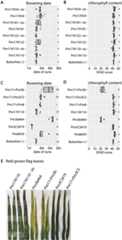
Flowering date, flag leaf chlorophyll content, and photograph of a flag leaf of field-grown transgenic wheat from field season 3. Four plots per genotype were measured (A–D). Different letters denote a significant difference in Tukey’s HSD test (α=0.050). (A) Flowering dates of fourPm17 events and the corresponding sister lines. (B) Flag leaf chlorophyll content of fourPm17 events and the corresponding sister lines. SPAD scores of four plants per plot and four plots per genotype were measured using a portable chlorophyll meter. (C) Flowering dates of the pyramided lines and the corresponding parental events. (D) Flag leaf chlorophyll content of the pyramided lines and the corresponding parental events. SPAD scores of four plants per plot and four plots per genotype were measured using a portable chlorophyll meter. (E) Photograph of two representative field-grown flag leaves per indicated genotype.
Discussion
Several factors contribute to powdery mildew resistance levels in the field
In previous studies with transgenic Bobwhite lines overexpressing single and pyramidedPm3 alleles, we attributed the observed increase of powdery mildew resistance in the field to two effects, transgene overexpression andPm3 allele specificity (Brunneret al., 2011,2012;Kolleret al., 2018,2019). Resistance strength has also been shown to correlate with expression levels of NLR resistance genes in other plant pathosystems (Feuilletet al., 2003;Wanget al., 2021). In this study, the fourPm17 events showed similar levels ofPm17 expression and PM17 protein accumulation, and high levels of powdery mildew resistance (Fig. 1). We speculate that both high transgene expression and PM17 specificity by recognition of AVRPM17 contributed to the strong powdery mildew resistance phenotype in the field. However, additionalPm17 events with varying transgene expression levels have to be tested to evaluate the contribution of the expression level to the resistance phenotype. The twoPm8 events, which both showed similar levels of PM8 protein accumulation in field-grown flag leaves, were powdery mildew susceptible (Fig. 2). Thus, the absence of AVRPM8 recognition likely led to the susceptibility phenotype in the field. Pyramided line Pm17+Pm8 showed the same high level of powdery mildew resistance in the field as parental line Pm17#110 (Fig. 4). Thus, the resistance phenotype of Pm17+Pm8 was mediated by transgenePm17 alone, and not by transgenePm8, because parental event Pm8#59 was powdery mildew susceptible. Pyramided line Pm17+Pm3b showed the same high level of powdery mildew resistance in the field as both parental events Pm17#110 and Pm3b#64 (Fig. 4). We speculate that the powdery mildew resistance phenotype of Pm17+Pm3b is more durable than the resistance phenotype of the two parental events due to additive race-specific resistance shown in seedling assays (Fig. 3), but this will need further field testing during more years and at more locations. Since we show thatBgt isolates lacking the corresponding AVRs retain full virulence on the specific transgenic events overexpressingPm17,Pm3b, orPm8 under theubi promoter used in this study (Fig. 3), we exclude that these transgenic events suffer from overexpression artefacts. This retained race-specificity has already been demonstrated previously for overexpressedPm17 (Singhet al., 2018;Mülleret al., 2022),Pm3b (Brunneret al., 2011), andPm8 (Hurniet al., 2013;Kunzet al., 2023). Future studies based on the same genes but under control of the native promoters might reveal the contribution of overexpression versus the effect of gene combinations on improved resistance. Furthermore, virulence analysis of the prevailingBgt isolates during different years and at different locations would be helpful to fully understand effects of overexpression and gene combination.
Complete transgene promoter silencing in pyramided line Pm17+Pm3CS, but not in parental events Pm17#110 and Pm3CS#19
In pyramided line Pm17+Pm3CS, transproteins PM17 and PM3CS were not observed (Fig. 4B) and transgenemanA was not expressed (Fig. 5C). WhilePm17-HA andPm3CS-HA have high sequence homology,manA carries no homologous sequences to eitherPm gene. This suggests that transcriptional gene silencing due to methylation of the commonubi promoter is most likely the reason for silencing of all transgenes in pyramided line Pm17+Pm3CS. It is possible that double stranded RNA (dsRNA) containingubi promoter sequences, resulting from inverted repeats that can arise from transgene rearrangements during DNA transformation (Iyeret al., 2000), led to methylation of this promoter. Because the silencing mechanism functions through sequence-specific recognition of the promoter sequences by the dsRNA (Metteet al., 2000), methylation would be established in all copies of theubi promoter. Therefore, all transgenes under the control of this promoter would be silenced.ubi promoter silencing has previously also been described in transgenic rice (Kumpatla and Hall, 1998). Field-grown parental event Pm3CS#19 showed low levels of PM3CS protein (Fig. 4B). We assume that this is due to incomplete silencing of theubi promoter, which in progeny line Pm17+Pm3CS progressed to completeubi promoter silencing. In future, promoters less prone for silencing could be used (Schmitzet al., 2022).
Pleiotropic effects observed in the field but not in the greenhouse emphasize the importance of field trials
We observed chlorotic leaves in field-grown event Pm3b#64 and progeny pyramided line Pm17+Pm3b, but not in any other transgenic genotypes tested in this study (Fig. 6). Greenhouse grown Pm3b#64 and Pm17+Pm3 had no chlorotic leaves, either at seedling or later stages (Fig. 3). Field-grown parental line Pm3b#64 showed higher levels of HA-tagged protein accumulation than the other parental lines tested (Fig. 4B). Pyramided line Pm3b+Pm17 showed the highest levels of HA-tagged protein accumulation from all the tested genotypes. We speculate that overexpression ofPm3b in the Bobwhite background can lead to the emergence of pleiotropic effects. This is in accordance with the observations byBrunneret al. (2011), where they tested four transgenicPm3b events and the corresponding sister lines in the field, and observed a positive correlation betweenPm3b expression levels and the emergence of pleiotropic effects. To generate pyramided line Pm17+Pm3b we did not use thePm3b events fromBrunneret al. (2011), because in those events, thePm3b transgene is not epitope tagged. The difference in plant phenotypes between greenhouse- and field-grown plants confirms the importance of field trials to determine the phenotype in the agricultural environment, where the plants are exposed to a plethora of stimuli, as well as biotic and abiotic stresses. It is still complex and laborious in Switzerland to obtain permission for field trials with transgenic crops and to run these trials, and the field trials are potentially still threatened by vandalism (Romeiset al., 2013;Brunneret al., 2021). However, these obstacles should not prevent researchers from performing field trials, which are essential to test transgene function and possible pleiotropic effects.
Considerations on the future of using a transgenic approach for pyramiding of resistance genes from the extended gene pool of wheat
Our work shows, on the example of pyramided line Pm17+Pm3b, the potential of combining overexpressed NLR-encoding genes from the extended gene pool of wheat to provide strong disease resistance in the field. However, several aspects need further optimization. To thoroughly test a transgene, many events with varying levels of transgene expression need to be tested in the field, together with the corresponding sister lines.Brabhamet al. (2023, Preprint) showed that high expression levels of single transgenic NLRs can lead to higher resistance against wheat stem rust. Fine tuning of transgene expression level is crucial to optimize resistance while minimizing possible pleiotropic effects leading to fitness costs for the plants. A study performed with transgenic maize and soybean found that transgene expression levels were mainly impacted by the choice of promoter and the choice of genetic background cultivar, while the genomic site of transgene insertion played a minor role (Bettset al., 2019). Recent technological progress enables the transformation of any wheat genotype of interest (Debernardiet al., 2020;Wanget al., 2022;Johnsonet al., 2023), which greatly facilitates the testing of transgenes in different genetic backgrounds. In this study we used a combined approach of transgene insertion by biolistic transformation and subsequent cross-breeding to generate plants overexpressing two pyramidedNLR type of resistance genes from the primary and the tertiary gene pool of wheat. In another studyLuoet al. (2021) achieved high field resistance against wheat stem rust by pyramiding of five resistance transgenes in wheat cultivar Fielder. They usedAgrobacterium-mediated transformation for the integration of a large transgene cassette containing all five resistance genes. Inserting DNA fragments into plant genomes by biolistic- orAgrobacterium-mediated transformation has so far not been well accepted politically, especially not in Europe (Wulff and Dhugga, 2018). In the future, the more politically accepted genome editing technology could be used (Dimaet al., 2022;FAO, 2022). So far insertion of large DNA fragments by genome editing has been challenging in plants, but recently an optimized approach called PrimeRoot was introduced (Sunet al., 2023;Wang and Doudna, 2023). Together, the above-mentioned approaches will facilitate the deployment of the existingNLR gene diversity (Barragan and Weigel, 2021) from the extended gene pool of wheat, by insertingNLR genes with additive resistance effects quickly and precisely into wheat cultivars of interest, to achieve strong and durable disease resistance.
Supplementary data
The following supplementary data are available atJXB online.
Fig. S1.Pm8 andPm17 introgression from rye into wheat compared with transgenicPm8 andPm17 events in wheat.
Fig. S2. Infection test of transgenic Bobwhite wheat with powdery mildew isolateBgt 96224.
Fig. S3.Pm17 andPm3 expression of field-grown transgenic pyramided lines Pm17+Pm3b and Pm17+Pm3CS, and their parental events determined by RT-qPCR.
Fig. S4. Selectable marker genemanA expression analysis in seedlings of four plant families of pyramided line Pm17+Pm3CS using RT-qPCR.
Acknowledgements
We thank the field technicians from Agroscope in Zurich-Reckenholz for their help with the field trials. We thank Lukas Kunz for advice onBlumeria graminis f. sp.tritici haplotype diversity.
Contributor Information
Teresa Koller, Department of Plant and Microbial Biology, University of Zurich, Zollikerstrasse 107, 8008 Zurich, Switzerland.
Marcela Camenzind, Department of Plant and Microbial Biology, University of Zurich, Zollikerstrasse 107, 8008 Zurich, Switzerland.
, Esther Jung, Department of Plant and Microbial Biology, University of Zurich, Zollikerstrasse 107, 8008 Zurich, Switzerland.
Susanne Brunner, Agroscope, Reckenholzstrasse 191, 8046 Zurich, Switzerland.
Gerhard Herren, Department of Plant and Microbial Biology, University of Zurich, Zollikerstrasse 107, 8008 Zurich, Switzerland.
Cygni Armbruster, Department of Plant and Microbial Biology, University of Zurich, Zollikerstrasse 107, 8008 Zurich, Switzerland.
Beat Keller, Department of Plant and Microbial Biology, University of Zurich, Zollikerstrasse 107, 8008 Zurich, Switzerland.
Susanne Dreisigacker, CIMMYT, Mexico.
Author contributions
TK and BK conceptualized the project. TK, EJ, MC, and SB designed and carried out the field trials. MC, TK, GH, and CA performed experiments. TK, BK, MC, and SB wrote the manuscript.
Conflict of interest
The authors declare no conflicts of interest.
Funding
Funding was provided by grant 310030_192526 from the Swiss National Science Foundation.
Data availability
All data supporting the findings of this study are included in the paper and its supplementary data, or are available from the corresponding author on request.
References
- Barragan AC, Weigel D.. 2021. Plant NLR diversity: the known unknowns of pan-NLRomes. The Plant Cell 33, 814–831. 10.1093/plcell/koaa002 [DOI] [PMC free article] [PubMed] [Google Scholar]
- Betts SD, Basu S, Bolar J, et al. 2019. Uniform expression and relatively small position effects characterize sister transformants in maize and soybean. Frontiers in Plant Science 10, 1209. 10.3389/fpls.2019.01209 [DOI] [PMC free article] [PubMed] [Google Scholar]
- Bourras S, Kunz L, Xue M, et al. 2019. TheAvrPm3-Pm3 effector-NLR interactions control both race-specific resistance and host-specificity of cereal mildews on wheat. Nature Communications 10, 2292. 10.1038/s41467-019-10274-1 [DOI] [PMC free article] [PubMed] [Google Scholar]
- Bourras S, McNally KE, Ben-David R, et al. 2015. Multiple avirulence loci and allele-specific effector recognition control thePm3 race-specific resistance of wheat to powdery mildew. The Plant Cell 27, 2991–3012. 10.1105/tpc.15.00171 [DOI] [PMC free article] [PubMed] [Google Scholar]
- Brabham HJHernández-Pinzón I, Yanagihara C, et al. 2023. Rapid discovery of functional NLRs using the signature of high expression, high-throughput transformation, and large-scale phenotyping. Cell Press Sneak Peek. [Preprint]. 10.2139/ssrn.4446759 [DOI]
- Brunner S, Hurni S, Herren G, Kalinina O, von Burg S., Zeller SL, Schmid B, Winzeler M, Keller B.. 2011. TransgenicPm3b wheat lines show resistance to powdery mildew in the field. Plant Biotechnology Journal 9, 897–910. 10.1111/j.1467-7652.2011.00603.x [DOI] [PubMed] [Google Scholar]
- Brunner S, Romeis J, Patocchi A.. 2021. Die Protected Site – sieben Jahre Freilandforschung mit gentechnisch veränderten Pflanzen. Agrarforschung Schweiz 12, 9–15. 10.34776/afs12-9e [DOI] [Google Scholar]
- Brunner S, Stirnweis D, Diaz Quijano C, et al. 2012. TransgenicPm3 multilines of wheat show increased powdery mildew resistance in the field. Plant Biotechnology Journal 10, 398–409. 10.1111/j.1467-7652.2011.00670.x [DOI] [PubMed] [Google Scholar]
- Chaudhary HK, Kaila V, Rather SA, Badiyal A, Hussain W, Jamwal NS, Mahato A.. 2014. Wheat. In: Pratap A, Kumar J. (eds) Alien gene transfer in crop plants, vol. 2, New York: Springer, 1–26. 10.1007/978-1-4614-9572-7_1 [DOI] [Google Scholar]
- Debernardi JM, Tricoli DM, Ercoli MF, Hayta S, Ronald P, Palatnik JF, Dubcovsky J.. 2020. A GRF–GIF chimeric protein improves the regeneration efficiency of transgenic plants. Nature Biotechnology 38, 1274–1279. 10.1038/s41587-020-0703-0 [DOI] [PMC free article] [PubMed] [Google Scholar]
- de Mendiburu F.2021. agricolae: Statistical procedures for agricultural research. R package Version 1.3-5.https://CRAN.R-project.org/package=agricolae
- Dima O, Heyvaert Y, Inzé D.. 2022. Interactive database of genome editing applications in crops and future policy making in the European Union. Trends in Plant Science 27, 746–748. 10.1016/j.tplants.2022.05.002 [DOI] [PubMed] [Google Scholar]
- FAO. 2022. Gene editing and agrifood systems. Rome: Food and Agriculture Organization of the United Nations. 10.4060/cc3579en [DOI] [Google Scholar]
- Feuillet C, Travella S, Stein N, Albar L, Nublat A, Keller B.. 2003. Map-based isolation of the leaf rust disease resistance geneLr10 from the hexaploid wheat (Triticum aestivum L.) genome. Proceedings of the National Academy of Sciences, USA 100, 15253–15258. 10.1073/pnas.2435133100 [DOI] [PMC free article] [PubMed] [Google Scholar]
- Giménez MJ, Pistón F, Atienza SG.. 2011. Identification of suitable reference genes for normalization of qPCR data in comparative transcriptomics analyses in the Triticeae. Planta 233, 163–173.https://about.jstor.org/terms [DOI] [PubMed] [Google Scholar]
- Hurni S, Brunner S, Buchmann G, Herren G, Jordan T, Krukowski P, Wicker T, Yahiaoui N, Mago R, Keller B.. 2013. RyePm8 and wheatPm3 are orthologous genes and show evolutionary conservation of resistance function against powdery mildew. The Plant Journal 76, 957–969. 10.1111/tpj.12345 [DOI] [PubMed] [Google Scholar]
- Hurni S, Brunner S, Stirnweis D, Herren G, Peditto D, McIntosh RA, Keller B.. 2014. The powdery mildew resistance genePm8 derived from rye is suppressed by its wheat orthologPm3. The Plant Journal 79, 904–913. 10.1111/tpj.12593 [DOI] [PubMed] [Google Scholar]
- Iyer LM, Kumpatla SP, Chandrasekharan MB, Hall TC.. 2000. Transgene silencing in monocots. Plant Molecular Biology 43, 323–346. 10.1023/A:1006412318311 [DOI] [PubMed] [Google Scholar]
- Jo KR, Kim CJ, Kim SJ, Kim T-Y, Bergervoet M, Jongsma MA, Visser RGF, Jacobsen E, Vossen JH.. 2014. Development of late blight resistant potatoes by cisgene stacking. BMC Biotechnology 14, 50. 10.1186/1472-6750-14-50 [DOI] [PMC free article] [PubMed] [Google Scholar]
- Johnson K, Cao Chu U, Anthony G, Wu E, Che P, Jones TJ.. 2023. Rapid and highly efficient morphogenic gene-mediated hexaploid wheat transformation. Frontiers in Plant Science 14, 1151762.https://www.frontiersin.org/articles/10.3389/fpls.2023.1151762/full [DOI] [PMC free article] [PubMed] [Google Scholar]
- Jones JD, Dangl JL.. 2006. The plant immune system. Nature 444, 323–329. 10.1038/nature05286 [DOI] [PubMed] [Google Scholar]
- Koller T, Brunner S, Herren G, Hurni S, Keller B.. 2018. Pyramiding of transgenicPm3 alleles in wheat results in improved powdery mildew resistance in the field. Theoretical and Applied Genetics 131, 861–871. 10.1007/s00122-017-3043-9 [DOI] [PMC free article] [PubMed] [Google Scholar]
- Koller T, Brunner S, Herren G, Sanchez-Martin J, Hurni S, Keller B.. 2019. Field grown transgenicPm3e wheat lines show powdery mildew resistance and no fitness costs associated with high transgene expression. Transgenic Research 28, 9–20. 10.1007/s11248-018-0099-5 [DOI] [PubMed] [Google Scholar]
- Kumpatla SP, Hall TC.. 1998. Recurrent onset of epigenetic silencing in rice harboring a multi-copy transgene. The Plant Journal 14, 129–135. 10.1046/j.1365-313X.1998.00097.x [DOI] [PubMed] [Google Scholar]
- Kunz L, Sotiropoulos AG, Graf J, Razavi M, Keller B, Müller MC.. 2023. The broad use of thePm8 resistance gene in wheat resulted in hypermutation of theAvrPm8 gene in the powdery mildew pathogen. BMC Biology 21, 29.https://bmcbiol.biomedcentral.com/articles/10.1186/s12915-023-01513-5 [DOI] [PMC free article] [PubMed] [Google Scholar]
- Lu P, Guo L, Wang Z, et al. 2020. A rare gain of function mutation in a wheat tandem kinase confers resistance to powdery mildew. Nature Communications 11, 680. 10.1038/s41467-020-14294-0 [DOI] [PMC free article] [PubMed] [Google Scholar]
- Luo M, Xie L, Chakraborty S, et al. 2021. A five-transgene cassette confers broad-spectrum resistance to a fungal rust pathogen in wheat. Nature Biotechnology 39, 561–566. 10.1038/s41587-020-00770-x [DOI] [PubMed] [Google Scholar]
- McDonald BA, Linde C.. 2002. Pathogen population genetics, evolutionary potential, and durable resistance. Annual Review of Phytopathology 40, 349–379. 10.1146/annurev.phyto.40.120501.101443 [DOI] [PubMed] [Google Scholar]
- Mette MF, Aufsatz W, Van der Winden J., Matzke MA, Matzke AJM.. 2000. Transcriptional silencing and promoter methylation triggered by double-stranded RNA. The EMBO Journal 19, 5194–5201.https://onlinelibrary.wiley.com/doi/full/10.1093/emboj/19.19.5194 [DOI] [PMC free article] [PubMed] [Google Scholar]
- Müller MC, Kunz L, Schudel S, et al. 2022. Ancient variation of theAvrPm17 gene in powdery mildew limits the effectiveness of the introgressed ryePm17 resistance gene in wheat. Proceedings of the National Academy of Sciences, USA 119, e2108808119. 10.1073/pnas.2108808119 [DOI] [PMC free article] [PubMed] [Google Scholar]
- Müller MC, Praz CR, Sotiropoulos AG, et al. 2019. A chromosome-scale genome assembly reveals a highly dynamic effector repertoire of wheat powdery mildew. New Phytologist 221, 2176–2189. 10.1111/nph.15529 [DOI] [PMC free article] [PubMed] [Google Scholar]
- Ngou BPM, Ding P, Jones JDG.. 2022. Thirty years of resistance: zig-zag through the plant immune system. The Plant Cell 34, 1447–1478. 10.1093/plcell/koac041 [DOI] [PMC free article] [PubMed] [Google Scholar]
- Parlange F, Oberhaensli S, Breen J, Platzer M, Taudien S, Simková H, Wicker T, Doležel J, Keller B.. 2011. A major invasion of transposable elements accounts for the large size of theBlumeria graminis f.sp.tritici genome. Functional & Integrative Genomics 11, 671–677. 10.1007/s10142-011-0240-5 [DOI] [PubMed] [Google Scholar]
- Parlange F, Roffler S, Menardo F, et al. 2015. Genetic and molecular characterization of a locus involved in avirulence ofBlumeria graminis f. sp.tritici on wheat Pm3 resistance alleles. Fungal Genetics and Biology 82, 181–192. 10.1016/j.fgb.2015.06.009 [DOI] [PubMed] [Google Scholar]
- Romeis J, Meissle M, Brunner S, Tschamper D, Winzeler M.. 2013. Plant biotechnology: research behind fences. Trends in Biotechnology 31, 222–224. 10.1016/j.tibtech.2013.01.020 [DOI] [PubMed] [Google Scholar]
- Sánchez-Martín J, Keller B.. 2021. NLR immune receptors and diverse types of non-NLR proteins control race-specific resistance in Triticeae. Current Opinion in Plant Biology 62, 102053. 10.1016/j.pbi.2021.102053 [DOI] [PubMed] [Google Scholar]
- Sánchez-Martín J, Steuernagel B, Ghosh S, et al. 2016. Rapid gene isolation in barley and wheat by mutant chromosome sequencing. Genome Biology 17, 221. 10.1186/s13059-016-1082-1 [DOI] [PMC free article] [PubMed] [Google Scholar]
- Sánchez-Martín J, Widrig V, Herren G, et al. 2021. WheatPm4 resistance to powdery mildew is controlled by alternative splice variants encoding chimeric proteins. Nature Plants 7, 327–341.http://www.nature.com/articles/s41477-021-00869-2 [DOI] [PMC free article] [PubMed] [Google Scholar]
- Schlegel R, Korzun V.. 1997. About the origin of 1RS1BL wheat-rye chromosome translocations from Germany. Plant Breeding 116, 537–540.https://onlinelibrary.wiley.com/doi/10.1111/j.1439-0523.1997.tb02186.x [Google Scholar]
- Schmitz RJ, Grotewold E, Stam M.. 2022. Cis-regulatory sequences in plants: Their importance, discovery, and future challenges. The Plant Cell 34, 718–741. 10.1093/plcell/koab281 [DOI] [PMC free article] [PubMed] [Google Scholar]
- Singh RP, Singh PK, Rutkoski J, Hodson DP, He X, Jørgensen LN, Hovmøller MS, Huerta-Espino J.. 2016. Disease impact on wheat yield potential and prospects of genetic control. Annual Reviews in Phytopathology 54, 303–322.https://www.annualreviews.org/doi/10.1146/annurev-phyto-080615-095835 [DOI] [PubMed] [Google Scholar]
- Singh SP, Hurni S, Ruinelli M, Brunner S, Sanchez-Martin J, Krukowski P, Peditto D, Buchmann G, Zbinden H, Keller B.. 2018. Evolutionary divergence of the ryePm17 andPm8 resistance genes reveals ancient diversity. Plant Molecular Biology 98, 249–260. 10.1007/s11103-018-0780-3 [DOI] [PubMed] [Google Scholar]
- Stirnweis D, Milani S, Brunner S, Herren G, Buchmann G, Peditto D, Jordan T, Keller B.. 2014. Suppression among alleles encoding nucleotide-binding-leucine-rich repeat resistance proteins interferes with resistance in F1 hybrid and allele-pyramided wheat plants. The Plant Journal 79, 893–903. 10.1111/tpj.12592 [DOI] [PubMed] [Google Scholar]
- Sun C, Lei Y, Li B. et al. 2023. Precise integration of large DNA sequences in plant genomes using PrimeRoot editors. Nature Biotechnology, doi: 10.1038/s41587-023-01769-w. 10.1038/s41587-023-01769-w [DOI] [PubMed]
- Walkowiak S, Gao L, Monat C, et al. 2020. Multiple wheat genomes reveal global variation in modern breeding. Nature 588, 277–283. 10.1038/s41586-020-2961-x [DOI] [PMC free article] [PubMed] [Google Scholar]
- Wang J, Song W, Chai J.. 2023. Structure, biochemical function, and signaling mechanism of plant NLRs. Molecular Plant 16, 75–95. 10.1016/j.molp.2022.11.011 [DOI] [PubMed] [Google Scholar]
- Wang JY, Doudna JA.. 2023. CRISPR technology: a decade of genome editing is only the beginning. Science 379, eadd8643.https://www.science.org/doi/10.1126/science.add8643 [DOI] [PubMed] [Google Scholar]
- Wang K, Shi L, Liang X, et al. 2022. The geneTaWOX5 overcomes genotype dependency in wheat genetic transformation. Nature Plants 8, 110–117. 10.1038/s41477-021-01085-8 [DOI] [PubMed] [Google Scholar]
- Wang W, Chen L, Fengler K, et al. 2021. A giant NLR gene confers broad-spectrum resistance toPhytophthora sojae in soybean. Nature Communications 12, 6263. 10.1038/s41467-021-26554-8 [DOI] [PMC free article] [PubMed] [Google Scholar]
- Wicker T, Oberhaensli S, Parlange F, et al. 2013. The wheat powdery mildew genome shows the unique evolution of an obligate biotroph. Nature Genetics 45, 1092–1096. 10.1038/ng.2704 [DOI] [PubMed] [Google Scholar]
- Wright M, Dawson J, Dunder E, Suttie J, Reed J, Kramer C, Chang Y, Novitzky R, Wang H, Artim-Moore L.. 2001. Efficient biolistic transformation of maize (Zea mays L.) and wheat (Triticum aestivum L.) using the phosphomannose isomerase gene,pmi, as the selectable marker. Plant Cell Reports 20, 429–436. 10.1007/s002990100318 [DOI] [PubMed] [Google Scholar]
- Wulff BBH, Dhugga KS.. 2018. Wheat—the cereal abandoned by GM. Science 361, 451–452.https://www.science.org/doi/10.1126/science.aat5119 [DOI] [PubMed] [Google Scholar]
- Yahiaoui N, Brunner S, Keller B.. 2006. Rapid generation of new powdery mildew resistance genes after wheat domestication. The Plant Journal 47, 85–98. 10.1111/j.1365-313X.2006.02772.x [DOI] [PubMed] [Google Scholar]
Associated Data
This section collects any data citations, data availability statements, or supplementary materials included in this article.
Supplementary Materials
Data Availability Statement
All data supporting the findings of this study are included in the paper and its supplementary data, or are available from the corresponding author on request.