



Inversions in US Presidential Elections: 1836–2016†
Dean Spears
Ilyana Kuziemko was coeditor for this article.
Email:italesara@utexas.edu
Abstract
Inversions—in which the popular vote winner loses the election—have occurred in four US presidential races. We show that rather than being statistical flukes, inversions have been ex ante likely since the early 1800s. In elections yielding a popular vote margin within 1 point (one-eighth of presidential elections), about 40 percent will be inversions in expectation. We show this conditional probability is remarkably stable across historical periods—despite differences in which groups voted, which states existed, and which parties participated. Our findings imply that the United States has experienced so few inversions merely because there have been so few elections (and fewer close elections).
Keywords: D72, N41, N42
Over the last 200 years, the US presidential candidate with the most votes has lost the election about 8 percent of the time. The US Electoral College is a perennial focus of popular scrutiny and academic study because of theseelectoral inversions.1 Gallup has been consistently polling public opinion on the Electoral College since 1967.2 In all but one survey year since then, between half and four-fifths of Americans have expressed a preference to discontinue the Electoral College system in favor of a national popular vote (Saad 2011,2016;Jones 2019).3 The most common major concern among 2019 Gallup respondents about the Electoral College was that “the winner of the popular vote doesn’t always win the election”—as opposed to, for example, “small-population states have a disproportionate influence on the outcome” or “candidates mostly focus their campaigns on voters in a small number of competitive swing states.” In other words, most Americans who oppose the Electoral College do so because of the possibility of inversion.
Beliefs about the likelihood of inversions motivate practical efforts to change or eliminate the Electoral College, too. These efforts include more than 100 failed Constitutional amendments proposed by members of Congress across many decades4 as well as the recent activity around the National Popular Vote Interstate Compact, which has been signed into law by 16 states as of 2020.5 Meanwhile, many proponents of the current system explicitly motivate their support with claims about which party is likely to benefit from an inversion. Yet many basic facts at the root of these positions and policy actions remain unknown. How ex ante probable, in fact, are electoral inversions in US presidential races? Precisely how do inversion probabilities vary with the closeness of the election? Is the overrepresentation of small-state populations in the voting system likely to be pivotal in generating inversions (and today to favor Republican candidates), as is often claimed? The literature contains many studies of the Electoral College, but these key questions remain unanswered. The answers are not obvious because the sample of presidential elections is small—only 25 observations per century—making it difficult to distinguish statistical flukes from events that were ex ante probable.
Furthermore, the reform debate depends not only on how probable electoral inversions are today but also on howstable such statistical properties are in the face of changing demographics and politics. Two of the first six elections of the twenty-first century have awarded the presidency to the candidate who lost the popular vote. Is that indicative of the long-run characteristics of the Electoral College or an artifact of two unusual political moments? Reforms would affect not only the near future but could persist into the distant future when many features of the political system and electorate—even the set of states—could be different from today.
In this paper, we resolve these questions. We show, for the first time, that the probability of an inversion, conditional on a close election, is high and quantitatively stable—unchanging throughout the history of popular voting and unchanging across alternative future scenarios for presidential politics. We also decompose which features of the Electoral College’s aggregation mechanism have contributed to partisan asymmetries, favoring one party or another at various points in history. To do so, we begin by defining a data-generating process for state vote totals in presidential races. Our statistical model is flexible enough to nest the various standard approaches to election modeling in the positive political science literature. Our data-generating process also nests the methods of statistically sophisticated professional forecasters and analysts (e.g.,Silver 2016). We estimate the model(s) using historical state-level voting data extending back to 1836.6 Sampling from an estimated model yields a probable outcome for each state, and aggregating across states yields a probable national election. By sampling many thousands of these probable presidential elections, we characterize the joint distribution over the national popular vote and the Electoral College outcome.
Because US politics has changed dramatically over the last two centuries, we estimate all outcomes of interest separately within historical periods. In particular, we generate results for the Antebellum, post-Reconstruction, and Modern periods, as well as for the early and mid-twentieth century. This allows us to characterize whether and how the ex ante inversion probabilities have changed as the underlying data-generating process has evolved.
Because different structural restrictions on the data-generating process correspond to different substantive assumptions about the complex and interacting behaviors of voters, campaigns, and other social and economic forces, we generate results under many alternative estimation approaches within each period. Rather than preferring a particular set of assumptions, we show that the envelope of results described byany plausible model generates an informative lower bound on inversion probabilities in close elections. This is true even when we study geographic configurations of US politics that have never occurred—but could. For example, the hundreds of models we examine differ substantially in their implied probability distributions over the national popular vote and differ substantially in the covariance structure that links state-level voting shocks within an election year. The latter determines, for example, whether Florida and Ohio tend to move together in an election. Key results hold even when, in place of estimating model parameters, we iterate over a large grid of exogenously set variances and covariances representing uncertainty in state-level voting outcomes.
We find that in elections decided by a margin of 1 percentage point or less (equal to 1.3 million votes by 2016 turnout), the probability of inversion is at least about 40 percent. This holds across the two centuries of US history we study. Thus, an important explanation for the difference between the patterns of the twenty-first century (in which there have been two inversions) and of the twentieth century (in which there were none) is that recent elections have simply been closer in terms of the national popular vote. This contrasts with explanations focused on some special property of the candidates, parties, or partisan geographies in the twenty-first century.
Our main results hold across modeling and estimation approaches and are robust to excluding from our sampling frame the election-year observations in which an inversion actually occurred (1876, 1888, 2000, and 2016). The similarity of results across the diverse catalog of statistical models we examine implies that there need not be any consensus on the best model of election uncertainty to establish the high probability of inversion in close elections.
The results also shed new light on the extent of partisan asymmetry in the Electoral College. In the past 30 years, this asymmetry has favored Republicans. For example, conditional on an inversion occurring, the ex ante probability that it would have been won by a Republican ranges from 62 percent to 93 percent across models we analyze (in contrast to the ex post realization of 100 percent). But partisan advantage—unlike the chance of an inversion in a close race—has varied over time. In the post-Reconstruction period (1872–1888), for example, it was the Democrats who were advantaged.
InSection IV, we decompose how various features of the Electoral College’s aggregation algorithm contribute to inversions and asymmetry over US history. These features include (i) the allocation of two electors to each state corresponding to the state’s senators and so not in proportion to population, (ii) the winner-takes-all awarding of state electoral votes to the winner of the statewide popular vote in most states, (iii) the rounding errors inherent in dividing the US population across just a few hundred indivisible electors (today, there are 435 House seats and so 538 electors), and (iv) the substantial demographic differences between residents-at-last-census and voters-on-election-day.7 Almost all popular accounts focus on (i) and (ii), but we develop several striking facts related to (iii) and (iv). In particular, during the post-Reconstruction era, Democrats’ Electoral College advantage had little to do with malapportionment (the two senator-linked electors) or the “wasted” votes in states won by large margins. Instead, it was closely tied to the wedge between residents-at-last-census used to determine Electoral College apportionment (which included Blacks) and voters (which, due to suppression, largely did not). We show that the turnout-to-population heterogeneity across states remains an important driver of inversion possibilities today.8 Our findings imply that even if all state governments changed their election laws to split the awarding of Electoral College votes across candidates in proportion to the state vote, and even if federal law changed to inflate the size of the US House to be arbitrarily large, and even if a constitutional amendment were passed that made Electoral College representation proportional to state population (removing the two senator-linked electors per state), the possibility of a mismatch between the Electoral College outcome and the national popular vote would persist.
The Electoral College is a distinguishing feature of the US political system and so has been widely studied across many fields (e.g.,May 1948;Peirce and Longley 1981;Merrill 1978;Ball and Leuthold 1991;Garand and Parent 1991;Katz, Gelman, and King 2004; seeMiller 2012 for a complete review). Nonetheless, the facts we document here are new. Much prior attention in the economics, law, and positive political science literatures has been focused on demographic inequalities and other facts about the Electoral College—such as effective voting power by geography or race (Banzhaf III 1968,Sterling 1978,Blair 1979), the strategic deployment of campaign resources across states (Strömberg 2008), the probability of a single voter being individually pivotal (Gelman, Silver, and Edlin 2012;Gelman and Kremp 2016), or the voter response to perceptions around that probability (Gerber et al. 2020). However, very few empirical papers have quantified any aspect of the probability of an inversion.9 Estimating the conditional probability of inversion as a function of the national popular vote is a main contribution of this paper and provides a new result to inform the ongoing debate.10
Another main contribution of our paper is to establish that the high probability of inversion at narrow vote margins is not a modern phenomenon but has been true for as long as citizens have cast votes for US presidents. The prior literature has not established this fact, and forecasters whose methods are closest to the methods of this paper (e.g.,Silver 2016;Economist, Gelman, and Heidemanns 2020) have focused almost exclusively on making predictions of inversion probabilities in the weeks or months preceding some future election—and only for the last few elections. By applying our estimation and simulation backward through US history, we establish a surprising result. The core estimates of the likelihood of inversions in close races are essentiallyunchanging across radically different facts about politics, parties, and state and voter populations.
The US Electoral College has grown from including 24 states in 1836 to 50 states and the District of Columbia today. Over this time, larger shares of the population (nonwhites, the poor, women) have been granted and have exercised the right to vote for president, and different sets of parties have participated in national politics. Our work shows that even as the Union has changed in these ways over the past two centuries, the high probability of an inversion has remained a constant feature of US presidential elections. Thus, the statistical randomness inherent in the Electoral College’s tiered system of voting dominates the role of historical variation in demographic, institutional, cultural, or political factors in accounting for inversions. An implication is that the demographic and political changes likely to be experienced in the coming decades, which pale in comparison to the changes experienced over the study period (1836–2016), are unlikely to substantially alter the probability of inversion in a close election.
I. Background and Data
A. The Electoral College
The general provisions for the Electoral College (EC) system are established in Article II,Section 1 of the Constitution, though the particular method for determining the number of electors and allocating these across states has varied over time. EC electors are linked to congressional apportionment, and so their number and geographic distribution have been affected by the various Apportionment Acts of Congress that have set the rules for allocating congressional seats across states. In particular, the EC electors allocated to each state are equal in number to the state’s voting members in the US House of Representatives plus two (for the two senators of each state).11 Today, there are 538 electors in total: 435 corresponding to US representatives, 100 corresponding to US senators, and 3 electors for Washington, DC. Washington, DC’s allocation was established by the Twenty-Third Amendment. The present cap at 435 US representatives and the method for apportionment of congressional seats across states was established by the Reapportionment Act of 1929. As is the case for US House seats, reapportionment of EC electors across states follows each decennial census. States individually determine how to award their EC votes in an election. Currently, in all states except Maine and Nebraska, the statewide popular vote winner is awarded all of the state’s EC votes, though there is no constitutional requirement to involve citizens in presidential elections at all.
Inversions have been possible—and, we show below, likely—over US history because of this tiered system of voting, in which citizens cast votes for electors, who in turn elect the president. Even absent the possibility of faithless electors,12 the national popular vote and the EC outcome can diverge for a host of reasons that we detail below inSection IV, where we examine the aggregation mechanics of the EC. At a high level, inversions can occur when EC votes at the second tier can be captured by different numbers of citizen votes at the first tier.
B. Party Systems and Sample Periods
Figure 1 describes the periods in US history that we study. Political scientists have identified several stable party systems, characterized by competition between a fixed pair of parties with stable political properties. To define estimation samples, we further restrict attention within party systems to spans of years with stable partisan geographies.13 This avoids, for example, grouping together election outcomes for the Democratic Party before and after the 1960s partisan realignment of the North and South.
Figure 1. Background: Parties, Victory Margins, and Inversions in US Presidential Elections.
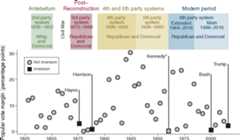
Notes: Timeline shows the periods of stable “party systems.” The plotted points indicate the national popular vote margin for each US presidential election from 1828 to 2016. The margin is measured as the difference in vote shares of the two major parties competing in the election. These shares are calculated as the fraction of the two-party vote total won by each of the two parties. States-years with no citizen vote for president do not contribute to the national popular vote statistics. There are four widely acknowledged inversions: 1876, 1888, 2000, and 2016. All were won by Republicans.
a In the 1960 election, Kennedy arguably lost the popular vote to Nixon despite winning the Electoral College; seeGaines (2001) andonline Appendix B.
Sources:Leip (2018),Pallardy (2016),Eldridge (2013).
We begin our study in 1836, after the Twelfth Amendment changed the rules of the Electoral College and after various state-level reforms rendered the presidential election somewhat similar to our system today. Most importantly, we start only after all states (other than South Carolina) began allowing their citizens to vote in presidential elections. We do not study the Civil War era. Nor do we include in our main sample the first half of the twentieth century, which generated decades of consecutive landslide victories—first for Republicans, then for Democrats. Landslides are less informative of the probability distribution of votes around the 50 percent threshold of interest. Given these restrictions, we study the Antebellum (1836–1852), post-Reconstruction (1872–1888), and Modern (1964–2016/1988–2016) periods.14 For completeness (though with the caveats noted above), we also generate results for the party systems spanning the early and mid-twentieth century (1916–1956).15
Figure 1 displays the popular vote margin of victory in each US presidential election in our study period.16 There have been four electoral inversions over this time: in 1876, 1888, 2000, and 2016. There are also reasonable arguments that Kennedy’s 1960 victory (outside of our sample) was an inversion too. (SeeGaines 2001 and ouronline Appendix B.) The figure makes clear that, to date, electoral inversions have been limited to fairly close elections. One goal of this paper is to establish the conditional probability of inversion at any level of popular vote margin, including races that are not close. The figure also highlights the key inferential challenge in studying presidential elections: There have been just a few dozen elections in total. A credible empirical analysis has to contend with the model and parameter uncertainty arising from that fact.
C. Data
The key inputs to our analysis are the historical election returns by state for each presidential election. Data on state-level vote tallies for each candidate and the size of the state’s EC delegation in each election come from theLeip (2018) compilation of state election returns. For data on state demographics including race and education, we use IPUMS extracts from decennial censuses (Manson et al. 2020) and the American Community Survey (US Census Bureau 2016). Further data details are documented inonline Appendix C.
Following the literature (e.g.,Vogl 2014 andCullen, Turner, and Washington 2019), we normalize vote shares as a fraction of the total won by the two major candidates/parties. The major parties were the Democrats and Whigs from 1836 to 1852 and Democrats and Republicans for the later periods we examine. The 50 percent share of the two-party vote is the relevant threshold for our analysis. For example, in 2000 the Republican candidate (Bush) won 48.847 percent of Florida citizen votes. This equaled 50.005 percent of votes cast for either of the two major parties. By crossing the 50 percent two-party threshold, Bush took all of Florida’s EC votes. This two-party normalization simplifies the graphical presentation but does not substantively impact our analysis, as third-party candidates won no EC votes over our primary study periods.17
A related but distinct issue is that a third-party candidate could be important in affecting the shares of votes won by the two major party candidates. In some instances, third-party candidates won a large share of votes nationally. For example, Perot won 19 percent of the popular vote in the 1992 presidential election despite receiving no EC votes. We examine sensitivity to various ways of handling third-party votes below.
II. Methods
We construct probability distributions over national election outcomes. We proceed in two stages: first, we estimate the statistical model (i.e., the data-generating process) for presidential elections at the level of the states, and then we sample from the estimated model to build distributions of likely outcomes.18 We do this many times, for many models.
A. Data-Generating Process/Statistical Model
We flexibly model the data-generating process for a state-by-election-year outcome as consisting of a state expectation,, and a mean-zero shock, which may be correlated across states in an election:
| (1) |
The outcome variable of interest is, the two-party vote share for the indexed party (normalized to be Whigs before the Civil War and Republicans afterward) in the state-year or the log-odds transformation of this vote share.
The compound shock includes an election year shock that is common to all states and independent across years. It also includes a state-specific shock that varies independently across states within each election year. The last component of is a vector that accommodates correlation in the shocks experienced by different states in the same election year on the basis of common state characteristics—for example, because some issue or candidate appeals to western states (in which is a vector of region indicators) or states with large nonwhite populations (in which is the fraction of each state’s population that is nonwhite). We defer parameterizing the distributions of, and until we discuss estimation below.
The statistical model in equation (1) is a generalization of the consensus approach to modeling uncertainty in US election outcomes in political science. It nests the “unified method of evaluating electoral systems” (Gelman and King 1994) and its more recent applications (e.g.,Katz, Gelman, and King 2004). The unified method, as it is typically applied to legislative elections such as US House seats, estimates the variances of legislative district shocks and a common shock. By varying the assumptions on the structure of, our statistical model can accommodate any typical approach in the positive political science literature.19 It also nests contemporary forecasting approaches (e.g.,Silver 2016).
Equation (1) serves as both a model to be estimated and—post-estimation—the process from which we sample Monte Carlo draws to generate distributions of probable elections. In the context of estimation, corresponds to a particular election, like Hayes vs. Tilden 1876. In the context of simulation, is a probable election that could have occurred during the period from which the parameters were estimated. In other words, is a single simulation run, which contains state realizations ( in the Modern sampling frame, which includes DC). Aggregating across states yields a national popular vote for each. Aggregating EC votes, which are implied by each state’s voting outcome, yields an EC winner for each. For each model we estimate, we generate 100,000 election simulations to yield smooth joint probability distributions of popular vote and EC outcomes.
The reason for simulating election outcomes from these models is that the Electoral College is a complex statistical object. There is no analytical mapping from model estimates (i.e., the parameters defining, and) to the outcomes of interest. Focusing our discussion on simulation outcomes rather than model parameters—in particular, focusing on the conditional expectation of an inversion for each level of the national popular vote—also facilitates comparisons across models with different assumed shock structures and so different sets of estimated parameters.
This flexibility in equation (1) is central to our approach. Specification uncertainty is an important challenge in this context: The sample of elections is too small to be confident of any single model for the distribution of potential presidential election outcomes. Therefore, we estimate results under alternative sets of assumptions on, including restrictions on the correlation structure that links outcomes across states in an election year. We also vary whether the distribution is parametrically estimated following the literature or built up from bootstrap draws that avoid parametric assumptions.
Below, we report results produced by hundreds of parametric and bootstrap models. For tractability, we sometimes focus attention on 25 named models that span much of the relevant space of model uncertainty.20 Rather than preferring any single model or estimation approach, we show that the envelope of results described byany plausible model generates an informative lower bound on inversion probabilities. Demonstrating robustness to model uncertainty is a key contribution of the paper.
B. Parametric Estimation
Because we estimate many variants ofequation (1), we give names to some focal models. In the “” set of models—A1, R1, M1, for application to the Antebellum, post-Reconstruction, and Modern periods, respectively—shocks to the log-odds vote shares are assumed to be distributed as independent normals, with and. Note, is restricted to zero. Thus, each state draws an idiosyncratic shock from the same distribution, and all states receive a common national shock in each election. This error structure, in which common national shocks are the only source of correlated shocks across states, aligns with the stylized fact in the elections literature that common, national shocks are an important component of the across-election-year variance. These baseline models are similar to the model in theKatz, Gelman, and King (2004) analysis of the Electoral College, though applied to different study periods and to answer a somewhat different set of questions. We estimate the parameter vector via maximum likelihood.
In other models, we allow subnational correlation in state outcomes, though there are important constraints on our ability to estimate a variance-covariance matrix for state vote shares. For example, the modern study period includes observations for 51 states over the 8 elections that fall between 1988 and 2016. The unconstrained covariance matrix would be 51 × 51 triangular. Therefore, when effectively constraining this matrix by choosing the vector—i.e., making substantive assumptions about which state characteristics could link the shocks between states—we follow the elections literature and recent practice in election forecasting.
In models M2, R2, and A2, we follow FiveThirtyEight’s published methodology (Silver 2016) in using fatter-tailed distributions and an alternative process for correlated shocks. In particular, we use distributions with one degree of freedom fewer than the number of election years in the sample period. And, in addition to independent state and national shocks described by and, we specify an vector that includes region indicators, fraction nonwhite in the state, and fraction with a college degree in the state. Other parametric models vary the set of characteristics permitted to link the state shocks, as indicated below. Parameters are estimated via maximum likelihood.
It is important to understand that the unknowns of interest here are parameters describing the uncertainty in election outcomes—i.e., the shock process described by—rather than parameters describing the expectations of state election outcomes in past elections. The best unbiased predictor of, for example, the expected Republican vote share in Ohio over elections in the last 30 years is arguably the observed mean of the Republican vote share in Ohio over that period. The challenge lies in statistically describing uncertainty around how these historical elections could have unfolded differently. Our focus on estimating spread is in contrast to studies investigating, for example, how ongoing demographic changes could shiftexpectations of states’ future partisan alignment. Nonetheless, we examine below the potential impacts of shifting partisan alignment in key states.21
C. Hyperparameter Grid
A challenge for any study of the EC is that with only a few elections per party system, it is impossible to be confident that estimates precisely reflect the true variance-covariance matrix of random shocks across states. We therefore investigate the sensitivity of our results toassuming model parameters that cover a large grid of national shock variances, state shock variances, and census-region shock variances. This exercise allows us to assess the importance of parameter uncertainty. Although arbitrarily specifying model parameters would in most settings and for most questions generate uninformative bounds, we show that for the probability of inversions in close presidential elections, these bounds are informative (far from zero).
D. Nonparametric, Bootstrap-Based Monte Carlo
Beyond assessing parameter uncertainty, we further address model uncertainty. In place of the parametric assumptions on the error process described above, we perform a bootstrap Monte Carlo in several forms. The bootstrap procedures conform to the data-generating process described inequation (1), but, rather than making parametric assumptions on the shocks and estimating these parameters, we draw directly from the discrete distributions of historical events.
To generate a single counterfactual election (), an actual election year outcome is drawn for each state from among the election years in the sampling frame. In the baseline, these draws of election years are independent across states and are made with equal probability among the election years included in the sampling frame. Thus, a simulated election during the Antebellum era might include the Whig vote share in Alabama in 1836, in Arkansas in 1852, in Connecticut in 1840, and so on. Combining a draw from each state yields a counterfactual election. Generating many such elections yields a probability distribution over election outcomes.
We also perform variants on the bootstrap procedure that preserve within-year, across-state correlation in outcomes to various degrees. In one set of simulations, we include a tunable parameter that places excess probability weight on drawing state outcomes from the same realized election year. Within each simulation, we first randomly (with uniform probability) draw a focal year on which to apply the excess probability mass. In models M4, R4, and A4, we set this excess mass parameter to 0.50 so that for each state there is a 50 percent chance that the draw comes from the randomly selected focal year for that simulation. The remaining 50 percent probability is divided uniformly across all years in the sample frame to generate 1 simulated election.22
In models M5, R5, and A5, we use wild bootstrap draws (Cameron, Gelbach, and Miller 2008) from a common pool of discrete shocks experienced by all states over the sample period. Other bootstrap variants are reported below. Among these are cases in which we allow for swing-state bootstrap draws to be correlated.
III. Results
Using the parameter estimates, or taking bootstrap draws in the case of nonparametric simulations, we draw Monte Carlo samples to find the joint distributions of national popular votes and Electoral College outcomes. The summary statistics of interest from these distributions are the conditional probability of an inversion at each popular vote level, Inv(NPV), and the conditional probability that the index party wins the presidency at each popular vote level, Win(NPV).
A. Inversion Rates
Figure 2 reports baseline results from the models over the Modern, post-Reconstruction, and Antebellum periods. We generate similar figures for a wider set of models below. In each panel of the figure, NPV along the horizontal axis is the share of the two-party vote won by the Republican candidate (or the Whig in the earliest period). The left panels show the probability distribution over the national popular vote as a histogram. These panels also plot Win(NPV) nonparametrically, as a series of nonsmoothed means in narrow bins of the NPV vote share.Online Appendix Table A1 reports the parameter estimates behind these simulations and others described in this section.
Figure 2. Simulated NPV Distributions and Inversion Probabilities, Baseline Estimates.
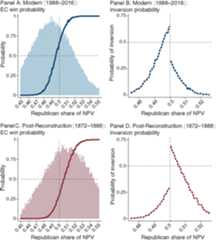
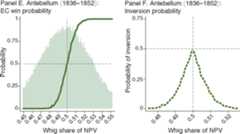
Notes: Figure shows inversion probabilities and probability distributions over national popular vote (NPV) outcomes implied by the parametric estimates of the baseline model (M1, R1, A1). Rows correspond to different historical periods, as indicated. Each panel consists of 100,000 simulated election draws. The Whig and Republican national popular vote shares run along the horizontal axes. The solid lines in the left panels (A, C, E) trace the conditional probability of a Whig/Republican electoral win at each level of the Whig/Republican vote share. In the left panels, win rates greater than 0 for Whig/Republican vote shares < 50 percent indicate inversions in favor of the Whig/Republican candidate. Win rates less than 1 for Whig/Republican vote shares > 50 percent indicate inversions in favor of the Democrat candidate. The right panels (B, D, F) plot the inversion probabilities at each level of the vote share.
If the EC and the national popular vote outcome always agreed, then Win(NPV) would follow a step function that increased from 0 to 1 as the national popular vote share crossed 0.50. For each of the historical periods,Figure 2 shows that Win(NPV) evolves smoothly across the 0.50 vote share threshold.
The mere fact that the Win(NPV) function is smooth rather than discontinuous at NPV = 0.50 is not surprising given the history and known mechanics of the Electoral College. The value of these plots is in providing an estimate of the magnitude of inversion probabilities at any vote share. In the Modern period, Win(NPV) equals about 65 percent at 0.50 Republican vote share, implying that Republicans should be expected to win 65 percent of presidential contests in which they narrowly lose the popular vote.23
In the Antebellum and post-Reconstruction eras, the estimated Win(NPV) function shifts but retains a similar overall shape. The slope is roughly constant over a wide range—1 or 2 percentage points depending on the historical period. Thus, the electoral system is similarly “responsive” in theGelman and King (1990) sense to citizen votes at various margins of the national distribution.
In panels B, D, and F ofFigure 2, we restrict the axes to focus on closer elections and plot Inv(NPV). In the post-Reconstruction period spanning 1872–1888, Inv(49.99) is about 0.4, and so Inv(50.01) is about 0.6. Thus, a Democratic candidate from this period would be expected to win 60 percent of elections in which they narrowly lost the national popular vote.
A useful summary statistic is the probability of an inversion, conditional on the election being decided by within some popular vote margin. Denote the popular vote margin as, where indicates party’s share of the two-party vote. We define as
| (2) |
In relation toFigure 2, is the conditional inversion function (from the right panels) integrated over the predicted probability distribution of the popular vote (from the left panels) in the range. Calculating from the estimates inFigure 2, we find that, for a race decided by a 1 percentage point margin or less, the probability that the result is an inversion is 42 percent, 43 percent, and 39 percent in the Modern, post-Reconstruction, and Antebellum periods, respectively.
Both twenty-first-century inversions occurred in elections with small popular vote margins. Clinton in 2016 won the popular vote by a 2.1 point margin. Gore in 2000 won it by a 0.5 point margin. ButFigure 2 warns against concluding that only in such close elections could inversions occur. The figure shows that probable EC–NPV disagreement persists even at wide popular vote losses for Whigs, Democrats, and Republicans. Our results indicate that a 3.0 point margin favoring a generic modern Democrat—i.e., 48.5 percent Republican vote share, or a gap of about 4 million votes by 2016 turnout—is associated with a 15 percent inversion probability.
In theonline Appendix, we compare results across 25 alternative models.Online Appendix Figure A1 reports key summary statistics from several parametric and bootstrap models, each with different assumptions and constraints on the data-generating process. The models covered in the figure track the main approaches to modeling election uncertainty from the political science literature and election forecasting professionals, though such models have generally not been applied backward to the periods of US history we study. The catalog of results shows that the probability of an inversion in a close election is not very sensitive to the particular modeling assumptions, such as the structure that allows for correlated shocks across states in an election year or whether the shock distribution is assumed to have fat tails.
B. Stability, over US History and into Alternative Future Scenarios
An important question is whether the high probability of inversions is a fundamental property of the EC. In other words, is the fact that two out of the last five elections (through 2016) have been inversions a reflection of some deep, stable property of the EC? Or is it the unlikely product of extraordinary circumstances—hanging chads and butterfly ballots in Florida in 2000 and the unique political moment and candidates in the 2016 election? This matters because the desirability of reform, for many commentators and observers, is tied to the probability that mismatches between the EC and national popular vote will continue.
In this section, we address this question of stability. The probability of an inversion in a close race is strikingly similar for all periods we study. In elections within a 1 percentage point margin—about 1.3 million votes, based on 2016 turnout—the probability of an inversion is around 40 percent. In historical fact, 6 presidential elections of the 46 since 1836 have yielded a popular vote margin within 1 percentage point. Two of these six have been inversions (three if one counts Kennedy/Nixon 1960).
The fact that is about 40 percent is true as well for presidential elections in the first half of the twentieth century, in which no inversions occurred. This period was excluded from the main analysis because it contained many landslide victories and so lacked variation around the 50 percent NPV threshold of interest.24 With that caveat, we estimate statistics for this period inonline Appendix E.5.Online Appendix Figure A2 reports results. These show that the probability of an inversion in a race decided by less than 1 and 2 percentage points, respectively, is 41 percent and 36 percent over the period 1916–1932 and 43 percent and 36 percent over the period 1936–1956. The corresponding M1 estimates from the Modern period (1988–2016) are 42 percent and 35 percent. The corresponding estimates from the extended Modern period (1964–2016), which estimates a substantially higher unconditional probability of a Republican popular vote majority, are 41 percent and 33 percent.
Thus, and are remarkably stable over the entire twentieth-century United States, which began in 1900 as a union of 45 states in which Republicans dominated on the West Coast and Northeast and Democratic power was concentrated in the South.25 Extending the comparison further back in time, we note that even as the set of states has expanded from 24 in 1836, even as nonwhites and women have been granted the vote, even as reforms like the Twenty-Fourth Amendment eliminated poll taxes and other obstacles to exercise that right, and even as different sets of political parties have dominated national politics, the conditional probability of an inversion in a close election has been stable. For as long as there has been a popular vote to compare to the EC outcome, the high probability of inversion in a close race has been a constant property of the Electoral College.26
But that is the past. One question frequently asked in the public sphere is how the changing demographics across states and in the nation overall will affect Electoral College outcomes in the near and distant future. Could inversion probabilities in close races meaningfully change? Our results suggest not: though changing demographics may cause changes in party politics, the party alignment of states, and the presidential candidates chosen in the primaries and general election, our study suggests that one thing unlikely to change is the conditional probability of an EC inversion in a close election. Why? Because the type of demographic changes invoked in these hypotheticals—e.g., will Texas’s growing nonwhite population make it a potential swing state in the coming decade?—pale in comparison to the historical demographic changes we study here. For example, our analysis spans periods in which Texas was and was not a state.
To further illustrate the irrelevance of such future possibilities to our main finding, we simulate a range of potential changes to the partisan alignment of voters across states. We do not model the underlying behaviors that might generate these outcomes but simply ask whether there could be any change to voters’ party alignment in large states or swing states that would importantly change our conclusions. To do so, we counterfactually shift the state-level distribution of possible voting outcomes to be more Democratic- or Republican-leaning for individual states or groups of states.27 As reported in detail inonline Appendix Tables A2 throughA4, we variously shift swing states, non-swing states, other large states, states won by Clinton in 2016, states won by Trump in 2016, or groups of such states. The range of the hypothetical shifts we consider includes a 10 point margin shift toward the Republican and a 10 point margin shift toward the Democrat (all relative to the actual M1 estimate).
These permutations are plotted inonline Appendix Figure A3. First and unsurprisingly, the probability of a Democratic or Republican candidate winning the presidency is highly sensitive to such assumed shifts in the electorate: The range of estimates for the unconditional expected probability of a Republican victory is 10–83 percent across counterfactuals. Likewise, conditional on an inversion occurring, which party is likely to win it varies from a 90 percent chance that the Democratic candidate wins to a 99 percent chance that the Republican candidate wins. Which party tends to win via inversion also changes. For example, under the assumed realignment in which swing states become more Republican, the probability that inversions favor Republicans increases.
Most importantly, the figure shows that no such change significantly decreases the probability of an inversion in a race decided by within one point. The underlying inversion rate is stable and at least about 40 percent across the same set of permutations. This range extends up to above 50 percent across the extreme scenarios considered. Texas (or any other state) shifting its political alignment will not change this fact.
C. Robustness to Model and Parameter Uncertainty
The high probability of an inversion in a close election is a result that is robust to various alternative model and sample restrictions. Nonetheless, US presidential elections are rare events, occurring only 25 times per century. There is a serious inferential challenge in estimation with so few data points. To examine sensitivity to this fundamental parameter uncertainty, we next report results that iterate over a grid of exogenously specified variances and covariances in the data-generating process. This hyperparameter approachassumes rather than estimates parameters. These models, which include state shocks, regional shocks, and national shocks, are described in full detail inonline Appendix E.3 and displayed acrossonline Appendix Figures A4 andA5. The resulting parameter sets span distributions from an underdispersed across-simulation minimum standard deviation of 0.5 popular vote percentage points to a maximum standard deviation of 5.1 percentage points. Across these simulations, the probability of an inversion in a close election is entirely robust.
To visually summarize the impact of model and parameter uncertainty,Figure 3 overlays the simulated election outcomes for about 100 different data-generating processes of the modern period. Panel A plots Win(NPV). Panel B plots the unconditional distribution of the NPV. A detailed description of every model included inFigure 3 is provided inonline Appendix Table A5. The set includes the hyperparameter approaches. It also includes, for comparison, parametric models (M1, M2, M5), nonparametric bootstrap models (M3, M4, M6), models that omit data from the elections in which an inversion actually occurred (M10, M11), models that extend the modern sample backward to include elections from 1964 to 2016 (M12)—the widest possible time frame in which “Democrat” and “Republican” are arguably stable identities for our purposes—and further variants.28
Figure 3. The Conditional Probability of Inversion Is Invariant to Model and Parameter Uncertainty.
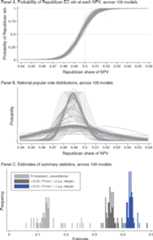
Notes: Figure shows statistics under various modeling restrictions and approaches. NPV is national popular vote. All models are for the Modern sampling frame. Seeonline Appendix Table A5 for a detailed list of each model included. For each model, 100,000 simulated elections are drawn. Panel C displays histograms of summary statistics across these models: the unconditional inversion probability and the probability conditional on a close election decided by a margin of less than 1 or 2 percentage points.
Among the expanded parametric results displayed inFigure 3 are models that either assign all third-party votes to Democrats prior to estimation or assign all third-party votes to Republicans prior to estimation. Assigning the third-party votes in these extreme ways significantly changes the central tendency of the NPV distribution. Despite this, the Inv(NPV) function is indistinguishable between the default handling of third parties and each of these two extremes inFigure 3. (See alsoonline Appendix Figure A6, which narrowly focuses on just this third party robustness result.)
Other variants on the parametric results included inFigure 3 are models that make different assumptions regarding turnout. Differences across states in turnout could in principle impact simulated election results because, as we discuss below, these affect the state-specific ratio of citizen votes to EC electors. In practice, however, choices around which numbers to use for relative turnout have no substantive bearing on our results:Figure 3 includes eight variants on the M1 model, assigning turnout according to the actual 1988, 1992, 1996, 2000, 2004, 2008, 2012, and 2016 levels. The probability of an inversion in a close election is remarkably stable across these specifications. (See alsoonline Appendix Figure A7 for further detail.)
For additional specifications of the bootstrap models, we alter the structure of the bootstrap sampling procedure, varying the extent to which shocks in a simulated election are correlated across states. We do this by tuning the excess probability that state draws come from the same election year in 5 percent steps from 15 percent up to 50 percent as described inSection IID. InFigure 3, we repeat this procedure for swing states only, sampling non-swing states independently.29 We also repeat this procedure for “safe” states only, sampling nonsafe states independently. Here, safe states are those in the top quintile of vote share margin (Democrat- or Republican-leaning) averaged over the sample period. Finally, we also step the M1 and M3 simulated election results left and right along the horizontal NPV axis by adding a deterministic, common shift to the simulated election outcomes. These hybrid models shift the partisan balance mechanically, making the whole country more or less Republican-leaning than estimated, while preserving the correlation structure and estimated variance and covariance parameters that govern election uncertainty. These models help to disentangle whether the Democrat/Republican asymmetry in conditional inversion probabilities is driven by the unconditional probability that the Republican loses the popular vote. It is not. Even as the distributions in panel B ofFigure 3 shift, the Win(NPV) function in panel A remains fixed. (See alsoonline Appendix Figure A8 for further detail.)
Across all 109 model variants inFigure 3, the Win(NPV) function in panel A remains similar. Most importantly, panel C, which provides the distribution of inversion rates across models, shows that these results establish an informative lower bound for our primary parameter of interest,. The minimum across all models for the probability of inversion in races decided by a 1 point margin or less is 40 percent. The median across models is 43 percent.
Despite the similarity in the probability of an EC victory at each level of the NPV and despite the similarity in inversion probabilities in close elections, the models inFigure 3 are substantially different in terms of the simulated elections they produce. Panel B shows that the probability densities over the national popular vote differ. The cross-state correlations—which have been critical in recent innovations in election forecasting—also differ considerably across the models considered.Online Appendix Figure A9—which plots every within-model, across-state correlation term against the model’s inversion rate—shows that these models are substantially different by these metrics. Nonetheless, there is little relationship between these cross-state correlation magnitudes (or even signs) and the probability of inversion in a close race.
In sum,Figure 3 andonline Appendix Figures A4,A5, andA9 indicate that even if it is not possible to fully identify the data-generating process for presidential elections from the small set of observed elections, our main results are robust to alternative models and parameter sets. Importantly, models with shocks linked by election year, region, racial composition, and educational characteristics (e.g., models M2, M7, M8, M9 included inFigure 3 andonline Appendix Figure A1) produce similar inversion probabilities to models that assume that state shocks are completely independent. This suggests that smaller econometric changes, such as the particular choices around how state demographic variables are parameterized, are unlikely to affect the conclusions here. We illustrate this inonline Appendix E.4, where we alter the parameterizations of the race and education variables.Online Appendix Figure A10 shows that this has negligible impact on conditional inversion estimates.
D. Asymmetry
The probabilities of inversion we estimate are asymmetric across parties. In the past 30 to 60 years, this has favored Republicans: conditional on an inversion occurring, the probability that it is won by a Republican ranges from 62 percent to 93 percent across the 12 modern-era models (online Appendix Table A8). This range includes models for which the inversion wins for Republicans are dropped from the estimation sample. One can also ask, conditional on winning the presidency, what is the probability that the victory was generated by an inversion rather than by a popular vote majority? Here, there is less model agreement on the precise parameter, though all models show a modern Republican advantage: the probability that any single presidential win arises from a popular vote loss ranges from 6 percent to 72 percent across models for Republicans, compared to less than 6 percent across models for Democrats (online Appendix Table A7).30
Figure 2 shows that the asymmetry in the post-Reconstruction and Modern periods favors the party expected to lose the popular vote. This is not a general property of the EC.Online Appendix Figure A2 shows that the pattern does not hold over the middle of the twentieth century, 1936–1956. Nor does it hold in simulations in the modern period in which we shift the popular vote distribution artificially in order to understand robustness to modeling assumptions regarding third parties. (Seeonline Appendix Figure A6.) The only sense in which there is a systematic advantage for the popular vote minority is that a party can only win via inversion if it loses the NPV. Because of this, the minority party typically has anunconditionally higher probability of winning via inversion simply because it is more likely to lose the popular vote.
In general, partisan asymmetry arises because states are heterogeneous both in EC representation (electors per citizen vote cast) and in partisan alignment. Correlation between these leads to one party or another being advantaged in the EC. The historical and political forces behind this correlation—and therefore asymmetry—have differed over time. So unlike, asymmetry is entirely sensitive to the political context. For example, in the Modern period, Democrats have tended to win large states by large margins and lose them by small margins. In 2016, Clinton won by double-digit margins in some of the largest states: 30 points in California, 22 points in New York, and 17 points in Illinois. Further, Modern Republicans have been favored, on average, by the disproportionate electoral advantage given to small states by the two senator-linked electors. In contrast, the statistical asymmetry that favored Democrats in the post-Reconstruction period (panel D ofFigure 2) was in large part due to heterogeneity in turnout, not margins of victory or small-state overrepresentation.31
The post-Reconstruction asymmetry is instructive in highlighting how turnout shapes inversion probabilities. The number of citizens who cast votes on election day determines the national popular vote, but the population that determines EC representation is all persons, including nonvoters and noncitizens, as measured in the last census. If the turnout-to-population ratio differs across states in a way that is correlated with states’ partisan alignment, it can create a wedge between the probable popular vote and the probable EC outcome. This is exactly what happened in the post-Reconstruction South at the beginning of the Jim Crow era.
Over the 1872–1888 sample period, Blacks counted toward the apportionment of EC electors in the South but were disenfranchised. A statistical consequence of the brutal voter suppression was that an EC vote in the South could be won with fewer votes. Because Democrats controlled the South, the typical EC ballot cast for a Democratic candidate during this time was backed by fewer citizen votes.Online Appendix Figure A11 illustrates the point, showing that the number of electors per citizen vote in a state was positively correlated with Democratic partisan alignment of the state in the period.Online Appendix Figure A12 shows that overall and within just the former Confederate states, turnout per population was strongly negatively correlated with the Black share of the state population. In other words, by suppressing Black votes while benefiting from the apportionment that counted Black persons, Southern politics delivered an Electoral College advantage to the Democrats relative to the national popular vote.
IV. Decomposing Sources of Inversion
A. Malapportionment and “Wasted” Votes
It is broadly understood that EC apportionment, which allocates electors to states equal in number to senators plus representatives, overweights votes in states with small populations. Today, this malapportionment amounts to more than a three-times difference in EC votes per capita between Wyoming and California. It is also broadly understood that because states award EC votes on a winner-takes-all basis (statewide or—in the case of Maine and Nebraska—district-wide), the aggregation algorithm attaches zero weight to citizen votes cast in excess of the vote needed to generate the slimmest plurality in the voting unit. Large margins in a state amount to many “wasted” votes in the Electoral College.32 But what is the relative importance of malapportionment versus winner-takes-all state contests in generating inversions and asymmetry? In this section, we mechanically alter the EC’s aggregation formula and examine how the EC outcome would change, holding fixed the citizen votes. This decomposition sheds new light on the statistical mechanics that underlie inversions.
Holding fixed the set of simulated votes cast by individual voters, we alter the EC system to either (i) eliminate the two electoral ballots that each state receives for its senators, (ii) award each state’s EC votes proportionally to the state’s popular vote outcome (up to the nearest whole ballot), or (iii) do both simultaneously. Under (i), DC and Wyoming are each apportioned one elector instead of three. Under (ii), a candidate who won 49.99 percent of the vote in a state with 25 EC electors, such as Gore in Florida in 2000, would win 12 EC votes instead of 0. This exercise is not intended as an evaluation that could account for the endogenous responses of voters or parties to a changing electoral system. Instead, it is meant to illustrate, for example, whether the popular press is correct in asserting that modern Republicans have a statistical advantage due to disproportionately garnering votes in lower-population states.33 We return to the issue of endogenous response below.
Figure 4 plots inversion probabilities under these alternative aggregation rules over the three periods. We start from an existing set of 100,000 simulated elections and use these alternative rules to aggregate up from simulated votes to an EC winner. In the left panels, we use the same simulation draws as inFigure 2 (models M1, R1, A1). In the right panels, we do the same for the family of models that incorporate subnational shocks correlated on the basis of state characteristics.
Figure 4. Inversion Probabilities under Alternative EC Aggregation Rules.
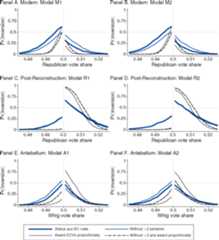
Notes: Figure illustrates inversions under alternative EC aggregation rules that translate citizen votes into a presidential winner. The alternative that removes the two senator-derived EC electors assigns each state electors equal in number to the size of the state’s US House delegation. The alternative that removes the winner-takes-all condition awards state EC votes (ECVs) according to each candidate’s popular vote share in the state, up to a rounding error.
The alternative aggregation rules variously shrink or shift the range over which inversions are likely. Consistent with popular perception of a modern Republican EC advantage due to small states’ alignment, removing two EC electors per state (corresponding to the senators) shifts the Inv(NPV) function right in the Modern period. This implies a smaller chance of an inversion that awards the presidency to the Republican candidate. However, the shift is moderate and merely changes the partisan balance without markedly reducing the overall inversion probability (the area under the displayed function). For example, in M1, the probability of an inversion within a 1 percentage point NPV margin changes negligibly from 42.4 percent to 41.6 percent with the removal of the two senator-linked electors, even as Inv(NPV) moves closer to symmetry.
Because the sources of asymmetry differ over history, these alternative aggregation rules yield different effects in the earlier periods. In the Antebellum-era models, each of the aggregation structures either introduces or exacerbates partisan asymmetry, without much overall reduction in the frequency of inversion. The probability of inversion in a race decided by less than a point is reduced from a baseline of 39 percent in A1 inFigure 4 to a minimum of 35 percent across the alternative aggregation rules, while making it much more likely that any inversion is won by a Democrat.
In the post-Reconstruction-era models, removing two electors per state has no effect on asymmetry because Democrats and Republicans tended to split the small states in this period. Perhaps counterintuitively, awarding EC votes proportionally in this period exacerbates partisan asymmetry. We return to why below.
The decomposition inFigure 4 is intended to shed light on which aspects of the aggregation rules in the EC are mechanically contributing to inversions. A related but distinct question involves counterfactuals—how frequently would inversions occur under these alternative rule sets, allowing for politics to endogenously respond to the new system? Inonline Appendix F, we modify our modeling approach to confront this issue. These counterfactuals incorporate a stylized, reduced-form representation of behavioral responses to the changing electoral map, as states move in or out of “battleground” and “safe” status under the counterfactual EC aggregation rules.34 Results allowing for endogenous responses (online Appendix Figure A15) tend to generate somewhat higher inversion rates in the counterfactuals, compared to theFigure 4 decomposition, which holds the data-generating process fixed. This suggests thatFigure 4 may represent a lower bound on counterfactual inversion rates, as behaviors of agents change to pursue the EC victory condition.
B. Rounding and Turnout
Popular accounts of what drives EC inversions focus on the plus-two (malapportionment) and winner-takes-all (wasted votes) aggregation rules. Indeed, some proposals for reform would implement exactly these rules.35 So why would inversions persist under these alternatives? One reason is that apportionment is coarse and infrequent. States’ representation in the EC is rebalanced only every ten years. The infrequency implies that as state populations differentially change in the intercensal years, states’ per capita electoral representation in the EC drifts out of parity. When the rebalancing occurs after each census, electors are few in number and indivisible. The small number of electors (which is linked to the size of the US House) generates rounding errors in EC representation.
First, to understand the potential magnitude of rounding effects,Figure 5 considers counterfactual sizes of the US House of Representatives. The present size of the House is 435, which leads to 538 electors. In the figure, we consider how EC aggregation would be affected by various sizes of the House, up to 10,000. We apportion congressional seats across states in accordance with the 2010 census population with increasingly fine granularity as the House size increases. We then apply M1’s estimates for vote totals to each state. To isolate the role of rounding errors, the plots inFigure 5 consider the aggregation rules that remove two EC electors per state and replace the winner-takes-all rule with awarding EC votes proportionally.36 Thus, malapportionment and wasted votes can play no role in the figure.
Figure 5. An Arbitrarily Large House Does Not Eliminate Inversions.
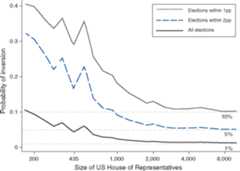
Notes: Figure shows how inflating the size of the US House of Representatives affects inversion probabilities in our simulated election outcomes. The lines trace the probability of inversion unconditionally and conditionally on a 1 or 2 percentage point (pp) margin, and. As the House grows, rounding errors are reduced in allocating whole House seats across states. In addition to inflating the House, the exercise applies the aggregation rule set fromFigure 4 that removes two EC electors per state (corresponding to senators) and awards EC votes proportionally within a state. Therefore, as the House grows, rounding errors are also reduced in how (whole) state electoral votes are awarded across the candidates. For the exercise, Washington, DC is apportioned electors equal in number to the number apportioned to the smallest-population state.
Figure 5 shows that inflating the number of seats in the US House of Representatives, and therefore the size of the Electoral College, would further shrink inversion probabilities.37 But it would not produce an inversion probability below about 10 percent in a close race decided by within 1 percentage point. The remaining source of divergence between the NPV and EC is that electors are apportioned according to population-last-census, which includes all residents of all ages, measured up to a decade prior to election day. In contrast, election day turnout includes only some adults of the current population.
Panel A ofFigure 6 illustrates the role of population growth in this, using the case of the reapportionments that followed the 1980, 1990, 2000, and 2010 censuses. The figure shows, for a few of the largest states, that differential population growth can quickly cause EC representation to diverge across states. The figure plots House seats per million current persons in the state. The statistics jump following each census as reapportionment brings representation across states closer to parity (up to a rounding error due to the small House size). But the disparity reemerges immediately and continues to grow until the next reapportionment. In fact, by the time of the first presidential election following reapportionment, the census count used is already two or four years out of date. Election years ending in zero—just before a reapportionment—are likely to be especially skewed by this measure of representation.38
Figure 6. Differential Population Growth and Turnout Create Disparities in EC Representation.
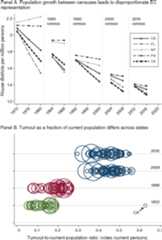
Notes: Figure shows how EC representation per voter is heterogeneous across states due to population growth between census counts and due to turnout differences across states. Panel A plots House districts per million persons over time. House districts per person are rebalanced after each census reapportionment. Panel B shows the extent to which the ratio of turnout (voters on election day) to census persons differs across states. Each marker is a state. Marker sizes proportional to population. The various horizontal lines in panel B correspond to different election years as indicated.
But even resolving this (via some hypothetical just-in-time census on election day), and even combining a just-in-time census and apportionment with any of the alternative aggregation rules considered above, it would not be possible to eliminate inversions in the US Electoral College. Panel B ofFigure 6 illustrates the final major hurdle: turnout differences across states relative to current state populations. Electors are apportioned according to population, but election day turnout includes only voters in that election. There is significant variation across states in the ratio of persons to votes cast. This is in part because of differences—both systematic and random (Alvarez, Bailey, and Katz 2008;Fujiwara, Meng, and Vogl 2016)—across states and election years in the turnout of eligible voters. It is in part because of differences across states in the proportion of noncitizens, disenfranchised felons, and other non-voting-eligible persons. And it is in part because of differences across states in the ages of residents. In 2016, among the lowest turnout-to-current-population states was Texas at 29 percent, which had a median age of 33.6 in the 2010 census. The highest was New Hampshire at 55 percent, which had a median age of 41.1 in the 2010 census.
The voter-turnout-to-current-population heterogeneity was wider at other points in history with different political forces and institutions. In 1888, the ratio ranged from 7 percent in South Carolina, which had the largest Black population share in the 1880 census (61 percent Black), to 26 percent in Colorado, where the 1880 Black population share was 1 percent.39 In the Antebellum period, slaves counted toward the apportionment-relevant population at a rate of three-fifths and cast no votes.40 Accordingly, for these time periods we find less convergence between the popular vote and EC outcome under the alternatives inFigure 4, all of which ignore the discrepancy between apportionment-relevant persons and voters.41
In the post-Reconstruction era, asSection IIID noted, the suppression of Black votes can be understood in terms of this turnout-to-population ratio. Blacks counted fully toward apportionment, but their disenfranchisement meant that an EC vote was controlled by fewer voters in states with large Black populations. This advantaged the Democrats, who controlled the South. Indeed, there is a strong negative relationship over this time period in EC votes per person and the Black share of the state population: even focusing just on former Confederate states with large Black populations, the states with the largest Black populations could control an EC vote with fewer (White) citizen votes. (Seeonline Appendix Figure A12 andonline Appendix E for further details.)
Malapportionment, winner-takes-all awarding of EC votes, coarse apportionment of House seats, and turnout heterogeneity all contribute to inversion possibilities. In some historical periods, these phenomena reinforce each other in generating partisan asymmetry. In others, including the post-Reconstruction era, they act as counterbalancing forces. Indeed, correcting one source of inversion without addressing the others need not improve agreement between the NPV and the EC outcome. In the case of the post-Reconstruction era, removing the distortion caused by winner-takes-all without also addressing turnout heterogeneity (due to voter suppression) merely makes inversions more asymmetrical toward Democrats. In summary, there is no guarantee that any change to the Electoral College system, short of implementing a national popular vote, will reduce the probability of inversion or of asymmetry.
V. Conclusion
A robust finding of every model considered here is that inversions are likely in close elections—where “close” includes elections with popular vote margins in the millions. A game-theoretic equilibrium for two-party competition (Downs 1957) is a close election, which may be why US presidential popular vote margins have often been small in stable party systems. Recent decades have resulted in particularly close elections relative to most of the twentieth century (seeFigure 1). Our findings imply that if elections continue to remain close, frequent inversions are likely.
Ultimately, the EC system adds random—though not mean-zero—noise to the popular vote outcome. Feasible policy changes shrink the variance of—but do not eliminate—this noise, reducing the range over which inversions are likely, though at some margins actually increasing the probability of inversions.
Our paper shows that mismatches between the EC and the NPV have been historically rare events only because presidential elections—and, in particular, close presidential elections—have been historically rare events. We conclude that electoral inversions are not statistical flukes but are enduringly fundamental to the US Electoral College system. No tweak of election rules short of moving to a national popular vote will prevent a chance of inversions in close elections.
Supplementary Material
Acknowledgments
The authors are grateful to Sandy Black, Liz Cascio, Mitchell Hoffman, Wojtek Kopczuk, Leigh Linden, Jenna Stearns, David Strömberg, Duncan Thomas, Bob Town, Cody Tuttle, and Tom Vogl for useful feedback and to David Beheshti and Nathan Franz for excellent research assistance. This project is supported by the University of Texas Electoral College Study,utecs.org, and from grants K01HD098313, NICHD (Spears); P2CHD042849, NICHD (Geruso and Spears); and T32HD007081, NICHD (Geruso and Spears) awarded to the Population Research Center at the University of Texas at Austin by the Eunice Kennedy Shriver National Institute of Child Health and Human Development. The content is solely the responsibility of the authors and does not necessarily represent the official views of the National Institutes of Health. This material is based upon work supported by the National Science Foundation Graduate Research Fellowship under Grant No. 1745302 (Talesara).
Footnotes
Go tohttps://doi.org/10.1257/app.20200210 to visit the article page for additional materials and author disclosure statement(s) or to comment in the online discussion forum.
We followMiller (2012) in defining an electoral inversion as occurring when a candidate with the most votes from the electorate fails to win the election.
There was a 1948 Gallup poll with a similar question, but the survey did not ask the question of all respondents. It first screened on respondents correctly identifying what the Electoral College was. Of the respondents who did so, 53 percent favored discontinuing the Electoral College system; 31 percent favored retaining it.
Except for following the 2000 and 2016 inversions, a majority of survey respondents opposed the Electoral College regardless of party identification. For example, in the 2012 Gallup survey, 71 percent of Democrat/Lean Democrat respondents and 53 percent of Republican/Lean Republican respondents favored amending the Constitution in favor of the popular vote to determine presidential elections. Support for abolishing the Electoral College system temporarily dipped among Republican respondents following the 2000 election and fell sharply to historical lows among Republican respondents following the 2016 election. In late November 2016, just 49 percent of Americans supported a constitutional amendment to establish a popular vote for president (a historical low), with support divided along partisan lines.
Those 16 states cover 196 of the 270 electoral votes needed for activation.
By 1836, citizens rather than state legislatures voted in presidential elections in all but one state.
Electoral College apportionment is based on the count of persons of any age and citizenship status.
The turnout-to-representation mechanism highlighted here is important across the world as well. Notably, in India, the apportionment of parliamentary seats today is based on population counts in the 1971 census. As population growth has trended differentially in the north and south of India over the last 50 years, the number of citizen votes that can elect a minister of Parliament have diverged dramatically across regions of India, leading to skewed representation that favors populations in low-growth states. This creates a wedge between the popular vote and the electoral votes in Parliament and has the potential to generate an inversion in the election of a prime minister. Seeonline Appendix A.2 for further discussion of the history and possibility of inversions around the world.
Although a recent theoretical literature has specifically examined the probability of Electoral College inversions (Lepelley et al. 2014,Kikuchi 2017,de Mouzon et al. 2018,Kaniovski and Zaigraev 2018), the stylized mathematical models underlying these studies do not take as inputs actual election-related data or in some cases, even that there are 50 heterogeneous US states.
Besides providing important new facts to inform the present debate and active legislation around a national popular vote, our study connects to recent work applying econometric techniques to issues at the intersection of economic demography and US politics (Vogl 2014;Allcott and Gentzkow 2017;Boxell, Gentzkow, and Shapiro 2017) and particularly to studies with a historic focus (Cascio and Washington 2014,Gentzkow et al. 2015,Kuziemko and Washington 2018,Cascio and Na’ama 2020).
Below, we useelectors to denote a state’s number of representatives to the Electoral College. We also useelectors or sometimeselector ballots to denote a quantity of apportioned seats in the Electoral College. We useEC vote to denote a ballot cast by an elector in the Electoral College as well as to denote a state’s action in sending a pledged elector to cast such a ballot. So, a state has apportionedelectors before election day, but itsEC votes are only realized once the election occurs.
We abstract away from faithless electors in the analysis, the existence of which could further impact mismatch between the popular and Electoral College outcomes. In addition to the fact that faithless electors are rare and have never flipped a presidential election, the Supreme Court of the United States unanimously ruled inChiafalo v. Washington (2020) that states may require electors to vote for the state popular vote winner and may punish electors who fail to do so.
Although our periods largely align with external accounts of the start and end dates of various party systems, an overriding principle in constructing the endpoints for our sample periods is the need to circumscribe a period of similar underlying geographic partisan alignment.
Because, by design, the study periods in our main analysis are characterized by tighter elections than the overall historical mean, the simulated NPV distributions for these periods are less dispersed than the empirical frequency of close elections over the full history of the last 200 years.
Inonline Appendix A.1, we provide further historical context as it relates to sample definition.
This is the absolute value of the percentage point difference in the vote share of the two major party candidates, with shares defined over the two party total. SeeSection IC. We denote this margin of victory measure with Δ.
In a robustness check, we extend the Modern sample period back to 1964. In the 1968 election, Wallace won 46 electoral votes across 5 states. For those five states in 1968, we apply the two-party normalization to determine Democratic and Republican vote shares to estimate our model. For example, AR went 31.0 percent/30.3 percent/38.7 percent for Nixon/Humphrey/Wallace. We calculate the Republican share of the two-party vote as 50.6 percent.
It is not possible to estimate and simulate our data-generating process at the level of US congressional districts because the frequency of redistricting (after every decennial census) means that we observe only two or three presidential election data points before the congressional electoral map is redrawn.
Seeonline Appendix B for a complete discussion of how our statistical model nests other models in the literature and how it relates to deterministic methods like uniform partisan swing analysis.
Figure A1 in theonline Appendix lists details for each named model compactly.
Our primary approach examines periods of stable partisan alignment of states in order to estimate unobserved parameters for the electoral data-generating process: variances, means, and covariances of election outcomes. By definition, it would not be possible to estimate these for the moment of a structural break such as a geographic partisan realignment, when model parameters would be changing. When we perform counterfactuals that evaluate possible realignments, it necessarily involves specifying rather than estimating parameters. See, e.g.,online Appendix Figure A3.
Seeonline Appendix D for complete details.
For Republican/Whig vote shares less than 0.50, any Republican/Whig victory is an inversion, so for. For Republican/Whig vote shares greater than 0.50,.
This generates an additional dimension of uncertainty in the estimates of close-election inversions over this period.
An important difference between the early twentieth-century results and results from the Antebellum, post-Reconstruction, and Modern periods is that the probability of a close election was much lower in the first half of the twentieth century, making the unconditional probability of an inversion lower.
In the earliest US presidential elections, most states determined how to award EC votes by means other than a statewide vote. Even by the 1812 election, less than half of states determined how to cast their EC votes by a popular vote. We begin our first study period in 1836 both because it aligns with the start of a stable party system and because by this time, almost all states determined EC votes by a statewide popular vote.
This is a stochastic extension of the (deterministic) “uniform partisan swing” method common in election studies.
The M12 model, which covers 1964–2016 and generates a diffuse distribution over the national popular vote, offers a point of comparison withStrömberg (2008). In a paper primarily focused on resource allocation across state races,Strömberg (2008) estimates the unconditional probability of a presidential inversion in a model trained on 1948 to 2004 data, finding about a 4 percent inversion rate. Our unconditional inversion probability, represented by the triangle for M12 inonline Appendix Figure A1, is 5.9 percent. Our M12 model doesn’t perfectly overlap with Strömberg’s sample period: we do not extend further back than 1964 to avoid combining election outcomes before and after the partisan realignment of the early 1960s.
For this exercise, we followPolitico and FiveThirtyEight in defining swing states. Seeonline Appendix D.5.
The EC is asymmetric under various other measures of partisan symmetry. For example, graphs of Win(NPV) show that the Electoral College does not meet the standard for partisan symmetry thatKatz, King, and Rosenblatt (2020) define for legislative elections because, in general,.
Although inversions were likely for both parties in the post-Reconstruction period, and although no Democrat has ever in fact won via an inversion, we find that the ex ante probabilities of inversions favored Democrats. Seeonline Appendix Table A7. Statistics indicating an advantage for Whigs or Democrats in the Antebellum period are sensitive to model choice. Seeonline Appendix Table A8.
Seeonline Appendix Figure A13 for an illustration of vote margins by party in large states over the Modern period.
See, for example, theEconomist “American Democracy’s Built-in Bias Toward Rural Republicans” (July 12, 2018) and theNew York Times “Why Trump Had an Edge in the Electoral College” (December 19, 2016).
Online AppendixFigure A14 shows how the set of battleground states changes.
Andrew Yang’s 2020 proposal for Electoral College reform involves keeping the EC but “making electors determined on a proportional basis,” presumably mirroring one of the exercises inFigure 4 exercise. See, for example,https://www.politico.com/2020-election/candidates-views-on-the-issues/elections/electoral-college/.
There are two types of rounding errors simultaneously addressed here: As the House size grows, rounding errors in apportioning US House districts across states are reduced. And because this exercise assumes that EC votes are awarded proportionally with state popular vote, rounding errors in dividing states’ whole EC votes between presidential candidates are reduced. For example, take a House size of 5,000. Florida would have 305 House seats and EC electors in theFigure 5 calculation. Winning Florida 50.005 to 49.995 (as Bush did in 2000) would yield 153 EC votes from Florida for the state winner and 152 for the loser.
House size effects on presidential races have been investigated in the prior literature, though previous studies have examined the impacts assuming a deterministic model of presidential elections. See, e.g.,Barthélémy, Martin, and Piggins (2014). In such studies, it is not possible to calculate inversion probabilities as a function of House size, which we do inFigure 5.
Apportionment for the 2020 presidential election, for example, was based on populations on the last census day, April 1, 2010. In the intercensal decade, the population of Texas, with 38 electoral votes from the 2010 census, has grown by about 15 percent; the populations of swing states Pennsylvania and Ohio have grown by about 1 percent each; and the population of Illinois, with 20 electoral votes, has declined.
1880 census data on race come fromGibson and Jung (2002).
The extreme turnout-to-current-population ratio in California in 1852 inFigure 6 reflects the fact that California’s population in the mid-nineteenth century experienced rapid change in size and composition due to the gold rush. Our calculation of the 1852 population for the purpose of this figure is based on exponential interpolation between the 1850 and 1860 decennial censuses—the same procedure done for all states for all non-census years. But the extreme growth between censuses in California was front-loaded in the decade, so that the 1852 interpolation is an underestimate, generating an overestimate of the turnout-to-current-population ratio.
Online Appendix Figures A16 throughA18 show the interaction between inflating the House and other changes, over each of the study periods.
Contributor Information
Michael Geruso, University of Texas at Austin; NBER.
Dean Spears, University of Texas at Austin; Economics and Planning Unit, Indian Statistical Institute, Delhi; r.i.c.e.; IZA
Ishaana Talesara, University of Texas at Austin.
REFERENCES
- Allcott Hunt, and Gentzkow Matthew. 2017. “Social Media and Fake News in the 2016 Election.” Journal of Economic Perspectives31 (2): 211–36. [Google Scholar]
- Alvarez R. Michael, Bailey Delia, and Katz Jonathan N.. 2008. “The Effect of Voter Identification Laws on Turnout.” Caltech/MIT Voting Technology Project Working Paper 57. [Google Scholar]
- Ball William J., and Leuthold David A.. 1991. “Estimating the Likelihood of an Unpopular Verdict in the Electoral College.” Public Choice70 (2): 215–24. [Google Scholar]
- Banzhaf John F. III. 1968. “One Man, 3.312 Votes: A Mathematical Analysis of the Electoral College.” Villanova Law Review13 (2): 304–32. [Google Scholar]
- Barthélémy Fabrice, Martin Mathieu, and Piggins Ashley. 2014. “The Architecture of the Electoral College, the House Size Effect, and the Referendum Paradox.” Electoral Studies34: 111–18. [Google Scholar]
- Blair Douglas H.1979. “Electoral College Reform and the Distribution of Voting Power.” Public Choice34 (2): 201–15. [Google Scholar]
- Boxell Levi, Gentzkow Matthew, and Shapiro Jesse M.. 2017. “Greater Internet Use is Not Associated with Faster Growth in Political Polarization among U.S. Demographic Groups.” Proceedings of the National Academy of Sciences114 (40): 10612–17. [DOI] [PMC free article] [PubMed] [Google Scholar]
- Cameron A. Colin, Gelbach Jonah B., and Miller Douglas L.. 2008. “Bootstrap-Based Improvements for Inference with Clustered Errors.” Review of Economics and Statistics90 (3): 414–27. [Google Scholar]
- Cascio Elizabeth U., and Shenhav Na’ama. 2020. “A Century of the American Woman Voter: Sex Gaps in Political Participation, Preferences, and Partisanship Since Women’s Enfranchisement.” NBER Working Paper 26709. [Google Scholar]
- Cascio Elizabeth U., and Washington Ebonya. 2014. “Valuing the Vote: The Redistribution of Voting Rights and State Funds Following the Voting Rights Act of 1965.” Quarterly Journal of Economics129 (1): 379–433. [Google Scholar]
- Cullen Julie Berry, Turner Nicholas, and Washington Ebonya. 2019. “Political Alignment, Attitudes Toward Government, and Tax Evasion.” NBER Working Paper 24323. [Google Scholar]
- de Mouzon Olivier, Laurent Thibault, Le Breton Michel, and Lepelley Dominique. 2018. “The Theoretical Shapley-Shubik Probability of an Election Inversion in a Toy Symmetric Version of the U.S. Presidential Electoral System.” Social Choice and Welfare1–33. [Google Scholar]
- Downs Anthony. 1957. “An Economic Theory of Political Action in a Democracy.” Journal of Political Economy65 (2): 135–50. [Google Scholar]
- Edwards George C. III. 2011. Why the Electoral College is Bad for America. 2nd ed. New Haven, CT: Yale University Press. [Google Scholar]
- Eldridge Alison. 2013. “United States Presidential Election of 1828.” Encyclopedia Britannica.https://www.britannica.com/event/United-States-presidential-election-of-1828 (accessed December 16, 2020). [Google Scholar]
- Fujiwara Thomas, Meng Kyle, and Vogl Tom. 2016. “Habit Formation in Voting: Evidence from Rainy Elections.” American Economic Journal: Applied Economics8 (4): 160–88. [Google Scholar]
- Gaines Brian J.2001. “Popular Myths about Popular Vote-Electoral College Splits.” PS: Political Science and Politics34 (1): 71–75. [Google Scholar]
- Garand James C., and Parent T. Wayne. 1991. “Representation, Swing, and Bias in U.S. Presidential Elections, 1872–1988.” American Journal of Political Science35 (4): 1011–31. [Google Scholar]
- Gelman Andrew, and King Gary. 1990. “Estimating the Electoral Consequences of Legislative Redistricting.” Journal of the American Statistical Association85 (410): 274–82. [Google Scholar]
- Gelman Andrew, and King Gary. 1994. “A Unified Method of Evaluating Electoral Systems and Redistricting Plans.” American Journal of Political Science38 (2): 514–54. [Google Scholar]
- Gelman Andrew, and Kremp Pierre-Antoine. 2016. “The Electoral College Magnifies the Power of White Voters.” Vox, December16. [Google Scholar]
- Gelman Andrew, Silver Nate, and Edlin Aaron. 2012. “What is the Probability Your Vote Will Make a Difference?” Economic Inquiry50 (2): 321–26. [Google Scholar]
- Gentzkow Matthew, Petek Nathan, Shapiro Jesse M., and Sinkinson Michael. 2015. “Do Newspapers Serve the State? Incumbent Party Influence on the U.S. Press, 1869–1928.” Journal of the European Economic Association13 (1): 29–61. [Google Scholar]
- Gerber Alan, Hoffman Mitchell, Morgan John, and Raymond Collin. 2020. “One in a Million: Field Experiments on Perceived Closeness of the Election and Voter Turnout.” American Economic Journal: Applied Economics12 (3): 287–325. [Google Scholar]
- Geruso Michael, Spears Dean, and Talesara Ishaana. 2022. “Replication data for: Inversions in US Presidential Elections: 1836–2016.” American Economic Association [publisher], Inter-university Consortium for Political and Social Research [distributor]. 10.3886/E123381V1. [DOI] [Google Scholar]
- Gibson Campbell, and Jung Kay. 2002. “Historical Census Statistics on Population Totals by Race, 1790 to 1990, and by Hispanic Origin, 1970 to 1990, for the United States, Regions, Divisions, and States.” U.S. Census Bureau Population Division Working Paper 56. [Google Scholar]
- Jones Jeffrey M.2019. “Americans Split on Proposals for Popular Vote.” Gallup, May14. [Google Scholar]
- Kaniovski Serguei, and Zaigraev Alexander. 2018. “The Probability of Majority Inversion in a Two-Stage Voting System with Three States.” Theory and Decision84 (4): 525–46. [Google Scholar]
- Katz Jonathan N., Gelman Andrew, and King Gary. 2004. “Empirically Evaluating the Electoral College.” In Rethinking the Vote: The Politics and Prospects of American Election Reform, edited by Crigler Ann N., Just Marion R. and McCaffery Edward J., 75–88. Oxford, UK: Oxford University Press. [Google Scholar]
- Katz Jonathan N., King Gary, and Rosenblatt Elizabeth. 2020. “Theoretical Foundations and Empirical Evaluations of Partisan Fairness in District-Based Democracies.” American Political Science Review114 (1): 164–78. [Google Scholar]
- Kikuchi Kazuya. 2017. “The Likelihood of Majority Inversion in an Indirect Voting System.”https://ssrn.com/abstract=2785971.
- Kuziemko Ilyana, and Washington Ebonya. 2018. “Why Did the Democrats Lose the South? Bringing New Data to an Old Debate.” American Economic Review108 (10): 2830–67. [Google Scholar]
- Leip Dave. 2018. “David Leip’s Atlas of U.S. Presidential Elections, Datasets.” Harvard Dataverse, 10.7910/DVN/XX3YJ4. [DOI] [Google Scholar]
- Lepelley Dominique, Merlin Vincent R., Rouet Jean-Louis, Vidu Laurent. 2014. “Referendum Paradox in a Federal Union with Unequal Populations: The Three State Case.” Economics Bulletin34 (4): 2201–07. [Google Scholar]
- Manson Steven, Schroeder Jonathan, Van Riper David, Kugler Tracy, and Ruggles Steven. 2020. “IPUMS National Historical Geographic Information System: Version 15.0.” IPUMS, 10.18128/D050.V15.0. [DOI] [Google Scholar]
- May Kenneth. 1948. “Probabilities of Certain Election Results.” American Mathematical Monthly55 (4): 203–09. [Google Scholar]
- Merrill Samuel. 1978. “Empirical Estimates for the Likelihood of a Divided Verdict in a Presidental Election.” Public Choice33 (2): 127–33. [Google Scholar]
- Miller Nicholas R.2012. “Election Inversions by the U.S. Electoral College.” In Electoral Systems, edited by Felsenthal Dan S. and Machover Moshé, 93–127. London: Springer. [Google Scholar]
- Pallardy Richard. 2016. “United States Presidential Election of 1833.” Encyclopedia Britannica.https://www.britannica.com/event/United-States-presidential-election-of-1832 (accessed December 16, 2020). [Google Scholar]
- Peirce Neal R., and Longley Lawrence D.. 1981. The People’s President: The Electoral College in American History and the Direct-Vote Alternative. New Haven, CT: Yale University Press, (Orig. pub. 1968). [Google Scholar]
- Saad Lydia. 2011. “Americans Would Swap Electoral College for Popular Vote.” Gallup, October24.https://news.gallup.com/poll/150245/americans-swap-electoral-college-popular-vote.aspx. [Google Scholar]
- Saad Lydia. 2016. “Gallup Vault: Rejecting the Electoral College.” Gallup, June14.https://news.gallup.com/vault/192704/gallup-vault-rejecting-electoral-college.aspx. [Google Scholar]
- Silver Nate. 2016. “A User’s Guide to FiveThirtyEight’s 2016 General Election Forecast.”FiveThirtyEight.com.https://fivethirtyeight.com/features/a-users-guide-to-fivethirtyeights-2016-general-election-forecast/ (accessed June 13, 2019).
- Sterling Carleton W.1978. “The Electoral College Biases Revealed: The Conventional Wisdom and Game Theory Models Notwithstanding.” Western Political Quarterly31 (2): 159–77. [Google Scholar]
- Strömberg David. 2008. “How the Electoral College Influences Campaigns and Policy: The Probability of Being Florida.” American Economic Review98 (3): 769–807. [Google Scholar]
- Economist The, Gelman Andrew, and Heidemanns Merlin. 2020. “Forecasting the U.S. Elections.”Economist.com.https://projects.economist.com/us-2020-forecast/president/how-this-works (accessed September 16, 2020).
- U.S. Census Bureau. 2016. “American Community Survey.”https://data.census.gov/cedsci/table?q=education&g=0100000US.04000.001&d=ACS%201-Year%20Estimates%20Subject%20Tables&tid=ACSST1Y2016.S1501.https://data.census.gov/cedsci/table?q=hispanic%20opulation%20by%20state&g=0100000US.04000.001&tid=ACSDT1Y2016.B03001.https://data.census.gov/cedsci/table?q=ACSDT1Y2019.B02001&text=B02001&g=0100000US.04000.001&tid=ACSDT1Y2019.B02001.Accessed: 2020-12-16.
- Vogl Tom S.2014. “Race and the Politics of Close Elections.” Journal of Public Economics109: 101–13. [Google Scholar]
This article has been cited by:
- 1.Blavatskyy Pavlo. 2023. The likelihood of the referendum paradox for a given referendum result. European Journal of Political Economy76, 102228. [Google Scholar]
- 2.Kaniovski Serguei, Zaigraev Alexander. 2022. Asymptotic probability of majority inversion under a general binomial voting model. Operations Research Letters50:4, 391–398. [Google Scholar]
- 3.Wise Geoffrey. 2022. Politically Viable U.S. Electoral College Reform. Statistics, Politics and Policy13:2, 119–143. [Google Scholar]
Associated Data
This section collects any data citations, data availability statements, or supplementary materials included in this article.