



Zika virus infectsAedes aegypti ovaries
Dilip K Nag
Anne Payne
Constentin Dieme
Alexander T Ciota
Laura D Kramer
Authors’ contributions
DKN and LKD conceived the idea. DKN, AC designed the experiments; DKN, CD, AP conducted the experiments; DKN analyzed the data; DKN wrote the first draft, LDK/AC/AP/CD reviewed/edited the manuscript. All authors read and approved the final manuscript.
Corresponding author: Griffin Laboratory, Wadsworth Center, 5668 State Farm Road, Slingerlands, NY 12159,dilip.nag@health.ny.gov, Ph: 518-485-6508
Issue date 2021 Sep.
Abstract
Pathogens are transmitted from one host to another either by vertical transmission (VT) or horizontal transmission (HT). Mosquito-borne arboviruses (arthropod-borne viruses), including several clinically important viruses such as dengue, Zika, West Nile and chikungunya viruses persist in nature by both VT and HT. VT may also serve as an essential link in the transmission cycle during adverse environmental conditions. VT rates (VTRs) vary between virus families and even among viruses within the same genus. The mechanism behind these differences in VTRs among viruses is poorly understood. For efficient VT to occur, viruses must infect the mosquito germline. Here, we show that Zika virus infects mosquito ovaries and is transmitted vertically at a low rate. The infected progeny derive from mosquitoes with infected ovaries. The prevalence of ovary infection increases after a second non-infectious blood meal following an infectious blood meal.
Keywords: Mosquito,Aedes aegypti, arboviruses, Zika virus, vertical transmission, blood meal, infectious blood meal
1. Introduction
Mosquito-borne arboviruses (arthropod-borne viruses) include several clinically important viruses, such as dengue (DENV), Zika (ZIKV), yellow fever (YFV), West Nile (WNV), and chikungunya (CHIKV) viruses1–3. DENV causes about 390 million human infections and 96 million clinical cases each year4. DENV outbreaks in Florida, Texas and Hawai’i also raised concerns for virus transmission in the USA5–7. Recently, ZIKV has become a focus of intense research due to its rapid geographic spread in the Americas and its association with birth defects (e.g., microcephaly) and neurological syndromes8–10. Similarly, the recent surge in CHIKV and YFV in various parts of the world increases the potential of virus introduction into the non-endemic countries by travelers who have visited the endemic regions11,12. Since there are no antiviral drugs or safe and effective FDA-approved vaccines against several medically important arboviruses, vector-control strategies remain the only effective route to prevent a disease outbreak. One vector-control strategy involves the widespread use of insecticides, which not only leads to the generation of insecticide resistance, but also leaves a negative impact on the environment by eliminating beneficial insect pollinators. It is, therefore, essential to understand the biological basis of virus transmission to develop an efficient vector-control strategy.
Arboviruses are transmitted from one host to another either by vertical or horizontal transmission13. Vertical transmission (VT) is defined as direct transmission of viruses from parents to offspring. All other modes of transmission are categorized as horizontal transmission (HT). Although VT has been reported for several arboviruses, mosquitoes generally become infected during blood feeding on viremic vertebrate host, and after a period of replication in the midgut, viruses disseminate into secondary tissues, such as salivary glands, where they become capable of being transmitted to another susceptible host during subsequent blood meals. Arboviruses persist in nature by a combination of both VT and HT. Within the mosquito population, viruses can be maintained by both VT and venereal transmission during mating between an infected and an uninfected mosquito14–16. VT can serve as an essential link in the transmission cycle during unfavorable environmental conditions, such as dry seasons in tropical areas, or cold seasons in temperate regions or when the number of susceptible vertebrate hosts becomes low due to vaccination or herd immunity16–18.
Vertical transmission of arboviruses occurs mainly by two different mechanisms: transovarial transmission (TOT), where the virus infects the germinal tissues of the female vector, and trans-ovum transmission, which occurs at the time of fertilization or due to virus contamination of eggs during oviposition from neighboring infected tissues19–21. Previous studies have shown that the vertical transmission rate (VTR) is modulated by several factors, including viral and mosquito taxa, gonotrophic cycle, climate, and bacterial infection status of the vector16. After a mosquito ingests an infectious blood meal, offspring produced during the second and later gonotrophic cycle display higher VTRs than offspring produced in the first gonotrophic cycle, suggesting that either the viruses are not disseminated to the ovaries in the first gonotrophic cycle or ovaries become more permeable during second and later gonotrophic cycles16,22,23.
Vertical transmission also varies between virus families and even among viruses within the same genus16. Orthobunyaviruses, such as La Crosse virus, California encephalitis virus (CEV), or San Angelo virus display high VTRs, whereas flaviviruses, such as DENV or ZIKV and alphaviruses (e.g., CHIKV) exhibit low VTRs. There is a group of viruses within the genusFlavivirus that grows only in invertebrate cells24. For these insect-specific flaviviruses (ISFs), VT and venereal transmission are the only mechanisms of persistence in nature, and they have higher VTRs than dual-host flaviviruses, demonstrating evolution of VT within the same genus. DENV VTR is usually <1%, depending on the serotype and the mosquito strain, while the filial infection rate of orthobunyaviruses or Culex flavivirus (an ISF) can be 97–100%16,25–27. High VTRs are believed to result from TOT, which depends on infection of developing oocytes, which can lead to 100% infections (stabilized infections) in subsequent generations. It is not clear why orthobunyaviruses or ISFs and dual-host flaviviruses or alphaviruses show dissimilar VTRs. Infection of mosquito ovaries is the first step in efficient VT of an arbovirus. Orthobunyaviruses have been well documented to infect mosquito ovaries28. Among the dual-host flaviviruses, DENV, Japanese encephalitis and St. Louis encephalitis viruses have been shown to infect mosquito ovaries23,29–31. ZIKV, a flavivirus, exhibit slightly higher VTRs compared to DENV32,33, but it is not known whether it infects the mosquito germinal tissues. Here we show that ZIKV infectsAe. aegypti ovaries, using both molecular and cell biological approaches.
2. Materials and Methods
Cell lines and viruses
A. albopictus cells (C6/36; ATCC, CRL-1660) were grown in MEM supplemented with 10 % FBS, 1.5 g/L sodium bicarbonate, 0.1 mM non-essential amino acids, and maintained at 28°C in 5 % CO2. All media had 100 U penicillin ml−1 and 100 μg streptomycin ml−1. Viral titers were determined by plaque assay in African green monkey kidney (Vero; ATCC CCL-81) cells, which were grown in MEM (Sigma-Aldrich, M0268) supplemented with 10 % FBS, 2.2 g/L sodium bicarbonate, and maintained at 37°C in 5 % CO2. Zika virus strain PRVABC59 (kindly provided by the Centers for Disease Control and Prevention, Fort Collins, CO, USA; GenBank accession no.KU501215), was initially obtained from serum of a patient who had traveled to Puerto Rico in 2015 and was passaged 3 times on Vero cell culture and 1 time on C6/36 cell culture. All stock viruses were generated in C6/36 cells as follows: confluent monolayers of C6/36 cells in six-well plates were infected with ZIKV at 0.1 multiplicity of infection (MOI). After one hour of adsorption, 3 ml of maintenance medium (growth medium with 2% FBS) were added to each well and incubated at 28oC. Supernatants from each well were collected after 5 days and pooled. Freshly prepared viruses were used for all mosquito infections.
Mosquito infections and detection of ZIKV in ovaries
All mosquito rearing was done at 28°C. Five hundred 4–7 day oldAe. aegypti (from Poza Rica, Mexico, kindly provided by Greg Ebel) were orally infected with ZIKV (strain PRVABC59, Accession number:KU501215) at 1 × 10⁸ plaque forming unit (pfu)/ml with a defibrinated sheep-blood meal as previously described34. Engorged mosquitoes were separated and maintained with 10% sucrose. No additional blood meal was provided for the entire study period. An oviposition substrate was provided for laying eggs. Legs, ovaries, and carcass from each mosquito were dissected at indicated time points post blood feeding. Ovaries were washed three times in phosphate-buffered saline (PBS) before collecting in 500 μl of mosquito diluent (1xPBS containing 20% heat inactivated FBS, 100 U/ml of Penicillin, 100 μg/ml Streptomycin, 10μg/ml Gentamycin and 1μg/ml of Fungizone). They were frozen at −80°C until RNA isolation. Infection and viral dissemination were determined by RT-PCR for the presence of the viral RNA in the body or leg homogenate, respectively. Viral titer was determined by plaque assay on Vero cells. Differences in the mean viral titers were determined using a Kruskal-Wallis test with Dunn’s multiple comparisons test (GraphPad Prism).
Detection of DNA forms of the viral RNA genome
ZIKV infection was carried out as described above. No additional blood meal was given for the entire study period. Ovaries were collected from infected mosquitoes, which were identified by removing one leg and then determining the presence of the viral RNA in the leg homogenate by RT-PCR35. Ovaries from 8–10 infected mosquitoes were pooled in 250 μl of PBS, homogenized and then used for DNA isolation by the Qiagen DNeasy DNA isolation kit following the manufacturer’s protocol. About 70 ng DNA was used for each conventional polymerase chain reaction (PCR) assay; primer information and PCR parameters are described in Nag et al.36, except that amplifications were carried out for 46 cycles.
Immunofluorescence assay
Immunofluorescence assay (IFA) was carried out as described by Dong et. al37. Dissected ovaries were fixed with 10% formalin (Fisher Chemicals) in a 50 mm petri dish (~10 ovaries per dish) for 4–7 days at 4°C. After three washes with PBS, tissues were permeabilized by incubation with PBT (1 X PBS containing 1% BSA and 0.2% Triton X-100) for one hour on an orbital shaker at room temperature. Samples were then incubated overnight at 4°C with anti-flavivirus mouse monoclonal antibody {D1–4G2–4-15 (4G2) from Absolute antibody (Boston, MA, USA)} after 1:100 dilution with PBT. The tissues were then washed four times with PBST (1 X PBS containing 1% BSA and 0.1% Triton X-100). Samples were then incubated 1.5 to 2 hours at 37°C with 1:125 dilution (in PBT) of FITC-labeled goat anti-mouse IgG (H+L) (SeraCare life sciences, Milford, MA, USA) in the dark. DAPI (0.5 μl of 0.5 μg/μl per 100 μl) was added during the last 30 min of incubation. After 4 washes with PBST, ovaries were placed on slides, mounted with Vectashield mounting medium (Vector laboratories, Burlingame, CA, USA), covered with cover slips, then viewed under an inverted spectral confocal microscope. Both primary and secondary antibody treatment were carried out on slides and the washing steps in 35 mm petri dishes.
Vertical Transmission assay
Four to seven day-old females were fed with a ZIKV (1×10⁸ pfu/ml) containing infectious blood meal. Fully engorged mosquitoes were separated into a cardboard container and maintained with 10% sucrose at 28°C. After 2 days, mosquitoes were separated into individual cups each containing a 30 ml plastic cup half filled with water and the remaining half had a coffee filter paper touching the water. After 7 days, mosquitoes that had laid eggs were transferred to a cardboard container and maintained with 10% sucrose at 28°C. Thirty-three mosquitoes were also tested by RT-PCR to determine the prevalence of infection. On day 10, oviposited mosquitoes were given a second non-infectious blood meal; engorged mosquitoes were separated individually into cups with oviposition substrates as described above. On day 17, coffee filter papers with eggs and any hatched larvae present in the 30 ml cup were transferred to a 148 ml cup containing water for hatching. Third and fourth instar larvae were collected in pools of 8 in 800 μl of mosquito diluent and stored at −80°C until they were homogenized and processed for RNA extraction. Larvae pools from individual mosquitoes were kept separate. The presence of the ZIKV in the larvae was determined by RT-PCR using ZIKV-specific primer-probe combination. Also on day 17, mosquitoes with disseminated infection were identified after separating a leg and detecting the presence of viral RNA in the leg homogenate by RT-PCR. Larvae from infected mosquitoes were used for the RT-PCR assay. Ovaries from mosquitoes with disseminated infections were dissected and fixed in 10% formalin for subsequent detection of infected ovaries by IFA.
3. Results and Discussion
Detection of ZIKV inAe. aegypti ovaries by plaque assay
In order to determine whether ZIKV infects ovaries,Ae. aegypti (from Poza Rica, Mexico) were infected with ZIKV using an infectious blood meal containing 1×10⁸ pfu/ml of ZIKV. Engorged mosquitoes were separated and maintained with 10% sucrose. No additional blood meal was given for the entire study period. Ovaries were dissected on days 3, 6, 10, 14, and 19 following infection (Fig. 1A). Thirty-five to 50 mosquitoes were analyzed per time point. The infection status of the mosquitoes and virus dissemination were determined by RT-PCR and the viral titer was determined by plaque assay. Ninety percent of mosquitoes were infected by day 3 with 57% dissemination among the infected mosquitoes (Table 1). The mean viral titer in the ovary increased from 2.0 log10 pfu/mL at 3 days post infection (dpi) to 2.8 log10 pfu/mL at 6 dpi to 3.6 log10 pfu/mL at 10 dpi and 3.8 log10 pfu/mL at 19 dpi (Fig. 1B). However, viral loads at 3 and 6 dpi were not significantly different. Viral titer, as determined by plaque assay, does not always reflect a true infection of the tissue, since the tissue can be contaminated with hemolymph during dissection, or the virus particles could be loosely attached to the ovary. To address these issues, the presence of the virus in the ovaries were monitored by detecting the presence of the DNA form of the viral RNA genome and the presence of viral antigen by indirect immunofluorescence assay (IFA). The presence of the DNA form was detected in the 21-day sample from the experiment described above as well as in other independent experiments, described below.
Figure 1.
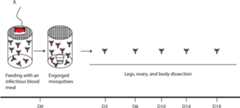
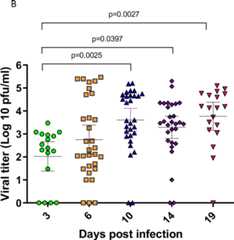
A. A schematic of the workflow for determining virus infection ofAe. aegypti ovaries. B. Viral load in ovaries at different time points following ZIKV infection. Mosquitoes were fed with a ZIKV containing infectious blood meal as described inMaterials and Methods. Ovaries, legs, and carcass were collected in mosquito diluent at the indicated times points. Differences in the mean viral titers were determined using a Kruskal-Wallis test followed by Dunn’s multiple comparisons test. Solid line shows the mean titer with the 95% CI.
Table 1.
Infection and dissemination of Zika virus at various time points following infection.
| Days post infection | Infection (%) | Dissemination (%)* | |
|---|---|---|---|
| Legs | Ovary | ||
| 3 | 90 (44/49) | 57 (25/44) | 39 (17/44) |
| 6 | 96 (47/49) | 91 (43/47) | 66 (31/47) |
| 10 | 97(34/35) | 94 (32/34) | 88 (30/34) |
| 14 | 91 (32/35) | 97 (31/32) | 91 (29/32) |
| 19 | 84 (21/25) | 90 (19/21) | 90 (19/21) |
Dissemination among the infected mosquitoes.
Detection of the DNA form of the ZIKV RNA genome inAe. aegypti ovaries
Previously, we showed that DNA forms of the ZIKV RNA genome are generated following infection both in mosquito cell cultures and in mosquitoes36. Therefore, detecting the presence of the viral DNA (vDNA) in the genomic DNA preparation from mosquito ovaries would be an indication of viral infection. Mosquitoes were infected with the ZIKV as described above. No additional blood meals were given for this experiment. A day before dissection, the infection status of individual mosquitoes was determined by removing a leg and then determining the presence of the viral RNA in the mosquito leg extract35. We collected ovaries from 8–10 mosquitoes with disseminated infection in PBS, and total genomic DNA was prepared using the Qiagen DNeasy Blood and Tissue DNA preparation kit as described before36. We prepared total DNA from mosquito ovaries at 10 and 21 dpi. DNA forms were detected using ZIKV specific primers in a conventional PCR assay, and the PCR products were confirmed by DNA sequencing. Our results indicated that the vDNA can be easily detected at 21 dpi (Fig. 2). We performed this experiment (vDNA detection) several times, because vDNA on day 10 could not always be detected (1 in 8 experiments), although it could be easily detected on day 21. These results suggest that ovaries are not frequently infected at 10 dpi or vDNAs are generated late in infection. However, the latter possibility seems unlikely based on the IFA results described below.
Figure 2.
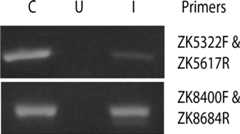
Detection of the DNA forms of the viral RNA genome. Total DNA was isolated from uninfected (U) or ZIKV infected (I) ovary samples collected at 21 dpi. No additional blood meal was given post infection. Infection status of mosquitoes was determined by the presence of the viral RNA in the leg homogenate by RT-PCR35. Viral DNA was detected via conventional polymerase chain reaction. Examples of two different primer combinations are shown. Primers sequences were described previously36. Lane C, positive control.
Detection of ZIKV infection by Immunofluorescence assay
Finally, we used indirect IFA to detect the presence of the virus in the ovaries. Mosquito infection was carried out as described above. IFA was carried out with ovary samples collected at 10 and 18 dpi from mosquitoes with disseminated infections. Infected mosquitoes were identified as described above. Ovaries from mosquitoes fed with non-infectious blood meal were used as controls. We checked ovaries from 15–35 infected mosquitoes at each time point. IFA positive samples were infrequent at 10 dpi (2 in 15 ovaries tested), but could be easily detected with 18 dpi samples (Fig. 3). At least 40% (10/25) of infected mosquitoes had the virus in ovaries at 18 dpi. These results suggest that the level of infection of ZIKV in ovaries is low at 10 dpi and virus detected by plaque assay at early time points may represent loosely attached virus particles.
Figure 3.
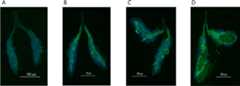
IFA to detect ZIKV antigens in mosquito ovaries. Ovaries from infected mosquitoes were dissected at various time points and processed for IFA as described inMaterials and Methods. Shown are ovaries collected at 18 dpi, where a second non-infectious blood meal was given at 9 dpi. A, uninfected control ovaries; B-D, ZIKV infected ovaries.
It has been demonstrated that progeny from the second or third gonotrophic cycle exhibit a higher VTR than those from the first gonotrophic cycle16,22,23,38. Based on this observation, we wanted to see if a second feeding increases the prevalence of ovary infections. Mosquitoes were fed with a second non-infectious blood meal 9 days after the first infectious meal and engorged mosquitoes were separated and provided with an oviposition substrate. Ovaries were collected from infected mosquitoes at 18 dpi. Our results showed that the prevalence of ovary infections increases to 62% (21/34) after second feeding. The difference between ovary infections at 18 dpi in single-fed and double-fed mosquitoes, however, was not statistically significant (p = 0.098). The staining intensity was slightly higher in 10% of ovaries from double-fed mosquitoes compared to single-fed mosquitoes. These results suggest that the increased VT in the second gonotrophic cycle could be due to delayed infection and/or enhanced infection status of mosquito ovaries. Sanchez-Vargas et al.23 had similar observations in a genetically diverse laboratory strain ofAe. aegypti following DENV2 infection. DENV2 was found in ovaries at 17 dpi in both single-fed and doubled-fed mosquitoes. However, they were unable to detect the DENV2 in ovaries at 10 dpi. Since we observed ZIKV infected ovaries at 10 dpi, it is possible that DENV2 and ZIKV exhibit a slightly different infection pattern or there is a difference in the number of ovaries processed in these two studies. We were unable to determine whether oocytes were infected. Since ZIKV was passaged in mosquito cells (C6/36) prior to infection, it is difficult to say whether adaptation may have played a role in the prevalence of mosquito infections.
Vertical transmission of ZIKV
Since ZIKV infects mosquito ovaries, we determined whether infected progeny derive from mosquitoes with infected ovaries. Female mosquitoes were orally fed with a 108 pfu/ml of ZIKV-containing infectious blood meal. Engorged mosquitoes were kept in individual cups (see Methods for details, andFig. 4A). By day 7, 97% (32/33) of mosquitoes were infected. On day 7, mosquitoes that laid eggs were pooled and then fed with a non-infectious blood meal on day 10. Engorged mosquitoes were kept separately in individual cups, each containing an oviposition substrate. On day 17, eggs and larvae were collected and allowed to develop until the third/fourth instar stage, when they were pooled. Pooled larvae from individual mosquitoes were kept separate. On Day 18, ovaries were dissected from mosquitoes with disseminated infections and ovary infection status was determined by IFA. Ninety-two percent (36/39) of mosquitoes had disseminated infection and 52% ovaries were infected with the virus. There were 127 pools, containing 970 larvae derived from 30 mosquitoes with disseminated infection. The infection status of the progeny larvae produced in the second gonotrophic cycle were determined by RT-PCR. Two pools turned out to be ZIKV positive. Larvae in these two pools were produced by the same mosquito, which had infected ovaries (Fig. 4B). A total of 18 larvae was generated by this mosquito which were distributed into two pools. None of the other mosquitoes irrespective of their ovary infection status produced infected progeny. These results suggest that ZIKV VTR (proportion of infected mosquitoes producing at least one infected infecting progeny) is just 3.33%. We have also determined the presence of the viral RNA in pools of larvae from the first gonotrophic cycle; among 1035 larvae in 115 pools (9 larvae per pool), none were positive for ZIKV.
Figure 4.
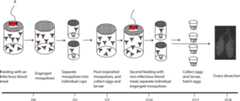
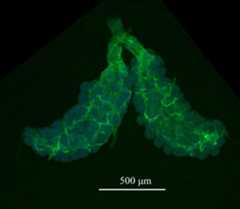
A. A Schematic of the workflow for the vertical transmission assay. B. Infection status of ovaries from the mosquito that produced infected progeny. Ovaries were dissected 8 days following the second non-infectious blood meal. Ovary pairs were infected with the ZIKV.
Sanchez-Vargas et al23. detected a small number of oocytes infected with DENV2 among the double-fed mosquitoes. A stabilized infection may result in a small number of females when the viruses infect germline. Once established, the stabilized infection may yield high VTRs in subsequent generations via TOT. Such stabilized infections have been demonstrated for California encephalitis serogroup viruses (orthobunyaviruses) in variousAedes species and for Culex flavivirus inCulex pipiens26,39,40. We showed here by plaque assay, IFA, and by monitoring the generation of vDNA that ZIKV also infects mosquito ovaries. Viruses could be detected frequently at 18 dpi, but seldom at 10 dpi. These results suggest that viruses observed by plaque assay at early time points do not represent true infections. It appears that like midgut escape barrier, there might be present a barrier that restricts ovary infection by arboviruses. The above results also indicated that only a minor fraction of mosquitoes with infected ovaries produce infected offspring. It is possible that oocytes are generally not infected and only those mosquitoes with infected oocytes transmit the virus vertically. It is unclear whether all progeny were infected with the virus. It is also not clear how the oocytes are protected from virus infection. In our studies, we observed that in most ovary samples, the viral antigen was present in the tracheal system (Figs. 3 and4B). Similar results were also obtained with Rift Valley fever virus (RVFV)41. Although the infection of ovarian tissues or VT through the tracheal cells is not known, it is possible that some of the progeny might get infected due to virus entering through the tracheal system. Tracheal conduits have also been suggested to facilitate virus dissemination from the midgut to hemocoel in DENV2 and RVFV infections ofAe. aegypti41,42.
VTRs for dual-host flaviviruses are low and the reported filial infection rates vary among reports16,32,33,43–47. Several possibilities can explain these variations. First, VTs are known to be dependent on mosquito species and their geographic origin33,43,46–50. Second, ovary infection is not a guarantee for VT, which likely depends on the infection status of oocytes. Third, most of the previous studies on VT were carried out using pools of eggs, larvae, or adult mosquitoes that originated from several mosquitoes with an unknown infection status or from a mixture of both infected and uninfected mosquitoes. Virus-positive pools might have had progeny that derived from the same mosquito. Consequently, the rates can vary from one experiment to another depending on how many offspring are produced by the infected mosquitoes and how the infected offspring are distributed among the pools. Finally, various stages of mosquito development are tested in different laboratories, which may impact the calculated VTRs, since virus present during larval stages can be lost during metamorphosis. In addition, sensitivities of various techniques used in different laboratories may alter the VTRs.
An increased VTR was observed following second and later gonotrophic cycles for several arboviruses. When mosquitoes are provided with a second non-infectious blood meal 3 days following the first infectious blood meal, the disseminated infection rate for ZIKV and DENV was significantly higher in early time points following the second blood meal, but no significant difference was observed at later time points (beyond 7 dpi)51. It is possible that ovary infection prevalence increases in the second or later gonotrophic cycles due to a combination of multiple factors, such as timing of dissemination of the virus to ovaries and morphological alterations of ovaries following egg formation. Such morphological alterations (stretched parous ovaries) may be necessary for a productive infection of the ovaries by arboviruses. Since an oviposition substrate was provided in our studies, it is possible that eggs were laid before the viruses reached the reproductive tissue during the first gonotrophic cycle. Supporting this idea is the observation that delayed egg laying byCulex pipiens females to 11–14 dpi and 25 dpi resulted in VT of St. Louis encephalitis virus during the first ovarian cycle52. We also previously showed that delaying oviposition increases VT of WNV inCx. pipiens53.
It was found that when measured in immature developmental stages, VTs are higher than the corresponding adults.Ae. aegypti also exhibited delayed development when infected with YFV, Kunjin virus, ZIKV, and Japanese encephalitis virus16,54. It is possible that vertically infected larvae have a low survival rate, leading to lower transstadial transmission rates in adults. Since we have not tested the infection status of eggs or adults, transstadial transmission could not be determined. The ISFs exhibit higher VTRs than dual-host flaviviruses, as VT is the predominant mode of survival for ISVs in nature55. It would be interesting to determine whether similar ovary-infection barrier is also present for ISVs and the timing of infection following an infectious blood meal.
Conclusions
ZIKV, like DENV, infectsAe. aegypti ovaries and VT occurs at a low rate. Infected progenies derive from mosquitoes with infected ovaries. However, not all mosquitoes with infected ovaries transmit the virus vertically. Although ZIKV could be detected in dissected ovaries of infected mosquitoes by plaque assay at 6 dpi, they represent mostly loosely attached virus particles, since viral presence could rarely be detected by IFA and vDNA assay at 10 dpi, but easily detected at 18 dpi. The prevalence of ovary infections increases in the second ovarian cycle following a second non-infectious blood meal.
Acknowledgement
Sequencing of the PCR products for detection of DNA forms of the viral RNA genome was performed at the Wadsworth Center’s Applied Genomics Technology Core facility. The Wadsworth Center’s Media and Tissue culture facility provided Vero and mosquito cells and the necessary media. The authors would like to thank the insectary staff for maintaining mosquito colonies and providing mosquito eggs, and Alex Franz for providing the IFA protocol. This work was supported by NIH grant 1 R21 AI138344 (DKN and LDK). The funding bodies had no role in the design of the study and collection, analysis and interpretation of data and writing of the manuscript.
Footnotes
Competing interests
The authors declare that they have no competing interests.
References
- 1.Gubler DJ. Vector-borne diseases. Rev Sci Tech. 2009; 28:583–588. [DOI] [PubMed] [Google Scholar]
- 2.Weaver SC, Charlier C, Vasilakis N, Lecuit M. Zika, chikungunya and other emerging vector-borne viral diseases. Ann Rev Med. 2018; 69:395–408. [DOI] [PMC free article] [PubMed] [Google Scholar]
- 3.Mayer SV, Tesh RB, Vasilakis N. The emergence of arthropod-borne viral diseases: a global perspective on dengue, chikungunya and Zika fevers. Acta Trop. 2017; 166:155–163. [DOI] [PMC free article] [PubMed] [Google Scholar]
- 4.Bhatt S, Gething PW, Brady OJ, Messina JP, Farlow AW, Moyes CL, Drake JM, Brownstein JS, Hoen AG, Sankoh O, Myers MF, George DB, Jaenisch T, Wint GR, Simmons CP, Scott TW, Farrar JJ, Hay SI. The global distribution and burden of dengue. Nature2013; 496(7446):504–7. [DOI] [PMC free article] [PubMed] [Google Scholar]
- 5.Gubler DJ. The global emergence/resurgence of arboviral diseases as public health problems. Arch Med Res. 2002; 33(4):330–42. [DOI] [PubMed] [Google Scholar]
- 6.Effler PV, Pang L, Kitsutani P, Vorndam V, Nakata M, Ayers T, Elm J, Tom T, Reiter P, Rigau-Perez JG, Hayes JM, Mills K, Napier M, Clark GG, Gubler DJ; Hawaii Dengue Outbreak Investigation Team. Dengue fever, Hawaii, 2001–2002. Emerg Infec Dis. 2005; 11(5):742–9. [DOI] [PMC free article] [PubMed] [Google Scholar]
- 7.Thomas DL, Santiago GA, Abeyta R, Hinojosa S, Torres-Velasquez B, Adam JK, Evert N, Caraballo E, Hunsperger E, Muñoz-Jordán JL, Smith B, Banicki A, Tomashek KM, Gaul L, Sharp TM. Reemergence of dengue in Southern Texas, 2013. Emerg Infect Dis. 2016; 22(6):1002–7. [DOI] [PMC free article] [PubMed] [Google Scholar]
- 8.Higgs SZika virus: emergence and emergency. Vector-Borne and Zoonotic Dis. 2016; 16(2):75–6. [DOI] [PubMed] [Google Scholar]
- 9.Petersen LR, Jamieson DJ, Powers AM, Honein MA. Zika virus. N Engl J Med. 2016; 374(16): 1552–63. [DOI] [PubMed] [Google Scholar]
- 10.Weaver SC, Costa F, Garcia-Blanco MA, Ko AI, Ribeiro GS, Saade G, Shi PY, Vasilakis N. Zika virus: history, emergence, biology, and prospects for control. Antiviral Res. 2016; 130: 69–80. [DOI] [PMC free article] [PubMed] [Google Scholar]
- 11.Morrison TE (2014). Reemergence of chikungunya virus. J Virol. 88(20): 11644–11647. [DOI] [PMC free article] [PubMed] [Google Scholar]
- 12.Musso D, Parola P, Raoult D. Yellow fever: the pacific should be prepared. The Lancet2018; 392(10162):2347. [DOI] [PubMed] [Google Scholar]
- 13.Fine PE. Vectors and vertical transmission: an epidemiologic perspective. Ann N Y Acad Sci. 1975; 266:173–194. [DOI] [PubMed] [Google Scholar]
- 14.Rosen LSexual transmission of dengue viruses by Aedes albopictus. Am J Trop Med Hyg1987; 37(2):398–402. [PubMed] [Google Scholar]
- 15.Kramer LD, Ebel GD. Dynamics of flavivirus infection in mosquitoes. Adv virus Res2003; 60:187–232. [DOI] [PubMed] [Google Scholar]
- 16.Lequime S, Paul RE, Lambrechts L. Determinants of arbovirus vertical transmission in mosquitoes. PLoS Pathog. 2016;12(5):e1005548. [DOI] [PMC free article] [PubMed] [Google Scholar]
- 17.Lipsitch M, Siller S, Nowak MA. The evolution of virulence in pathogens with vertical and horizontal transmission. Evolution1996; 50:1729–41. [DOI] [PubMed] [Google Scholar]
- 18.Mink GI. Pollen-transmitted and seed-transmitted viruses and viroids. Annu Rev phytopathol. 1993; 31: 375–402. [DOI] [PubMed] [Google Scholar]
- 19.Higgs S, Beaty BJ. Natural cycles of vector-borne pathogens. In: Marquardt WC, Kondratieff BC, Moore CG, Freier JE, Hagedorn HH, Black WC IV, James AA, In Hemingway J, Higgs S, editors. Biology of disease vectors. 2. Elsevier; San Diego, CA: 2005. pp. 167–185. [Google Scholar]
- 20.Rosen LOn the mechanism of vertical transmission of dengue virus in mosquitoes. C R Acad Sci III. 1987; 304(13):347–50. [PubMed] [Google Scholar]
- 21.Leake CJ. Transovarial transmission of arboviruses by mosquitoes. Vectors in virus biology. New York and London: Academic Press, 1984; pp 63–91. [Google Scholar]
- 22.Molina-Cruz A, Gupta L, Richardson J, Bennett K, Black W 4th, Barillas-Mury C. Effect of mosquito midgut trypsin activity on dengue-2 virus infection and dissemination in Aedes aegypti. Am J Trop Med Hyg. 2005; 72(5):631–7. [PubMed] [Google Scholar]
- 23.Sánchez-Vargas I, Harrington LC, Doty JB, Black WC, Olson KE. Demonstration of efficient vertical and venereal transmission of dengue virus type-2 in a genetically diverse laboratory strain of Aedes aegypti. PLoS Negl Trop Dis. 2018; 12(8): e0006754. [DOI] [PMC free article] [PubMed] [Google Scholar]
- 24.Blitvich BJ, Firth AE. Insect-specific flaviviruses: a systematic review of their discovery, host range, mode of transmission, superinfection exclusion potential and genomic organization. Viruses2015; 7:1927–1959. [DOI] [PMC free article] [PubMed] [Google Scholar]
- 25.Tesh RB. Transovarial transmission of arboviruses in their invertebrate vectors. In Harris KF, editor. Current topics in vector research. New York, NY, 1984; pp 57–76. [Google Scholar]
- 26.Saiyasombat R, Bolling BG, Brault AC, Bartholomay LC, Blitvich BJ. Evidence of efficient transovarial transmission of Culex flavivirus by Culex pipiens (Diptera: Culicidae). J Med Entomol. 2011; 48(5): 1031–38. [DOI] [PubMed] [Google Scholar]
- 27.Bolling BG, Eisen L, Moore CG, Blair CD. Insect-specific flaviviruses from Culex mosquitoes in Colorado, with evidence of vertical transmission. Am J Trop Med Hyg. 2011; 85(1): 169–77. [DOI] [PMC free article] [PubMed] [Google Scholar]
- 28.Tesh RB, Cornet M. The location of San Angelo virus in developing ovaries of transovarially infected Aedes albopictus mosquitoes as revealed by fluorescent antibody technique. Am J Trop Med Hyg. 1981; 30(1): 212–218. [DOI] [PubMed] [Google Scholar]
- 29.Kuberski TFluorescent antibody studies on the development of dengue-2 in Aedes albopictus (Diptera: Culicidae). J Med Entomol. 1979; 16:343–349. [DOI] [PubMed] [Google Scholar]
- 30.Doi RStudies on the mode of development of Japanese encephalitis virus in some groups of mosquitoes by the fluorescent antibody technique. Jap J Exp Med. 1970; 40:101–115. [PubMed] [Google Scholar]
- 31.Whitfield SG, Murphy FA, Sudia WD. St. Louis encephalits virus: an ultrastructural study of infection in a mosquito vector. Virology1973; 56:70–87. [DOI] [PubMed] [Google Scholar]
- 32.Thangamani S, Huang J, Hart CE, Guzman H, Tesh RB. Vertical transmission of Zika virus in Aedes aegypti mosquitoes. Am J Trop Med Hyg. 2016; 95(5): 1169–1173. [DOI] [PMC free article] [PubMed] [Google Scholar]
- 33.Ciota AT, Bialosuknia SM, Ehrbar DJ, Kramer LD. Vertical transmission of Zika virus by Aedes aegypti and Ae. albopictus mosquitoes. Emerg Infect Dis. 2017; 23(5): 880–882. [DOI] [PMC free article] [PubMed] [Google Scholar]
- 34.Ciota AT, Bialosuknia SM, Zink SD, Brecher M, Ehrbar DJ, Morrissette MN, Kramer LD. Effects of Zika Virus Strain and Aedes Mosquito Species on Vector Competence. Emerg Infect Dis. 2017; 23(7):1110–1117. [DOI] [PMC free article] [PubMed] [Google Scholar]
- 35.Styer LM, Kent KA, Albright RG, Bennett CJ, Kramer LD, Bernard KA. Mosquitoes inoculate high doses of West Nile virus as they probe and feed on live hosts. PLoS Pathog. 2007; 3(9): 1262–70. [DOI] [PMC free article] [PubMed] [Google Scholar]
- 36.Nag DK, Kramer LD. Patchy DNA forms of the Zika virus RNA genome are generated following infection in mosquito cell cultures and in mosquitoes. J Gen Virol. 2017; 98(11):2731–2137. [DOI] [PubMed] [Google Scholar]
- 37.Dong S, Behura SK, Franz AWE. The midgut transcriptome of Aedes aegypti fed with saline or protein meals containing chikungunya virus reveals genes potentially involved in viral midgut escape. BMC Genomics. 2017; 18(1): 382. [DOI] [PMC free article] [PubMed] [Google Scholar]
- 38.Shroyer DA. Vertical maintenance of dengue-1 virus in sequential generations of Aedes albopictus. J Am Mosq Control Assoc. 1990; 6(2):312–4. [PubMed] [Google Scholar]
- 39.Turell MJ, Hardy JL, Reeves WC. Stabilized infection of California encephalitis virus in Aedes dorsalis, and its implications for viral maintenance in nature. Am J Trop Med Hyg. 1982; 31:1252–1259. [DOI] [PubMed] [Google Scholar]
- 40.Tesh RB, Shroyer DA. The mechanism of arbovirus transovarial transmission in mosquitoes: Sam Angelo virus in Aedes albopictus. Am J Trop Med Hyg. 1980; 29:1394–1404. [DOI] [PubMed] [Google Scholar]
- 41.Kading RC, Crabtree MB, Bird BH, Nochol ST, Erickson BR, Horiuchi K, Biggerstaff BJ, Miller BR. Deletion of NSm virulence gene of Rift Valley fever virus inhibits virus replication in and dissemination from the midgut of Aedes aegypti mosquitoes. PLOS Neg Trop Dis. 2014; 8(2):e2670. [DOI] [PMC free article] [PubMed] [Google Scholar]
- 42.Salazar MI, Richardson JH, Sanchez-Vergas I, Olsen KE, Beaty BJ. Dengue virus type 2: replication and tropisms in orally infected Aedes aegypti mosquitoes. BMC Microbiol. 2007; 7:9. [DOI] [PMC free article] [PubMed] [Google Scholar]
- 43.Rosen L, Shroyer DA, Tesh RB, Freier JE, Lien JC. Transovarial transmission of dengue viruses by mosquitoes.: Aedes albopictus and Aedes aegypti. Am J Trop Med Hyg. 1983; 32:1108–1119. [DOI] [PubMed] [Google Scholar]
- 44.Tesh RB. Experimental studies on the transovarial transmission of Kunjin and San Angelo viruses in mosquitoes. Am J Trop Med Hyg. 1980; 29:657–666. [DOI] [PubMed] [Google Scholar]
- 45.Baqar S, Hayes CG, Murphy JR, Watts DM. Vertical transmission of West Nile virus by Culex and Aedes species mosquitoes. Am J Trp Med Hyg. 1993; 48:757–762. [DOI] [PubMed] [Google Scholar]
- 46.Rosen L, Lien JC, Shroyer DA, Baker RH, Lu LC. Experimental vertical transmission of Japanese encephalitis virus by Culex tritaeniorhynchus and other mosquitoes. Am J Trop Med Hyg. 1989; 40:548–556. [DOI] [PubMed] [Google Scholar]
- 47.Hardy JL, Rosen L, Kramer LD, Presser SB, Shroyer DA, Turell MJ. Effect of rearing temperature on transovarial transmission of St. Louis encephalitis virus in mosquitoesAm J Trop Med Hyg. 1980; 29:963–968. [DOI] [PubMed] [Google Scholar]
- 48.Nayar JK, Rosen L, Knight JW. Experimental vertical transmission of Saint Louis encephalitis virus by Florida mosquitoes. Am J Trop Med. 1986; 35:1296–1301. [DOI] [PubMed] [Google Scholar]
- 49.da Costa CF, da Silva AV, do Nascimento VA, et al. Evidence of vertical transmission of Zika virus in field collected eggs of Aedes aegypti in the Brazilian Amazon. PLOS Neg Trop Dis. 2018; 12(7):e0006594. [DOI] [PMC free article] [PubMed] [Google Scholar]
- 50.Lai Z, Zhou T, Zhou J, Liu S, Zu Y, Gu J, Yan G, Chen X-G. Vertical transmission of Zika virus in Aedes albopictus. PLOS Neg Trop Dis. 2020; 14(10):e0008776. [DOI] [PMC free article] [PubMed] [Google Scholar]
- 51.Armstrong PM, Ehrlich HY, Magalhaes T, Miller MR, Conway PJ, Bransfield A, Misencik MJ, Gloria-Soria A, Warren JL, Andreadis TG, Shepard JJ, Foy BD, Pitzer VE, Brackney DE. Successive blood meals enhance virus dissemination within mosquitoes and increase transmission potential. Nature Microbiol. 2020; 5(2):239–247. [DOI] [PMC free article] [PubMed] [Google Scholar]
- 52.Francy DB, Rush WA, Montoya M, Inglish DS, Bolin RA. Transovarial transmission of St. Louis encephalitis virus by Culex pipiens complex mosquitoes. Am J Trop Med Hyg. 1981; 30(3):699–705. [DOI] [PubMed] [Google Scholar]
- 53.Ciota AT, Ehrbar DJ, Matacchiero AC, Van Slyke GA, Kramer LD. The evolution of virulence of West Nile virus in a mosquito vector: implications for arbovirus adaptation and evolution. BMC Evol Biol. 2013; 13:71. [DOI] [PMC free article] [PubMed] [Google Scholar]
- 54.Chaves BA, Junior ABV, Silveira KRD, Paz ADC, Vaz EBDC, Araujo RGP, Rodrigues NB, Campolina TB, Orfano ADS, Nacif-Pimenta R, Villegas LEM, Melo FF, Silva BM, Monteiro WM, Guerra MDGVB, Lacerda MVG, Norris DE, Secundino NFC, Pimenta PFP. Vertical transmission of Zika virus (Flaviviridae, Flavivirus) in Amazonian Aedes aegypti (Diptera: Culicidae) delays egg hatching and larval development of progeny. J Med Entomol. 2019; 56(6):1739–1744. [DOI] [PMC free article] [PubMed] [Google Scholar]
- 55.Bolling BG, Olea-Popelka FJ, Eisen L, Moore CG, Blair CD. Transmission dynamics of an insect-specific flavivirus in a naturally infected Culex pipiens laboratory colony and effects of co-infection on vector competence for West Nile virus. Virology2012; 427:90–7. [DOI] [PMC free article] [PubMed] [Google Scholar]