



The genetic history of the Southern Arc: a bridge between West Asia and Europe
Iosif Lazaridis
Songül Alpaslan-Roodenberg
Ayşe Acar
Ayşen Açıkkol
Anagnostis Agelarakis
Levon Aghikyan
Uğur Akyüz
Desislava Andreeva
Gojko Andrijasevic
Dragana Antonović
Ian Armit
Alper Atmaca
Pavel Avetisyan
Ahmet İhsan Aytek
Krum Bacvarov
Ruben Badalyan
Stefan Bakardzhiev
Jacqueline Balen
Lorenc Bejko
Rebecca Bernardos
Andreas Bertsatos
Hanifi Biber
Ahmet Bilir
Michelle Bonogofsky
Clive Bonsall
Dušan Borić
Nikola Borovinić
Guillermo Bravo Morante
Katharina Buttinger
Kim Callan
Francesca Candilio
Mario Carić
Olivia Cheronet
Stefan Chohadzhiev
Maria-Eleni Chovalopoulou
Stella Chryssoulaki
Ion Ciobanu
Natalija Čondić
Mihai Constantinescu
Emanuela Cristiani
Brendan J Culleton
Elizabeth Curtis
Jack Davis
Tatiana I Demcenco
Valentin Dergachev
Zafer Derin
Sylvia Deskaj
Seda Devejyan
Ruben Davtyan
Vojislav Djordjević
Kellie Sara Duffett Carlson
Laurie R Eccles
Nedko Elenski
Atilla Engin
Nihat Erdoğan
Sabiha Erir-Pazarcı
Daniel M Fernandes
Matthew Ferry
Suzanne Freilich
Alin Frînculeasa
Michael L Galaty
Beatriz Gamarra
Boris Gasparyan
Bisserka Gaydarska
Elif Genç
Timur Gültekin
Serkan Gündüz
Tamás Hajdu
Volker Heyd
Suren Hobosyan
Nelli Hovhannisyan
Lora Iliev
İlkay İvgin
Ivor Janković
Lence Jovanova
Panagiotis Karkanas
Berna Kavaz-Kındığılı
Esra Hilal Kaya
Denise Keating
Douglas Kennett
Seda Deniz Kesici
Anahit Khudaverdyan
Krisztián Kiss
Sinan Kılıç
Paul Klostermann
Sinem Kostak Boca Negra Valdes
Marta Krenz-Niedbała
Maja Krznarić Škrivanko
Rovena Kurti
Ann Marie Lawson
Catalin Lazar
Krassimir Leshtakov
Thomas E Levy
Ioannis Liritzis
Kirsi O Lorentz
Sylwia Łukasik
Matthew Mah
Swapan Mallick
Kirsten Mandl
Kristine Martirosyan-Olshansky
Roger Matthews
Wendy Matthews
Kathleen McSweeney
Varduhi Melikyan
Adam Micco
Megan Michel
Lidjia Milasinovic
Alissa Mittnik
Janet M Monge
Georgi Nekhrizov
Rebecca Nicholls
Alexey G Nikitin
Vassil Nikolov
Mario Novak
Iñigo Olalde
Jonas Oppenheimer
Anna Osterholtz
Celal Özdemir
Kadir Toykan Özdoğan
Nurettin Öztürk
Nikos Papadimitriou
Niki Papakonstantinou
Anastasia Papathanasiou
Evgeny G Paskary
Nick Patterson
Ilian Petrakiev
Levon Petrosyan
Vanya Petrova
Anna Philippa-Touchais
Ashot Piliposyan
Nada Pocuca Kuzman
Hrvoje Potrebica
Bianca Preda-Bălănică
T Douglas Price
Lijun Qiu
Siniša Radović
Kamal Raeuf Aziz
Petra Rajić Šikanjić
Kamal Rasheed Raheem
Sergei Razumov
Amy Richardson
Jacob Roodenberg
Rudenc Ruka
Victoria Russeva
Mustafa Şahin
Ayşegül Şarbak
Emre Savaş
Constanze Schattke
Lynne Schepartz
Tayfun Selçuk
Ayla Sevim-Erol
Michel Shamoon-Pour
Henry M Shephard
Athanasios Sideris
Angela Simalcsik
Hakob Simonyan
Vitalij Sinika
Kendra Sirak
Ghenadie Sirbu
Mario Šlaus
Andrei Soficaru
Bilal Söğüt
Arkadiusz Sołtysiak
Çilem Sönmez-Sözer
Maria Stathi
Martin Steskal
Kristin Stewardson
Sharon Stocker
Fadime Suata-Alpaslan
Alexander Suvorov
Anna Szécsényi-Nagy
Tamás Szeniczey
Nikolai Telnov
Strahil Temov
Nadezhda Todorova
Ulsi Tota
Gilles Touchais
Sevi Triantaphyllou
Atila Türker
Todor Valchev
Fanica Veljanovska
Zlatko Videvski
Anna Wagner
Sam Walsh
Piotr Włodarczak
J Noah Workman
Aram Yardumian
Evgenii Yarovoy
Alper Yener Yavuz
Hakan Yılmaz
Fatma Zalzala
Anna Zettl
Zhao Zhang
Rafet Çavuşoğlu
Nadin Rohland
Ron Pinhasi
David Reich
Corresponding authors. Iosif Lazaridis (lazaridis@genetics.med.harvard.edu), Songül Alpaslan-Roodenberg (msglalpaslan@gmail.com), Ron Pinhasi (ron.pinhasi@univie.ac.at), David Reich (reich@genetics.med.harvard.edu)
Co-lead authors
Author Contributions:
Conceived the study: ILa, SA, RP, DR
Supervised the study: SA, DKen, NPat, NR, RP, DR
Assembled archaeological material and prepared the site descriptions: SA, AAca, AAçı, AAg, LA, UA, DAnd, GA, DAnt, IA, AAt, PA, AIA, KBa, RBa, JB, LB, ABe, HB, ABi, MBod, MBon, CB, DB, NB, MCa, SCho, M-EC, SChr, IC, NC, MCo, ECr, JD, TID, VD, ZD, SDes, SDev, RD, VDj, NEl, AE, NEr, SE-P, AF, MLG, BGas, BGay, EG, TG, SG, TH, VH, SH, NH, IIl, SI, Iİv, IJ, LJ, PKa, BKK, EK, SDK, AK, KK, SKı, PKl, SKBNV, SKo, MK-N, MKŠ, RK, PKu, CL, KLe, TEL, ILi, KLo, SŁ, KM-O, RM, WM, KMc, VM, LM, DMi, JMM, GN, RN, AGN, VN, MN, AO, CÖ, NÖ, NPap, NPap, APa, LPa, EPa, IP, LPe, VP, APh-T, APi, NPocK, HP, BP-B, ZP, DP, SRad, KRA, PRŠ, KRR, SRaz, AR, JR, RR, VR, MŞa, AŞar, ES, AS LS, TSe, AS-E, MSh-P, HMS, ASid, ASim, HS, VS, GS, MŠl, ASof, BS, ASoł, ÇS, MSta, MSt, SS, FSA, AS-N, TSz, NTe, STe, NTo, UT, GT, STr, AT, MU, FV, ZV, CV, SW, PW, AYar, EY, AYYav, HY, RÇ, RP
Performed laboratory work: SA, GBM, KBu, KC, FC, BJC, ECu, KSDC, LRE, DMF, MF, SF, BGam, LI, DKea, AML, KMa, MMi, JO, KTO, LQ, CS, KSi, KSt, AW, JNW, FZ, AZ, NR
Performed population genetic analyses: ILa, DR
Analyzed data: ILa, SA, RBe, OC, MMa, SM, AMic, AMit, IO, ZZ, NR, DR
Wrote the manuscript and compiled the supplementary sections with the input of all other co-authors: ILa, SA, DR
Issue date 2022 Aug 26.
Abstract
By sequencing 727 ancient individuals from the Southern Arc (Anatolia and neighbors in Southeastern Europe and West Asia) over 10,000 years, we contextualize its Chalcolithic and Bronze Ages (~5000-1000BCE), when extensive gene flow entangled it with the Eurasian steppe. Two streams of migration transmitted Caucasus and Anatolian/Levantine ancestry northward, and the Yamnaya pastoralists, formed on the steppe, then spread southwards: into the Balkans, and across the Caucasus into Armenia, where they left numerous patrilineal descendants. Anatolia was transformed by intra-West Asian gene flow, with negligible impact of the later Yamnaya migrations. This contrasts with all other regions where Indo-European languages were spoken, suggesting that the homeland of the Indo-Anatolian language family was in West Asia, with only secondary dispersals of non-Anatolian Indo-Europeans from the steppe.
One-Sentence Summary:
Web of migrations between Anatolia, its neighbors, and the Steppe suggests a West Asian origin of Indo-Anatolian languages.
Print page summary
Introduction
Humans moved, for thousands of years, across the “Southern Arc,” the area bridging Europe through Anatolia with West Asia. We report ancient DNA data from 727 individuals of this region over the last 11,000 years, which we co-analyse with the published archaeogenetic record to understand the origins of its people. We focus on the Chalcolithic and Bronze Age periods ~7,000-3,000 years ago, when Indo-European language speakers first appeared.
Rationale
Language is not encoded in the genome. But genetic data are relevant to understanding linguistic evolution because they may identify population movements that were opportunities for language spread. How does the changing ancestral landscape of the Southern Arc revealed by ancient DNA correspond to the structure inferred by linguistics, which links Anatolian (such as Hittite and Luwian) and Indo-European (such as Greek, Armenian, Latin, and Sanskrit) languages as twin daughters of a common Proto-Indo-Anatolian parent?
Results
Steppe pastoralists of the Yamnaya culture initiated a chain of migrations across Eurasia, linking Europe in the west to China and India in the east. We find people throughout the Balkans who traced almost all their ancestry to this Yamnaya expansion (~5,000-4,500 years ago). These steppe migrants soon admixed with locals to create a tapestry of diverse ancestry from which speakers of Greek, Paleo-Balkan, and Albanian languages emerged.
The Yamnaya expansion also crossed the Caucasus and by ~4,000 years ago, Armenia had become an enclave of low but pervasive steppe influence in West Asia, where the patrilineal descendants of Yamnaya men, virtually extinct across Europe and the steppe, persisted. The Armenian language was born there and its relationship with faraway Indo-European languages of Europe such as Greek reflects their shared Yamnaya heritage.
Neolithic Anatolia (Turkey) was home to diverse populations descended from both local hunter- gatherers and eastern populations of the Caucasus, Mesopotamia, and the Levant. By ~6,500 years ago and thereafter, Anatolians became more similar to each other, a process driven substantially by the flow of eastern ancestry across the breadth of the peninsula. The numerous languages revealed by archaeology, both Anatolian, but also non-Indo-European ones like Hattic and Urartian, are likely to be those of locals and migrants who participated in this great mixture.
Anatolia is remarkable for its lack of steppe (Yamnaya or earlier) ancestry down to the Bronze Age. The ancestors of the Yamnaya were, however, substantially drawn from West Asia, mainly from the Caucasus, a process that had started by ~7,000 years ago, but also from the more southern Anatolian-Levantine continuum. The Bronze Age expansion of the Yamnaya into the Caucasus can thus be seen as a return to the homeland of about half their ancestors.
Conclusion
All ancient Indo-European speakers can be traced back to the Yamnaya culture, whose southern expansions into the Southern Arc left a trace in the DNA of the Bronze Age people of the region. But, the link connecting the Proto-Indo-European speaking Yamnaya with the speakers of Anatolian languages was in the highlands of West Asia, the ancestral region shared by both.
Graphical Abstract
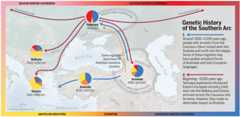
Many partings, many meetings—how migration and admixture drove early language spread. Westward and northward migrations out of the West Asian highlands split the Proto- Indo-Anatolian language into Anatolian and Indo-European branches. Yamnaya pastoralists, formed on the steppe by a fusion of newcomers and locals, admixed again as they expanded far and wide, splitting the Proto-Indo-European language into its daughter languages across Eurasia. Locations and routes are approximate.
The Balkans and Anatolia are often portrayed as geographically peripheral to Europe and Asia, rather than as central to an interconnected region spanning both continents. Here we take a different view by providing a systematic genetic history of what we refer to as the “Southern Arc”, a region (Fig. 1A) centered on the large Anatolian peninsula (Turkey), including in the west (in Europe) the Balkans and the Aegean, and in the south and east, Cyprus, Mesopotamia, the Levant, Armenia, Azerbaijan, and Iran. We present new genome-wide DNA data from 777 individuals from the SA: 727 previously unsampled and 50 previously published for which we report new data from 1,094 newly reported ancient DNA libraries (1). As a resource to guide future sampling efforts, we also report negative results for 476 samples that we screened using 537 libraries and that failed to yield ancient DNA data passing criteria for authenticity (1). We finally provide 239 new radiocarbon dates on the same skeletal elements analyzed for DNA (1). We study these along with previously published individuals for a total sample size of 1,317 ancient individuals in the region (Fig. 1B) (1).
Fig. 1. Studied individuals and PCA analysis.

(A) The geography of the Southern Arc; Sampling locations of previously published individuals (grey circle), new data on published individuals (pink square), and new individuals (yellow circle); convex hulls of individuals from each present-day country are also shown. (B) Timeline of studied individuals (random uniform jitter applied to the vertical dimension). (C) Principal components analysis of ancient individuals projected on modern West Eurasian variation. Country names represented by 3-letter ISO codes.
Our newly reported data fills many sampling gaps in space and time in the Southern Arc. In Turkey our new sampling has a particular focus on the western (Aegean, Marmara), northern (Black Sea) and eastern (Eastern Anatolia, Southeastern Anatolia) regions connecting it with the rest of the Southern Arc. Another area of high-density sampling is Armenia with substantial coverage of the Bronze and Iron Ages representing an order of magnitude more individuals than previously available. Many individuals of Bronze-to-Iron Age timeframe are also sampled from the Iranian highlands at Hasanlu, where only a single individual has previously been studied (2), and Dinkha Tepe, neighboring Anatolia, Mesopotamia, Armenia and the Caucasus. In the southern part of Southeastern Europe, we sample Mycenaean-era individuals from multiple regions of the Aegean. From the southern Balkans, we present a full time transect of Albania, numerous individuals from North Macedonia where previously data from only a single Neolithic individual had been published (3), and more than double the previously available body of ancient DNA data from Bulgaria. Further north, at the western wing of the Southern Arc, we sample individuals from Croatia, Montenegro, and Serbia in the west; and Romania and Moldova in the east; which interface with the extensively studied worlds of Central Europe and the Eurasian steppe. This dataset includes >100 Bronze Age individuals, including many from Cetina Valley and Bezdanjača Cave in Croatia which we add to only 5 previously published from the entire area (3,4). Some of the Balkan individuals include culturally Yamnaya individuals from Serbia and Bulgaria, allowing us to compare them with those of the Eurasian steppe. With this greatly enhanced dataset across the entire region, we are able to fill in major gaps in sampling in time, space, and cultural context. Our large sample sizes also allow us to identify main clusters as well as genetic outliers, providing insights about within-population patterns of variation and contact networks with neighboring groups. Details of all studied individuals can be found in (1) (Figs. S5-S21).
To discuss the geographic distribution of these individuals, we take a flexible approach, in some cases using the names of ecological or topographical regions and in others the names of present-day countries depending on how well these align with genetic patterns. In some cases, we also use more specific regional location information to be more precise (5). In the interest of having a uniform nomenclature that is easily accessible to readers familiar with the current political map of the Southern Arc, we also refer to groups of individuals with labels prefixed with 3-letter International Standards Organization (ISO) codes for countries, as inFig. 1. Multiple toponyms have been used for the same sites during the Southern Arc’s long history, and we typically choose labels appropriate for the period and/or present-day usage. To designate the period in which individuals lived, we use conventional archaeological designations for each region, e.g., Eneolithic and Chalcolithic both denote copper-using cultures in different parts of the archaeological literature. We caution that the transition between the Eneolithic or Chlacolithic and Bronze Ages did not occur simultaneously in different parts of the Southern Arc. Detailed archaeological information for each individual is presented in (1) specifying the analysis labels we use integrating information from chronology, geography, archaeology, and genetics.
Overview of genetic variation in the Southern Arc
To understand genetic variation in the Southern Arc, we began with ADMIXTURE (Fig. S1) analysis, which allowed us to detect individuals with non-West Eurasian-associated ancestry (7) and to appreciate the broad pattern of variation in terms of the four West Eurasian components that appear in the ADMIXTURE analysis: Iran/Caucasus-related, “Eastern hunter-gatherer”, Anatolian/Levantine-related, and “Balkan hunter-gatherer”. Principal components analysis (Fig. 1C) of Southern Arc individuals together with other West Eurasian individuals demonstrates the central position of the Southern Arc within the continuum of West Eurasian variation, with a long “bridge” of individuals joining Europe (left) to West Asia (right), but with individuals spread across the entire range of variation.
To quantify the ancestry of Southern Arc individuals, we developed a 5-source modeling framework (using qpAdm and F4admix) (1) that allows a high-resolution description of the ancestry of the Southern Arc population as a whole and as individuals. To generate this model, we used an automated procedure that did not pre-select a specific set of surrogates for the source populations, but instead explored many possible sets and identified those that, for as many individuals as possible, maximized the quality of the statistical fit of the model while minimizing the standard errors in inferences of ancestry proportions (Tables S1-S21,Figs. S22-S27). After applying this procedure, the five sources of ancestry we used are: Caucasus hunter-gatherers (8), Eastern hunter-gatherers (9,10), Levantine Pre-Pottery Neolithic (11), Balkan hunter-gatherers from the Iron Gates in Serbia (3), and Northwestern Anatolian Neolithic from Barcın (10); these correspond to the 4-source ADMIXTURE model, with further distinction between the Anatolian and Levantine ends of the “Mediterranean” interaction zone (6). These five sources should not be unduly emphasized beyond their utility as a descriptive convenience, as they: (i) could be swapped for related ones (e.g., Neolithic Iran captures much of the same deep ancestry as Caucasus hunter-gatherers do (6,11)), (ii) were themselves derived from earlier (more “distal”) populations (e.g., Levantine PPN from earlier Natufian hunter-gatherers (11)), and (iii) transmitted their ancestry via later (more “proximal”) sources (e.g., Eastern hunter-gatherers via Yamnaya steppe pastoralists (9)). The inferred proportions of ancestry for individuals are summarized inFigs. S2-S4 andFigs. S28-S76, and discussed in detail in (1).
The Anatolian core of the Southern Arc
When we apply our 5-way model to individuals from Anatolia (Fig. 2A-E), it is immediately apparent that prior to ~3,000 years ago, virtually all ancestry there is drawn from local West Asian sources (northwest Anatolian Neolithic hereafter called “Anatolian”, Levantine, Caucasus) with negligible contribution from the two European (Balkan and Eastern hunter-gatherer) sources of our model. Broadly speaking, the temporal trend is one of increasing Caucasus/Levantine-related ancestry between the Neolithic and Chalcolithic periods with a corresponding decrease of the Anatolian-related ancestry. To better understand this process in the Anatolian peninsula, we examined geographical sub-populations of the Chalcolithic and Bronze Age in comparison to the Neolithic ones that preceded them (Fig. 2F). We observed that northwest Anatolian-related ancestry varied between ~100% (at Barcın, Menteşe, and Ilıpınar in the Marmara region; we use the high quality data we have from Barcın to define this component of ancestry) to ~16% (the Pre-Pottery Neolithic individual from Mardin in SE Anatolia/North Mesopotamia). Conversely, Caucasus/Levantine ancestry varied between ~50/~32% in North Mesopotamia to ~0% in northwest Anatolia.
Fig. 2: The Anatolian heartland.

Panels (A-E) show five components of ancestry in Anatolia from the Pottery Neolithic to the Roman/Byzantine period. Boxes in this and subsequent figures indicate the temporal extent (horizontal) and 95% confidence interval (±1.96s.e.) for each period; we also show the fit (solid line) and 5/95% (dotted lines) of the fit of a heteroskedastic Gaussian process (55) on the individuals without any assignment to populations, which allows us to appreciate the degree of variation in ancestry in each time period. The results show that across the peninsula the post-Neolithic period was characterized by expansion of Caucasus hunter-gatherer (CHG)-related ancestry (A) and dilution of northwest Anatolian-related ancestry (E). European hunter-gatherer-related ancestry from both the steppe/eastern Europe (B) and the Balkans (D) was insignificant until the last 3,000 years. A detailed look at the Chalcolithic/Bronze Age period (F) shows that populations there had ancestry intermediate between early farmers from western/central Anatolia (Barcın(10), Tepecik-Çiftlik(13), and Çatalhöyük(12)) and southeastern Anatolia (northern Mesopotamia at Mardin) on the other, the result of admixture between the preceding Neolithic populations, without discernible external influences (that would have elevated any of the five components above their Neolithic levels).
The Chalcolithic period in Anatolia has a wide temporal range (Fig. 2) that spans from the end of the Neolithic (~6000BCE) to the beginning of the Bronze Age (~3000BCE). Individuals in our analysis are mostly from the Late Chalcolithic (post ~4500BCE) and from the entirety of the Bronze Age (down to 1300BCE). Both Chalcolithic and Bronze Age populations from all regions generally had intermediate admixture proportions within the Neolithic ranges of ancestry. This suggests that they could be modeled as drawn from mixtures of the preceding Neolithic populations. In the Marmara region, Caucasus hunter-gatherer ancestry increased from ~0% to ~33% between the Neolithic and Chalcolithic periods (to defined the Chalcolithic we added four individuals from Ilıpınar to a single one from Barcın previously published(11)). In the Central region, we document an increase from ~10-15% at Neolithic Çatalhöyük (12) and Tepecik-Çiftlik (13) to a similar ~33% at Chalcolithic Çamlıbel Tarlası(14) and ~42% at Bronze Age Kalehöyük and Ovaören(15). In the Mediterranean region (southwest Anatolia) the same ~1/3 proportion was present at Harmanören Göndürle (16) in the Bronze Age. In the Aegean region (western Anatolia) we observe a similar ~29% in the Bronze Age. Thus, individuals from more western regions of Anatolia (Marmara, Aegean, Central, and Mediterranean) all had more Caucasus-related ancestry (and correspondingly less Anatolian-related ancestry) during the Chalcolithic and Bronze Age than the preceding Neolithic populations of the area, suggesting a spread of this ancestry westward across the peninsula occurred after the Neolithic, a pattern also observed in the Levant (6). In the more eastern regions of Anatolia (East, in Arslantepe (14); Southeast, from Batman, Gaziantep, Kilis, and Şırnak (new data) and Titriş Höyük (14); Black Sea, from Devret Höyük in Amasya, Samsun (new data), and İkiztepe (14)), populations of the Chalcolithic and Bronze Age periods had, conversely, more western Anatolian Neolithic-related, and less Caucasus-related ancestry, than the Pre-Pottery Neolithic individual from Mardin. This pattern is also observed when we compare the Chalcolithic with the Bronze Age. Differences are small but all in the direction of more western Anatolian Neolithic-related ancestry (an increase of ~3-7% in the East, Southeast, and Black Sea regions) except in the Hatay province (14) where western Anatolian Neolithic-related ancestry decreased and Caucasus-related ancestry increased (from ~14% to 43%) between the Early Chalcolithic (~5500BCE) and Middle to Late Bronze Age (post ~2000BCE).
Taken as a whole, the genetic history of Anatolia during the Chalcolithic and Bronze Age can be characterized as one of homogenization. Neolithic populations differed by as much as ~80% in terms of western Anatolian Neolithic-related and ~50% in terms of Caucasus-related ancestry. In the Chalcolithic and Bronze Age, the range of these differences narrowed substantially: that of western Anatolian Neolithic-related ancestry halved to ~40% (becoming ~20-60%) and that of Caucasus-related ancestry to ~15% (becoming ~30-45% except in the Hatay province). Despite this homogenization, some ancestry differences persisted: the eastern regions retained more Caucasus-related ancestry than the western ones, but the overall pattern was one of attenuated differentiation following intra-Anatolian gene flow stemming from the highly differentiated Neolithic populations of western/central Anatolia on the one hand and northern Mesopotamia on the other (as well as hitherto unsampled others).
Homogenization in Anatolia was coupled by impermeability to exogenous gene flow from Europe, which could be explained by either a large and stable population base that attenuated the demographic impact of external immigration, or cultural factors impeding it. The asymmetry of gene flow between Anatolia and its neighbors is evident for example in the fact that Caucasus hunter-gatherer-related ancestry flowed westward across Anatolia into the Balkans and northward into the Eurasian steppe, but Balkan hunter-gatherer ancestry did not flow into Anatolia or further eastward, and Eastern hunter-gatherer ancestry entered West Asia only as far south as Armenia and to a lesser extent Iran (as we will see below), even down to the Urartian period of the Iron Age, where a population lacking Eastern hunter-gatherer ancestry still existed in the center of the Kingdom of Van (7).
The origin and expansion of steppe pastoralists
The absence of European hunter-gatherer admixture in Anatolia during the Chalcolithic and Bronze Age periods contrasts with developments to the north of the Southern Arc, and north of the Black and Caspian Seas, which saw the formation of Eneolithic (a term used instead of Chalcolithic for this area) and Bronze Age pastoralist populations that harbored a mixture of populations from Eastern Europe and the Southern Arc (9,10,17). Examining individuals from the steppe (Fig. 3), we observe that in the post-5000BCE period, Caucasus-related ancestry is added to the previous Eastern hunter-gatherer population, forming the Eneolithic populations at Khvalynsk (10) and Progress-2 (17); this ancestry persisted in the Steppe Maykop population of the 4th millennium BCE (17). Yet, all these populations prior to ~3000BCE lack any detectible Anatolian/Levantine-related ancestry, contrasting with all contemporaneous ones from the Southern Arc, which possess at least some such ancestry at least since the Neolithic (6). In all later periods in the Southern Arc, Caucasus hunter-gatherer-related ancestry is never found by itself, but always admixed, to various degrees, with Anatolian/Levantine-ancestry. This suggests that whatever the source of the Caucasus-related ancestry in the Eneolithic steppe, it cannot have been from the range of variation sampled in the Southern Arc, as this would have introduced Anatolian/Levantine-related ancestry. This implies that the proximal source of the Caucasus-related ancestry in the Eneolithic steppe should be sought in an unsampled group that did not experience Anatolian/Levantine-related gene flow until the Eneolithic. Plausibly this population existed in the North Caucasus, from which Caucasus hunter-gatherer-related but not Anatolian/Levantine-related ancestry could have entered the Eneolithic steppe.
Fig. 3: Yamnaya origins and expansions.

(A) The earliest inhabitants of the steppe (Eastern hunter-gatherers; EHG) were followed by Caucasus hunter-gatherer (CHG)-admixed populations by ~5000BCE and by Anatolian/Levantine-admixed populations by ~3000BCE with the emergence of the Yamnaya-Afanasievo genetic cluster. The proportion of Balkan hunter-gatherer-related ancestry (not shown) is 0.8±0.6% in the Yamnaya cluster and −0.5±0.5% in the Afanasievo. (B) The Yamnaya had nearly half their ancestry from CHG, higher than any Bronze Age Europeans from the Balkans, Italy, or central-northern Europe, but their CHG-EHG balance was equal, similar to the Corded Ware/Beaker clusters of central/northern Europe and contrasting with Southeastern and Mediterranean Europe where CHG was significantly higher than EHG. (95% confidence intervals of ±1.96s.e. are shown.)
The Eneolithic steppe population contrasts with that of the Yamnaya cluster of individuals ~3000BCE, which does have significant Anatolian (3±1%) and Levantine (3.5±1%)-related ancestry (Fig. 3A; steppe individuals in this analysis listed in (1) ). This inference is further supported by detailed analysis of Yamnaya ancestry at different time depths (Tables S22-S28) (1) which indicates that they derived from at least two southern sources. The first source dates to the Eneolithic and includes Caucasus hunter-gatherer ancestry only. The second source dates to prior to the formation of the Yamnaya cluster, and includes Anatolian/Levantine-related ancestry in addition to Caucasus hunter-gatherer (as deep sources), ancestry related to Neolithic people of Armenia (more proximally), or ancestry related to Chalcolithic people of the Caucasus to SE Anatolia (even more proximally). A more direct and geographically proximate source in the Maykop population of the North Caucasus of the 4th millennium BCE has also been proposed (18). While the exact source cannot be at present determined (all of the candidates have different combinations of the same Anatolian/Levantine/Caucasus ancestry;Fig. S1), it was people drawn from this meta-population in the Chalcolithic Caucasus and SE Anatolia that must have been responsible for the second pulse of Southern Arc ancestry into the precursors of Yamnaya steppe pastoralists. The genetic contribution of the second pulse may have been as low as 6.5%, the sum of Anatolian and Levantine ancestry in the Yamnaya, or as high as 53.1%, the totality of the combined Caucasus hunter-gatherer and Anatolian/Levantine ancestry. The low end is unlikely, as Caucasus hunter-gatherer ancestry was ubiquitous in West Asia during the Chalcolithic period and some of it should be added to the 6.5% figure. The high end is also unlikely, as it suggests that all Caucasus hunter-gatherer ancestry flowed northwards with the second pulse, thus ignoring the evidence for its independent flow into the Eneolithic steppe. Our modeling suggests intermediate values of ~21-26% (Table S28), in the middle of the 6.5-53.1% range, an estimate that may be updated in the future as better proximate sources in both West Asia and the steppe come to light.
Archaeological evidence documents how western steppe populations interacted with European farmer groups such as the Tripolye-Cucuteni and Globular Amphora, and it was previously suggested that ancestry from such groups contributed to the ancestry of the Yamnaya (17). Our genetic results contradict this scenario, as European farmers were themselves a mixture of Anatolian Neolithic and European hunter-gatherer ancestry, but the Yamnaya: (i) lacked the European hunter-gatherer ancestry differentiating European from West Asian farmers, and (ii) had an approximately 1:1 ratio of Levantine-to-Anatolian ancestry in our 5-way model, contrasting with the overwhelming predominance of Anatolian ancestry in European farmers. The Caucasus hunter-gatherer/Eastern hunter-gatherer/Western hunter-gatherer/Anatolian Neolithic model of (17) fails (p<1e-10) because it underestimates shared genetic drift with Levantine farmers (Z=5.6), whose contribution into the Yamnaya cannot be explained under that model. These results shift the quest for the ancestral origins of a component of Yamnaya ancestry firmly to the south of the steppe and the eastern wing of the Southern Arc. Determining the proximate source of the two movements into the steppe from the south will depend on further sampling across the Anatolia-Caucasus-Mesopotamia-Zagros area where populations with variations of the three components existed. Similarly, on the steppe side, study of Eneolithic (pre-Yamnaya) individuals could disclose the source dynamics of Caucasus hunter-gatherer infiltration northwards and identify the likely geographical region for the emergence of the distinctive Yamnaya cluster which we show has an autosomal signal of admixture dating to the mid-5th millennium BCE (Fig. S5 and (19)), coinciding with the direct evidence of the first southern influence provided by the Eneolithic individuals of the steppe.
The role of Yamnaya-like populations in spreading both Eastern hunter-gatherer and West Asian ancestry into mainland Europe has been previously recognized (9), but it has also become apparent that some of the latter entered Europe independently of steppe expansions into the Aegean (10,16), Sicily (20), and even as far west as Iberia (21) by the Bronze Age. We observe that the Caucasus minus Eastern hunter-gatherer ancestry difference in the Yamnaya is ~0% (Fig. 4B) and this allows us to both (a) test whether steppe migrants into mainland Europe may have originated from a different steppe population (with a non-equal balance of Caucasus and Eastern hunter-gatherer components), and (b) test whether additional migrations (with either more Eastern or Caucasus hunter-gatherer ancestry, thus shifting the difference away from zero) occurred. We find that the Corded Ware and Bell Beaker complex individuals from Europe are all consistent with a balanced presence of the two components (consistent with having been transmitted via a Yamnaya-like population). Even the early Corded Ware from Bohemia where a third “northern” source has been suggested to have been substantially involved (22), the difference is one of a small 3.1±2.1% excess of Eastern hunter-gatherer ancestry, which is entirely consistent with being transmitted entirely by the Yamnaya to the limits of the resolution of our statistical analysis. This is not the case for Southeastern Europe where Bronze Age individuals had an excess of Caucasus over Eastern hunter-gatherer ancestry not only in the Aegean (~17% in both Minoans and Mycenaeans) (16), but throughout the Balkan peninsula (Fig. 3B) where the overall Bronze Age excess is 7.4±1.7% (with by-country estimates of ~4-13%). A possible explanation for this excess is the existence of a small 5.2±0.6% Caucasus hunter-gatherer component in the Neolithic substratum of Southeastern Europe (Fig. 4A); we estimated that this proportion is ~0-1% in four separate Early Neolithic populations from Hungary (Starčevo-Körös cultural complex), France, Spain, and the Linearbandkeramik of Austria, Germany and Hungary(3,23-30). Thus, the Bronze Age Caucasus hunter-gatherer ancestry in Southeastern Europe compared to central-northern-western Europe may continue this contrast from the Neolithic. However, the even higher levels observed in the Aegean (Fig. 3B and (7)) suggest additional gene flow after the Neolithic by the time of the Early Bronze Age(31).
Fig. 4: Genetic heterogeneity in Southeastern Europe following the Yamnaya expansion.

Panels (A-E) show five components of ancestry in Southeastern Europe. The replacement of hunter-gatherer by early farmer ancestry (panels D and E) was followed by the rise of Caucasus hunter-gatherer (CHG) and Eastern hunter-gatherer (EHG) ancestry over the last 5,000 years (panels A and B) with Levantine ancestry being relatively unimportant and showing no discernible temporal pattern (C). In panel (F) we show a linear regression of population dates (using directly radiocarbon dated individuals for each population) on admixture times in generations; more recent populations have older admixture times, and the regression places admixture between populations related to the southeast European Neolithic and Yamnaya at 4853±205 years ago and the generation length at 28±4 years, virtually identical to its independent empirical estimation of 28 years.
Interplay of Local, Steppe, and West Asian ancestries in Southeastern Europe
Southeastern Europe interfaces geographically with both the Eurasian steppe and with Anatolia and its genetic history (Fig. 4) bears traces of both connections, starting from the partial replacement of its local Balkan hunter-gatherers by Anatolian Neolithic farmers beginning ~8,500 years ago, followed by the expansion of Eastern hunter-gatherer-ancestry bearing steppe populations ~5,000 years ago (3). While the Bronze Age was a period of partial homogenization in Anatolia as we have seen, in Southeastern Europe it was a time of remarkable contrasts.
One aspect of this heterogeneity was the retention of the local Balkan hunter-gatherer ancestry itself; this was detected only in the Balkans (within the SA), thus precluding any substantial migration from the area to the rest of the Southern Arc. Balkan hunter-gatherer ancestry was variable during the Bronze Age and related to geography. A striking contrast is found within Romania where our new data shows that it makes up ~12% of the ancestry of 42 individuals from the Bodrogkeresztúr Chalcolithic, and ~24-30% in 10 Bronze Age individuals from Cârlomăneşti (Arman), and in Ploieşti and Târgşoru Vechi south of the Carpathian Mountains. Together with another Bronze Age individual from Padina in Serbia (2460-2296 calBCE) near the Iron Gates, whose Balkan hunter-gatherer ancestry was ~37%, these results prove remarkable hunter-gatherer ancestry preservation in the North Balkans postdating the arrival of both Anatolian Neolithic and steppe ancestry in the region. This contrasts with the southern end of the Balkan peninsula in the Aegean (7) where neither the Neolithic nor the Bronze Age populations had any significant Balkan hunter-gatherer ancestry, raising the question of whether the region’s pre-Neolithic population was more similar to that of the North Balkans (Balkan hunter-gatherer-like) or western Anatolia (and thus similar to the Neolithic population).
The key driver of the Bronze Age heterogeneity was the appearance of Eastern hunter-gatherer ancestry that became ubiquitous in Southeastern Europe after its sporadic Chalcolithic appearance (3). This is most evident (~31-44%) in Moldova at several Bronze Age sites including those of the Catacomb and Multi-cordoned Ware cultures, and individuals from Romania (Trestiana and Smeeni) on the eastern/southeastern slopes of the Carpathians which contrast with the high-Balkan hunter-gatherer group from Arman. We also detect a contrast between Catacomb culture individuals from Moldova and those from the Caucasus(17), driven by an individual from Purcari with substantial (17±4%) Anatolian Neolithic ancestry, suggesting some heterogeneity within this culture on opposite sides of the Black Sea. For the rest of the Balkans, the amount of Eastern hunter-gatherer ancestry is ~15% and drops to ~4% in Mycenaean Greece and to negligible levels in Minoan Crete (7,16).
Our study identifies a “High-steppe ancestry” set of individuals, a term we use to refer to individuals from the Balkans during the Early Bronze Age who had unusually high proportions of Eastern hunter-gatherer ancestry compared to their contemporaries (Fig. 4B). This includes two previously published individuals from Nova Zagora in Bulgaria and Vucedol in Croatia (3), as well as five newly reported individuals, including an Early Bronze Age individual from Çinamak in Albania (2663-2472 calBCE) and four that are culturally Yamnaya: one from Vojlovica-Humka in Serbia, and two from Boyanovo and one from Mogila in Bulgaria. In aggregate, this group of Balkan individuals has 35.9±2.5% Eastern hunter-gatherer, 36.4±1.9% Caucasus hunter-gatherer, and 23.0±1.9% Anatolian Neolithic ancestry in comparison to the Yamnaya cluster individuals (46.1±1.0%, 46.6±1.6%, and 3.0±1.0% respectively), i.e., the same Caucasus/Eastern hunter-gatherer balance as the Yamnaya but diluted by about one-fifth by local Neolithic ancestry of ultimately Anatolian origin.
When we use DATES (19) to date the admixture of steppe ancestry in populations of Southeastern Europe (Fig. 5F;Fig. S6), we arrive at an estimate that this took place ~4850 years ago, i.e., precisely following the Yamnaya expansion, and within the timeframe of our “High-steppe” cluster individuals. This suggests that (as a first approximation) steppe ancestry in Southeastern Europe from the Bronze Age onward was largely mediated by descendants of Yamnaya and local Balkan populations and not by earlier waves out of the steppe that affected the region sporadically. This admixture need not have taken place in one locality, as indicated by the presence of Yamnaya-like individuals in several regions of the Balkans, spatially beyond both the cultural transition zone between steppe pastoralist and settled populations(32), and the geographical one from the eastern European flatlands into mountainous areas.
Fig. 5: A genetic history of Armenia.

Panels (A-D) show changes in the four components of ancestry. (A) Caucasus hunter-gatherer (CHG) is the most important component in all ages, rising to its maximum in the Kura-Araxes culture of the Early Bronze Age. (B) Eastern hunter-gatherer (EHG) ancestry first appears in the Chalcolithic at Areni Cave, disappears during the Kura-Araxes period, re-appears strongly in the Middle-Late Bronze Age period and decreases to ~1/3 of its peak value by ~2,000 years ago. (C, D) Levantine and Anatolian ancestry were present in all periods as minority components. Balkan hunter-gatherer ancestry (not shown) is <1% in all periods. (All individuals shown are from Armenia save for two Neolithic and a Chalcolithic individual previously published from Azerbaijan). (E) During the Middle-to-Late Bronze Age peak, Armenia had more EHG ancestry than its neighbors in West Asia (Anatolia, the Levant, and Iran), (F) C14-dated Bronze-to-Iron Age individuals from Armenia admixed 52.2±8.0 generations (1460±224 years) prior to their average date of 1119BCE, or ~2579BCE (mid-3rd millennium BCE), assuming a generation length of 28 years(56) (we use Early Bronze Age Armenia and Yamnaya cluster individuals from Russia as proxy sources).
Armenia: fluctuating steppe ancestry against a persistent West Asian genetic background
Armenia is situated in the highlands of West Asia to the east of Anatolia and to the south of the Caucasus mountains separating West Asia from the Eurasian steppe to the north. When we examine the trajectory of ancestry there (Fig. 5), we observe that the local Caucasus hunter-gatherer-related ancestry (Fig. 5A) has always been the most important component of the population from the Neolithic to the present, making up ~50-70% of ancestry over the last 8,000 years. As in Anatolia, the two other components of West Asian ancestry had a strong presence as well making up most of the remainder.
The most striking feature of the history of Armenia compared to all other Asian regions of the Southern Arc is the tentative appearance of Eastern hunter-gatherer ancestry in the Chalcolithic at Areni-1 Cave (11) ~6,000 years ago (Fig. 5B) followed by its disappearance ~5,000 years ago with the Early Bronze Age Kura-Araxes culture and its reappearance at the Middle Bronze Age where a level of ~14% was followed by ~10% in the Late Bronze Age and Iron Age and then diluted to ~7% by the Urartian period of the first half of the 1st millennium BCE and to the ~1-3% levels observed since the second half of that millennium at sites like Aghitu and through the medieval period (at Agarak) down to present-day Armenians. When we compare the Middle/Late Bronze Age individuals from Armenia (when Eastern hunter-gatherer ancestry was highest and from which we have individuals from more than twenty sites) with other West Asian European and steppe populations (Fig. 5E) it is evident that Armenia is an outlier. Populations from Armenia have significantly more such ancestry than all surrounding populations: Anatolia and the Levant where this ancestry is undetected during the Bronze Age, Iran where it makes up ~2% overall, and even the Maykop cluster populations of the North Caucasus (17) where it reaches ~3%. These analyses in Armenia show that Eastern hunter-gatherer ancestry flowed from the steppe not only west of the Black Sea into southeastern Europe attaining its minimum in the Aegean and east of it, but also across the Caucasus into Armenia. However, significant proportions of Steppe ancestry spread no further into Anatolia from either west or east.
The appearance of Eastern hunter-gatherer ancestry at Areni-1 Cave is the first known genetic influence of peoples of the Eurasian steppe on West Asia, although with our current sparse sampling of the Eneolithic steppe we do not know the precise geographical source of this ancestry within the steppe. The Areni individuals date to the same 5th millennium BCE in which we saw that the Eneolithic steppe came to be influenced by Caucasus hunter-gatherer-related ancestry from the south and to which our admixture dating of Yamnaya origins also points. However, it was only during the Middle/Late Bronze Age that Eastern hunter-gatherer ancestry became entrenched in Armenia, at least for a while, forming an “enclave” of Steppe influence in West Asia that eventually dissipated during the 1st millennium BCE. This period of relatively high steppe ancestry corresponds to the “Lchashen-Metsamor” culture of the Bronze-to-Iron Age (1). Linkage disequilibrium dating of steppe admixture (Fig. 5F) in our extensive set of individuals of average late 2nd millennium BCE date suggests it occurred a millennium and a half earlier, at the middle of the 3rd millennium BCE and thus in parallel with the transformation of mainland Europe and the Balkans. In Armenia itself, the mid-3rd millennium BCE corresponds to the demise of the Kura-Araxes culture and its succession by the “Early Kurgan” culture, followed during the end of that millennium by the “Trialeti-Vanadzor” complex from which an individual from Tavshut (2127-1900 calBCE) already has the ~10% Eastern hunter-gatherer ancestry of the Lchashen-Metsamor population, the first documented steppe descendant in Armenia two millennia after the Chalcolithic. The analysis of Y-chromosomes to which we now turn provides an independent line of evidence for a link between the Yamnaya and populations of Armenia following this 3rd millennium BCE re-appearance of Eastern hunter-gatherer ancestry.
Y-chromosome links between the Steppe and West Asia in their genome-wide context
Y-chromosome variation (Tables S29-S34;Figs. S77,S79)(1) can be used to provide confident upper bounds on the date when two populations shared ancestors as the large number of mutations that can be analyzed over almost ten million nucleotides of alignable sequence means that the split times in the genealogy are accurately known. When the ancient individuals Y-chromosome analysis also has the potential to provide insight into the social processes.
Subclades of Y-chromosome haplogroup R-L389 are particularly informative for tracing connections between the Southern Arc and the Eurasian steppe (Fig. 6). First, haplogroup R-V1636 with an inferred common ancestor in the 5th millennium BCE documents gene flow between the steppe and the Southern Arc in the Eneolithic/Chalcolithic period (Fig. 6B). R-V1636 is present in two individuals from the Late Chalcolithic at Arslantepe (Turkey) (14) and the Early Bronze Age in Armenia at Kalavan (11). It is also found in the piedmont of the North Caucasus at Progress-2 (17), the open steppe at Khvalynsk II (10), and the Single Grave Culture of northern Europe (Gjerrild) (33). Importantly, the individuals from Armenia and Arslantepe lack any detectible Eastern hunter-gatherer autosomal ancestry (Fig. 6C) which is maximized in the Khvalynsk individuals, an observation that provides some evidence for a southern origin for the R-V1636 haplogroup (we caution, however, that the haplogroup occurs earlier in several sites in the north, which could be consistent with an alternative scenario in which male migrants from the steppe introduced it into Southern Arc populations during the Chalcolithic but their autosomal genetic legacy was diluted by the much more numerous locals). The earliest individuals from the R-L389 clade belong to the R-P297 sister clade of R-V1636, including the hunter-gatherer from Lebyazhinka IV(9,10) and hunter-gatherers from the Baltic region (3), both without Caucasus hunter-gatherer ancestry, suggesting an eastern European origin of this clade which would eventually give rise to the R-M269 clade that spread extremely widely in the Bronze Age.
Fig. 6: Y-chromosome links between the Southern Arc and the Eurasian steppe.

(A) Phylogeny of haplogroup R-L389 (R1b1a1) with TMRCA estimates ofyfull.com. (B) Caucasus hunter-gatherer (CHG)/Eastern hunter-gatherer (EHG) ancestral composition of R-L389 Y-chromosome individuals. (C) R-L389 individuals from the Southern Arc, representing a subset of the individuals plotted in panel B. Individuals more than 2,000 years old are shown.
Haplogroup R-M269, which is inferred to have a shared common ancestor in the 5th millennium BCE is crucial for understanding steppe expansions as it was the dominant lineage of the Yamnaya-Afanasievo group (4,9,34), in its 4th millennium BCE R-Z2103→R-M12149 sub-lineage. In the Balkans, a group of six Bronze Age individuals from the 3rd millennium BCE carrying R-M269 (Fig. 6C) are associated with >30% Eastern hunter-gatherer ancestry and this includes not only Catacomb and Multi-cordoned Ware individuals from Moldova, adjacent to the steppe, but also from further south, including two Yamnaya males from Bulgaria (Boyanovo and Mogila, the latter associated with Yamnaya burial custom and with the R-Z2103 haplogroup typical of the steppe Yamnaya) and one from Albania (Çinamak) belonging to the “High steppe” ancestry group. By the Late Bronze Age (late 2nd millennium BCE), as well as later, no high-steppe ancestry individuals are observed, but steppe-associated Y-chromosomes persist, including R-Z2106, a lineage that links North Macedonia (Ulanci-Veles), Albania (Çinamak), the steppe, and Armenia. The population of Southeastern Europe contrasts strongly with those of the central/northern Europe and Eurasian steppe archaeological cultures of ~3000-2000BCE that were strongly associated with particular Y-chromosome lineages: Afanasievo (4,34) with the same R-Z2103 as the Yamnaya, Corded Ware/Fatyanovo/Sintashta (4,9,34,35) with R-M417, and Beaker (36) with R-L51. In Southeastern Europe during the Bronze Age we detect 32/30/21/11 Y-chromosomes belonging to haplogroups R/J/I/G linking it with central-northern Europe and the steppe/West Asia/local hunter-gatherers/Anatolian-European Neolithic farmers respectively. Together with the extraordinary heterogeneity in autosomal ancestry in the Balkans, a picture emerges of a fragmented genetic landscape that may well parallel the poorly understood linguistic diversity in the ancient Balkans which among IE languages includes Paleo-Balkan speakers prior to the spread of Latin and Slavic, with Albanian the only surviving representative. Did early Indo-European become successful in Southeastern Europe because it functioned as a “lingua franca”, facilitating communication among speakers of the diverse languages of previous farmer and hunter-gatherer populations?
Our newly reported data reveals that a large proportion of individuals in Armenia and northwest Iran belonged to the R-Z2103→R-M12149 haplogroup during the 2nd and early 1st millennium BCE, providing a genetic link with the Yamnaya in these regions where no archaeological presence of the Yamnaya culture itself is attested. It definitely represents a more direct link than either R-V1636 or the early appearance of Eastern hunter-gatherer ancestry at Areni-1 cave in Armenia (11) during the Chalcolithic at the end of the 5th millennium BCE which provides evidence of converse movement of Caucasus hunter-gatherer ancestry into the steppe Eneolithic.
Despite the Y-chromosome movement southward attested by our data, any association between R-haplogroup bearers and Eastern hunter-gatherer ancestry was lost south of the steppe as these had similar proportions of Eastern hunter-gatherer ancestry as I-Y16419 bearers (the second most prevalent lineage in Armenia). Two Bronze-to-Iron Age sites with substantial sample sizes (Bagheri Tchala, n=7 and Noratus, n=12 unrelated males) have contrasting haplogroup distributions dominated by R-M12149 and I-Y16419 respectively (Fisher’s exact test p<0.001), suggesting the existence of a patrilocal mating system ~1000BCE in Armenia. During the same period at Hasanlu in northwest Iran many individuals have no trace of Eastern hunter-gatherer ancestry at all despite the presence of R-M12149 there(7), suggesting that the initial association of this lineage with Eastern hunter-gatherer ancestry on the steppe had vanished as R-M12149 bearers reproduced with Southern Arc individuals without Eastern hunter-gatherer ancestry (Fig. 6C).
We observe that, on the steppe, R-M12149 Y-chromosomes (within haplogroup R1b) at the beginning of the 3rd millennium BCE, associated with the Yamnaya, were replaced by the beginning of the next millennium by R-Z93 Y-chromosomes (within haplogroup R1a), associated with Corded Ware/Fatianovo (35) steppe descendants such as those of the Sintashta culture (34). It is important to emphasize that the genetic data cannot distinguish whether this Y chromosome replacement was the result of competition between patrilineal groups from the steppe, one of which may have had cultural adaptations such as usage of an improved variety of domesticated horse (37), or whether one group simply filled in an ecological niche vacated by earlier groups. A fuller understanding of the reason for this profound genetic change requires combined analysis of genetic and archaeological data.
Whatever the reason for their demise on the steppe itself, the Yamnaya-descended R-Z2103 patrilineages survived in Armenia, down to the present-day where this clade is present in appreciable frequencies in all studied Armenian groups (38), despite the substantial dilution of autosomal steppe ancestry inferred in our study. The persistent and lasting presence of Yamnaya patrilineal descendants in Armenia contrasts with mainland Europe and South Asia where steppe ancestry was introduced by people who were not patrilineal descendants of the dominant R-M12149 lineage of the Yamnaya population. Instead, they belonged to different descent groups that had received autosomal steppe admixture while carring different predominant Y-chromosome lineages. Armenia also contrasts with Anatolia for which no R-M269 Y-chromosomes are observed at all during the Chalcolithic, Bronze Age, or Ancient (pre-Roman) periods (n=80 unrelated individuals; 95% C.I.: 0-4.5%) and in which haplogroups J (36 individuals) and G (17 individuals) are most common with the former—also still most common, at a frequency of ~1/3, in present-day people from Turkey (39)—achieving such prominence despite occurring in only in 1/18 Neolithic male individuals from Barcın and Ilıpınar in the Marmara region during the pre-Chalcolithic period. A likely explanation for the haplogroup J increase is that it accompanied the spread of Caucasus hunter-gatherer ancestry inferred by our admixture analysis (Fig. 2). This inference is made plausible by the fact that both Caucasus hunter-gatherer individuals from Kotias and Satsurblia (7) and a Mesolithic individual from Hotu Cave (11,34) in Iran belonged to this lineage, suggesting its very old presence in the Caucasus/Iran region, and contrast it with haplogroup G which occurred in the majority (10/18) individuals from the Neolithic Marmara region. By the Chalcolithic, haplogroups G and J were ubiquitous in Anatolia, each making up 10/28 males from that period, paralleling the homogenization that had occurred by that time.
The Indo-Hittite hypothesis in the light of genetic data
In what follows we discuss the implications of our genetic findings for hypotheses about the origins and spread of Indo-European and Anatolian languages. We also highlight a caveat: in contrast to findings about movements of people, the relevance of genetics to debates about language origins is more indirect, as languages can be replaced with little or no genetic change, and populations can migrate and mix with little or no linguistic change. Nevertheless, the detection of migration is important as it identifies a plausible vector for language change(40).
The discoveries of massive migrations from the steppe both westwards into central and western Europe (4,9) and eastwards into South Siberia (4) and Central/South Asia (34) have provided powerful evidence for the theory of steppe Indo-European origins by linking populations all the way from northwest Europe (36) to India via common steppe ancestry. The present paper adds further support to the theory by the discovery of ubiquitous ancestry from the steppe in the Bronze Age Balkans (where indubitably Indo-European Paleo-Balkan languages such as Thracian and Illyrian (41) were spoken), including individuals of predominantly steppe ancestry; by documenting the ubiquity of steppe ancestry in Bronze and Iron Age Armenia where Armenian is first attested and links between Armenia, the steppe, and the Balkans; and by the further documentation of steppe ancestry in the Aegean (7) during the Mycenaean period when the Greek language is first attested, albeit at lower levels. All ancient and present-day branches of the Indo-European language family can be derived or at least linked to the early Bronze Age Yamnaya pastoralists of the steppe or genetically similar populations.
A link to the steppe cannot be established for the speakers of Anatolian languages due to the absence of Eastern hunter-gatherer ancestry in Anatolia (4,11,14,16) which our study reinforces in three ways: (i) first, by documenting its paucity in ~100 new Anatolian individuals from the Chalcolithic to pre-Roman antiquity, (ii) by contrasting western parts of Anatolia with its immediate Aegean-Balkan neighbors to the west, and (iii) by contrasting eastern/northern parts of Anatolia with its neighbors in Armenia in the east. Certainly, the absence of Eastern hunter-gatherer ancestry in Anatolia can never be categorically proven (as more sampling can always disclose some such ancestry); however, at present, and despite extensive sampling, such ancestry is not detected either at possible entry points (west and east by land, or even north by sea), or in the population as a whole.
The Indo-Hittite hypothesis, first proposed by E.H. Sturtevant in 1926 (42), has been supported by more modern phylolinguistic analyses that indicate that Anatolian languages such as Hittite are basal to the rest of the Indo-European family tree (43), suggesting an early split between the two. We have shown that Anatolia was indeed transformed by the Late Chalcolithic by the spread of Caucasus hunter-gatherer-related ancestry to its westernmost edges, as were apparently Eneolithic populations of the steppe, which included also Anatolian/Levantine-related ancestry by the time of the formation of the Yamnaya pastoralists. It is premature to identify the proximate sources of these movements before all the candidate source populations of Anatolia, north Mesopotamia, western Iran, Armenia, Azerbaijan, and the Caucasus have been adequately sampled.
Our analyses show that there were at least two gene flows from two group related to West Asians into the steppe, which transformed the steppe’s population and may have induced linguistic change there; the reverse movement is more tentative, with early influences from the north such as at Areni Cave (11) or possibly associated with R-V1636 Y-chromosomes not making a sizeable genetic impact on the population of Anatolia. The evidence is consistent with two hypotheses: Hypothesis A postulates that Proto-Indo-Anatolian (including both Anatolian languages and Proto-Indo-European) was spoken by a population with high Eastern hunter-gatherer ancestry which had a disproportionate linguistic impact on Anatolia while contributing little if any ancestry. In the post-Bronze Age landscape of Anatolia, we do find outliers marked by European or steppe influence (7), but this is a period when Anatolia is influenced by numerous linguistically non-Anatolian Indo-European populations, including Phrygians, Greeks, Persians, Galatians, and Romans, to name only a few. Yet in individuals from Gordion, a Central Anatolian city that was under the control of Hittites before becoming the Phrygian capital and then coming under the control of Persian and Hellenistic rulers, the proportion of Eastern hunter-gatherer ancestry is only ~2%, a tiny proportion for a region controlled by at least four different Indo-European speaking groups. In medieval times, Central Asian ancestry associated with Turkic speakers was added to the population (7), which persists to the present. Clearly, Anatolia has not been impervious to linguistic change during its recorded history, and the harbingers of that change are also detected genetically, even if as outliers. By contrast, the complete absence of Eastern hunter-gatherer ancestry in the Chalcolithic and Bronze Age either as isolated outliers or as a general low-level presence challenges the steppe theory to suggest a plausible mechanism of how a population that made little-if-any genetic impact could nonetheless effect large-scale linguistic change. A common vocabulary for wheeled vehicles is not attested for both Anatolian languages and the rest of Indo-European (44), thus potentially removing a technological advantage regarded as potentially crucial in the dissemination of Indo-European languages (45).
Hypothesis B postulates that Proto-Indo-Anatolian was spoken by a population of West Asia and the Caucasus, with low or no Eastern hunter-gatherer ancestry which affected both Anatolia and the steppe. Hypothesis B may help explain the linguistic diversity observed in Bronze Age Anatolia in which both Anatolian (Hittite, Luwian, and Palaic) speakers, as well as speakers of other languages including Hattic (a non-Indo-European linguistic isolate of central-northern Anatolia), and Hurrian (a non-Indo-European language from eastern Anatolia and north Mesopotamia related to the later Iron Age Urartian language(7)) co-existed. The non-Indo-European Hattic language, attested only in Anatolia, would most economically represent the linguistic substratum, spoken by a population of high Anatolian-related ancestry, while the Indo-European Anatolian languages would be spoken by a population of high Caucasus hunter-gatherer-related ancestry. The spread of people of high Caucasus hunter-gatherer ancestry across the peninsula from the east, at least some of which may have spoken early forms of Anatolian languages, would simultaneously explain both the genetic homogenization prior to the Late Chalcolithic (Fig. 2) and the co-existence of the two linguistic groups. How many of the people associated with the spread of Caucasus hunter-gatherer ancestry spoke Anatolian languages? Other languages, related to the diverse non-Indo-European language families of the Caucasus, such as Kartvelian and Northwest/Northeast Caucasian, may have also participated in the westward movements.
As for the steppe, at least two streams of migration from the south (Eneolithic and Yamnaya-specific) present the opportunity for an early (Chalcolithic) split of Yamnaya linguistic ancestors from the Anatolian linguistic ancestors, followed 1000-2000 years later by the dispersal of Indo-European languages from the steppe with the expansion of the Yamnaya culture. Linguistic borrowings (46) between Proto-Indo-European and other language families such as Kartvelian (spoken primarily in Georgia) could be useful for localizing the Proto-Indo-Anatolian homeland, but these may have alternatively come about by long-range mobility since the Chalcolithic, proven by such evidence as the presence of R-V1636 descendants ~3000km apart from Khvalynsk to Anatolia during this period. Contributions of Indo-European to Uralic (spoken in the forest-zone of eastern Europe and Siberia) appears to have involved only Indo-Iranian speakers around 4200 years ago (47); this is important as it constrains the migratory history of Proto-Indo-Iranian, suggesting that it spread through the Steppe to South Asia and ruling out the possibility it spread from West Asia to South Asia over the Iranian plateau. However, the contribution of Indo-Iranian to Uralic languages does not shed light on the deeper question of early Indo-Anatolian origins. A challenge for the theory that Proto-Indo-Anatolian was formed in the south in a Caucasus hunter-gatherer-rich population will be to trace the origins of the autosomal ancestry of the Yamnaya in the Caucasus or West Asia (where some existing proposals place the Proto-Indo-Anatolian homeland (48,49)) and to identify the place where the R-M269 ancestral lineage expanded from, as this will be a most plausible secondary homeland of Indo-European expansion outside Anatolia.
The scenario of a West Asian source of Proto-Indo-Anatolian is consistent with a linguistic analysis (50) which places the split of Tocharian from the remaining (Inner Indo-European) languages ~3000BCE associated with the Yamnaya expansion and the disintegration of the remaining languages during the 3rd millennium BCE, in line with our inferences of major steppe admixture into the Balkans and Armenia for the subset of Indo-European languages of these regions. The Anatolian split is placed by that study at ~3700BCE (4314–3450 BC, 95% Highest Posterior Density interval), a period during which the Caucasus hunter-gatherer ancestry first appears as far west as the Chalcolithic individuals from northwest Anatolia (at Ilıpınar) sampled in our study and during which the flow of Caucasus hunter-gatherer ancestry into the steppe had already commenced.
Overall we suggest that a scenario in which Anatolian and Indo-European languages are descended from a common West Asian progenitor matches the evidence of population change provided by ancient DNA for four reasons. First, the genetic transformation of Anatolia between the Neolithic and before the Late Chalcolithic (Fig. 2) was a clear opportunity for linguistic spread resulting in the co-existence of Hattic and Anatolian languages. Second, the two transformations of steppe populations during the Chalcolithic and before the Bronze Age, with their strong south-north directionality (Fig. 3) were opportunities for linguistic spread and match exactly the Anatolia/Indo-European split inferred by linguists. Third, steppe migrations into regions where Indo-European daughter languages were spoken, such as the Balkans (Fig. 4), Armenia (Fig. 5), central-northern Europe(4,9,36) and Central/South Asia(4,34) were clear opportunities for the disintegration of Proto-Indo-European and the dispersal of its daughter languages across Eurasia. Fourth, the absence of such migrations into Anatolia (Fig. 2F), in contrast to both neighboring Armenia and Southeastern Europe (Fig. 4,5 and (7)), makes Anatolia the only exception in the association of steppe ancestry with Indo-Anatolian languages.
This outline of events points toward a concrete research program of investigating the archaeological cultures of West Asia, the Caucasus, and the Eurasian steppe to identify a population driving both transformations (i) and (ii) above, thus linking Anatolia and the steppe. The discovery of such a “missing link” (corresponding to Proto-Indo-Anatolians if our reconstruction is correct) would bring to an end the centuries-old quest for a common source binding through language and some ancestry many of the peoples of Asia and Europe (41,51)
Supplementary Material
Ethics Statement and Acknowledgments:
This study was carried following the principles for ethical DNA research on human remains laid out in (52). We are grateful to the authorities and sample stewards including museums, museum curators, and archaeologists, for providing written permission to sample each human remain. We acknowledge the ancient individuals whose genetic data we analyzed and whose permission we could not directly ask. We aimed to write a manuscript that was respectful of the ancient individuals, treating samples from them as derived from real people whose memories must be respected. We sought to reflect the perspectives of people from the diverse geographic regions and cultural contexts from which the sampled individuals came by having each sample be represented by at least one co-author who was a sample steward and was part of a network engaged with local communities. We thank J. Bennett, V. Narasimhan, H. Ringbauer; J. Sedig, A. Shaus, L. Vokotopoulos, M. Wiener, and several anonymous reviewers for critical comments; D. Mitrevski, M. Pantelidou-Gofa for archaeological work; G. Rollefson for support for publishing additional data from ‘Ain Ghazal and advising on archaeological contextualization; V. Urasin for technical help with theyfull.com phylogeny; and N. Adamski for lab work. Most of the samples from Albania (sites of Podgorie; Tren Cave 2; Dukat; Çinamak; Kënetë; Bardhoc; Shtikë, Barç and Pazhok) were included in this study as part of the project "The paleogenetics of southeastern Europeans, admixture, selection and transformations: the case of Albania", a joint-collaboration between the Albanian Institute of Archaeology (Tirana) and the Anthropology Department of the University of Vienna (principal investigators R.P, R.K. and R.R). We thank the National Museum of Bosnia and Herzegovina and its staff. We honor the memories of Gregory Areshian, Milos Bilbija, Edgar Peltenburg, who would have been our co-authors if they had not passed away in the course of this study.
Funding:
The ancient DNA work for this study was supported by the National Institutes of Health (NIGMS GM100233), the John Templeton Foundation (grant 61220), a private gift from Jean-Francois Clin, and by the Allen Discovery Center program, a Paul G. Allen Frontiers Group advised program of the Paul G. Allen Family Foundation and the Howard Hughes Medical Institute (DR). We acknowledge European Research Council (ERC) Starting Grant Project HIDDEN FOODS (Grant No. 639286) (ECr); two grants of the Romanian Ministry of Research, Innovation, and Digitization (CNCS, CNFIS, CCCDI – UEFISCDI), project numbers 351PED (PN-III-P2-2.1-PED-2019-4171), and CNFIS-FDI-2021-0405 D6/ 2021, within PNCDI III (CL)’ support from the FF-MAC project (Face to Face: Meet an Ancient Cypriot; Grant No. INTEGRATED/0609/29) and the BioMERA project (Platform for Biosciences and Human Health in Cyprus: MicroCT and Synchrotron Radiation Enabled Analyses; Grant No. INFRASTRUCTURES/1216/09) co-financed by the European Regional Development Fund and the Republic of Cyprus through the Research and Innovation Foundation (KOL); a grant of the Hungarian Research, Development and Innovation Office (FK128013) (TH, TSz, KK); Croatian Science Foundation grant HRZZ IP-2016-06-1450 (MN, IJ, JB); Grant NCN 2015/17/B/HS3/01327 (PW); and a Bursa Uludağ University (Turkey) General Research Project Grant SGA-2021-389 (project title ‘Early Christian Martyriums in the Light of the Basilica Church of the Lake of Iznik) (MŞa).
Footnotes
Competing interests: The authors declare that they have no competing interests.
Data and Materials availability: Genotype data for individuals included in this study can be obtained from the Harvard Dataverse repository through the following link (doi to be added upon publication). BAM files of aligned reads can be obtained from the European Nucleotide Archive (Accession number PRJEB54831).
References and Notes
- 1.Detailed information is provided in thesupplementary materials
- 2.Broushaki Fet al. , Early Neolithic genomes from the eastern Fertile Crescent. Science353, 499 (2016). [DOI] [PMC free article] [PubMed] [Google Scholar]
- 3.Mathieson Iet al. , The genomic history of southeastern Europe. Nature555, 197–203 (2018). [DOI] [PMC free article] [PubMed] [Google Scholar]
- 4.Allentoft MEet al. , Population genomics of Bronze Age Eurasia. Nature522, 167–172 (2015). [DOI] [PubMed] [Google Scholar]
- 5.Eisenmann Set al. , Reconciling material cultures in archaeology with genetic data: The nomenclature of clusters emerging from archaeogenomic analysis. Scientific Reports8, 13003 (2018). [DOI] [PMC free article] [PubMed] [Google Scholar]
- 6.Lazaridis I, Alpaslan-Roodenberg Set al. , A genetic probe into the ancient and medieval history of Southern Europe and West Asia. (in submission), (2022). [DOI] [PMC free article] [PubMed] [Google Scholar]
- 7.Jones ERet al. , Upper Palaeolithic genomes reveal deep roots of modern Eurasians. Nature Communications6, 8912 (2015). [DOI] [PMC free article] [PubMed] [Google Scholar]
- 8.Haak Wet al. , Massive migration from the steppe was a source for Indo-European languages in Europe. Nature522, 207–211 (2015). [DOI] [PMC free article] [PubMed] [Google Scholar]
- 9.Mathieson Iet al. , Genome-wide patterns of selection in 230 ancient Eurasians. Nature528, 499–503 (2015). [DOI] [PMC free article] [PubMed] [Google Scholar]
- 10.Lazaridis Iet al. , Genomic insights into the origin of farming in the ancient Near East. Nature536, 419–424 (2016). [DOI] [PMC free article] [PubMed] [Google Scholar]
- 11.Lazaridis I, Alpaslan-Roodenberg Set al. , Ancient DNA from Mesopotamia suggests distinct Pre-Pottery and Pottery Neolithic migrations into Anatolia. (in submission), (2022). [DOI] [PMC free article] [PubMed] [Google Scholar]
- 12.Yaka Ret al. , Variable kinship patterns in Neolithic Anatolia revealed by ancient genomes. Current Biology, (2021). [DOI] [PMC free article] [PubMed] [Google Scholar]
- 13.Kilinc GMet al. , The Demographic Development of the First Farmers in Anatolia. Curr Biol26, 2659–2666 (2016). [DOI] [PMC free article] [PubMed] [Google Scholar]
- 14.Skourtanioti Eet al. , Genomic History of Neolithic to Bronze Age Anatolia, Northern Levant, and Southern Caucasus. Cell181, 1158–1175.e1128 (2020). [DOI] [PubMed] [Google Scholar]
- 15.de Barros Damgaard Pet al. , The first horse herders and the impact of early Bronze Age steppe expansions into Asia. Science360, (2018). [DOI] [PMC free article] [PubMed] [Google Scholar]
- 16.Lazaridis Iet al. , Genetic origins of the Minoans and Mycenaeans. Nature548, 214–218 (2017). [DOI] [PMC free article] [PubMed] [Google Scholar]
- 17.Wang C-Cet al. , Ancient human genome-wide data from a 3000-year interval in the Caucasus corresponds with eco-geographic regions. Nature Communications10, 590 (2019). [DOI] [PMC free article] [PubMed] [Google Scholar]
- 18.Kristiansen K, in Dispersals and Diversification. (Brill, Leiden, The Netherlands, 2019), pp. 157–165. [Google Scholar]
- 19.Chintalapati M, Patterson N, Moorjani P, Reconstructing the spatiotemporal patterns of admixture during the European Holocene using a novel genomic dating method. bioRxiv, 2022.2001.2018.476710 (2022). [Google Scholar]
- 20.Fernandes DMet al. , The spread of steppe and Iranian-related ancestry in the islands of the western Mediterranean. Nature Ecology & Evolution4, 334–345 (2020). [DOI] [PMC free article] [PubMed] [Google Scholar]
- 21.Villalba-Mouco Vet al. , Genomic transformation and social organization during the Copper Age–Bronze Age transition in southern Iberia. Science Advances7, eabi7038. [DOI] [PMC free article] [PubMed] [Google Scholar]
- 22.Papac Let al. , Dynamic changes in genomic and social structures in third millennium BCE central Europe. Science Advances7, eabi6941. [DOI] [PMC free article] [PubMed] [Google Scholar]
- 23.Brunel Set al. , Ancient genomes from present-day France unveil 7,000 years of its demographic history. Proceedings of the National Academy of Sciences117, 12791–12798 (2020). [DOI] [PMC free article] [PubMed] [Google Scholar]
- 24.Fregel Ret al. , Ancient genomes from North Africa evidence prehistoric migrations to the Maghreb from both the Levant and Europe. Proceedings of the National Academy of Sciences115, 6774–6779 (2018). [DOI] [PMC free article] [PubMed] [Google Scholar]
- 25.Lazaridis Iet al. , Ancient human genomes suggest three ancestral populations for present-day Europeans. Nature513, 409–413 (2014). [DOI] [PMC free article] [PubMed] [Google Scholar]
- 26.Lipson Met al. , Parallel palaeogenomic transects reveal complex genetic history of early European farmers. Nature551, 368–372 (2017). [DOI] [PMC free article] [PubMed] [Google Scholar]
- 27.Olalde Iet al. , A Common Genetic Origin for Early Farmers from Mediterranean Cardial and Central European LBK Cultures. Molecular Biology and Evolution32, 3132–3142 (2015). [DOI] [PMC free article] [PubMed] [Google Scholar]
- 28.Rivollat Met al. , Ancient genome-wide DNA from France highlights the complexity of interactions between Mesolithic hunter-gatherers and Neolithic farmers. Science Advances6, eaaz5344. [DOI] [PMC free article] [PubMed] [Google Scholar]
- 29.Valdiosera Cet al. , Four millennia of Iberian biomolecular prehistory illustrate the impact of prehistoric migrations at the far end of Eurasia. Proceedings of the National Academy of Sciences115, 3428–3433 (2018). [DOI] [PMC free article] [PubMed] [Google Scholar]
- 30.Villalba-Mouco Vet al. , Survival of Late Pleistocene Hunter-Gatherer Ancestry in the Iberian Peninsula. Curr Biol29, 1169–1177.e1167 (2019). [DOI] [PubMed] [Google Scholar]
- 31.Clemente Fet al. , The genomic history of the Aegean palatial civilizations. Cell, (2021). [DOI] [PMC free article] [PubMed] [Google Scholar]
- 32.Renfrew C, Archaeology and language: the puzzle of Indo-European origins. (CUP Archive, 1990). [Google Scholar]
- 33.Egfjord AF-Het al. , Genomic Steppe ancestry in skeletons from the Neolithic Single Grave Culture in Denmark. PLOS ONE16, e0244872 (2021). [DOI] [PMC free article] [PubMed] [Google Scholar]
- 34.Narasimhan VMet al. , The formation of human populations in South and Central Asia. Science365, eaat7487 (2019). [DOI] [PMC free article] [PubMed] [Google Scholar]
- 35.Saag Let al. , Genetic ancestry changes in Stone to Bronze Age transition in the East European plain. Science Advances7, eabd6535 (2021). [DOI] [PMC free article] [PubMed] [Google Scholar]
- 36.Olalde Iet al. , The Beaker phenomenon and the genomic transformation of northwest Europe. Nature555, 190–196 (2018). [DOI] [PMC free article] [PubMed] [Google Scholar]
- 37.Librado Pet al. , The origins and spread of domestic horses from the Western Eurasian steppes. Nature598, 634–640 (2021). [DOI] [PMC free article] [PubMed] [Google Scholar]
- 38.Balanovsky Oet al. , Genetic differentiation between upland and lowland populations shapes the Y-chromosomal landscape of West Asia. Human Genetics136, (2017). [DOI] [PubMed] [Google Scholar]
- 39.Cinnioğlu Cet al. , Excavating Y-chromosome haplotype strata in Anatolia. Hum Genet114, 127–148 (2004). [DOI] [PubMed] [Google Scholar]
- 40.Bellwood PS, The Encyclopedia of global human migration. 1. Prehistory (Wiley Online Library, 2013). [Google Scholar]
- 41.Mallory JP, In search of the Indo-Europeans : language, archaeology, and myth / J.P. Mallory (Thames and Hudson, New York, N.Y, 1989). [Google Scholar]
- 42.Sturtevant EH, On the Position of Hittite among the Indo-European Languages. Language2, 25–34 (1926). [Google Scholar]
- 43.Ringe D, Warnow T, Taylor A, Indo-European and Computational Cladistics. Transactions of the Philological Society100, 59–129 (2002). [Google Scholar]
- 44.Kümmel MJ, paper presented at the European Association of Archaeologists (EAA), Bern, 2019. [Google Scholar]
- 45.Anthony DW, The Horse, the Wheel, and Language: How Bronze-Age Riders from the Eurasian Steppes Shaped the Modern World. (Princeton University Press, 2010). [Google Scholar]
- 46.Anthony DW, Ringe D, The Indo-European Homeland from Linguistic and Archaeological Perspectives. Annual Review of Linguistics1, 199–219 (2015). [Google Scholar]
- 47.Nichols J, The Origin and Dispersal of Uralic: Distributional Typological View. Annual Review of Linguistics7, 351–369 (2021). [Google Scholar]
- 48.Gamkrelidze TV, Ivanov VV, Jakobson R, Johanna N, Indo-European and the Indo-Europeans, A Reconstruction and Historical Analysis of a Proto-Language and Proto-Culture. (1995). [Google Scholar]
- 49.Grigoriev SA, Ancient Indo-Europeans. (RIFEI, 2002). [Google Scholar]
- 50.Kassian ASet al. , Rapid radiation of the inner Indo-European languages: an advanced approach to Indo-European lexicostatistics. Linguistics59, 949–979 (2021). [Google Scholar]
- 51.Jones W, Discourses Delivered Before the Asiatic Society: And Miscellaneous Papers, on the Religion, Poetry, Literature, Etc., of the Nations of India. (C. S. Arnold, 1824). [Google Scholar]
- 52.Alpaslan-Roodenberg Set al. , Ethics of DNA research on human remains: five globally applicable guidelines. Nature599, 41–46 (2021). [DOI] [PMC free article] [PubMed] [Google Scholar]
- 53.Binois M, Gramacy RB, hetgp: Heteroskedastic Gaussian process modeling and sequential design in R. Journal of Statistical Software98, 1–44 (2021). [Google Scholar]
- 54.Moorjani Pet al. , A genetic method for dating ancient genomes provides a direct estimate of human generation interval in the last 45,000 years. Proceedings of the National Academy of Sciences113, 5652 (2016). [DOI] [PMC free article] [PubMed] [Google Scholar]
- 55.Sirak Ket al. , Human auditory ossicles as an alternative optimal source of ancient DNA. Genome research30, 427–436 (2020). [DOI] [PMC free article] [PubMed] [Google Scholar]
- 56.Sirak KAet al. , A minimally-invasive method for sampling human petrous bones from the cranial base for ancient DNA analysis. Biotechniques62, 283–289 (2017). [DOI] [PubMed] [Google Scholar]
- 57.Dabney Jet al. , Complete mitochondrial genome sequence of a Middle Pleistocene cave bear reconstructed from ultrashort DNA fragments. Proceedings of the National Academy of Sciences110, 15758 (2013). [DOI] [PMC free article] [PubMed] [Google Scholar]
- 58.Korlević Pet al. , Reducing microbial and human contamination in DNA extractions from ancient bones and teeth. Biotechniques59, 87–93 (2015). [DOI] [PubMed] [Google Scholar]
- 59.Rohland N, Glocke I, Aximu-Petri A, Meyer M, Extraction of highly degraded DNA from ancient bones, teeth and sediments for high-throughput sequencing. Nature Protocols13, 2447–2461 (2018). [DOI] [PubMed] [Google Scholar]
- 60.Briggs AW, Heyn P, Preparation of next-generation sequencing libraries from damaged DNA. Methods Mol Biol840, 143–154 (2012). [DOI] [PubMed] [Google Scholar]
- 61.Rohland N, Harney E, Mallick S, Nordenfelt S, Reich D, Partial uracil-DNA-glycosylase treatment for screening of ancient DNA. Philos Trans R Soc Lond B Biol Sci370, 20130624 (2015). [DOI] [PMC free article] [PubMed] [Google Scholar]
- 62.Gansauge M-T, Aximu-Petri A, Nagel S, Meyer M, Manual and automated preparation of single-stranded DNA libraries for the sequencing of DNA from ancient biological remains and other sources of highly degraded DNA. Nature Protocols15, 2279–2300 (2020). [DOI] [PubMed] [Google Scholar]
- 63.Briggs AWet al. , Removal of deaminated cytosines and detection of in vivo methylation in ancient DNA. Nucleic Acids Res38, e87–e87 (2010). [DOI] [PMC free article] [PubMed] [Google Scholar]
- 64.Fu Qet al. , DNA analysis of an early modern human from Tianyuan Cave, China. Proceedings of the National Academy of Sciences110, 2223 (2013). [DOI] [PMC free article] [PubMed] [Google Scholar]
- 65.Fu Qet al. , An early modern human from Romania with a recent Neanderthal ancestor. Nature524, 216–219 (2015). [DOI] [PMC free article] [PubMed] [Google Scholar]
- 66.Behar DMet al. , A "Copernican" reassessment of the human mitochondrial DNA tree from its root. Am J Hum Genet90, 675–684 (2012). [DOI] [PMC free article] [PubMed] [Google Scholar]
- 67.Speir MLet al. , The UCSC Genome Browser database: 2016 update. Nucleic Acids Res44, D717–725 (2016). [DOI] [PMC free article] [PubMed] [Google Scholar]
- 68.Li H, Durbin R, Fast and accurate short read alignment with Burrows–Wheeler transform. Bioinformatics25, 1754–1760 (2009). [DOI] [PMC free article] [PubMed] [Google Scholar]
- 69.Weissensteiner Het al. , HaploGrep 2: mitochondrial haplogroup classification in the era of high-throughput sequencing. Nucleic Acids Res44, W58–63 (2016). [DOI] [PMC free article] [PubMed] [Google Scholar]
- 70.Fu Qet al. , A Revised Timescale for Human Evolution Based on Ancient Mitochondrial Genomes. Current Biology23, 553–559 (2013). [DOI] [PMC free article] [PubMed] [Google Scholar]
- 71.Korneliussen TS, Albrechtsen A, Nielsen R, ANGSD: Analysis of Next Generation Sequencing Data. BMC Bioinformatics15, 356 (2014). [DOI] [PMC free article] [PubMed] [Google Scholar]
- 72.Skoglund Pet al. , Separating endogenous ancient DNA from modern day contamination in a Siberian Neandertal. Proceedings of the National Academy of Sciences111, 2229 (2014). [DOI] [PMC free article] [PubMed] [Google Scholar]
- 73.Patterson N, Price AL, Reich D, Population Structure and Eigenanalysis. PLOS Genetics2, e190 (2006). [DOI] [PMC free article] [PubMed] [Google Scholar]
- 74.Alexander DH, Novembre J, Lange K, Fast model-based estimation of ancestry in unrelated individuals. Genome Res19, 1655–1664 (2009). [DOI] [PMC free article] [PubMed] [Google Scholar]
- 75.Fu Qet al. , The genetic history of Ice Age Europe. Nature534, 200–205 (2016). [DOI] [PMC free article] [PubMed] [Google Scholar]
- 76.Reich Det al. , Reconstructing Native American population history. Nature488, 370–374 (2012). [DOI] [PMC free article] [PubMed] [Google Scholar]
- 77.Patterson Net al. , Ancient Admixture in Human History. Genetics192, 1065–1093 (2012). [DOI] [PMC free article] [PubMed] [Google Scholar]
- 78.Moorjani Pet al. , The History of African Gene Flow into Southern Europeans, Levantines, and Jews. PLOS Genetics7, e1001373 (2011). [DOI] [PMC free article] [PubMed] [Google Scholar]
- 79.Busing FMTA, Meijer E, Leeden RVD, Delete-m Jackknife for Unequal m. Statistics and Computing9, 3–8 (1999). [Google Scholar]
- 80.Adamov D, Gurianov VM, Karzhavin S, Tagankin V, Urasin V, Defining a New Rate Constant for Y-Chromosome SNPs based on Full Sequencing Data. Russian Journal of Genetic Genealogy7, 1920–2997 (2015). [Google Scholar]
- 81.Binois M, Gramacy RB, Ludkovski M, Practical heteroscedastic gaussian process modeling for large simulation experiments. Journal of Computational and Graphical Statistics27, 808–821 (2018). [Google Scholar]
- 82.Ringbauer H, Novembre J, Steinrücken M, Parental relatedness through time revealed by runs of homozygosity in ancient DNA. Nature Communications12, 5425 (2021). [DOI] [PMC free article] [PubMed] [Google Scholar]
- 83.Walsh Set al. , The HIrisPlex system for simultaneous prediction of hair and eye colour from DNA. Forensic Science International: Genetics7, 98–115 (2013). [DOI] [PubMed] [Google Scholar]
- 84.Chaitanya Let al. , The HIrisPlex-S system for eye, hair and skin colour prediction from DNA: Introduction and forensic developmental validation. Forensic Science International: Genetics35, 123–135 (2018). [DOI] [PubMed] [Google Scholar]
- 85.Stuiver M, Polach HA, Discussion Reporting of 14C Data. Radiocarbon19, 355–363 (1977). [Google Scholar]
- 86.Bronk Ramsey C, Bayesian Analysis of Radiocarbon Dates. Radiocarbon51, 337–360 (2009). [Google Scholar]
- 87.Reimer PJet al. , The IntCal20 Northern Hemisphere Radiocarbon Age Calibration Curve (0–55 cal kBP). Radiocarbon62, 725–757 (2020). [Google Scholar]
- 88.Lera P, Informata mbi zbulimet e reja arkeologjike në rrethin e Korçës. Buletin Arkeologjik, 191–194 (1971). [Google Scholar]
- 89.Lera P, Dy vendbanime prehistorike në Podgorie. Iliria1, 51–77 (1983). [Google Scholar]
- 90.Prendi F, Tipare të Neolitit të Vonë në Shqipëri në dritën e zbulimeve të reja arkeologjike (Kultura Maliq-Kamnik). Studime Historike2, 83–102 (1972). [Google Scholar]
- 91.Andrea Z, Archaeology in Albania, 1973–83. Archaeological Reports, 102–119 (1983). [Google Scholar]
- 92.Mano A, Kërkimet arkeologjike gjatë vitit 1982. Iliria13, 277–280 (1983). [Google Scholar]
- 93.Allen SEet al. , Zbulime të reja për Neolitin e hershëm në Shqipëri: Projekt Arkeologjik për Neolitin në Shqipërinë Jugore. (SANAP), 2006-2013. Iliria37, 37–53 (2013). [Google Scholar]
- 94.Allen SEet al. , in Proceedings of the International Congress of Albanian Archaeological Studies: 65th Anniversary of Albanian Archaeology (21-22 November, Tirana 2013, Përzhita L, Gjipali I, Hoxha G, Muka B, Eds. (Centre for Albanian Studies, 2014), pp. 107–119. [Google Scholar]
- 95.Bakiu I, Gjipali I, Datime të reja me C-14 për vendbanimet Neolitike të Rajcës dhe Podgorisë. Iliria39, 75–90 (2015). [Google Scholar]
- 96.Gjipali I, in Procedings of the International Conference: New Archaeological Discoveries in the Albanian Regions; 30 - 31 January, Tirana 2017. (Academy for Albanian Studies, 2017), vol. I, pp. 105–122. [Google Scholar]
- 97.Dhima A, Vështrim mbi tiparet antropologjike të ilirëve. Iliria15, 293–301 (1985). [Google Scholar]
- 98.Amore MG, in The Routledge Handbook of Archaeological Human Remains and Legislation. (Routledge, 2011), pp. 31–36. [Google Scholar]
- 99.Ruka R, Desideri J, Krapf T, Qadi AA, Eugène Pittard: Archaeological Explorations in Southeast Albania. Iliria42, 35–56 (2018). [Google Scholar]
- 100.Agolli E, Mbi modelin e vendbanimit gjatë epokave të Bronxit të Vonë dhe Hekurit të Hershëm rreth Liqenit të Prespës së Vogël. Iliria40, 39–57 (2016). [Google Scholar]
- 101.Korkuti M, Anamali S, Fouilles Archeologiques 1965–1966 en Albanie. Studia Albanica4, 139–156 (1967). [Google Scholar]
- 102.Korkuti M, in Materiale te sesionit arkeologjik. ( Instituti i Historisë dhe i Gjuhësisë/Sektori i Arkeologjisë:, Tiranë:, 1968), pp. 7–19. [Google Scholar]
- 103.Korkuti M, in Konferenca e Dytë e Studimeve Albanologjike, Tiranë, 12-18 Janar 1968, II. . (Universiteti Shtetëror i Tiranës, Instituti i Historisë dhe i Gjuhësisë:, Tiranë: , 1969), pp. 271–313. [Google Scholar]
- 104.Korkuti M, Vendbanimi prehistorik i Trenit. Iliria1, 31–48 (1971). [Google Scholar]
- 105.Korkuti M, Neolithikum Und Chalkolithikum in Albanien. (P. von Zabern, 1995). [Google Scholar]
- 106.Korkuti M, Qytetërimi neolitik dhe eneolitik në Shqipëri. (Akademia e Shkencave e Shqipërisë, 2010). [Google Scholar]
- 107.Trocino A, Rizzi A, Shpella e Tren, Una grotta archeologica ancora da studiare: un viaggio in Albania tra forti contrasti sociali e ricchezze culturali. Speleologia57, 50–53 (2007). [Google Scholar]
- 108.Ceka N, Gërmimi i një tume në Dukat. Iliria3, 131–152 (1974). [Google Scholar]
- 109.Bodinaku N, Varreza tumulare e Dukatit në rrethin e Vlorës (Gërmimet e viteve 1973-1974). Iliria30, 9–97 (2002). [Google Scholar]
- 110.Galaty ML, Bejko L, Archaeological Investigations in a Northern Albanian Province: Results of the Projekti Arkeologjik i Shkodrës (PASH) (forthcoming). Two Volumes. (University of Michigan Museum of Anthropological Archaeology Press; ). [Google Scholar]
- 111.Galaty ML, Bejko L, Deskaj S, in L’Illyrie méridionale et l’Épire dans l’Antiquité, Lamboley JL, Përzhita L, Skenderaj A, Eds. (De Boccard, 2019), vol. VI, Volume I, pp. 47–56. [Google Scholar]
- 112.Galaty MLet al. , in Landscape in Southeastern Europe, Mirošević L, Zaro G, Katić M, Birt D, Eds. (Lit Verlag Berlin-London-Munster-Wien-Zurich, 2018), pp. 35–48. [Google Scholar]
- 113.Jubani B, Varreza tumulare e Çinamakut (Kukës). Buletin Arkeologjik, 37–50 (1969). [Google Scholar]
- 114.Jubani B, Varreza tumulare e Çinamakut 1970/1971 (Kukës). Buletin Arkeologjik1971, 41–56 (1972). [Google Scholar]
- 115.Jubani B, Varreza tumulare e Çinamakut-Kukës 1973. Buletin Arkeologjik1974, 42–48 (1974). [Google Scholar]
- 116.Jubani B, Të dhëna për kulturën tumulare të Shqipërisë verilindore, Kuvendi I i. Studimeve Ilire, 189–209 (1974). [Google Scholar]
- 117.Jubani B, Tumat e Dardanëve alpinë të Çinamakut (Unpublished PhD thesis). (Tiranë, 1990). [Google Scholar]
- 118.Jubani B, Tumat ilire të Kënetës. Iliria13, 77–133 (1972). [Google Scholar]
- 119.Hoti A, Tumat V e VI të Kënetës. Iliria16, 41–70 (1986). [Google Scholar]
- 120.Komata D, Gërmime në varrezën mesjetare të Shtikës (Kolonjë). Buletin Arkeologjik, 119–127 (1966). [Google Scholar]
- 121.Dhima A, Tole D, Të dhëna mbi tipin antropologjik të shqiptarëve gjatë mesjetës. Iliria9–10, 301–351 (1985). [Google Scholar]
- 122.Andrea Z, Varreza tumulare ilire e Barçit. Buletin Arkeologjik3, 31–40 (1971). [Google Scholar]
- 123.Andrea Z, Varreza tumulare ilire e Barçit. Gërmime të vitit 1973. Iliria3, 403–407 (1974). [Google Scholar]
- 124.Andrea Z, Gërmime arkeologjike të viteve 1974–1975, Barç. Iliria6, 331–333 (1976). [Google Scholar]
- 125.Andrea Z, Kultura ilire e tumave në pellgun e Korçës. (Tiranë, 1985). [Google Scholar]
- 126.Caka E, Regjistri kadastral i Përmetit dhe i Korçës si burim të dhënash mbi gjendjen e Shqipërisë juglindore në gjysmën e parë të shek. XV. Studime HistorikeLXII (LV), 55–72 (2018). [Google Scholar]
- 127.Hoti A, Varreza tumulare e Bardhocit. Iliria12, 15–48 (1982). [Google Scholar]
- 128.Islami S, Ceka H, Nouvelles données sur l’antiquité illyrienne en Albanie. Studia Albanica1, 91–137 (1964). [Google Scholar]
- 129.Bodinaku N, Rezultatet e gërmimeve në varrezën tumulare të Pazhokut. Iliria3, 394–401 (1974). [Google Scholar]
- 130.Bodinaku N, Varreza tumulare e Pazhokut. Iliria12, 49–101 (1982). [Google Scholar]
- 131.Bodinaku N, Kultura tumulare ilire e Shqipërisë jugperëndimore. (Akademia e Studimeve Albanologjike, Instituti i Arkeologjisë, 2018). [Google Scholar]
- 132.Çambel H, Braidwood RJ, Prehistoric research in Southeastern Anatolia. The joint Istanbul - Chicago Universities. (İstanbul Üniversitesi Edebiyat Fakültesi Yayinlari, İstanbul, 1980). [Google Scholar]
- 133.Özdoğan M, From huts to houses. "Firsts" in architecture. In: Housing and settlement in Anatolia: a historical perspectiveSey Y, Ed., (Türkiye Ekonomik ve Toplumsal Tarih Vakfı Yayınları, 1996), pp. 19–30. [Google Scholar]
- 134.Özdoğan M, Özdoğan A, Yosef DB, Zeist W, Çayönü kazısı ve Güneydoğu Anadolu Karma Projesi, 30 Yıllık Genel Bir Değerlendirme. XV. (Kazı Sonuçları Toplantesı I, 1993), pp. 103–122. [Google Scholar]
- 135.Maresh MM, in Human growth and development, McCammon RW, Ed. (C.C. Thomas, Springfield IL, 1970), pp. 157–200. [Google Scholar]
- 136.Roodenberg J, van As A, Alpaslan-Roodenberg S, Barcın Hüyük in the Plain of Yenişehir (2005-2006). A preliminary note on the fieldwork, pottery and human remains of the prehistoric levels. AnatolicaXXXIV, 53–66 (2008). [Google Scholar]
- 137.Alpaslan-Roodenberg S, The Neolithic Cemetery - The anthropological view. Life and death in a prehistoric settlement in Northwest Anatolia The Ilıpınar Excavations, volume III. Pihans CX. Roodenberg J, Alpaslan-Roodenberg S, Eds., 35–68 (2008). [Google Scholar]
- 138.Roodenberg J, in Archäologie zwischen Asien und Europa. Festschrift für Harald Hauptmann zum 65. Geburtstag, Boemer RM, Maran J, Eds. (Rahden, Westfalen, 2001), pp. 351–355. [Google Scholar]
- 139.Roodenberg J, in Archaeology of the Countryside in Medieval Anatolia. Pihans CXIII, Vorderstrasse T, Roodenberg J, Eds. (The Netherlands Institute for the Near East, Leiden, 2009), pp. 154–167 [Google Scholar]
- 140.Engin A, in Batı Anadolu ve Doğu Akdeniz Geç Tunç Çağı Kültürleri Üzerine Yeni Araştırmalar, Erkanal-Öktü A, Günel S, Deniz U, Eds. (Hacettepe Üniversitesi, Ankara, 2008), pp. 101–118. [Google Scholar]
- 141.Engin A, Helwing B, in Studien zur Urbanisierung Nordmesopotamiens, Serie D: Supplementa 1, Laneri N, Pfälzner P, Stefano, Valentini, Eds. (Harrassowitz, Wiesbaden, 2012), pp. 93–104. [Google Scholar]
- 142.Özgen E, Helwing B, Ausgrabungen auf dem Oylum Höyük, 1997-2000:Zweiter vorläufiger Bericht. Istanbuler Mitteilungen51, 61–136 (2001). [Google Scholar]
- 143.Ay-Şafak F, Yeni Kazıların Işığında Güneydoğu Anadolu Bölgesi’nde Orta Tunç Çağı Ölü Gömme Gelenekleri (Yayimlanmamış doktora tezi). (Ege Üniversitesi Sosyal Bilimler Enstitüsü, İzmir, 2015). [Google Scholar]
- 144.Engin A, in Arslantepe: Proceedings of the I. International Archaeology Symposium, Durak N, Frangipane M, Eds. (İnönü Üniversitesi, Malatya, 2019), pp. 237–252. [Google Scholar]
- 145.Türker A, Devret Höyük 2013 Yılı Kazısı ve İlk Sonuçlar, Kazı Sonuçları ToplantısıCilt, Ankara36, 363–382 (2014). [Google Scholar]
- 146.Türker A, Şarbak A, Çırak MT, Tırıl CG, in TÜBA-AR Special Issue, Özfırat A, Işıklı M, Genç B, Eds. (Proceedings of the Session organized at European Association of Archaeologists (EAA) 20th Annual Meeting (İstanbul, 10-14 September 2014), Ankara, 2018), pp. 107–137. [Google Scholar]
- 147.Derin Z, in Neolithic in Turkey, New Excavations, New Discoveries, Yayınları A, Ed. (Istanbul, 2012), pp. 177–195. [Google Scholar]
- 148.Derin Z, İzmir’den İki Yeni Prehistorik Yerleşim Yeri: Yassıtepe Höyüğü, Çakallar Tepesi Höyüğü, . (Ege Üniversitesi Edebiyat Fakültesi Arkeoloji Dergisi, 2006), vol. VII, pp. 1–16. [Google Scholar]
- 149.Derin Z, İzmir’de 5 Bin Yıllık Yerleşim Alanı Yassıtepe’de Yeni Keşifler. Smyrna / Izmir Excavation and Research III. Yolaçan EB, Şakar G, Ersoy A, Eds., (2019). [Google Scholar]
- 150.Derin Z, in From Past to Present, Espagne EM, Demir RGG, Verge S, Aydemir P, Eds. (2017), pp. 221–240. [Google Scholar]
- 151.Derin Z, Bornova Yassıtepe Höyüğü 2010-2019 Yılı Çalışmaları. Arkeoloji DergisiXXV, 1–42 (2020). [Google Scholar]
- 152.Korfmann M, Demircihüyük: die Ergebnisse der Ausgrabungen 1975–1978. (Mainz, 1987). [Google Scholar]
- 153.Brothwell J, Digging up bones: The excavation, treatment and study of human skeletal remains. (Cornell University Press, 1981). [Google Scholar]
- 154.Kaya EH, Stratonikeia Antik Kenti Batı Cadde Kilise İskeletlerinin Antropolojik Analizi. Yüksek Lisans Tezi. (Aydın Adnan Menderes Üniversitesi, Sosyal Bilimler Enstitüsü, Arkeoloji Anabilim Dalı, 2020). [Google Scholar]
- 155.Yılmaz H, The skeletal remains from Babacan Village Early Iron Age (Muradiye, Van, Turkey). Journal of Human Sciences12, 1394–1396 (2015). [Google Scholar]
- 156.Çilingiroğlu A, Urartu Tarihi. (Ege Üniversitesi Edebiyat Fakültesi Yayınları, İzmir, 1994). [Google Scholar]
- 157.Zimansky P, Ecology and Empire.The Structure of the Urartian State (Studies in Ancient Oriental Civilization). (Oriental Institute Press of the University of Chicago: Chicago, 1985). [Google Scholar]
- 158.Zimansky P, A kingdom of fortresses: Urartu and eastern Anatolia in the Iron Age (1200-600 BCE. Sagona A, Zimansky P, Eds., (Routledge London; an NewYork, 2009). [Google Scholar]
- 159.Çavuşoğlu R, Biber H, Kılıç S, Yılmaz H, Van Çavuştepe Kalesi ve Urartu Nekropolü 2017 Yılı Çalışmaları, 40. Kazı Sonuçları Toplantısı3. Cilt, 07–11 (2019). [Google Scholar]
- 160.Çavuşoğlu Ret al. , Van Çavuştepe Kalesi ve Nekropolü 2018 Yılı Çalışmaları. 41. Kazı Sonuçları Toplantısı, 17-21 Haziran 2019 Diyarbakır. cilt 4, 17–29 (2020). [Google Scholar]
- 161.Selinsky P, Celtic Ritual Activity at Gordion, Turkey: Evidence from Mortuary Contexts and Skeletal Analysis. International Journal of Osteoarchaeology25, (2012). [Google Scholar]
- 162.Şahin M, Özbey AS, A. S. Nekropol Kazıları 2016-2017, Apollonia a. R. Araştırmaları I, Bursa. Şahin M, Ed., (2018), pp. 155–168. [Google Scholar]
- 163.Battistoni F, in Odryses’ten Nilüfer’e Uluslararası Nilüfer Sempozyumu, Nilüfer-Bursa, Şahin M, Sevim S, Eds. (2016), pp. 155–168. [Google Scholar]
- 164.Şahin M, Bursa ve İlçeleri Arkeolojik Kültür Envanteri II, Nilüfer İlçesi I (2016). [Google Scholar]
- 165.Şahin M, in ANODOS Studies of the Ancient World 14/2014. (2019), pp. 123–136. [Google Scholar]
- 166.Şahin M, Bilir A, Underwater Survey in Lake İznik 2015, North Meets East. Aktuelle Forschungen zu antiken Haefen3, 75–84 (2015). [Google Scholar]
- 167.Şahin M, İznik Gölü Bazilika Kalıntısında Sualtı Araştırmaları Başlıyor. TINA3, 69–70 (2015). [Google Scholar]
- 168.Şahin M, İznik Gölü Bazilika Kazısı. Kazı, Araştırma ve Arkeometri Sempozyumu38, 435–450 (2017). [Google Scholar]
- 169.Şahin S, Katalog der Antiken Inschriften des Museums von İznik (Nikaia)/İznik Müzesi Antik.Yazıtlar Kataloğu II,3. IK10,3, (1987). [Google Scholar]
- 170.Togan S, Nikaia Kıyı Şeridi Sualtı Kalıntıları. Uludağ Üniversitesi Sosyal Bilimler Enstitüsü (Yayınlanmamış Yüksek Lisans Tezi. (Bursa, 2019). [Google Scholar]
- 171.Trotter M, Gleser GC, Estimation of stature from long bones of American Whites and Negroes. American Journal Physical Anthropology10, 463–514 (1952). [DOI] [PubMed] [Google Scholar]
- 172.Trotter M, Gleser GC, A re-evaluation of estimation of stature based on measurements of stature taken during life and of long bones after death. American Journal Physical Anthropology16, 79–123 (1958). [DOI] [PubMed] [Google Scholar]
- 173.Gindhart P, Growth standards for the tibia and radius in children aged one month through eighteen years. American Journal of Physical Anthropology39, 41–48 (1973). [DOI] [PubMed] [Google Scholar]
- 174.Akçay AE, Türkiye Jeoloji Haritaları Bandırma H 19 Paftası ((Ankara, 2008). [Google Scholar]
- 175.Mango C, Byzantium: The Empire of New Rome. (London, 1980/2008). [Google Scholar]
- 176.Acsadi G, Nemeskeri J, History of human life span and mortality. (Hungarian Academic Society, 1970). [Google Scholar]
- 177.Aytek Aİ, Yavuz AY, Ötenen M, in Stratonikeia Çalışmaları 6 Camandras ve Dalagöz Kurtarma Kazıları Nekropoleri, Pazarcı BSS, Ed. (Bilgin Kültür Sanat Yayınları, 2019), pp. 111–126. [Google Scholar]
- 178.Buikstra J, Ubelaker DH, Standards for Data Collection from Human Skeletal Remains. (Arkansas Archaeological Survey Rep, 1994). [Google Scholar]
- 179.Arimura M, Badalyan R, Gasparyan B, Chataigner C, Current Neolithic Research in Armenia. Neo-Lithics, 77–85 (2010). [Google Scholar]
- 180.Chataigner C, Badalyan R, Arimura M, The Neolithic of the Caucasus. (Oxford Handbooks Online, Oxford University Press, 2014). [Google Scholar]
- 181.Areshian Get al. , The Chalcolithic of the Near East and southeastern Europe: discoveries and new perspectives from the cave complex Areni 1, Armenia”. Antiquity86, 115–130 (2012). [Google Scholar]
- 182.Avetisyan P, Chataigner C, Palumbi G, Excavations of Nerkin Godedzor. Armenian Journal of Near Eastern Studies1, 6–18 (2006). [Google Scholar]
- 183.Badalyan R, Chataigner C, Harutyunyan A, The Neolithic settlement of Aknashen (Ararat valley, Armenia): excavation seasons 2004-2015. (in press). [Google Scholar]
- 184.Badalyan RSet al. , The Settlement of Aknashen-Khatunarkh, a Neolithic Site in the Ararat Plain (Armenia): Excavation Results 2004-2009. TÜBA-AR13, 185–218 (2010). [Google Scholar]
- 185.Areshian GE, in Scientific Reports on the Work of the Archaeological Expeditions of 1985. Archaeological Laboratory. (Yerevan State University, 1986), pp. 1–18. [Google Scholar]
- 186.Areshian GE, in Scientific Report to the Archaeological Laboratory for the Yerevan State University. (Yerevan State University, 1987), pp. 4–7. [Google Scholar]
- 187.Martirosyan-Olshansky K, Sourcing of Obsidian Artifacts from Masis Blur, Armenia. ARAMAZD, Armenian Journal of Near Eastern StudiesXII, 19–34 (2018). [Google Scholar]
- 188.Martirosyan-Olshansky K, Areshian GE, Avetisyan PS, Hayrapetyan A, Masis Blur: A Late Neolithic Settlement in the Plain of Ararat. Backdirt. Annual Review of the Cotsen Institute of Archaeology, 142–146 (2013). [Google Scholar]
- 189.Olshansky K, Obsidian Economy in the Armenian Highlands During the Late Neolithic: A View from Masis Blur (PhD dissertation). (Institute of Archaeology, University of California-Los Angeles, 2018). [Google Scholar]
- 190.Japaridze OM, To the ethno-cultural history of the Georgian tribes in the III Millennium BCE (Early Kurgan Culture. («Metsniereba» Publishing house, Tbilisi, 1998). [Google Scholar]
- 191.Abay E, The Expansion of Early Transcaucasian Culture: Cultural Interaction or Migration?Altorientalische Forschijng, Band32, 115–131 (2005). [Google Scholar]
- 192.Avetisyan P, Armenian Highland During The 24-9th Centuries BC (The Dynamics of Socio-cultural Transformations, According to Archaeological Data). Scientific report of the request for a degree of doctor of historical sciences. (2014). [Google Scholar]
- 193.Badalyan R, New Data On The Periodization And Chronology Of The Kura-Araxes Culture In Armenia. Paléorient40, 71–92 (2014). [Google Scholar]
- 194.Frangipane M, After Collapse: Continuity And Disruption In The Settlement By Kura-Araxes-Linked Pastoral Groups At Arslantepe-Malatya (Turkey). New Dat. Paléorient40, 169–182 (2014). [Google Scholar]
- 195.Gobedishvili GF, Bedeni-The Culture of Kurgan Burials. («Metsniereba» Publishing house, Tbilisi, 1981). [Google Scholar]
- 196.Hauptmann H, in Chronologies des Pays du Caucase et de l’Euphrate aux IV-III Millenaires, Institut Français d’Etudes Anatoliennes d’Istanbul, Marro C, Hauptmann H, Eds. (2000), pp. 419–438. [Google Scholar]
- 197.Palumbi G, Chataigner C, The Kura-Araxes Culture from the Caucasus to Iran, Anatolia and the Levant: Between unity and diversity. A synthesis. Paléorient40, 247–260 (2014). [Google Scholar]
- 198.Risin MB, To the problem of synchronization of the Middle Bronze Age sites of the Northern and Southern Caucasus, Between Asia and Europe. Caucasus in the IV-I Mill. (State Hermitage, Sankt-Petersburg, 1996), pp. 81–84. [Google Scholar]
- 199.Rothman M, Early Bronze Age migrants and ethnicity in the Middle Eastern mountain zone. PNAS112, 9190–9195 (2015). [DOI] [PMC free article] [PubMed] [Google Scholar]
- 200.Sagona A, Rethinking the Kura-Araxes Genesis. Paléorient40, 23–46 (2014). [Google Scholar]
- 201.Sagona A, The Archaeology of the Caucasus. From Earliest Settlements to the Iron Age. (Cambridge University Press, 2018). [Google Scholar]
- 202.Dedabrishvili SS, in The Works of the Kakhetian Archaeological Expedition II. («Metsniereba» Publishing house, Tbilisi, 1979), pp. 35–75. [Google Scholar]
- 203.Badalyan R, Avetisyan P, Bronze and Early Iron Age Archaeological sites in Armenia, I. Mt. Aragats and its Surrounding Region. BAR International Series (Oxford)1697, 242–249 (2007). [Google Scholar]
- 204.Avetisyan P, Muradyan F, Sargsyan G, in Von Majkop bis Trialety, Gewinnung und Verbreitung von Metallen und Obsidian in Kaukasienim 4.-2. Jt.v.Chr (Bonn, 2010), pp. 161–165. [Google Scholar]
- 205.Simonyan H, Shengavit – An Ordinary Settlement Or An Early City?Hushardzan, Annual no. 8, 5–81 (2013). [Google Scholar]
- 206.Simonyan H, Rotman M, Regarding Ritual Behaviour at Shengavit, Armenia. Ancient Near Eastern Studies52, 1–46 (2015). [Google Scholar]
- 207.Aghikyan L, New elements of burial practice in the Kura-Araxes culture: The discovery of Karnut cemetery (Armenia). Quaternary International579, 59–71 (2021). [Google Scholar]
- 208.Avetisyan P, On Periodization and Chronology of The Iron Age of Armenia. ARAMAZD. Armenian Journal of Near Eastern StudiesIV, 55–76 (2009). [Google Scholar]
- 209.Avetisyan P, On the issues of chronology and periodisation of the Armenian Middle Bronze Age archaeological Cultures. ARAMAZD. Armenian Journal of Near Eastern StudiesXI, 57–87 (2017). [Google Scholar]
- 210.Avetisyan P, Bobokhyan A, in "Archaeology of Armenia in Regional Context", (Proceedings of The International Conference Dedicated to The 50th Anniversary of The Institute of Archaeology and Ethnography NAS RA. pp. 7–20. [Google Scholar]
- 211.Burney C A, Lang D M. (1971). [Google Scholar]
- 212.Gogadze EM, The Periodization and genesis of the Trialeti Kurgan Culture. («Metsniereba» Publishing house, Tbilisi, 1972). [Google Scholar]
- 213.Pitskhelauri KN, The Central Transcaucasus at the end of the III and the beginning of the II Mill. BCE, The Caucasus in the system of paleometallic cultures of Eurasia («Metsniereba» Publishing house, Tbilisi, 1987), pp. 21–26. [Google Scholar]
- 214.Sevin V, The Early Iron Age in the Elazıģ Region and the Problem of the Mushkians. AS41, 87–97 (1991). [Google Scholar]
- 215.Margaryan Aet al. , Eight Millennia of Matrilineal Genetic Continuity in the South Caucasus. Current Biology27, 2023–2028.e2027 (2017). [DOI] [PubMed] [Google Scholar]
- 216.Mkrtchyan R, Petrosyan L, Piliposyan A, in «B. B. Piotrovskiy i arkheologiya», Sbornik nauchnikhstatey posvyashchennikh pamyati izvestnogo urartologa, arkheologa i vostokoveda Borisa Borisovicha Piotrovskogo /«B. B.Piotrovskiy and Archaeology», Scientific Papers Dedicated to the Memory of the Famous Urartologist, Archaeologist and Orientologist Boris Borisovich Piotrovskiy. (Yerevan, 2014), pp. 222–230. [Google Scholar]
- 217.Mkrtchyan RA, Avetisyan PS, Piliposyan AS, in “Gorizonti Antropologii”, Trudi Mezhdunarodnoy nauchnoy konferentsii pamyati akademika V.P. Alekseeva/“Horizons of Anthropology”, Proceedings of the International Scientific Conference Dedicated to the Memory of Academician V.P. Alekseev. pp. 297–302. [Google Scholar]
- 218.Piliposyan A, Mkrtchyan R, Tumanyan G, Parmegiani N, Biscione R, Armenian-Italian archaeological expedition field season 2003: The Geo-archaeological program. Studi Micenei ed Egeo-AnatoliciXLV, 318–325 (2003). [Google Scholar]
- 219.Piliposyan A, in Hayastani Hanrapetutyunum 1989-1990 tt. dashtayin hnagitakan ashkhatankneri ardyunknerin nvirvats gitakan nstashrjan, Zekutsumneri tezisner / Abstracts of Reports of the Conference devoted to Archaeological Fieldwork Results in the Republic of Armenia in 1989-1990, Tiratsyan GA, Ed. (Armenian Academy of Sciences Publishing house, Yerevan, 1991), pp. 29–31. [Google Scholar]
- 220.Francesca Bet al. , in “12th International Congress on the Archaeology of the Ancient Near East (12th ICAANE)”. (Alma Mater Studiorum Universita di Bologna, 2021), pp. 338–339. [Google Scholar]
- 221.Francesca Bet al. , in Identity, Diversity & Contact: From the Southern Balkans to Xinjiang, from the Upper Palaeolithic to Alexander”, in: ICE I, International Congress “The East”, Lebeau M, Ed. (Brepols Publishers, Turnhout, Belgium, 2021), pp. 137–152. [Google Scholar]
- 222.Mirakyan M, Isahakyan E, Mkrtchyan R, Piliposyan A, Rentgenologicheskiye issledovaniya patalogii cherepov epokhi zheleza /X-ray studies of the pathology of the skulls of the Iron Age. Vestnik Mezhdunarodnoy Akademii Nauk Ekologii i Bezopasnosti Zhiznedeyatel’nosti /Herald of the International Academy of Sciences of Ecology and Life Safety5, 101–103 (1999). [Google Scholar]
- 223.Mkrtchyan RA, Piliposyan AS, in “Aktual’niye Napravleniya Antropologii”, Sbornik posvyashchenniy 80-letiyu akademika RAN T.I. Alekseevoy /“Actual Trends in Anthropology”, Collection dedicated to the 80th anniversary of Academician of RAS T.I. Alekseeva. (2008), pp. 175–179. [Google Scholar]
- 224.Philiposyan A, Hovhannisyan V, in Hayastani Hanrapetutyunum 1989-1990 tt. dashtayin hnagitakan ashkhatankneri ardyunknerin nvirvats gitakan nstashrjan Zekutsumneri tezisner / Abstracts of Reports of the Conference devoted to Archaeological Fieldwork Results in the Republic of Armenia in 1989-1990, Tiratsyan GA, Ed. (Armenian Academy of Sciences Publishing house; ), pp. 33–35. [Google Scholar]
- 225.Piliposyan A, Mkrtchyan R, Historico-anthropological analysis of group burials of the Nerkin Getashen Necropolis. International Scientific Session: Abstracts of Papers (1997), pp. 73–74. [Google Scholar]
- 226.Piliposyan A, Mkrtchyan R, Palikyan A, Kollektivnoe pogrebenie epokhi Sredney Bronzi Nerkin Getashena (sotsio-kul’turnaya kharakteristika) /Collective burial of the Middle Bronze Age of the Nerkin Getashen (socio-cultural characteristics). Lraber hasarakakan gitutyuinneri /Herald of Social Sciences/, 130–141 (1997). [Google Scholar]
- 227.Simonean H, Mkrtchean R, Piliposean, Sevani Avzani Erkatedaryan Khmbayin Taghumneri ErevuytƏ / The Phenomenon of the Sevan Iron Age Group Burials. Haigazian Hayagitakan Handes / Haigazian Journal of Armenology39, 713–724 (2019). [Google Scholar]
- 228.Mirakyan M, Isahakyan E, Mkrtchyan R, Piliposyan A, Paleopatalogiya kraniologicheskoy kollektsii iz pogrebeniy epokhi zheleza /Paleopathology of the craniological collection from the burials of the Iron Age. Voprosi teoreticheskoy i klinicheskoy meditsini /Journal of Theoretical and Clinical Medicine3, 53–57 (1999). [Google Scholar]
- 229.Philiposyan A, Gorgyan L, Zakyan A, Sarukhani «Pali tak» dambaranadashti nyutakan mshakuytƏ (m.t.a. II-I hazaramyakner) /The material culture of Sarukhan "Pali Tak" necropolis (II-I millennia BCE). (“Legal Plus” Publishing house, Yerevan, 2011). [Google Scholar]
- 230.L. P, Necropolis of Lchashen I, Yerevan, . (IAE publishing House, 2018). [Google Scholar]
- 231.Khudaverdyan AY, The anthropology of infectious diseases of Bronze Age and Early Iron Age from Armenia. Dental Anthropology2, 42–54 (2011). [Google Scholar]
- 232.Khudaverdyan AY, Artificial Deformation of Skulls from Bronze Age and Iron Age Armenia. The Mankind Quarterly56, 513–534 (2016). [Google Scholar]
- 233.Hovhannisyan V, in Arkheologicheskiye raboti na novostroykakh Armenii I (Rezul’tati raskopok 1986-1987 gg.) /The Archaeological Works in New Buildings of Armenia (The results of the 1986-1987 excavations), Tiratsyan GA, Kalantaryan AA, Areshyan GE, Eds. (Publishing house of the Academy of Sciences of Armenia, Yerevan, 1993), pp. 26–36, 159, 164. [Google Scholar]
- 234.Muradean F, Karashambi dambaranadashti hetakhuzakan karakusin, 2008 t. peghumnerƏ (The Test Trench of Karasahamb Necropolis, Excavations of 2008). Handes Amsoreay, Hayagitakan usumnatert /Handes Amsorya, Armenological Magazine1, 521–602 (2014). [Google Scholar]
- 235.Melikyan V, Newly Found Middle Bronze Age Tombs of Karashamb Cemetery: Preliminary Report. Aramazd, Armenian Journal of Near Eastern Studies (AJNES)IX, 1–28, 195–196, 218–227 (2015). [Google Scholar]
- 236.Khudaverdyan AY, Melikyan V, K voprosu o voinskikh pogrebeniyakh epokh bronzy i zheleza mogil'nika Karashamb, Armeniya (po dannim fizicheskoy antropologii i paleopatologii) /On the issue of military burials of the Bronze and Iron Ages of the Karashamb burial ground, Armenia (according for physical anthropology and paleopathology). Bulletin of the Moscow Region State University5, 125–155 (2019). [Google Scholar]
- 237.Petrosyan LA, Raskopki pamyatnikov Keti i Voskeaska (III-I tis. do. n.e.) /Excavations of monuments of Keti and Voskehask (III-I mill. BCE). iz serii Arkheologicheskiye raskopki v Armenii No 21 /from the series Archaeological Excavations in Armenia (Armenian SSR Academy of Sciences Publishing House, Yerevan, 1989). [Google Scholar]
- 238.L.A. P, Khudaverdyan AY, in Spiritual Modernization and Archaeological Heritage”, Margulanov Readings, Baitanaev BA, Ed. (Aktobe, Almaty, 2018), pp. 125–134. [Google Scholar]
- 239.Khudaverdyan AY, The population of the Armenian Uplands: The paleopathology and paleoecology. The New Armenian Medical Journal6, 4–14 (2012). [Google Scholar]
- 240.Khudaverdyan AY, Bioarchaeological analysis of skeletal remains from the Black Fortress, Armenia: a preliminary overview. Journal of Paleopathology (Italy)24, 1–3 (2014). [Google Scholar]
- 241.Kricun ME, Paleoradiology of the prehistoric Australian Aborigines. American Journal of Roentgenology163, 241–247 (1994). [DOI] [PubMed] [Google Scholar]
- 242.Pretty GL, Kricun ME, Prehistoric health status of the Roonka population. World Archaeology21, 198–224 (1989). [DOI] [PubMed] [Google Scholar]
- 243.Simonyan HE, Atoyantz EL, in ANCIENT NECROPOLISES — FUNERAL AND MEMORIAL RITUALISM, ARCHITECTURE AND PLANNING OF NECROPOLISES, Nosov EN, Kilunovskaya ME, Lazarevskaya NA, Yatsenko SA, Eds. (St. Petersburg, 2018), pp. 216–223. [Google Scholar]
- 244.Piotrovskiy B, Karmir-Blur I: The Results of the works of the archaeological expedition of the Institute of History of the Academy of Sciences of the Armenian SSR and the State Hermitage in 1943-1949. (Armenian SSR Academy of Sciences Press, Yerevan, 1950). [Google Scholar]
- 245.Piotrovskiy B, Karmir blur II: The Results of the works of the archaeological expedition of the Institute of History of the Academy of Sciences of the Armenian SSR and the State Hermitage in 1949-1950. (Armenian SSR Academy of Sciences Press, Yerevan, 1952). [Google Scholar]
- 246.Piotrovskiy B, Karmir blur III: The Results of the works of the archaeological expedition of the Institute of History of the Academy of Sciences of the Armenian SSR and the State Hermitage in 1951-1953. (Armenian SSR Academy of Sciences Press, Yerevan, 1955). [Google Scholar]
- 247.Sorokin B, Traces of old settlement near Karmir Blur. Sovetskaya Arkheologiya2, 149–163 (1958). [Google Scholar]
- 248.Martirosyan A, The city of Teyshebaini. (Armenian SSR Academy of Sciences Press, Yerevan, 1961). [Google Scholar]
- 249.Vayman A, Tiratsyan GA, The Karmir blur necropolis of the Hellenistic period. Herald of the Social Sciences, (1974). [Google Scholar]
- 250.Khudaverdyan AY, Ritual and ceremonial dismembering bones in a burials in Bronze and Iron centuries from Armenian Plateau. Antropologija14, 163–195 (2014). [Google Scholar]
- 251.Devejyan SH, Lori-Berd. Vol. I., (National Academy of Science of Armenian SSR Press, Yerevan, 1981). [Google Scholar]
- 252.Breitinger E, Zur Berechnung der Körperhöhe aus den langen Gliedmaßenknochen. Anthropologischer Anzeiger14, 249–274 (1937). [Google Scholar]
- 253.Bach H, Zur Berechnung der Körperhöhe aus den langen Gliedmaßenknochen weiblicher Skelette. Anthropologischer Anzeiger29, 12–21 (1965). [Google Scholar]
- 254.Yeritsyan BG, in Arxeologicheskie Otkritiya 1969 goda /Archaeological Discoveries for year 1969, Ribakov BA, Ed. (“Nauka” Publishers, Moscow, 1970), pp. 385. [Google Scholar]
- 255.Yeritsyan BG, Khudaverdyan AY, in Patmamshakutayin zharangutyun ev ardiakanutyun” Mijazgayin gitazhoghov, 4-6 hoktemberi, 2013, Gyumri, Zekutsumneri druytner /Historical and Cultural Heritage and Contemporaniety, International Conference, October 4-6, 2013, Gyumri, Abstracts of the Conference, Hayrapetyan S, Ed. (“Gitutyun” Publishing house, Yerevan, 2013), pp. 19–23. [Google Scholar]
- 256.Yeritsyan BG, Khudaverdyan AY, in Aragatsi tikunkum, Hnagitakan hetazotutyunner nvirvats Telemak Khachatryani hishatakin /Beyond Aragats, Archaeological Studies in Memory of Telemak Khachatryan, Avetisyan H, Bobokhyan A, Eds. (“Gitutyun” Publishing house, Yerevan, 2018), pp. 17–24. [Google Scholar]
- 257.Avetisyan P, Recently Found Archaeological sites in Armenia (Agarak). Aramazd, Armenian Journal of Near Eastern Studies (AJNES)III, 39–50, 194–195 (2008). [Google Scholar]
- 258.Tumanyan GS, in Hnagitakan peghumnerƏ Hayastanum /from the series Archaeological Excavations in Armenia, Avetisyan PS, Ed. (“Gitutyun” Publishing house, Yerevan, Yerevan, 2012), vol. 25. [Google Scholar]
- 259.Tumanyan GS, The Burials Discovered During Excavations of the Trench H12 at Agarak Archaeological Complex. Aramazd, Armenian Journal of Near Eastern Studies (AJNES)IX, 110–121, 152–153 (2016). [Google Scholar]
- 260.Fazekas IG, Kosa F, Forensic Fetal Osteology. (Akademiai Kiado, Budapest, 1978). [Google Scholar]
- 261.Alpaslan-Roodenberg S, The human burials of Yabalkovo. Praehistorische Zeitschrift88(1), 23–27 (2013). [Google Scholar]
- 262.Panayotov I, Gatsov T, Popova T, “Pompena stantsiya” bliz s. Malak Preslavets – ranneneoliticheskoe poselenie s intramuralnyimi pogrebeniyami”. Studia Praehistorica11–12, 51–61 (1992). [Google Scholar]
- 263.Yordanov Y, Dimitrova B, “Antropologichni danni za pogrebanite v intramuralen nekropol v selishte ot ranniya risuvan neolit – s. Malak Preslavets, Silistrensko”. Godishnik na Departament Arheologiya – Nov Balgarski Universitet2-3, 106–118 (1996). [Google Scholar]
- 264.Chohadzhiev S, Mihaylova N, Smyadovo. Prehistoric cemetery 2005–2008. (Direct Services Ltd., Sofia, 2014). [Google Scholar]
- 265.Iliev S, in Gold & Bronze. Metals, Technologies and Interregional Contacts in the East Balkans during the Bronze Age, Alexandrov S, Dimitrova Y, Popov H. H, Chukalev B,K, Eds. (Sofia, 2018), pp. 288–292. [Google Scholar]
- 266.Atanasova-Timeva N, Galabova B, Anthropological analysis of human skeletal remains from a collective burial of the Early Bronze Age at Sabrano near Nova Zagora. Arheologia (Sofia)1, 69–71 (2012). [Google Scholar]
- 267.Hristova T, Uzunov Z, Early Bronze Age collective inhumation grave at Sabrano near Nova Zagora. Arheologia (Sofia)1, 62–68 (2012). [Google Scholar]
- 268.Iliev IK, Bakardziev S, in Archaeolingua Series Maior 41; The Yamnaya Impact on Prehistoric Europe 1. (Budapest, 2020), pp. 11–17. [Google Scholar]
- 269.Echt R, Heyd V, Preda-Balanica BE, Iliev Ilja K. & Bakardziev Stefan, Kurgane der Frühen bis späten Bronzezeit im Bezirk Jambol, Sudostbulgarien. (2020). [Google Scholar]
- 270.MacSweeney K, Bacvarov K, in Children, death and burial: archaeological discourses. (Archaeology of Childhood 5) (Oxbow, Oxford, 2017), pp. 91–106. [Google Scholar]
- 271.McSweeney K, Bacvarov K, Nikolov V, Andreeva D, Bonsall C, in Der Schwarzmeerraum vom Neolithikum bis in die Früheisenzeit (6000–600 v. Chr.). (Marie Leidorf, 2016), pp. 391–402. [Google Scholar]
- 272.Кънчева-Русева T, ГрCбове от бронзовата епоха в праисторическо селище в Нова Загоаа. Археология. Кн3, (2000). [Google Scholar]
- 273.Bakardzhiev S, Iliev I, Russev Y, Rescue Archaeological Excavations of Tumuli Necropolis in “Baylar Kayryak” Locality in the Vicinity of Village Boyanovo, Yambol Municipality. Archaeological Discoveries and Excavations in 2010 (2019). [Google Scholar]
- 274.Iliev I, Bakărdžiev S, in ARCHAEOLINGIA, The Yamnaya Impact on Prehistoric Europe, 1, Echt R, Heyd V, Preda-Bălănică B, Eds. (2020), pp. 1215–9239. [Google Scholar]
- 275.Privat K, Sobotkova A, Russeva V, in The Tundzha Regional Archaeology Project: Surface Survey, Palaeoecology, and Associated Studies in Central and Southeast Bulgaria, 2009-2015 Final Report, Ross S, Sobotkova A, Tzvetkova J, Nekhrizov G, Connor S, Eds. (OXBOW books, Oxford & Philadelphia, 2018), pp. 182–190. [Google Scholar]
- 276.Iliev S, in Archaeological Discoveries and Excavations in 2018. (Sofia, 2019), pp. 122–124. [Google Scholar]
- 277.Nekhrizov G, Pit sanctuary from the Iron Age and a settlement from the Early Bronze Age near Svilengrad. Rescue archaeological excavations along the route of the railway line Plovdiv – Svilengrad in 2004, 397–501 (2006). [Google Scholar]
- 278.Nekhrizov G, Tzvetkova J, in Anatolian Iron Ages 7. The Proceedings of the Seventh Anatolian Iron Ages Colloquium Held at Edirne, 19-24 April2010. (Ancient Near Eastern Studies Supplement Series, 39. pp. 177–209. [Google Scholar]
- 279.Nekhrizov G, Tzvetkova J, in Rescue archaeological excavations along the route of the railway line Plovdiv – Svilengrad in 2005, Veliko Tarnovo, Nikolov V, Nekhrizov G, Tzvetkova J, Eds. (2008), pp. 331–493. [Google Scholar]
- 280.Nekhrizov G, in Archaeological discoveries and excavations of 2008. (2009), pp. 266–271. [Google Scholar]
- 281.Nekhrizov G, Tzvetkova J, in Archaeological discoveries and excavations of 2009. (2010), pp. 221–224. [Google Scholar]
- 282.Djebir Get al. , in Thracian antiquity : technological and genetic research, history and non-material heritage. Collection commemorating the 75th anniversary of Peter Mandzhukov, N. V ed, Ed. (Publisher of BAN “Professor Marin Drinov”, 2017), vol. 33–51. [Google Scholar]
- 283.Nekhrizov G, Parvin M, Kecheva N, Tumuli excavation in the necropolis near Yasenovo and Golyamo Dryanovo villages, Kazanlak district. Problems and researches of the Thracian culture6, 17–41 (2013). [Google Scholar]
- 284.Nekhrizov G, Parvin M, Grigorov A, in Archaeological Discoveries and Excavations in 2018. (Sofia, 2019), pp. 162–164. [Google Scholar]
- 285.Stanev P, Samovodene. Neolitna selištna mogila. (Faber, 2002). [Google Scholar]
- 286.Adamić A, Šlaus M, Comparative analysis of dental health in two archaeological populations from Croatia: the late medieval Dugopolje and early modern Vlach population from Koprivno. Bulletin of the International Association of Paleodontology11, 11–22 (2017). [Google Scholar]
- 287.Gjurašin H, Zaštitna arheološka istraživanja u selu Koprivno sjeveroistočno od Klisa. Starohrvatska prosvjetaIII, 163–193 (2005). [Google Scholar]
- 288.Novak M, Šlaus M, Pasarić M, Bioarchaeological characteristics of the Early Modern population from the Koprivno–kod križa site near Klis. Opuscula Archaeologica31, 303–346 (2007). [Google Scholar]
- 289.Šućur J, Mucić K, Matkovići (Gomila, Dvije pećine, bunar Bristovača, Gradina – kota 316). . Hrvatski arheološki godišnjak5, 561–563. (2008). [Google Scholar]
- 290.Periša D, Lokalitet: Velika gomila – Zavojane/Ravča, rescue excavations. . Hrvatski Arheološki Godišnjak6, 686–688 (2009). [Google Scholar]
- 291.Iskra-Janošić I, Arheološka istraživanja na području općine Vinkovci. Izdanja HAD9, 143–151 (1984). [Google Scholar]
- 292.Iskra-Janošić I, Cibalae-Vinkovci. Zaštitni radovi. Arheološki Pregled19, 68–72 (1977). [Google Scholar]
- 293.Krznarić Škrivanko M, Vinkovačko Novo Selo – Zablaće. Hrvatski arheološki godišnjak11, 70–74 (2015). [Google Scholar]
- 294.Krznarić Škrivanko M, Preliminarno izvješće s arheološkog istraživanja sopotskog sela na poziciji Vinkovačko Novo Selo – Zablaće (Borinci-Vinka-Blato. Godišnjak Matice hrvatske Ogranak Vinkovci32, 197–216 (2015). [Google Scholar]
- 295.Krznarić Škrivanko M, Vinkovačko Novo Selo – Zablaće. Hrvatski arheološki godišnjak12, 96–98 (2016). [Google Scholar]
- 296.Rajić Šikanjić P, Premužić Z, Krznarić Škrivanko M, Rib anomalies in a Neolithic period skeleton from Croatia. Anthropologischer Anzeiger74, 123–130 (2017). [DOI] [PubMed] [Google Scholar]
- 297.Bodružić M, Gornja Vrba - Savsko Polje. Hrvatski arheološki godišnjak12/2015, 129–133 (2016). [Google Scholar]
- 298.Bodružić M, Gornja Vrba - Savsko polje. Hrvatski arheološki godišnjak13/2016, (in press). [Google Scholar]
- 299.Bodružić M, Gornja Vrba - Savsko polje. Hrvatski arheološki godišnjak14/2017, (in press). [Google Scholar]
- 300.Botić K, Middle Neolithic transformation: Starčevo–LBK–Vinča meeting point and the emergence of Ražište style in Drava river valley. Quaternary International560, 197–207 (2020). [Google Scholar]
- 301.Đakovo-Franjevac, Late Eneolithic Settlement. Balen J, Herak V, Eds., (Archaeological Museum in Zagreb, Zagreb, 2011). [Google Scholar]
- 302.Marović I, Istraživanja kamenih gomila Cetinske kulture u srednjoj Dalmaciji. Vjesnik za historiju i arheologiju dalmatinsku84, 15–214 (1991). [Google Scholar]
- 303.Marović I, Iskopavanje kamenih gomila u Bogomolju na otoku Hvaru. Vjesnik za historiju i arheologiju dalmatinsku. Vjesnik za historiju i arheologiju dalmatinsku78, 5–35 (1985). [Google Scholar]
- 304.Benac A, Napomene uz problematiku prahistorijske nekropole u Bezdanjači. Vjesnik Arheološkog muzeja u Zagrebu26, 21–23 (1993/1994). [Google Scholar]
- 305.Drechsler-Bižić R, Nekropola brončanog doba u pećini Bezdanjači kod Vrhovina. Vjesnik Arheološkog muzeja u Zagrebu12, 27–32 (1979/1980). [Google Scholar]
- 306.Malez M, Pećina Bezdanjača kod Vrhovina i njezina kvartarna fauna. Vjesnik Arheološkog muzeja u Zagrebu12, 1–26 (1979/1980). [Google Scholar]
- 307.Malinar M, Brončanodobni lokalitet špilja Bezdanjača: novi material i interpretacija. Opuscula Archaeologica22, 141–162 (1998). [Google Scholar]
- 308.Sliepčević A, Srdoč D, Određivanje starosti uzoraka drveta i sige iz spilje Bezdanjače. Vjesnik Arheološkog muzeja u Zagrebu12, 79–85 (1979/1980). [Google Scholar]
- 309.Zavodny E, Culleton B, McClure S, Kennett D, Balen J, Recalibrating grave-good chronologies: New AMS radiocarbon years from Late Bronze Age burials in Lika, Croatia. Antiquity93, 113–127 (2019). [Google Scholar]
- 310.Čondić N, Velim–Kosa (Proizvodna zona Stankovci). Hrvatski arheološki godišnjak11/2014, 513–515 (2015). [Google Scholar]
- 311.Cvitković I, Škoberne Ž, The find of an equestrian grave of Iron Age at Sv Križ Brdovečki (Croatia). Archäologisches Korrespondenzblatt33, 221–228 (2003). [Google Scholar]
- 312.Škoberne Ž, in Ratnici na Razmeđu Istoka i Zapada, Starije Željezno Doba u Kontinentalnoj Hrvatskoj, Balen-Letunić D, Ed. (Arheološki muzej u Zagrebu, Zagreb, 2004), pp. 131–160. [Google Scholar]
- 313.Nicholls R, University of Bradford, Bradford (2017). [Google Scholar]
- 314.Paraman Let al. , Report on New Excavations in Ancient Trogir. The 2018 Croatian-Austrian Mission. Jahreshefte des Österreichischen Archäologischen Institutes88, 387–459 (2019). [Google Scholar]
- 315.Peltenburg E, The Colonisation and Settlement of Cyprus: Investigations at Kissonerga-Mylouthkia, 1976–1996. Peltenburg E, Ed., LAP; (2003), vol. III. [Google Scholar]
- 316.Croft P, in The Colonisation and Settlement of Cyprus: Investigations at Kissonerga-Mylouthkia, 1976–1996, LAP, Peltenburg E, Ed. (Paul Astroms Forlag, Savedalen, 2003), vol. III, pp. 49–58. [Google Scholar]
- 317.Fox SC, in The Colonisation and Settlement of Cyprus: Investigations at Kissonerga-Mylouthkia, 1976–1996, LAPPeltenburg E, Ed. (Paul Astroms Forlag, Savedalen, 2003), vol. III, pp. 43–47. [Google Scholar]
- 318.Lorentz KO, External auditory exostoses and early Neolithic aquatic resource procurement in Cyprus: Results from Cypro-PPNB Kissonerga-Mylouthkia in regional context. International Journal of Paleopathology2020, 98–104 (2020). [DOI] [PubMed] [Google Scholar]
- 319.Sideris A, Liritzis I, Liss B, Howland MD, Levy TE, AT-RISK CULTURAL HERITAGE: NEW EXCAVATIONS AND FINDS FROM THE MYCENAEAN SITE OF KASTROULI, PHOKIS, GREECE. Mediterranean Archaeology & Archaeometry17, (2017). [Google Scholar]
- 320.Sideris A, Liritzis I, THE MYCENAEAN SITE OF KASTROULI, PHOKIS, GREECE: SECOND EXCAVATION SEASON, JULY 2017. Mediterranean Archaeology & Archaeometry18, (2018). [Google Scholar]
- 321.Levy TEet al. , in Cyber-Archaeology and Grand Narratives. (Springer, 2018), pp. 143–234. [Google Scholar]
- 322.Liritzis I, Kastrouli fortified settlement (Desfina, Phokis, Greece): A Chronicle of research. Sci. Cult, (2021). [Google Scholar]
- 323.Koh AJ, Birney KJ, Roy IM, Liritzis I, The Mycenaean citadel and environs of Desfina-Kastrouli: A transdisciplinary approach to southern Phokis. (2020). [Google Scholar]
- 324.McInerney J, Delphi and Phokis: A Network Theory Approach. Pallas. Revue d'études antiques, 95–106 (2011). [Google Scholar]
- 325.Sideris A, Antikyra. History and Archaeology. (Municipality of Distomo, Athens, 2014). [Google Scholar]
- 326.Chovalopoulou ME, Kontopoulos I, Liritzis I, Further investigation of skeletal remains from late Mycenaean in Kastrouli-Desfina (Greece): new data and first isotopic results. Mediterranean Archaeology & Archaeometry, (2021). [Google Scholar]
- 327.Chovalopoulou M-E, Bertsatos A, Manolis SK, Identification of skeletal remains from a Mycenaean burial in Kastrouli-Desfina, Greece. Mediterranean Archaeology and Archaeometry17, 265–269 (2017). [Google Scholar]
- 328.Kontopoulos Iet al. , Screening archaeological bone for palaeogenetic and palaeoproteomic studies. PloS one15, e0235146 (2020). [DOI] [PMC free article] [PubMed] [Google Scholar]
- 329.Kontopoulos I, Penkman K, Liritzis I, Collins MJ, Bone diagenesis in a Mycenaean secondary burial (Kastrouli, Greece). Archaeological and Anthropological Sciences11, 5213–5230 (2019). [Google Scholar]
- 330.Sideris A, The Mycenaean site of Kastrouli, Phokis, Greece: third excavation season, July 2018 (forthcoming). Mediterranean Archaeology and Archaeometry21, (2021). [Google Scholar]
- 331.Xanthopoulou V, Iliopoulos I, Liritzis I, Mineralogical and Microstructure Analysis for Characterization and Provenance of Ceramic Artifacts from Late Helladic Kastrouli Settlement, Delphi (Central Greece). Geosciences11, 36 (2021). [Google Scholar]
- 332.Baziotis I, Xydous S, Manimanaki S, Liritzis I, An integrated method for ceramic characterization: A case study from the newly excavated Kastrouli site (Late Helladic). Journal of Cultural Heritage42, 274–279 (2020). [Google Scholar]
- 333.Liritzis Iet al. , Characterization and provenance of ceramic artifacts and local clays from Late Mycenaean Kastrouli (Greece) by means of p-XRF screening and statistical analysis. Journal of Cultural Heritage46, 61–81 (2020). [Google Scholar]
- 334.Liritzis I, Polymeris GS, Vafiadou A, Sideris A, Levy TE, Luminescence dating of stone wall, tomb and ceramics of Kastrouli (Phokis, Greece) Late Helladic settlement: Case study. Journal of Cultural Heritage35, 76–85 (2019). [Google Scholar]
- 335.Liritzis I, Jin Z, Fan A, Sideris A, Drivaliari A, Late Helladic and later reuse phases of Kastrouli settlement (Greece): preliminary dating results. Mediterranean Archaeology and Archaeometry16, 245–250 (2016). [Google Scholar]
- 336.Χρυσουλάκη Σ, Βοκοτόπουλος Λ, Το αρχαιολογικό τοπίο ενός ανακτόρου. H έρευνα επιφανείας στην περιοχή του μινωικού ανακτόρου Ζάκρου Σητείας. Αρχαιολογία49, 78 (1993). [Google Scholar]
- 337.Stathi M, Psallida M, in Athens and Attica in Prehistory: Proceedings of the International Conference, Athens, 27–31 May 2015, Papadimitriou N, Wright CJ, Fachard S, Polychronakou- Sgouritsa N, Andrikou E, Eds. (Archaeopress, Oxford, 2020), pp. 471–482. [Google Scholar]
- 338.Stathi M, in Praktika IE Epistimonikis Synantisis NA Attikis, Stephanis A, Ed. (Etaireia Meletwn Notioanatolikis Attikis, Kalyvia Thorikou Attikis, 2015), pp. 135–147. [Google Scholar]
- 339.Papakonstantinou N, Triantafyllou S, "Acts of memorialization of the dead body in the Mycenaean cemetery at Kolikrepi Spata, Attica," (Aristotle University of Thessaloniki, 2019). [Google Scholar]
- 340.Papakonstantinou N, Mortuary practices in Mycenaean Attica; Bioarchaeological and Taphonomic Analysis of the Human Skeletal Remains from the Chamber Tomb Cemetery at Kolikrepi-Spata. (Ph.D. thesis in prep.). (Aristotle University of Thessaloniki, Thessaloniki: ). [Google Scholar]
- 341.Papakonstantinou N, Booth T, Triantaphyllou S, Human remains under the microscope of funerary taphonomy: Investigating the histological biography of the decaying body in the prehistoric Aegean. Journal of Archaeological Science: Reports34, 102654 (2020). [Google Scholar]
- 342.Kyparissis N, Mykinaikoi tafoi eis Belanidezan. Archaiologikon Deltion Parartima, 64–65 (1927–28). [Google Scholar]
- 343.Stamatakis P, Praktika Archaiologikis Etaireias, 23–24 (1877). [Google Scholar]
- 344.Marinatos S, Marathonos Anaskafai. Praktika tis en Athinais Archaeologikis Etaireias, 5–28 (1972). [Google Scholar]
- 345.Pantelidou-Gofa M, Touchais G, Philippa-Touchais A, Papadimitriou N, Meleti Proistorikon Timvon Vrana Marathonos. Praktika tis en Athinais Archaeologikis Etaireias173, 29–39 (2020). [Google Scholar]
- 346.Pantelidou-Gofa M, Touchais G, Philippa-Touchais A, Papadimitriou N, Meleti Proistorikon Timvon Vrana Marathonos. Praktika tis en Athinais Archaeologikis Etaireias172, 29–58 (2019). [Google Scholar]
- 347.Pantelidou-Gofa M, Touchais G, Philippa-Touchais A, Papadimitriou N, Meleti Proistorikon Timvon Vrana Marathonos. Praktika tis en Athinais Archaeologikis Etaireias171, 27–62 (2018). [Google Scholar]
- 348.Pantelidou-Gofa M, Touchais G, Philippa-Touchais A, Papadimitriou N, Meleti Proistorikon Timvon Vrana Marathonos. Praktika tis en Athinais Archaeologikis Etaireias170, 25–70 (2017). [Google Scholar]
- 349.Pantelidou-Gofa M, Touchais G, Philippa-Touchais A, Papadimitriou N, Meleti Proistorikon Timvon Vrana Marathonos. Praktika tis en Athinais Archaeologikis Etaireias169, 29–69 (2016). [Google Scholar]
- 350.Pizzorno GH, Dinkha Tepe revisited: A critical evaluation and stratigraphic analysis of the Hasanlu Project excavations. Art and Archaeology of the Mediterranean World, University of Pennsylvania, (2011). [Google Scholar]
- 351.Danti MD, Hasanlu V: The Late Bronze and Iron I Periods. (University of Pennsylvania Museum of Archaeology and Anthropology, Philadelphia, 2013). [Google Scholar]
- 352.The Early Neolithic of the Eastern Fertile Crescent: Excavations at Bestansur and Shimshara, Iraqi Kurdistan. Matthews R, Matthews W, Rasheed Raheem K, Richardson A, Eds., (Oxbow, Oxford, 2020). [Google Scholar]
- 353.Walsh S, in The Early Neolithic of the Eastern Fertile Crescent: Excavations at Bestansur and Shimshara, Iraqi Kurdistan, Matthews R, Matthews W, Rasheed Raheem K, Richardson A, Eds. (Oxbow, Oxford, 2020), pp. 429–459. [Google Scholar]
- 354.Matthews Ret al. , The early Neolithic of Iraqi kurdistan: Current research at bestansur, shahrizor plain. Paleorient45, (2019). [Google Scholar]
- 355.Kozłowski SK, Nemrik. An Aceramic Village in Northern Iraq. Światowit Supplement Series P: Prehistory and Middle Ages 8. . (Instytut Archeologii UW, Warsaw, 2002). [Google Scholar]
- 356.Sołtysiak A, Wiercińska A, Kozłowski SK, Human remains from Nemrik, Iraq. An insight into living conditions and burial customs in a Pre-Pottery Neolithic village. Paléorient, 101–114 (2015). [Google Scholar]
- 357.Cummings LS, Yost C, Sołtysiak A, Plant microfossils in human dental calculus from Nemrik 9, a Pre-Pottery Neolithic site in Northern Iraq. Archaeological and Anthropological Sciences10, 883–891 (2018). [Google Scholar]
- 358.Lasota-Moskalewska A, Nemrik 9. Volume 4: Animal Remains. (Wydawnictwa Uniwersytetu Warszawskiego, Warszawa, 1994). [Google Scholar]
- 359.Sołtysiak A, Darabi H, Human remains from Ali Kosh, Iran, 2017. Bioarchaeology of the Near East11, 76–83 (2017). [Google Scholar]
- 360.Solecki RS, Archaeological Survey of Caves in Northern Iraq. The International Journal of Kurdish Studies12, 1–70 (1998). [Google Scholar]
- 361.Solecki RS, Solecki RL, Agelarakis AP, The Proto-Neolithic Cemetery in Shanidar Cave. (Texas A&M University Press, 2004). [Google Scholar]
- 362.Braidwood RJ, Howe B, Prehistoric Investigations in Iraqi Kurdistan Studies in Ancient Orient Civilization, 31. (University of Chicago Press, 1960). [Google Scholar]
- 363.Solecki RL, An Early Village Site at Zawi Chemi Shanidar. Bibliotheca MesopotamicaV, (1981). [Google Scholar]
- 364.Agelarakis AP, Serpanos Y, On the prevalence of External Auditory Exostoses among the Proto-Neolithic Homo sapiens Population of Shanidar Cave, Iraq. Human EvolutionV, 247–252 (2002). [Google Scholar]
- 365.Agelarakis AP, The Shanidar Cave Proto-Neolithic Human Population: Aspects of Demography and Paleopathology". Human Evolution8, 235–253 (1993). [Google Scholar]
- 366.Agelarakis AP, The Paleopathological Evidence, Indicators of Stress of the Shanidar Proto-Neolithic and the Ganj Dareh Early Neolithic Human Skeletal Collections, Doctoral Dissertation. (Columbia University, 1989). [Google Scholar]
- 367.Agelarakis AP, The Proto-Neolithic People of Zawi Chemi Village and Shanidar Cave in the Western Zagros Highlands: Adaptations, Innovations, and the Advent of Neolithic Revolution. Sumer67, (2021). [Google Scholar]
- 368.Rollefson GO, Kafafi Z, in ‘Ain Ghazal Excavation Reports Volume 3: Symbols at ‘Ain Ghazal, Schmandt-Besserat D, Ed. (Ex Oriente, 2013), pp. 3–30. [Google Scholar]
- 369.Rollefson GO, Kafafi ZA, Simmons AH, in Annual of the Department of Antiquities of Jordan. (1989), pp. 9–26. [Google Scholar]
- 370.Grindell B, Unmasked Equalities: An Examinatin of Morturay Practices and Social Complexity in the Levantine Natufian and Pre-Pottery Neolithic (Ph.D. dissertation). (University of Arizona; ). [Google Scholar]
- 371.Butler CR, "Burial Excavations at ‘Ain Ghazal, Jordan: A Preliminary Report on the 1988 Season," (1988). [Google Scholar]
- 372.Borić Det al. , Spearheading into the Neolithic: Last foragers and first farmers in the Dinaric Alps of Montenegro. European Journal of Archaeology22, 470–498 (2019). [Google Scholar]
- 373.Della Case P, The Cetina group and the transition from Copper to Bronze Age in Dalmatia. Antiquity69, 565–576 (1995). [Google Scholar]
- 374.Primas M, Hiigelgräber des friihen 3. Jahrtausends v. Chr. im Adriagebiet – Velika Gruda, Mala Gruda und ihr Kontext (Habelt, Bonn, 1996). [Google Scholar]
- 375.Della Case P, Die bronzezeitliche Nekropole Velika Gruda (Opš. Kotor). Fundgruppen der mittleren und späten Bronzezeit zwischen Adria und Donau (Habelt, Bonn, 1996). [Google Scholar]
- 376.Razumov SN, Lysenko SD, Sinika VS, Telnov NP, Chetverikov IA, Bronze Age Barrows from the Glinoe Cemetery on the Left Bank of the Lower Dniester. Stratum plus2, 297–340 (2013). [Google Scholar]
- 377.Arnăut T, in Vestigii ale sec VII-III a. Chr. în spaţiul de la răsărit de Carpaţi. (Chişinău, 2003). [Google Scholar]
- 378.Yarovoj EV, Kurgans of the Eneolithic – Bronze Age from the Lower Dniester. Kishinev: Shtiintsa. (Kishinev, Shtiintsa, 1990). [Google Scholar]
- 379.Savva EN, in Archaeological investigations in Moldavia in 1983. In Russian, Chebotarenko GF, Ed. (Shtiintsa, Kishinev, 1988), pp. 44–59. [Google Scholar]
- 380.Leviţki O, Manzura I, Demcenko T, Necropola Tumulară de la Sărăteni. (Institutul Român de Tracologie, Bucuresti, 1996). [Google Scholar]
- 381.Dergachev VA, Excavations at Dănceni and some issues in investigating the monuments of late Tripolie and Catacomb culture. Archaeological investigations in Moldavia in 1974-1976 (Shtiintsa, Kishinev, 1981). [Google Scholar]
- 382.Razumov SN, Chetverikov IA, Novyye materialy k diskussii o migratsiyakh stepnogo naseleniya na Verkhniy Dnestr v rannem bronzovom veke. Stratum plus2, 117–134 (2020). [Google Scholar]
- 383.Ciobanu I, Vornic V, Agulnikov S, Noroc I, Tumulul 1 de la Ciumai (com. Vinogradovca, r-nul Taraclia). Date preliminare. Arheologia Preventivă în Republica MoldovaIII, 29–44, 45–60 (2016). [Google Scholar]
- 384.Ciobanu I, Simalcsik A, Bejenaru L, Pîrnău R, Agulnikov S, Popovici S (2019). , Consideraţii preliminare privind cercetările arheologice şi interdisciplinare de la Crihana Veche (raionul Cahul). Campaniile 2016 şi 2017. Arheologia Preventivă în Republica MoldovaIV, 71–118 (2019). [Google Scholar]
- 385.Ciobanu I, Simalcsik A, Agulnicov S, in Hapoды u кульmуpы MuжMƧo Дyнaя e дpeBнocmu, Proceedings of International Conference of Izmail State University and Odessa Archaeological Museum, Ukraina. (2018), pp. 87–97. [Google Scholar]
- 386.Serbanescu D, in Cultura Boian pe teritoriul României, Neagu M, Ed. (Editura Daim, Călăraşi, 1999), pp. 15–16. [Google Scholar]
- 387.Lazar C, Rituri şi ritualuri funerare în neoliticul şi eneoliticul din România. (Cetatea de Scaun, Târgovişte, 2021). [Google Scholar]
- 388.Iharka S-C, Virag C, THE ORIENTATION OF THE DEAD AT URZICENI NECROPOLIS. AN ARCHAEOASTRONOMICAL APPROACH. [Google Scholar]
- 389.Boroneanţ A, Virag C, Astaloş C, Bonsall C, Sourcing obsidian from prehistoric sites in northwest Romania. Materiale şi Cercetari Arheologice, 13–23 (2018). [Google Scholar]
- 390.Mărgărit M, Virag C, Vânător şi în lumea ”de dincolo”. Analiza inventarului funerar confecţionat din materii osoase, provenind dintr-un mormânt din necropola eneolitică de la Urziceni (Vamă), (jud. Satu mare. Studii şi comunicări–Satu Mare. Seria Arheologie, 2015-2016, 23–34 (2019). [Google Scholar]
- 391.Haluszko A, Hajdu T, Virag C, Increase in 14C dating accuracy of prehistoric skeletal remains by optimised bone sampling: chronometric studies on eneolithic burials from Mikulin 9 (Poland) and Urziceni-Vada ret (Romania). GEOCHRONOMETRIA47, 196–208 (2021). [Google Scholar]
- 392.Mărgărit M, Virag C, Diaconu A, in Beauty and the eye of the beholder: personal adornments across the millennia, volum conferinta (2020), pp. 399–412. [Google Scholar]
- 393.Popuşoi E, Trestiana. Monografie arheologică. (Ed. Sfera, Bârlad, 2005). [Google Scholar]
- 394.Popuşoi E, Câteva consideraţii asupra unui grup de locuinţe din aşezarea Starčevo-Criş de la Trestiana. Acta Musei MeridionalisXII-XIV, 21–44 (1990). [Google Scholar]
- 395.Necrasov O, Cristescu M, Botezatu D, Miu G, Cercetări paleoantropologice privitoare la populaţiile de pe teritoriul României. Arheologia MoldoveiXIII, 173–223 (1990). [Google Scholar]
- 396.Necrasov O, Antoniu S, Contribuţii la studiul antropologic al populaţiilor care au trăit în Zona Bârlad. Acta Musei MeridionalisI, 19–39 (1979). [Google Scholar]
- 397.Necrasov O, Antoniu S, Contribuţie la antropologia populaţiei din cultura Criş. Studii şi Cercetări de Antropologie15, 3–10 (1978). [Google Scholar]
- 398.Frînculeasa A, Un complex funerar preistoric descoperit la Târgşoru Vechi (jud. Prahova). Buletinul Muzeului Judeţean Teleorman, 133–156 (2015). [Google Scholar]
- 399.Frînculeasa A, Preda B, Heyd V, Pit-Graves, Yamnaya and Kurgans along the Lower Danube: disentangling IVth and IIIrd millennium BC burial customs, equipment and chronology. Praehistorische Zeitschrift90, 45–113 (2015). [Google Scholar]
- 400.Frînculeasa A, in Bronze and Iron Ages in Eurasia: Rituals and Grave Goods as Possible Markers of the Social Identity of the Dead, Buzău County Museum, 17th-20th of October 2019, Matei S, Ed. (Mousaios. Buletinul Ştiinţific al Muzeului Judeţean Buzău, 2020), vol. XXIII, pp. 127–144. [Google Scholar]
- 401.Frînculeasa A, Simalcsik A, Preda B, Garvăn D, Smeeni-Movila Mare: monografia unui sit regăsit. . (Târgovişte., 2017). [Google Scholar]
- 402.Giric M, Mokrin - The Early Bronze Age Necropolis. (Archaeological Society of Yugoslavia, Belgrade, 1971). [Google Scholar]
- 403.Boric D, Adaptations and transformations of the Danube Gorges foragers (c. 13,000–5500 cal. BC): an overview. (2011). [Google Scholar]
- 404.Jovanović B, Micro-regions of the Lepenski Vir culture: Padina in the Upper Gorge and Hajdučka Vodenica in the Lower Gorge of the Danube. Documenta Praehistorica35, 289 (2008). [Google Scholar]
- 405.Borić D, Price TD, Strontium isotopes document greater human mobility at the start of the Balkan Neolithic. Proceedings of the National Academy of Sciences110, 3298–3303 (2013). [DOI] [PMC free article] [PubMed] [Google Scholar]
- 406.Ottoni Cet al. , Tracking the transition to agriculture in Southern Europe through ancient DNA analysis of dental calculus. Proceedings of the National Academy of Sciences118, (2021). [DOI] [PMC free article] [PubMed] [Google Scholar]
- 407.Mallick Set al. , The Simons Genome Diversity Project: 300 genomes from 142 diverse populations. Nature538, 201–206 (2016). [DOI] [PMC free article] [PubMed] [Google Scholar]
- 408.van de Loosdrecht Met al. , Pleistocene North African genomes link Near Eastern and sub-Saharan African human populations. Science, (2018). [DOI] [PubMed] [Google Scholar]
- 409.Raghavan Met al. , Upper Palaeolithic Siberian genome reveals dual ancestry of Native Americans. Nature505, 87–91 (2014). [DOI] [PMC free article] [PubMed] [Google Scholar]
- 410.Feldman Met al. , Late Pleistocene human genome suggests a local origin for the first farmers of central Anatolia. Nature Communications10, 1218 (2019). [DOI] [PMC free article] [PubMed] [Google Scholar]
- 411.Olalde Iet al. , Derived immune and ancestral pigmentation alleles in a 7,000-year-old Mesolithic European. Nature507, 225–228 (2014). [DOI] [PMC free article] [PubMed] [Google Scholar]
- 412.Nepusz GCT, The igraph software package for complex network research. InterJournalComplex Systems, 1695 (2006). [Google Scholar]
- 413.Clauset A, Newman MEJ, Moore C, Finding community structure in very large networks. Physical Review E70, 066111 (2004). [DOI] [PubMed] [Google Scholar]
- 414.Rosvall M, Bergstrom CT, Maps of random walks on complex networks reveal community structure. Proceedings of the National Academy of Sciences105, 1118 (2008). [DOI] [PMC free article] [PubMed] [Google Scholar]
- 415.Rosvall M, Axelsson D, Bergstrom CT, The map equation. The European Physical Journal Special Topics178, 13–23 (2009). [Google Scholar]
- 416.Blondel VD, Guillaume J-L, Lambiotte R, Lefebvre E, Fast unfolding of communities in large networks. Journal of Statistical Mechanics: Theory and Experiment2008, P10008 (2008). [Google Scholar]
- 417.Reichardt J, Bornholdt S, Statistical mechanics of community detection. Physical Review E74, 016110 (2006). [DOI] [PubMed] [Google Scholar]
- 418.Pons P, Latapy M, in Computer and Information Sciences - ISCIS 2005, Yolum p., Güngör T, Gürgen F, Özturan C, Eds. (Springer Berlin Heidelberg, Berlin, Heidelberg, 2005), pp. 284–293. [Google Scholar]
- 419.Newman MEJ, Finding community structure in networks using the eigenvectors of matrices. Physical Review E74, 036104 (2006). [DOI] [PubMed] [Google Scholar]
- 420.Harney Éet al. , Ancient DNA from Chalcolithic Israel reveals the role of population mixture in cultural transformation. Nature Communications9, 3336 (2018). [DOI] [PMC free article] [PubMed] [Google Scholar]
- 421.Hofmanová Zet al. , Early farmers from across Europe directly descended from Neolithic Aegeans. Proceedings of the National Academy of Sciences113, 6886 (2016). [DOI] [PMC free article] [PubMed] [Google Scholar]
- 422.Omrak Aet al. , Genomic Evidence Establishes Anatolia as the Source of the European Neolithic Gene Pool. Current Biology26, 270–275 (2016). [DOI] [PubMed] [Google Scholar]
- 423.Veeramah KRet al. , Population genomic analysis of elongated skulls reveals extensive female-biased immigration in Early Medieval Bavaria. Proceedings of the National Academy of Sciences115, 3494 (2018). [DOI] [PMC free article] [PubMed] [Google Scholar]
- 424.Shinde Vet al. , An Ancient Harappan Genome Lacks Ancestry from Steppe Pastoralists or Iranian Farmers. Cell179, (2019). [DOI] [PMC free article] [PubMed] [Google Scholar]
- 425.Alexander DH, Lange K, Enhancements to the ADMIXTURE algorithm for individual ancestry estimation. BMC Bioinformatics12, 246 (2011). [DOI] [PMC free article] [PubMed] [Google Scholar]
- 426.Kroonen G, Barjamovic G, Peyrot M, Linguistic supplement to Damgaard et al. 2018 : Early Indo-European languages, Anatolian, Tocharian and Indo-Iranian. Zenodo, (2018). [Google Scholar]
- 427.Ralph P, Coop G, The Geography of Recent Genetic Ancestry across Europe. PLOS Biology11, e1001555 (2013). [DOI] [PMC free article] [PubMed] [Google Scholar]
- 428.Hellenthal Get al. , A Genetic Atlas of Human Admixture History. Science343, 747 (2014). [DOI] [PMC free article] [PubMed] [Google Scholar]
- 429.Krzewińska Met al. , Ancient genomes suggest the eastern Pontic-Caspian steppe as the source of western Iron Age nomads. Science Advances4, eaat4457 (2018). [DOI] [PMC free article] [PubMed] [Google Scholar]
- 430.Unterländer Met al. , Ancestry and demography and descendants of Iron Age nomads of the Eurasian Steppe. Nature Communications8, 14615 (2017). [DOI] [PMC free article] [PubMed] [Google Scholar]
- 431.Damgaard P. d. B.et al. , 137 ancient human genomes from across the Eurasian steppes. Nature557, 369–374 (2018). [DOI] [PubMed] [Google Scholar]
- 432.Agranat-Tamir Let al. , The Genomic History of the Bronze Age Southern Levant. Cell181, 1146–1157.e1111 (2020). [DOI] [PMC free article] [PubMed] [Google Scholar]
- 433.Haber Met al. , Continuity and Admixture in the Last Five Millennia of Levantine History from Ancient Canaanite and Present-Day Lebanese Genome Sequences. The American Journal of Human Genetics101, 274–282 (2017). [DOI] [PMC free article] [PubMed] [Google Scholar]
- 434.Haber Met al. , A Transient Pulse of Genetic Admixture from the Crusaders in the Near East Identified from Ancient Genome Sequences. The American Journal of Human Genetics104, 977–984 (2019). [DOI] [PMC free article] [PubMed] [Google Scholar]
- 435.Haber Met al. , A Genetic History of the Near East from an aDNA Time Course Sampling Eight Points in the Past 4,000 Years. The American Journal of Human Genetics107, 149–157 (2020). [DOI] [PMC free article] [PubMed] [Google Scholar]
- 436.Antonio MLet al. , Ancient Rome: A genetic crossroads of Europe and the Mediterranean. Science366, 708 (2019). [DOI] [PMC free article] [PubMed] [Google Scholar]
- 437.Davis JL, Stocker SR, The Lord of the Gold Rings: The Griffin Warrior of Pylos. Hesperia: The Journal of the American School of Classical Studies at Athens85, 627–655 (2016). [Google Scholar]
- 438.González-Fortes Get al. , Paleogenomic Evidence for Multi-generational Mixing between Neolithic Farmers and Mesolithic Hunter-Gatherers in the Lower Danube Basin. Current Biology27, 1801–1810.e1810 (2017). [DOI] [PMC free article] [PubMed] [Google Scholar]
- 439.van den Brink ECMet al. , A Late Bronze Age II clay coffin from Tel Shaddud in the Central Jezreel Valley, Israel: context and historical implications. Levant49, 105–135 (2017). [Google Scholar]
- 440.Feldman Met al. , Ancient DNA sheds light on the genetic origins of early Iron Age Philistines. Science Advances5, eaax0061 (2019). [DOI] [PMC free article] [PubMed] [Google Scholar]
- 441.Lazaridis Iet al. , Paleolithic DNA from the Caucasus reveals core of West Eurasian ancestry. bioRxiv, 423079 (2018). [Google Scholar]
- 442.Simonyan H, l’Armenia e la Grande Stippa Onori al Principe Eroe. Archeologia Viva209, 3–12 (2021). [Google Scholar]
- 443.Diakonoff IM, The Pre-History of the Armenian People. (Delmar, New York, 1984). [Google Scholar]
- 444.Schroeder Het al. , Unraveling ancestry, kinship, and violence in a Late Neolithic mass grave. Proceedings of the National Academy of Sciences116, 10705–10710 (2019). [DOI] [PMC free article] [PubMed] [Google Scholar]
- 445.Cassidy LMet al. , Neolithic and Bronze Age migration to Ireland and establishment of the insular Atlantic genome. Proceedings of the National Academy of Sciences113, 368 (2016). [DOI] [PMC free article] [PubMed] [Google Scholar]
- 446.Ebenesersdóttir SSet al. , Ancient genomes from Iceland reveal the making of a human population. Science360, 1028 (2018). [DOI] [PubMed] [Google Scholar]
- 447.Linderholm Aet al. , Corded Ware cultural complexity uncovered using genomic and isotopic analysis from south-eastern Poland. Scientific Reports10, 6885 (2020). [DOI] [PMC free article] [PubMed] [Google Scholar]
- 448.Martiniano Ret al. , Genomic signals of migration and continuity in Britain before the Anglo-Saxons. Nature Communications7, 10326 (2016). [DOI] [PMC free article] [PubMed] [Google Scholar]
- 449.Olalde Iet al. , The genomic history of the Iberian Peninsula over the past 8000 years. Science363, 1230 (2019). [DOI] [PMC free article] [PubMed] [Google Scholar]
- 450.Schiffels Set al. , Iron Age and Anglo-Saxon genomes from East England reveal British migration history. Nature Communications7, 10408 (2016). [DOI] [PMC free article] [PubMed] [Google Scholar]
- 451.Cassidy LMet al. , A dynastic elite in monumental Neolithic society. Nature582, 384–388 (2020). [DOI] [PMC free article] [PubMed] [Google Scholar]
- 452.Sánchez-Quinto Fet al. , Megalithic tombs in western and northern Neolithic Europe were linked to a kindred society. Proceedings of the National Academy of Sciences116, 9469 (2019). [DOI] [PMC free article] [PubMed] [Google Scholar]
- 453.Marcus JHet al. , Genetic history from the Middle Neolithic to present on the Mediterranean island of Sardinia. Nature Communications11, 939 (2020). [DOI] [PMC free article] [PubMed] [Google Scholar]
- 454.Järve Met al. , Shifts in the Genetic Landscape of the Western Eurasian Steppe Associated with the Beginning and End of the Scythian Dominance. Current Biology29, 2430–2441.e2410 (2019). [DOI] [PubMed] [Google Scholar]
- 455.Martiniano Ret al. , The population genomics of archaeological transition in west Iberia: Investigation of ancient substructure using imputation and haplotype-based methods. PLOS Genetics13, e1006852 (2017). [DOI] [PMC free article] [PubMed] [Google Scholar]
- 456.Saag Let al. , Extensive Farming in Estonia Started through a Sex-Biased Migration from the Steppe. Current Biology27, 2185–2193.e2186 (2017). [DOI] [PubMed] [Google Scholar]
- 457.Saag Let al. , The Arrival of Siberian Ancestry Connecting the Eastern Baltic to Uralic Speakers further East. Current Biology29, 1701–1711.e1716 (2019). [DOI] [PMC free article] [PubMed] [Google Scholar]
- 458.Mittnik Aet al. , The genetic prehistory of the Baltic Sea region. Nature Communications9, 442 (2018). [DOI] [PMC free article] [PubMed] [Google Scholar]
- 459.Malmström Het al. , The genomic ancestry of the Scandinavian Battle Axe Culture people and their relation to the broader Corded Ware horizon. Proc Biol Sci286, 20191528 (2019). [DOI] [PMC free article] [PubMed] [Google Scholar]
- 460.Underhill PAet al. , The phylogenetic and geographic structure of Y-chromosome haplogroup R1a. European Journal of Human Genetics23, 124–131 (2015). [DOI] [PMC free article] [PubMed] [Google Scholar]
- 461.Furtwängler Aet al. , Ancient genomes reveal social and genetic structure of Late Neolithic Switzerland. Nature Communications11, 1915 (2020). [DOI] [PMC free article] [PubMed] [Google Scholar]
- 462.Myres NMet al. , A major Y-chromosome haplogroup R1b Holocene era founder effect in Central and Western Europe. Eur J Hum Genet19, 95–101 (2011). [DOI] [PMC free article] [PubMed] [Google Scholar]
- 463.Cruciani Fet al. , Strong intra- and inter-continental differentiation revealed by Y chromosome SNPs M269, U106 and U152. Forensic Science International: Genetics5, e49–e52 (2011). [DOI] [PubMed] [Google Scholar]
- 464.Wang C-Cet al. , The Genomic Formation of Human Populations in East Asia. bioRxiv, 2020.2003.2025.004606 (2020). [Google Scholar]
- 465.Herrera KJet al. , Neolithic patrilineal signals indicate that the Armenian plateau was repopulated by agriculturalists. Eur J Hum Genet20, 313–320 (2012). [DOI] [PMC free article] [PubMed] [Google Scholar]
- 466.Bosch Eet al. , Paternal and maternal lineages in the Balkans show a homogeneous landscape over linguistic barriers, except for the isolated Aromuns. Annals of Human Genetics70, 459–487 (2006). [DOI] [PubMed] [Google Scholar]
- 467.King RJet al. , Differential Y-chromosome Anatolian Influences on the Greek and Cretan Neolithic. Annals of Human Genetics72, 205–214 (2008). [DOI] [PubMed] [Google Scholar]
- 468.Schuenemann VJet al. , Ancient Egyptian mummy genomes suggest an increase of Sub-Saharan African ancestry in post-Roman periods. Nature Communications8, 15694 (2017). [DOI] [PMC free article] [PubMed] [Google Scholar]
- 469.Chiaroni Jet al. , The emergence of Y-chromosome haplogroup J1e among Arabic-speaking populations. Eur J Hum Genet18, 348–353 (2010). [DOI] [PMC free article] [PubMed] [Google Scholar]
- 470.Kitchen A, Ehret C, Assefa S, Mulligan CJ, Bayesian phylogenetic analysis of Semitic languages identifies an Early Bronze Age origin of Semitic in the Near East. Proceedings. Biological sciences276, 2703–2710 (2009). [DOI] [PMC free article] [PubMed] [Google Scholar]
- 471.Semino Oet al. , Origin, Diffusion, and Differentiation of Y-Chromosome Haplogroups E and J: Inferences on the Neolithization of Europe and Later Migratory Events in the Mediterranean Area. The American Journal of Human Genetics74, 1023–1034 (2004). [DOI] [PMC free article] [PubMed] [Google Scholar]
- 472.Günther Tet al. , Population genomics of Mesolithic Scandinavia: Investigating early postglacial migration routes and high-latitude adaptation. PLOS Biology16, e2003703 (2018). [DOI] [PMC free article] [PubMed] [Google Scholar]
- 473.Solé-Morata Net al. , Analysis of the R1b-DF27 haplogroup shows that a large fraction of Iberian Y-chromosome lineages originated recently in situ. Scientific Reports7, 7341 (2017). [DOI] [PMC free article] [PubMed] [Google Scholar]
- 474.Rootsi Set al. , Phylogeography of Y-Chromosome Haplogroup I Reveals Distinct Domains of Prehistoric Gene Flow in Europe. The American Journal of Human Genetics75, 128–137 (2004). [DOI] [PMC free article] [PubMed] [Google Scholar]
- 475.Amorim CEGet al. , Understanding 6th-century barbarian social organization and migration through paleogenomics. Nature Communications9, 3547 (2018). [DOI] [PMC free article] [PubMed] [Google Scholar]
- 476.Cruciani F, La Fratta R, Torroni A, Underhill PA, Scozzari R, Molecular dissection of the Y chromosome haplogroup E-M78 (E3b1a): a posteriori evaluation of a microsatellite-network-based approach through six new biallelic markers. Hum Mutat27, 831–832 (2006). [DOI] [PubMed] [Google Scholar]
- 477.Battaglia Vet al. , Y-chromosomal evidence of the cultural diffusion of agriculture in southeast Europe. European Journal of Human Genetics17, 820–830 (2009). [DOI] [PMC free article] [PubMed] [Google Scholar]
- 478.Cruciani Fet al. , Tracing Past Human Male Movements in Northern/Eastern Africa and Western Eurasia: New Clues from Y-Chromosomal Haplogroups E-M78 and J-M12. Molecular Biology and Evolution24, 1300–1311 (2007). [DOI] [PubMed] [Google Scholar]
- 479.Šarac Jet al. , Genetic heritage of Croatians in the Southeastern European gene pool—Y chromosome analysis of the Croatian continental and Island population. American Journal of Human Biology28, 837–845 (2016). [DOI] [PubMed] [Google Scholar]
- 480.Kohl PL, THE EARLY INTEGRATION OF THE EURASIAN STEPPES WITH THE ANCIENT NEAR EAST: MOVEMENTS AND TRANSFORMATIONS IN THE CAUCASUS AND CENTRAL ASIA in Beyond the Steppe and the Sown: Proceedings of the 2002 University of Chicago Conference on Eurasian Archaeology (Peterson DL, Popova LM, Smith AT eds.). D. L. Peterson, L. M. Popova, A. T. Smith, Eds., (Brill, Chicago, USA, 2002), pp. 3–39 [Google Scholar]
- 481.Harney Éet al. , Ancient DNA from the skeletons of Roopkund Lake reveals Mediterranean migrants in India. Nature Communications10, 3670 (2019). [DOI] [PMC free article] [PubMed] [Google Scholar]
- 482.Lamnidis TCet al. , Ancient Fennoscandian genomes reveal origin and spread of Siberian ancestry in Europe. Nature Communications9, 5018 (2018). [DOI] [PMC free article] [PubMed] [Google Scholar]
- 483.Sikora Met al. , Ancient genomes show social and reproductive behavior of early Upper Paleolithic foragers. Science358, 659 (2017). [DOI] [PubMed] [Google Scholar]
Associated Data
This section collects any data citations, data availability statements, or supplementary materials included in this article.