The Sun’s fiery surface, a tattooed tardigrade, rare red lightning and more.
By Emma Stoye & Fred Schwaller
15 December 2025

Walking on sunshine. A skydiver takes a leap of faith, perfectly silhouetted against the surface of the Sun. The backdrop features dark sunspots, which form where strong magnetic fields block some of the heat that normally rises to the surface. It took astrophotographer Andrew McCarthy and skydiver Gabriel Brown months of planning and meticulous timing to pull off the dramatic shot using a specially designed solar telescope.
Andrew McCarthy/cosmicbackground.io
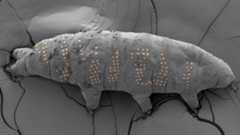
Icy ink. This tardigrade is sporting what is perhaps the world’s tiniest ‘tattoo’. Researchers used anelectron beam to etch the dots into a layer of ice coating the animal. The beam transforms the substance into a compound that sticks to the tardigrade’s skin, leaving the design visible when the rest of the ice evaporates. The method’s extremely high precision means it could have applications in biomedical engineering, the scientists who developed the technique say. They are now working on tattooing even smaller organisms, including bacteria, in the same way.
Adapted from Z. Yang et al. Nano Lett. 15, 6168–6175 (2025)
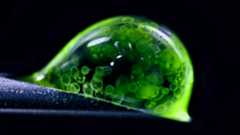
Green living. Colonies ofVolvox algae float around in a water droplet in this microscopy image taken by chemical engineer Jan Rosenboom. EachVolvox sphere is made up of hundreds to thousands of individual cells working co-operatively — offering a glimpse of what early multicellular life might have looked like. The shot came second place overall in the2025 Nikon Small World photomicroscopy contest.
Jan Rosenboom/Nikon Small World
Fake kidney. This lab-grown human kidney ‘assembloid’ is astep towards creating artificial kidneys. Tiny filtering units have formed around a central drainage tube, similar to the organization of a real kidney. When transplanted into mice, these structures can filter blood and take up proteins.
Pedro Medina/Li Lab
Red lightning. Photographers managed to capture rare ‘red sprites’ in the sky above New Zealand in October. The phenomenon is caused by bursts of electrical energy in the atmosphere that shoot upwards, creating unusual, jagged shapes that glow for only a few milliseconds. “It looks like you’re seeing something that is not real, it’s very ethereal,” says photographer Tom Rae.
Dan Zafra/Capture the Atlas
Solar-powered slug. The sheep nudibranchCostasiella kuroshimae can feed on algae and sequester the chloroplasts into its own cells, where they capture sunlight and produce energy through photosynthesis. The sea slug gets its name from the sensory organs on either side of its head that look a bit like sheep’s ears. This one was photographed laying its eggs in a spiral pattern by Giancarlo Mazarese and was part of aseries of photos honoured inOceanographic’sOcean Photographer of the Year award.
Giancarlo Mazarese/Ocean Photographer of the Year 2025
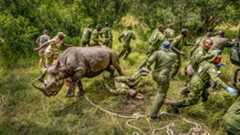
Rhino revival. Kenya’s black rhinoceroses (Diceros bicornis) haverebounded from near-extinction thanks to conservation efforts, but protecting them is difficult work. In this photograph — awinner in the 2025 BigPicture wildlife photography competition — a team treats a sick rhino, showing the skill and coordination needed to handle these powerful animals safely — even when the rhino is under sedation.
Ami Vitale/BigPicture Natural World Photography Competition
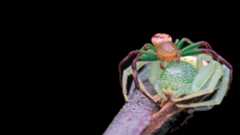
Creepy cuddle. This shot of a pair of courting crab spiders, taken by nature photographer Sandip Guha in Siliguri, India, highlights the difference in size between the male and his mate — in some species, the female is more than 60 times larger. The picture was a winner at this year’sLondon Camera Exchange Photographer of the Year competition.
Sandip Guha
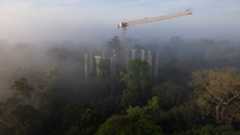
Forest time machine. Scientists have built a ‘time machine’ in Brazil that pumps carbon dioxide into the forest canopy to simulate future atmospheric conditions. The project aims to investigate how the biome adapts to climate change. It is located near Belém, where theCOP30 climate summit took place in November.
Lalo de Almeida/Panos Pictures
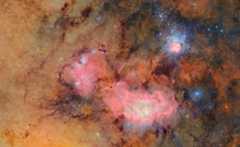
First light. This stunning shot of the Trifid Nebula (top right) and the Lagoon Nebula combines hundreds of images taken by the 3,200-megapixel digital camera — the world’s largest — at theVera C. Rubin Observatory in Chile that came online in 2025.
NSF–DOE Vera C. Rubin Observatory
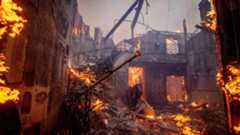
Urban inferno. Los Angeles, California, experienced some of itsdeadliest and most destructive fires on record in January. The fires ripped through neighbourhoods and reduced thousands of buildings to charred rubble. The city’s high density of buildings and strong winds were among the factors that helped the fires to spread so rapidly, researchers say.‘Weather whiplash’ — a drastic swing from very wet to very dry conditions — could also have played a part. Similar urban firestorms are likely to become more common in future as Earth warms.
Ethan Swope/Associated Press/Alamy
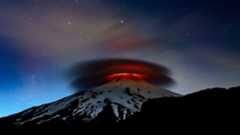
Rings of fire. A pair of pleasingly circular clouds is illuminated by lava from the Villarrica volcano in Chile as night falls. The scene wascaptured by photographer Francisco Negroni, who takes regular trips to the volcano to monitor its activity.
Francisco Negroni
In compiling this year’s collection of striking science images,Nature’s media editors each identified a photograph that said something special to them. Here is their take on the past 12 months.
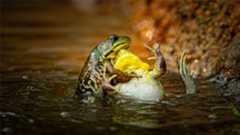
Froggy fight. Lizzy Brown (Managing media editor). Thiswinning entry in the 2025 Nikon Comedy Wildlife Awards caught my eye and really made me smile. It shows two male green frogs (Lithobates clamitans) fighting over territory. The picture was captured by Grayson Bell, a talented 13-year-old photographer who gave it the genius title ‘Baptism of the Unwilling Convert’.
Grayson Bell/Nikon Comedy Wildlife Award
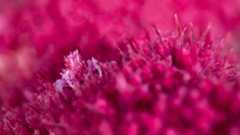
Pretty in pink. Jessica Hallett (Media editor). Of the thousands of images I have seen this year, this photograph of a tiny juvenile candy crab (Hoplophrys oatesii) perched on her vibrant pink coral mattress was one of my absolute favourites. This striking shot, taken by photographer and artist Jade Hoksbergen, was afinalist in the Fine Art category of this year’s Ocean Photographer of the Year competition. To spot such a well-camouflaged, tiny creature is a true testament to Hoksbergen’s sharp eye and creative vision, and the image bought me such joy — a refreshing and welcome break from the many hard-hitting, bleak images that crossed my desk this year.
Jade Hoksbergen/Ocean Photographer of the Year
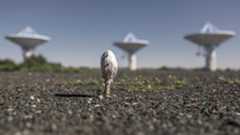
Astronomy background. Tom Houghton (Senior media editor). I was struck by the unexpected contrast of this image — a lone mushroom pictured in the foreground against the looming presence of three now-decommissioned KAT-7 radio-telescope antennas in South Africa’s MeerKAT National Park. The composition highlights the structures’ similarities and differences, and really speaks to the clever observation of AFP photographer Marco Longari.
Marco Longari/AFP via Getty
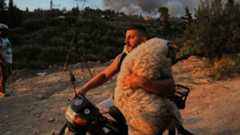
One-hand rescue. Agnese Abrusci (Senior media editor). A man guides his scooter down a dusty hill near Patras, Greece, while cradling a sheep— a moment of both urgency and tenderness as wildfires sweep through neighbourhoods on the slopes above Greece’s third-largest city. The photo was taken on a late afternoon in mid-August by AP photographer Thanassis Stavrakis. The frame captures the scene’s intensity and hints at a broader reality: the growing toll of fires across southern Europe, and the quiet heroism of those who refuse to leave animals behind.
Thanassis Stavrakis/AP Photo/Alamy
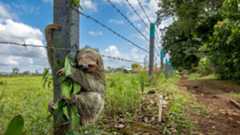
Hang in there. Amelia Hennighausen (Media editor). As a photo editor, I see various forms of tragedy every day, but this photo was unforgettable. The contrast of the placid face of the sloth and its calm demeanour against the human-made barbed-wire fence it clings to reflects how the natural world is clinging onto life. Globally, many wild habitats are being destroyed. This photo serves as a reminder for everyone to be more creative in how we steward Earth’s resources.
Emmanuel Tardy



 Built with Shorthand