

The PassoverHaggadah demands that each person see him or herself as having personally come forth out of Egypt. Accordingly, the seder is one of the most sensory-heavy rituals of the Jewish year. During the seder, we don’t just tell the story of theExodus, we see, smell, feel, and taste liberation.
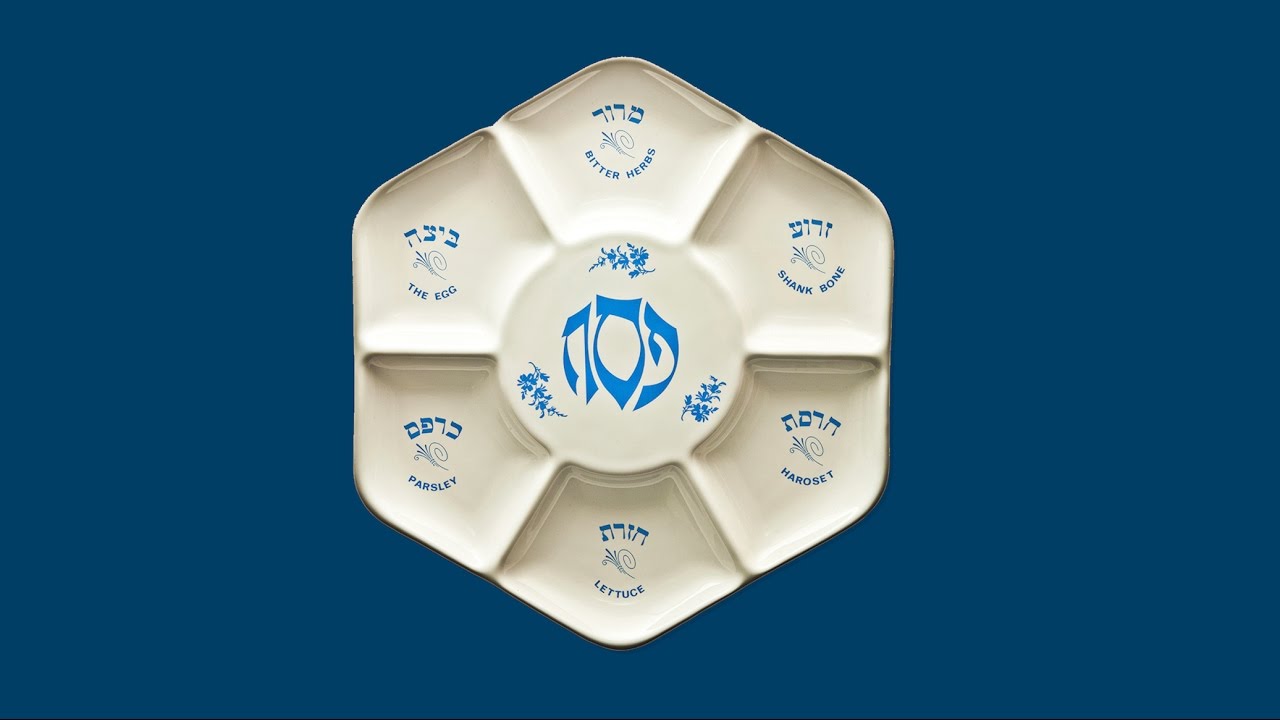
Many of the elements of this sensory experience appear on the seder plate (k’arah), which serves as the centerpiece of the seder table. The seder plate traditionally holds five or six items, each of which symbolizes a part (or multiple parts) of thePassover story.
What’s On the Seder Plate
Karpas (a green vegetable, most often parsley)
Karpas represents the initial flourishing of the Israelites during the first years in Egypt. At the end of the biblical book ofGenesis, Joseph moves his family to Egypt, where he becomes the second-in-command to Pharaoh. Protected by Joseph’s exalted status, the family lives safely for several generations and proliferate greatly, becoming a great nation. The size of this growing population frightens the new Pharaoh, who enslaves the Israelites, lest they make war on Egypt. Even under slave conditions, the Israelites continue to reproduce, and Pharaoh eventually decrees that all baby boys be killed. In the course of the seder, we dip the karpas in salt water (Ashkenazi custom) or vinegar (Sephardi custom) in order to taste both the hope of new birth and the tears that the Israelite slaves shed over their condition.

Karpas also symbolizes the new spring. One of the names for Passover isHag Ha-Aviv or the “holiday of spring.” Right around Passover the first buds emerge, and we look forward to the warmth and sense of possibility that accompany the beginning of spring. Some Ashkenazi Jews use a potato for karpas,as green vegetables were not readily available in Eastern Europe.
Haroset (sweet fruit paste symbolizing mortar)
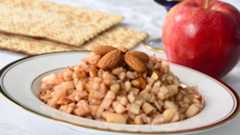
This mix of fruits, wine or honey, and nuts symbolizes the mortar that the Israelite slaves used to construct buildings for Pharaoh. The name itself comes from the Hebrew wordcheres or clay. Ashkenazi Jews generally include apples in haroset, a nod to themidrashic tradition that the Israelite women would go into the fields and seduce their husbands under the apple trees, in defiance of the Egyptian attempts to prevent reproduction by separating men and women.
Sephardic recipes forharoset allude to this fertility symbolism by including fruits, such as dates and figs, mentioned inSong of Songs, the biblical book that is most infused with images of love and sexuality.
Maror (bitter herb, often horseradish)

This bitter herb allows us to taste the bitterness of slavery. Today, most Jews use horseradish asmaror.Originally, though, maror was probably a bitter lettuce, such as romaine, or a root, such as chicory. Like life in Egypt, these lettuces and roots taste sweet when one first bites into them, but then become bitter as one eats more. We dip maror into haroset in order to associate the bitterness of slavery with the work that caused so much of this bitterness.
Hazeret (second bitter herb, often Romaine lettuce)
A second bitter herb, used inkorech or theHillel sandwich, which consists of matzah and bitter herbs (some add haroset as well). Many Jews use horseradish for maror and Romaine lettuce or another bitter green forhazeret. Others use the same vegetable for both parts of the seder, and do not include hazeret on the seder plate at all.
READ: How To Veganize Your Seder Plate
Zeroa (shank bone)
A roasted lamb shank bone that symbolizes the lamb that Jews sacrificed as the special Passover offering when theTemple stood inJerusalem. Thezeroadoes not play an active role in the seder, but serves as a visual reminder of the sacrifice that the Israelites offered immediately before leaving Egypt and that Jews continued to offer until the destruction of the Temple.Vegetarians often substitute aroasted beet, both because the red of the beet resembles the blood of the sacrifice and because the Talmud mentions beets as one of the vegetables sometimes dipped during the seder.
Beitzah (egg)
A roasted or hard-boiled egg that symbolizes thehagigah sacrifice, which would be offered on every holiday (including Passover) when the Temple stood. The roundness of the egg also represents the cycle of life — even in the most painful of times, there is always hope for a new beginning.
How Is the Seder Plate Arranged?
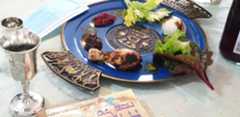
There are a few traditions regarding the arrangement of items on the seder plate. Most commonly, the maror is placed in the middle of the plate. The hazeret is at the six o’clock position followed by, moving clockwise, karpas (seven o’clock), beitzah (11 o’clock), z’roa (one o’clock), and haroset (five o’clock).
What Else Is On the Seder Table?
In addition to the items on the seder plate, the seder table should also have three pieces ofmatzah wrapped or covered in a cloth and a container of salt water or vinegar in which to dip the karpas. Some seder plates have a compartment for matzah underneath, or include space for salt water among the other symbols. In most cases, though, matzah and salt water or vinegar sit near, but not on, the seder plate.
Many contemporary Jews add additional items to the seder plate to symbolize modern liberation struggles. The most common new item is anorange, which honors the role of women and/or gays and lesbians in Jewish life. The orange symbolizes the fruitfulness that these previously marginalized communities bring to Jewish life. Some Jews place an olive on the seder plate to signal hope for eventual peace between Israelis and Palestinians.
READ: 10 Unique Items to Add to Your Seder Plate
One way to encourage participation in the seder is to ask each guest to bring one item that, for him or her, represents liberation. Participants might bring family heirlooms that remind them of their family’s immigration story, newspaper stories about current liberation struggles, or other symbolic objects. Each guest should place this item near the seder plate and, at an appropriate time in the seder, explain its significance.
Prep for Passover like a pro with this special email series.Click here to sign up and you’ll receive a series of helpful, informative, and beautiful emails that will help youget the most out of the holiday.
Ashkenazi
Pronounced: AHSH-ken-AH-zee, Origin: Hebrew, Jews of Central and Eastern European origin.
seder
Pronounced: SAY-der, Origin: Hebrew, literally "order"; usually used to describe the ceremonial meal and telling of the Passover story on the first two nights of Passover. (In Israel, Jews have a seder only on the first night of Passover.)
Talmud
Pronounced: TALL-mud, Origin: Hebrew, the set of teachings and commentaries on the Torah that form the basis for Jewish law. Comprised of the Mishnah and the Gemara, it contains the opinions of thousands of rabbis from different periods in Jewish history.
afikomen
Pronounced: ah-fee-KOH-men, Origin: Greek, a piece of matzah that is hidden during the Passover seder, found after dinner and eaten as dessert at the end of the meal.
Sign Up for Our Newsletter
Get Jewish wisdom & discovery in your inbox


