


Money Research Collective’s editorial team solely created this content. Opinions are their own, but compensation and in-depth research determine where and how companies may appear. Many featured companies advertise with us.How we make money.
How Does Coinbase Work?
By James F. TrummMONEY RESEARCH COLLECTIVE

Coinbase is a cryptocurrency exchange that allows investors to buy and sell cryptocurrency. It features an easy-to-use interface that doesn’t require its customers to have any technical knowledge of crypto trading. Coinbase is the largest crypto exchange in the United States by trading volume.
Table of contents
- What is Coinbase?
- How many cryptocurrencies does Coinbase support?
- Coinbase fees
- How to buy and sell crypto on Coinbase
- Coinbase vs Coinbase Pro
- What is the difference between Coinbase and Coinbase Wallet
- Is Coinbase safe?

What is Coinbase?
Coinbase Global, Inc. operates an online exchange that allows people to buy, sell and trade numerous types of cryptocurrency. Besides offering its trading platform, the company provides services that include crypto wallets, moneylending, staking, earn-by-learning promotions, a pro platform with sophisticated metrics and graphing, andcrypto tax forms that are required by the IRS. Coinbase is accessible on the web and via a mobile app.
Founded in 2012 (which makes it one of the oldest still-operating exchanges in the world), Coinbase did for crypto trading what Ford did for automobiles: it didn’t invent its products, but rather made them accessible to the general public.
How many cryptocurrencies does Coinbase support?
In addition to the major coins like Ethereum (ETH), Bitcoin (BTC), USD Coin (USDC), Bitcoin Cash, Binance USD, Dogecoin, Litecoin, Tether, Cardano and other altcoins, the Coinbase platform also supports the buying and selling of over 100 other digital currencies. New coins are regularly added to Coinbase’s offerings.
Coinbase fees
Some Coinbase reviews have suggested that the company charges more than its competitors and that its fee structure is hard to understand.
Yes, you can find less-expensive crypto exchanges, but you probably won’t find any that support as many different kinds of crypto, that offer learn-to-earn (aka Coinbase Earn), lending and staking, that feature an easy-to-use lightning-quick interface and offer a pro option that does even more (see below). Coinbase also offers the Coinbase Card, a Visa-branded debit card that pays users 4% back on every purchase. These customer-friendly benefits are why Coinbase is frequently lauded as thebest crypto exchange for virtual currency beginners.
The claim that the Coinbase fee structure is complex has some truth to it. Coinbase fees depend on an array of factors that include where you live, what you are buying or selling and how you are paying. To make things even more complicated, you may sometimes pay a fixed transaction fee and sometimes a variable one. That said, for smaller traders, the fee structure is pretty easy to understand. What’s more, the Coinbase interface features a preview feature for every transaction where you can see precisely what you’ll pay. So fees shouldn’t come as a surprise, even if they are difficult to calculate.
Here’s an example of that feature in action, showing reviews of a $200 Bitcoin purchase, a $200 Bitcoin sale and a conversion of $200 worth of Bitcoin to Ethereum:
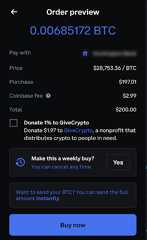

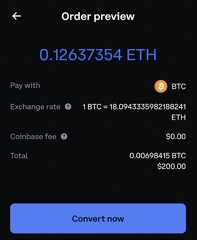
In the above $200 transactions, a Coinbase user pays a flat fee of $2.99 to buy Bitcoin – about 1.5%. The conversion from Bitcoin to Ethereum is free.
But on larger trades and transactions that involve trading different digital assets, things do get more complex, depending on whether you are deemed to be adding or subtracting liquidity from the market, as explained on Coinbase’swebsite:
When you place an order at the market price that gets filled immediately, you are considered a taker and will pay a fee between 0.05% and 0.60%. When you place an order which is not immediately matched by an existing order, that order is placed on the order book. If another customer places an order that matches yours, you are considered the maker and will pay a fee between 0.00% and 0.40%.
When you place an order that gets partially matched immediately, you pay a taker fee for that portion. The remainder of the order is placed on the order book and, when matched, is considered a maker order. You pay a maker fee for this remaining portion of the total order.
(Source:Coinbase website, accessed on June 13, 2022)
While this structure is complicated, all fees are clearly disclosed when users preview their transactions. So it’s hard to see how anyone could be surprised by a Coinbase fee.
How to buy and sell cryptocurrencies on Coinbase
As befits its reputation for ease of use, setting up aCoinbase account and making transactions is no more difficult than opening a bank or brokerage account online. You can do so either on the web or by downloading the Coinbase app, which is available for both Apple iOS and Android devices.
First, you’ll have to create an account. To do this, you provide your name and contact information, your citizenship information, and personal identifying info such as your Social Security Number or TID. You’ll also have to choose a password – and it’s important to write this down somewhere because changing or recovering it can be difficult. Coinbase accounts are secured by two-factor authentication and use the Google Authenticator for this purpose. You’ll have to download the authenticator on your phone and then input the number it displays.
Second, you’ll have to verify your identity. This starts with uploading a pic of a government-issued ID (note that passport cards will NOT work for this purpose) and a scan of a recent bank statement. You must also verify your phone number, email address, and residential address. You will have to answer some questions about your employment status and income; this is done to comply with federal “know your customer” (KYC) regulations. You can also link a debit card (but NOT a credit card) and PayPal to your Coinbase account and use them to fund your crypto purchases.
Third, you will need to link the bank account that you use to pay and receive fiat money in connection with your crypto transactions. Your Coinbase account can also be funded by wire transfer.
Once your account is active, you can begin to buy cryptocurrency. Click on the blue “buy/sell” button at the top of the screen. A dialogue box will open up. From there, select the type of cryptocurrency you want to buy, enter the amount you want to purchase (either in dollars or crypto units), choose your payment method, preview your transaction to see what your fees will be and click “buy now.” Small transactions are executed almost immediately – and you will receive a verification email promptly. Large transactions, however, may take longer to process.
When you see the crypto in your account, you can use a similar process to sell it for cash by selecting the “sell” tab or use it to purchase another cryptocurrency by clicking on the “convert” tab. Coinbase always displays the total value of all your crypto on your dashboard, which is the first screen you see when you log into your account.
Coinbase vs. Coinbase Pro
Coinbase Pro is a more advanced, more feature-rich and more extensive crypto exchange. It supports over 250 cryptocurrencies – more than twice the number that regular Coinbase does. Its enhanced functionality allows customers to place advanced cryptocurrency trading orders, such as stop and limit orders. Graphical data displays are more detailed, move quickly in real time and utilize the now-familiar“candlestick charts” that show a cryptocurrency’s open price, close price, lowest price and highest price at regular intervals. These tools make it easier to understand what’s going on in the crypto market. And it’s easy and free to transfer crypto between regular Coinbase and Coinbase Pro.
Various Coinbase reviews note that it’s possible to save money on transaction fees by using Coinbase Pro, especially if you’re an active trader.
What’s the difference between Coinbase and Coinbase Wallet?
What most people simply call “Coinbase” is a cryptocurrency exchange. It allows people to convert their fiat currency – their US dollars, pounds, euros or yen – into crypto and to do the reverse. When you buy crypto on Coinbase, it’s added to your account which is secured with a password – known by Coinbase – that allows you into the exchange. This facilitates rapid transactions and makes for an easy-to-use interface.
Coinbase Wallet, however, is acryptocurrency wallet, not an exchange. It can only be accessed by someone (presumably the customer) in possession of the private keys (passwords) needed to open it. It can only store and trade crypto. While some crypto wallets are “cold storage” devices (i.e., physical objects often resembling a thumb drive that you have to connect to your computer to make a transaction), Coinbase Wallet is a “hot wallet” that works without a physical key when a customer enters the current password into the Coinbase Wallet system. If you want to buy crypto with or sell it for fiat currency, you’ll first have to move your assets to an exchange.
In one sense, crypto wallets are more secure than crypto exchanges, because you and only you – and not Coinbase – know the passwords needed to unlock the wallet. But the downside is that if you lose or forget your passwords, you’ve lost access to your crypto and no one at Coinbase customer support or any other organization can come to your rescue.
Coinbase and Coinbase Wallet are separate from each other. Youdon’t need to have an accounton Coinbase to open a Coinbase Wallet and vice-versa.
Is Coinbase safe?
Cryptocurrency is a highly volatile and speculative investment. Crypto investments are not insured by the FDIC or by private entities. What’s more, crypto isn’t backed by anything other than a belief among investors that it has value.
Volatility isn’t unique to crypto assets traded on Coinbase, but the company has more than98 million verified users and has done much to bring cryptocurrency into the mainstream – and onto Main Street. A catastrophic crash in crypto prices would affect a lot of people, some of whom may not have understood how risky crypto can be.
There are other dangers that come with using Coinbase. Its customers were unsettled recently when the company updated its filings with the Securities & Exchange Commission (SEC) to state that if the company went bankrupt, a court might deem customers’ crypto accounts to beassets of the company rather than assets of its customers. In other words, if Coinbase itself went bankrupt, it’s possible that people with crypto on the Coinbase exchange (but not in a Coinbase Wallet) could lose some or all of their investment.
Despite the recent sharp downturn in cryptocurrency prices, Coinbase’s CEO Brian Armstrong hasassured customersthat the company is not at risk of going bust. Nevertheless, the company announced on June 14, 2022 that it waslaying off 18% of its workforce. This news surely has some Coinbase users reaching for a double dose of melatonin before they go to bed. Those customers should seriously consider safeguarding their crypto holdings by securing them in a crypto wallet.
Perhaps the biggest danger to Coinbase customers is posed by their own carelessness. A Coinbase account is secured by a password and two-factor authentication, just as many bank accounts, investment accounts and credit card accounts are. It’s theoretically possible that someone could hack into Coinbase’s computers and grab a trove of account passwords.
But it’s more likely that customers themselves may compromise their own passwords and authentication data. Less than two years ago, over 6,000 Coinbasecustomers were victimizedbyphishing scams in which they were persuaded to turn over their passwords to hackers, who then exploited weaknesses in Coinbase’s security protocols and stole customers’ crypto assets. In this case, the company compensated customers for their losses, but there’s no guarantee that it will do so again, especially if customer carelessness facilitated the thefts.
Disclaimer: the author has used Coinbase for several years and owns some of the cryptocurrencies mentioned in this article. He has received no compensation for this article other than a standard writer’s fee from the publisher.
