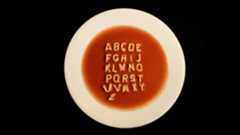
You know the alphabet—it’s one of the first things you’re taught in school. But did you know that they’re not teaching youall of the alphabet? There are quite a few letters (defined somewhat loosely) that English largely tossed aside as our language grew, and you probably never even knew they existed (though in some cases, their fossils can still be seen).
1. Thorn


Have you ever seen a place that calls itself “ye olde" whatever? As it happens, that’s not aY, or, at least, it wasn’t supposed to be. Originally, it was anentirely different letter calledthorn, which derived from the Old English runic alphabet, Futhorc. We replacedthorn withTH over time—it fell out of use at least in part because Gothic-style scripting made the lettersY andthorn look practically identical. And since Continental printing presses didn’t havethorn anyway, it just became common to replace it with aY, a practice that was dropped as well—except on olde signs.
2. Wynn


Another holdover from the Futhorc runic alphabet,wynn was adapted to the Latin alphabet because there wasn't a letter that quite fit the "w" sound that was common in English. You could (and they did) stick twoUs together, but that wasn’t exactly right. Over time, though, the idea of sticking twoUs together actually became quite popular, enough so that they literally became stuck together andbecame the letterW.
3. Yogh


Yogh represented quite a few sounds in Middle English. According to English scholar Dennis Freeborn’sFrom Old English to Standard English, in just the Middle English poemSir Gawain and the Green Knight, it could stand for the “y” sound inyet, the “ch” sound in GermanBach or Scottishloch, and many more.
But as the years went on, scholars startedreplacing all the instances ofyogh withY,G, orGH in their texts. Then, these newGH letters,through various linguistic processes,split into some of the wide range of sounds associated with "gh" today (though not all—theGH you see inghost is thought to befrom Dutch printers, for instance). It wasn’t a smooth process—according to linguistics professor Kate Burridge, “in the 1600s the worddaughter was pronounced three ways: ‘dauter’, ‘dauchter’ and ‘daufter.’”
Theyogh held on in Scotland, where its shape began to resemble acursiveZ—so when printing presses arrived, Scottish printers just replaced the missingyoghs with readily availableZs. Over the centuries, this meant that people began mispronouncing names—even today the first name of the UK politician Menzies Campbell ispronounced “MING-iss” rather than “Men-zees," though some Menzies do pronounce it with aZ.
4. Ash


You’re probably familiar with this letter from old-fashioned text, especially the kind found in churches. It’s even still used stylistically in words today, likeæther andæon. What you may not know, however, is thatæ was an English letter back in the days of Old English; it was calledæsc orash after the ash Futhorc rune, for which it was used as a substitute when transcribing into Latin letters. The letter disappeared around the 13th century; then,according to author Stephen Webb, it found a use in the 16th century in the Latin form of certain Greek words and was also used to pluralize Latinate words that ended inA, meaning it disappeared and reappeared in the alphabet (though nowadays it’s back on the disappearing track).
5. Eth


Eth is kind of like the little brother tothorn. Originating from Irish,today it represents a slightly different pronunciation of the “th” sound than is usually associated with thorn, with eth being the “th” sound in the wordsthis orthere and thorn being the “th” sound in the wordthorn.
But all evidence suggests that this pronunciation difference didn’t exist in Old English—they were often usedinterchangeably, even within the same manuscript.According to British linguist David Crystal, a general lack of Old English manuscripts makes it difficult to determine why athorn or aneth might be used in a particular manuscript, but it could be because there was a difference in the scribe’s accent, the variations were fun, the scribe thought one looked better or was easier to write, or maybe they just didn’t notice.Eventually boththorn andeth were replaced byTH, thoughthorn managed to stick around a little longer.
6. Ampersand
Today we just use it for stylistic purposes, but the ampersand has had a long and storied history in English, and was actuallyfrequently included as a 27th letter of the alphabet asrecently as the 19th century.
In fact, it’s because of its placement in the alphabet that it gets its name. Originally, the character was simply calledand or sometimeset (from the Latin word forand, which the ampersand is usually stylistically meant to resemble). However, when teaching children the alphabet, the & was often placed at the end, afterZ, and recited as “and per seand,” meaning “and in and of itself” or “and standing on its own” (& wasn’t entirely unique for this—people also used to say "A per se A," "I per se I," and "O per se O," especially when spelling out words to signify that those letters were functioning as words in their own right).
So you’d have “w, x, y, z, and, per se,and.” Over time, the last bit morphed intoampersand, and it stuck even after we quit teaching it as part of the alphabet.
7. Insular G


This letter (referred to asinsular G orIrish G) is sort of the grandfather of the Middle English version ofyogh. Originally an Irish letter, it was used for sounds like "zhyah," "jhah," and "gah." But with the arrival of the more familiar shape of the Carolingian G, that took over the "g" sound.
As Old English transformed into Middle English,insular g turned intoyogh and, as mentioned earlier, was slowly replaced in large part with the now-standardGH by scribes, at which pointinsular g/yogh were no longer needed and the Carolingian G stood alone (though adescendant can still be seen in modern Ireland).
8. That
Much like the way we have a symbol forand, we also once had a similar situation withthat (or, in Old English,þæt), which was a letterthorn with a stroke at the top. It was originally just a shorthand, an amalgamation ofthorn andT (so more like “tht”), but it eventually caught on andgot somewhat popular in its own right—according to Unicode, the letter could even be used as a stand-in for Old English words that containedþæt,sooþþæt ("until") could be spelledO,thorn,thorn-with-stroke-in-ascender [PDF]. AndYt (with theY being arelic thorn, à laYe)survived as shorthand forthat until surprisingly late,showing up well into the 18th century.
9. Tironian “Et”


It’s said that a long time ago, Marcus Tullius Tiro (who was basically Roman statesman Cicero’s P.A.) invented a shorthand system called Tironian notes. It was a fairly simple system that was easily expanded, so it remained in use by scribes for centuries after Tiro’s death [PDF].
One of the most useful symbols was theet symbol—a simple way of tossing in an “and.” It was sometimes drawn in a way that’s now a popular stylistic way of drawing the number 7. And English scribes did something very clever with it—if they wrote b⁊, that would stand for "band" or "bond" or whatever spelling that particular scribe used (this being an era before spelling bees). The Tironian et still shows up on things like signs in Ireland, but it’s largely been replaced by the ampersand.
10. Long S

.svg)
You may have seen this in old books or other documents. Sometimes the letterS will be replaced by a character that looks a bit like anF. This is what’s known as along S, which was an early form of a lowercaseS. And yet the modern lowercaseS (then referred to as theshort S) was still used according to acomplicated set of rules (but most usually seen at the end of a word), which led to many words (especially plurals) using both. For example,ſuperſtitious is how the wordsuperstitious would have been printed. It was purely a stylistic lettering, and didn’t change pronunciation at all. It was also kind of silly and weird, since no other letters behaved that way—so around the beginning of the 19th century, the practice was largely abandoned and the modern lowercaseS became king. But it does survive somewhere possibly unexpected: calculus homework. The integral symbol isthought to derive from along S representing Latinsumma.
Additional research by Austin Thompson. A version of this story ran in 2012; it has been updated in 2021.
Loading recommendations... Please wait while we load personalized content recommendations