Super Nintendo Entertainment System
- This article is about the video game console. For the application forNintendo Switch andNintendo Switch 2, seeSuper Nintendo Entertainment System - Nintendo Classics.
| Super Nintendo Entertainment System | |||||||||||
|---|---|---|---|---|---|---|---|---|---|---|---|

| |||||||||||
| Generation | Fourth generation | ||||||||||
| Release dates | Super Famicom: November 21, 1990[1] November 21, 1990[1] 1992[?] 1992[?] 1994[?] 1994[?]Super Nintendo Entertainment System:  August 23, 1991[2] August 23, 1991[2] 1992[3][better source needed] 1992[3][better source needed] April 11, 1992[4] April 11, 1992[4] April 11, 1992[4] April 11, 1992[4] June 6, 1992[4][5] June 6, 1992[4][5] June 8, 1992[6] June 8, 1992[6] July 3, 1992[?] July 3, 1992[?] August 30, 1993[7] 1994[?] August 30, 1993[7] 1994[?] 1994[8] 1994[8] 1994[8] 1994[8] 1994[8] 1994[8] 1994[8] 1994[8] 1994[8] 1994[8] November 14, 1994[8] November 14, 1994[8] November 15, 1994[9] November 15, 1994[9]Super NES Classic Edition: September 29, 2017[?] September 29, 2017[?] September 30, 2017[?]Nintendo Classic Mini: Super Famicom: October 5, 2017[?] | ||||||||||
| Discontinued | 1999[10] September 25, 2003[11] | ||||||||||
| Ratings | Super NES Classic Edition:
| ||||||||||
| Predecessors | Family Computer Nintendo Entertainment System | ||||||||||
| Successor | Nintendo 64 | ||||||||||


 - Teen
 - Twelve years and older
 - Twelve years and older
 - Twelve years and older
 - Mature
- “Now you're playing with power. Super power!”
- —Advertisement slogan for the SNES
TheSuper Nintendo Entertainment System (abbreviated asSNES,Super NES, orSuper Nintendo), called theSuper Famicom or theSuper Family Computer[12] (abbreviated asSuFami orSFC)[13] in Japan, Taiwan, and Hong Kong, is a video game console created byNintendo. In early development, it was originally calledNintendo Entertainment System 2 orNES2.[citation needed] The system was released in Japan on November 21, 1990; in South Korea later that year; in North America on August 23, 1991; in the United Kingdom and Ireland on April 11, 1992; in most of continental Europe on June 6, 1992; in Chile two days later; in Oceania in July 1992; in Brazil on August 30, 1993; in Croatia, the Czech Republic, Slovakia, Slovenia, and Yugoslavia in 1994; in Poland on November 15, 1994 (simultaneously with the originalNintendo Entertainment System and theGame Boy)[8]. Nintendo additionally arranged a deal with the Russian technology company Steepler in 1994 to permit the sale and distribution for the PAL SNES in the former Soviet Union.[14][15][16] The South Korean version was rebranded as theSuper Comboy and was distributed byHyundai Electronics to circumvent the country's bans on Japanese cultural imports. It is the last Nintendo console that has a different design and name in North America and PAL regions. The PAL version is a mix between the Super Famicom and the American SNES, keeping the design of the Super Famicom, while using the name from the American version. The Super Nintendo Entertainment System is the successor to the original Nintendo Entertainment System and similarly went on to produce many popular games, many of which are of theSuper Mario franchise, most particularlySuper Mario World,Donkey Kong Country, andSuper Mario World 2: Yoshi's Island.
Many early North American SNES cartridges had a long crevice spanning the cartridge. This was to prevent people from pulling the cartridges out when the system was turned on. These were produced as late as March 1993, as some earlyStar Fox cartridges were manufactured with this mold. Later NA SNES cartridges opted into a different design because people were possibly breaking their SNES units,[citation needed] at the very earliest of June 1993, as cartridges forYoshi's Cookie orMario is Missing! do not have this mold.
The system's S-SMP audio chip, which usedADPCM sample playback instead of a digital synthesizer like competing systems, was developed by consumer electronics companySony. The success of this partnership resulted in another deal to create theSuper NES CD-ROM, a planned peripheral for the SNES that would have been able to play CD-ROM discs, in response to the Japanese success of a similar add-on for thePC Engine. However, because the contract would have given Sony full control of and royalties for CD-ROM titles, Nintendo publicly terminated their partnership and courted a new deal withPhilips, who previously co-developed the Compact Disc format with Sony throughout the 1970s. The Philips deal failed to result in a finished product, and instead, Philips was given the rights to use theSuper Mario andThe Legend of Zelda IPs for several titles on its own CD-based multimedia device, thePhilips CD-i. OnlyoneSuper Mario title emerged from this arrangement, though two others were planned before being canceled. Sony, meanwhile, would eventually release thePlayStation in response to its deal with Nintendo falling apart, considerably outselling theNintendo 64 during the late 1990s. Some games of theSuper Mario franchise, such asSuper Mario All-Stars andSuper Mario World 2: Yoshi's Island, were considered for the Super NES CD-ROM, only to be shifted to the base SNES following the add-on's cancelation.[17][18]
Because of the international rivalry between Nintendo and Sega, which competed against the SNES with theirSega Genesis, manySuper Mario games during this time included jabs at Sega's flagship series,Sonic the Hedgehog, and vice versa. InDonkey Kong Country 2: Diddy's Kong Quest,Sonic's boots and the plasma gun fromEarthworm Jim are seen next to a bin and labeled "no hopers." InSuper Mario World 2: Yoshi's Island, there areblue hedgehog enemies that greatly resemble Sonic, though this is likely just a coincidence.
The console was re-released as Super Famicom Jr. for Japan, and on October 20, 1997, it was released in North America as theNew-Style Super NES.[19] The newer model was smaller and lacked the eject button, and it also could not output the S-Video and RGB signals.
Accessories[edit]
SNES Controller[edit]


The SNES Controller has a layout which popularized the layout used by most modern controllers. It is more round-shaped instead of rectangle-shaped from theNES controller. It has the ,
, ,
, , and
, and buttons and the
 from the NES, plus four extra buttons: the
 ,
, ,
, , and
, and buttons. There was also aLodgeNet version for hotels.[20]
The American controller is slightly different from the Japanese and the PAL controllers. Instead of having each button be a different bright color, the and buttons were purple and the and buttons were lavender, tying into the mechanical color scheme of the SNES's American model.
There is also a Wii adaption of the SNES controller for use as a substitution for the Classic Controller with games that support said controller.
Super Game Boy[edit]
- Main article:Super Game Boy

The Super Game Boy is a cartridge adapter that allows play of allGame Boy games, as well asGame Boy Color games that were made backwards compatible to work on the original Game Boy, on the Super Nintendo. Some Game Boy games are labeled as enhanced for Super Game Boy, such asDonkey Kong.
Super NES Mouse[edit]

TheSuper NES Mouse (known in Japan as theSuper Famicom Mouse) is an accessory for certain Super NES games. It was only compatible with the Super NES and was thus was only used in the early-to-mid-1990s. The Super NES Mouse mimics the appearance and action of an actual computer mouse; the Super NES Mouse controlled the cursor in someSuper Mario games.
The Super NES Mouse was originally bundled withMario Paint and a mouse pad for $59.95.
On July 29, 2025, support for Super NES Mouse controls was added toSuper Nintendo Entertainment System - Nintendo Classics forNintendo Switch andNintendo Switch 2 whenMario Paint was added to the game list. On Nintendo Switch, the controls are utilized through a connected USB computer mouse, while on Nintendo Switch 2, theJoy-Con 2's mouse controls can also be used.
Super Mario games compatible with the Super NES Mouse[edit]
- Mario Paint
- Mario & Wario
- Mario's Early Years! Fun with Letters
- Mario's Early Years! Fun with Numbers
- Mario's Early Years! Preschool Fun
- Mario's Super Picross
- UNDAKE30 Same Game Daisakusen Mario Version
Super Scope[edit]
- Main article:Super Scope

The SNES Super Scope is alight gun accessory for the SNES. It has one "fire" button for shooting, either in single bursts or a constant stream, depending on whether or not its on/off switch is set to "turbo". It also has a second "cursor" button and a "pause" button. It was used for very few games, including oneSuper Mario title,Yoshi's Safari.
Super Multitap[edit]

TheSuper Multitap, byHudson Soft, allowed to turn the player 2 controller port into four controller ports, allowing for up to five simultaneous players, but only if the game supports it. Although noSuper Mario game for the SNES uses the Super Multitap, theGame Boy gameWario Blast: Featuring Bomberman! can use the accessory if played in aSuper Game Boy, although the game never uses the fifth available controller slot.
Satellaview[edit]
- Main article:Satellaview

A Japan-exclusive add-on for the Super Famicom was the Satellaview. It was the earliest known, commercially available, licensed product by Nintendo that allowed users to download games from an external source without the use of kiosks. The Super Famicom Jr. is incompatible with Satellaview because of the missing port underneath the first model had.
SF Memory Cassette[edit]
- Main article:Nintendo Power (cartridge)

Only in Japan, the SF Memory Cassette is a rewritable version of regular cartridges, through kiosks at retail stores between 1997–2007.
Cleaning Kit[edit]

Over time, pins inside the SNES and game cartridges would get dirty. Nintendo released an approved cleaning kit to improve the condition of the contacts so games would play without interruption.
Super NES Classic Edition[edit]

- Main section:Classics § Super NES Classic Edition
Announced on June 26, 2017, theSuper NES Classic Edition (known as theNintendo Classic Mini: Super Nintendo Entertainment System in Europe and Australia andNintendo Classic Mini: Super Famicom in Japan) is a smaller version of the Super Nintendo Entertainment System, and the successor to theNES Classic Edition. It comes with 21 pre-installed SNES games, including five games in theSuper Mario franchise:Super Mario World,Super Mario Kart,Donkey Kong Country,Super Mario World 2: Yoshi's Island, andSuper Mario RPG: Legend of the Seven Stars. It was released on September 29, 2017 in North America and Europe, September 30 in Oceania, and October 5 in Japan.
Appearances in theSuper Mario franchise[edit]
Super Mario series[edit]
In theSuper Mario series,Super Mario World had aSpecial Zone that used the logo for the Japanese and European markets, and inSuper Mario Odyssey, one of the filters that is available for use inSnapshot Mode is the graphics style of the SNES. InSuper Mario Maker 2, the Japanese/European logo represents theSuper Mario Kartsound effect.
Donkey Kong Country 2: Diddy's Kong Quest[edit]
InDonkey Kong Country 2: Diddy's Kong Quest, giant SNES controllers appear in bothMonkey Museum and the Interior ofThe Flying Krock.
Club Nintendo[edit]

A spaceship shaped like the PAL version of the SNES appeared in the 1997Club Nintendo comic "Die Jagd nach dem Nintendo 64: Krawall im All". It was used as a metaphor, referring to the discontinuation of the console, and the launch of theNintendo 64. In the comic,Mario andLuigi traveled with this spaceship, in search for a new one. During their quest they had to compete againstWario andBowser who chased after the new spaceship as well. At the end of the comic, the spacecraft turned out to be the Nintendo 64 and the plumbers went on to take possession of it (abandoning the SNES-spaceship), being hailed by several of their friends.
WarioWare: Smooth Moves[edit]
A Super Nintendo is the setting for themicrogameSuper Nostalgic Entertainment System inWarioWare: Smooth Moves.
The Super Mario Galaxy Movie[edit]
This section isreferring to a subject in an upcoming or recently released film. When the film is released, or more information about this subject is found, this section may need major rewriting.
This notice should be removed after a month has passed since the film was first released.

What appears to be a carriage resembling the SNES Controller appears in a scene inThe Super Mario Galaxy Movie taking place at a spaceport.[21]
Super Mario games[edit]
1990[edit]
1992[edit]
1993[edit]
1994[edit]
- Nintendo PowerFest '94
- Yoshi no Cookie: Kuruppon Oven de Cookie
- Mario's Early Years! Fun with Numbers
- Mario's Early Years! Fun with Letters
- Mario's Early Years! Preschool Fun
- Donkey Kong Country
- Donkey Kong Country Competition Cartridge
- Super Mario All-Stars + Super Mario World
- Tetris & Dr. Mario
- Wario's Woods
1995[edit]
- UNDAKE30 Same Game
- Super Mario World 2: Yoshi's Island
- Mario's Super Picross
- Panel de Pon /Tetris Attack
- Donkey Kong Country 2: Diddy's Kong Quest
1996[edit]
1998[edit]
1999[edit]
Gallery[edit]
Logos[edit]

An early version of the North American logo

Another early version of the North American logo

European logo

Alternate Japanese logo

English Super Famicom wordmark

Japanese Super Famicom wordmark

Symbol logo used in the Americas, resembling the four main buttons on the controller with a more simpler black and gray color scheme

Symbol logo used in Japan and Europe, resembling the shape of the four main buttons on the controller sporting the respective colors


Systems[edit]

Super Famicom

Super Famicom Jr.

New-Style Super NES
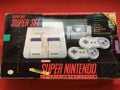
Super NES Super Set (includesSuper Mario World)
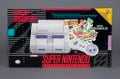
Super NES Mario Set (includesSuper Mario All-Stars + Super Mario World)
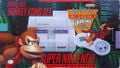
Super NES Donkey Kong Set (includesDonkey Kong Country)

New-Style Super NES Control Deck

New-Style Super NES Control Deck (includesSuper Mario World 2: Yoshi's Island)
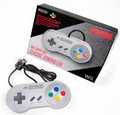
AWii Classic Controller themed after a European SNES controller, rewarded by AustralianClub Nintendo


Games[edit]


.png)


Miscellaneous[edit]

Super NESNintendo Player's Guide

Super Mario World

Donkey Kong Country 2: Diddy's Kong Quest

Donkey Kong Country 2: Diddy's Kong Quest

WarioWare: Smooth Moves

Super Paper Mario

Image macro from the official NintendoAUNZ social media accounts, showingSuper Mario games for the system


Names in other languages[edit]
- Super Famicom
| Language | Name | Meaning | Notes |
|---|---|---|---|
| Japanese | スーパーファミコン[22] Sūpā Famikon | Super Famicom | |
| スーファミ[13] Sūfami | SuFami | ||
| Korean | 슈퍼 패미컴[23] Syupeo Paemikeom | Super Famicom | |
| 슈퍼 컴보이[?] Syupeo Keomboi | Super Comboy |
References[edit]
- ^December 13, 2013. Retro Diary: 08 November – 05 December.Retro Gamer (No. 122) (English). Page 11. Retrieved November 23, 2024.
- ^Nintendo of America (August 23, 2021).On this day 30 years ago, the Super Nintendo Entertainment System launched in North America! What are some of your favorite #SNES games and memories?.X. Retrieved June 3, 2024. (Archived March 11, 2022, 19:29:37 UTC via archive.today[deprecated link].)
- ^Byrne, Brian (2017). History of the Super Nintendo (SNES): Ultimate Guide to the SNES Games & Hardware.Console Gamer Magazine. ISBN978-1-5498-9956-0. Page 4.
- ^abc"Super Nintendo Entertainment System (Platform)".Giant Bomb. Archived March 30, 2019, 23:36:08 UTC from the original via Wayback Machine. Retrieved April 27, 2024.
- ^"Nintendo History".Nintendo. Archived September 4, 2012, 13:41:55 UTC from the original via archive.today[deprecated link]. Retrieved April 27, 2024.
- ^November 21, 2015."Los juegos más recordados a 25 años del lanzamiento de la Super Nintendo".La Tercera (Latin American Spanish). Retrieved June 3, 2024.
- ^Super Nintendo.Trade In Post. Archived August 11, 2020, 19:15:05 UTC from the original via Wayback Machine. Retrieved June 3, 2024.
- ^abcdefgJoshua Rogers (December 26, 2020).World of Nintendo: Exploring Nintendo in (Eastern) Europe.PAX (via YouTube) (English). Retrieved June 5, 2024. (Archived June 5, 2024, 20:16:14 UTC via Wayback Machine.)
- ^Игорь Пичугин (November 1, 1994).Соглашение Steepler и Nintendo.Газета "Коммерсантъ" (Russian). Retrieved June 1, 2024. (Archived April 27, 2019, 02:58:42 UTC via Wayback Machine.)
- ^Reisinger, Don (January 21, 2009).Does the Xbox 360's 'lack of longevity' matter?.CNET. Retrieved December 19, 2021.
- ^Niizumi, Hirohiko (May 30, 2003).Nintendo to end Famicom and Super Famicom production.GameSpot. Retrieved June 22, 2025. (Archived January 22, 2012 via Wayback Machine.)
- ^Nintendo Co., Ltd.HISTORY → Console → Super Family Computer.Mario Portal. Retrieved August 3, 2024. (Archived October 3, 2024, 11:52:39 UTC via Wayback Machine.)
- ^abNintendo Co., Ltd.ファミコンに続いて、スーパーファミコンが小さくなって再登場! トピックス Nintendo.Nintendo Azusa. Retrieved December 12, 2025.
- ^Игорь Пичугин (November 1, 1994).Соглашение Steepler и Nintendo.Газета "Коммерсантъ" (Russian). Retrieved June 1, 2024. (Archived April 27, 2019, 02:58:42 UTC via Wayback Machine.)
- ^Семён Костин (December 14, 2021).Легенда о слоне: как IT-компания Steepler создала Dendy и основала российский консольный рынок.DTF (Russian). Retrieved June 1, 2024. (Archived June 1, 2024, 22:35:52 UTC via Wayback Machine.)
- ^Олег Хохлов (August 9, 2016).Приставка Dendy: Как Виктор Савюк придумал первый в России поп-гаджет.Секрет фирмы (Russian). Retrieved December 9, 2024. (Archived December 1, 2024, 05:49:08 UTC via Wayback Machine.)
- ^Development:Super Mario All-Stars.The Cutting Room Floor. Retrieved November 13, 2023.
- ^"As mentioned in Nintendo News Network last issue, not much is known at this stage, but we believe that the Super CD will be the same size as the Super NES. It will connect by the external port on the Super NES and the two units will become one by piggybacking. Super Mario 5 is said to be coming out on Super CD." – May 1993.Nintendo Magazine System (AU) Issue #2. Page 62.
- ^SHVC: Super Famicom. Retrieved July 9, 2023.
- ^Nintendrew (August 15, 2018).LodgeNet Game Controllers - Nintendo's Hotel Rental Service!.YouTube. Retrieved March 4, 2020.
- ^Illumination and Universal Pictures (January 25, 2026).The Super Mario Galaxy Movie | Yoshi Chomps Back.YouTube. Retrieved January 26, 2026.
- ^スーパーファミコン.nintendo.co.jp (Japanese). Retrieved September 15, 2025.
- ^September 4, 2020.슈퍼 마리오브라더스 35주년!.nintendo.com (Korean). Retrieved September 15, 2025.
External links[edit]


 | The Cutting Room Floor has an article onSuper Nintendo Entertainment System. |
 | Wikipedia has an article onSuper Nintendo Entertainment System. |
- Sonifi Solutions (Wikipedia) – A company that has brought Nintendo systems, including the SNES, to hotel rooms

