Game & Watch
- This article is about the Game & Watch system. For the character of the Game & Watch games with a similar name, seeMr. Game & Watch. For the characters with similar names that appeared in an advertisement for Game & Watch games, seeGame and Watch (characters).
- Not to be confused withNelsonic Game Watch orGamewatch Boy.
| Game & Watch | |
|---|---|
 | |
| Generation | Second generation |
| Release date |  April 28, 1980[1][2] April 28, 1980[1][2] |
| Discontinued |  Early 1985 (original lineup)[?] Late 1991 (original lineup)[?] Early 1985 (original lineup)[?] Late 1991 (original lineup)[?] |
| Successor | Game Boy |
- “I say you can't better the graphics, sounds and playability of a Game & Watch!”
- —Cranky Kong,Donkey Kong Country
TheGame & Watch series (initially released in North America as theTime-Out series)[3] is a series of handheld games developed byNintendo from 1980 to late 1991. The Game & Watch was Nintendo's earliest product to be very successful,[4] with the series selling a combined 43.4 million units worldwide.[5] Each Game & Watch had its own game built in, in addition to a clock and an alarm, and many Game & Watch games are of theSuper Mario franchise. Nintendo also let the Game & Watch games be used as promotional items for businesses that put their own logos on them.[6]
Most Game & Watch titles have two modes: Game A and Game B, the latter usually being a faster, more difficult version of Game A. In the Micro VS. System series of games, such asDonkey Kong 3 andDonkey Kong Hockey, Game B is the two-player mode. A few Game & Watch games such asSuper Mario Bros. do not have a Game B. The Game & Watch games normally become harder as the player progresses, but the gameplay usually slows down every 100points the player receives. The games usually end when the player receives three misses (generally meaning "lives that are lost"). In most games, misses can be removed if the player reaches a certain number of points; in some games, doing so with no misses starts a period called Chance Time, in which the score increases either temporarily or until a miss is made. The maximum score the player can get in most games is 999 points. Getting a higher score resets the score tally to zero points.
Nintendo ended new releases in Japan in early 1985 to focus on theFamily Computer; however, Nintendo continued to make new titles for overseas markets until late 1991, withMario the Juggler being the final game of the original lineup. On September 3, 2020, almost 28 years after the original Game & Watch series' discontinuation and as part of the celebration of the35th anniversary ofSuper Mario Bros., Nintendo announcedGame & Watch: Super Mario Bros., a full-color screen Game & Watch system featuring ports ofSuper Mario Bros. andSuper Mario Bros.: The Lost Levels as well as aSuper Mario–themed version ofBall, set for a limited release on November 13, 2020.
Games[edit]
- Footnotes
Game & Watch Gallery series[edit]
- Main article:Game & Watch Gallery (series)
These games areGame Boy–era ports of the classic Game & Watch titles, most of which are also given "Modern" versions featuringSuper Mario characters. The "Classic" versions remove the timekeeping functions from the original games, in order to allow the player to accomplish the compilations' goal of getting the highest score possible. There were plans for aGame & Watch Gallery series ofe-Reader cards calledGame & Watch-e, but these did not surface, because the e-Reader was abruptly discontinued overseas due to low sales.
- Game Boy Gallery (Europe and Australia only; not to be confused with the Japanese name forGame & Watch Gallery)
- Game & Watch Gallery (Game Boy Gallery in Japan;Game Boy Gallery 2 in Australia)
- Game & Watch Gallery 2 (Game Boy Gallery 2 in Japan;Game Boy Gallery 3 in Australia)
- Game & Watch Gallery 3 (Game Boy Gallery 3 in Japan;Game Boy Gallery 4 in Australia)
- Game & Watch Gallery 4 (Game Boy Gallery 4 in Japan;Game & Watch Gallery Advance in Europe and Australia)
Games with aSuper Mario–themed "Modern" version[edit]
In addition to all of the games listed below, theSuper Mario Game & Watch games also reappear, with their "Modern" versions featuring updated graphics and gameplay.
Game & Watch Collection[edit]
- Main article:Game & Watch Collection
Game & Watch Collection is aNintendo DS game that was released exclusively onClub Nintendo. It is a compilation of three Game & Watch games, one of which isDonkey Kong. A follow-up titledGame & Watch Collection 2 was also released, though it does not feature anySuper Mario titles.
Alarm function[edit]
Starting from the Gold version ofManhole, the Game & Watch titles started to have an alarm function, which was accessible only by gently pressing the ALARM switch with a sharp-pointed instrument. Alarm time can be set by pressing the left buttons (hour set) and the right buttons (minute set). Games with two buttons in the same side use only the top button for time setting. These are Game & Watch alarm indicators in theSuper Mario Game & Watch games:
| Image | Name | Game | Action at alarm time | Location |
|---|---|---|---|---|
 | Mini Donkey Kong | Donkey Kong | Jump and swing bell | Below the difficulty indicators |
 | Alarm cat | Green House | Be stung by a bee | Beside the ladder |
 | Alarm bell | Donkey Kong II | Be stricken by Mario | Beside leftmost lock |
 | Alarm bell | Mario Bros. | Ring | Under time/score |
 | Musical notes | Donkey Kong Jr. (Panorama Screen & Table Top series) | Be whistled by Mario | Below miss counter |
 | Alarm man | Mario's Cement Factory (Table Top) | Ring bell | Beside upward lift section |
 | Alarm Monkey | Mario's Bombs Away | Swing bell | Below time score |
 | Alarm bell | Donkey Kong Circus | Swing | Below time/score |
 | Alarm bell | Donkey Kong Jr. (New Wide Sceen) | Be stricken by Mario | Under Donkey Kong |
 | Alarm bell | Mario's Cement Factory (New Wide Screen) | Swing | Beside upward lift section |
 | Alarm Koopa | Super Mario Bros. | Nod head and spew fire | Upper left corner |
 | Bell Turtle | Mario the Juggler | Swing bell | Beside the pipe |
 | Alarm bell | Donkey Kong 3 | Flash | Beside Player 1's miss and spray value counters |
 | Alarm man | Donkey Kong Hockey | Ring bell | Beside Player 1's score |
Appearances in theSuper Mario franchise[edit]
WarioWare: Smooth Moves[edit]

InWarioWare: Smooth Moves, aDonkey Kong double-screen Game & Watch is a key part of9-Volt &18-Volt's story. 9-Volt shows it to 18-Volt, causing them to tug-of-war it until it breaks, breaking their friendship as well. 18-Volt then tries to buy a replacement, bumping into 9-Volt, who had the same intention, giving them the chance to reconcile.
Wario: Master of Disguise[edit]
InWario: Master of Disguise, there is a treasure based on the Game & Watch called theGame & Watch 9000.
Super Paper Mario[edit]

InSuper Paper Mario, the player can access two post-game level areas, theFlipside Pit of 100 Trials and theFlopside Pit of 100 Trials. Both dungeons are modeled after the Game & Watch's screen, with black walls, floors, and doors, and faded silhouettes of said objects in places they currently are not occupying. Additionally, in the Flopside Pit of 100 Trials specifically, stronger variants of the game's enemies appear with no visual distinctions from their normal counterparts, except they are pitch black, similar to characters that appear on Game & Watch screens.
Mario Kart World[edit]
It has been requested thatmore images beuploaded for this section. Remove this notice only after the additional images have been added.Specifics: Screenshot
InMario Kart World, the satellite inRainbow Road is themed after the Game & Watch. "GW-80" is painted on the outside, referencing the system first releasing in 1980.
Profiles and statistics[edit]
Super Smash Bros. Melee[edit]
| Trophy Game & Watch | ||
 | ||
| Game/move: Game & Watch 1980 | ||
| How to unlock: - | ||
| This stage of Super Smash Bros. Melee takes its motif from the Game & Watch series. It incorporates settings from Oil Panic, Helmet, and Manhole, and it's sure to send a wave of nostalgia crashing over old-school gamers. If you want to truly reproduce the Game & Watch experience, try playing this unique level in Fixed-Camera Mode. | ||
Gallery[edit]

Donkey Kong (Multi Screen)

Donkey Kong 3 (Micro VS. System)

Donkey Kong Circus (Panorama Screen)

Donkey Kong Hockey (Micro VS. System)

Donkey Kong II (Multi Screen)

Donkey Kong Jr. (New Wide Screen)

Donkey Kong Jr. (Panorama Screen)

Donkey Kong Jr. (Table Top)

Game & Watch: Super Mario Bros. (Color Screen)

Green House (Multi Screen)

Mario Bros. (Multi Screen)

Mario the Juggler (New Wide Screen)

Mario's Bombs Away (Panorama Screen)
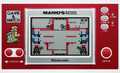
Mario's Cement Factory (New Wide Screen)

Mario's Cement Factory (Table Top)

Super Mario Bros. (Crystal Screen)

Super Mario Bros. (New Wide Screen)

Super Mario Bros. (special edition)


Names in other languages[edit]
| Language | Name | Meaning | Notes |
|---|---|---|---|
| Japanese | ゲーム&ウオッチ[?] Gēmu Ando Uotchi | Game & Watch |
References[edit]


 | Wikipedia has an article onGame & Watch. |
- ^Satoru Iwata.Iwata Asks - Game & Watch - Page 2.Iwata Asks (English). Retrieved December 8, 2024. (Archived April 21, 2023, 01:48:42 UTC via Wayback Machine.)
- ^Michael Panayiotakis (June 15, 2008).Game & Watch: A Retrospective.DS Fanboy (English). Archived July 5, 2008, 11:11:30 UTC from theoriginal via Wayback Machine. Retrieved December 8, 2024.
- ^Phil Salvador (June 13, 2024).Is this the first Nintendo commercial?.Video Game History Foundation. Retrieved July 2, 2024. (Archived June 27, 2024, 06:16:09 UTC via Wayback Machine.)
- ^Iwata Asks: Super Mario Bros. 25th Anniversary.Nintendo. Retrieved April 30, 2023.
- ^Iwata Asks: Game & Watch.Nintendo. Retrieved April 30, 2023.
- ^FAQ Promotional (Advertising) Game&Watch Games.www.gameandwatch.ch. Retrieved March 10, 2021.
[Edit] Game & Watchgames | ||
|---|---|---|
| Super Mario franchise | Donkey Kong (1982, MS) •Mario Bros. (1983, MS) •Mario's Cement Factory (1983, TT/NWS) •Mario's Bombs Away (1983, PS) •Donkey Kong Hockey (1984, MVS) •Super Mario Bros. (1986, CrS | 1987, Sp | 1988, NWS) •Mario the Juggler (1991, NWS) •Game & Watch: Super Mario Bros. (2020, CoS) | |
| Donkey Kong franchise | Donkey Kong (1982, MS) •Donkey Kong Jr. (1982, NWS) •Donkey Kong II (1983, MS) •Donkey Kong Jr. (1983, TT/PS) •Donkey Kong 3 (1984, MVS) •Donkey Kong Circus (1984, PS) •Donkey Kong Hockey (1984, MVS) | |
| Miscellaneous | Green House (1982, MS) | |
MS Multi Screen TT Table Top PS Panorama Screen NWS New Wide Screen MVS Micro VS. System CrS Crystal Screen Sp Special CoS Color Screen | ||

