Research CenterAfrican and Middle Eastern Reading Room
About this Reading Room

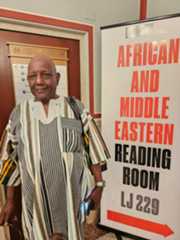
AMED Reading Room in LJ229 Open House Event

Nigerian National Assembly Library Delegation views rare African postcards.

Librarian Huda Dayton and Specialist Muhannad Salhi, Ph.D. showcase Arab American books to Rep. Rashida Tlaib (D-MI).

AMED staff display rare new materials during New Acquisitions event.

Dungan Community from Kazakhstan and Kyrgyzstan display gift books written in their language.
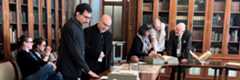
Kluge scholar Ali Boozari discusses Iranian and Indian lithographed books he used in his research.

Early recordings of Armenian Classics Vardanants Day Lecture.
The African and Middle Eastern Division (AMED) was created in1978 as part of a general Library of Congress reorganization. AMEDcurrently consists of three sections - African, Hebraic and NearEast - and covers more than 77 countries and regions from SouthernAfrica to the Maghreb and from the Middle East to Central Asia. Eachsection plays a vital role in the Library's acquisitions program;offers expert reference and bibliographic services to the Congressand researchers in this country and abroad; develops projects, specialevents and publications; and cooperates with other institutions andscholarly and professional associations in the US and abroad.
Africana Collections:An Illustrated Guide
Hebraic Collections:An Illustrated Guide
Near East Collections:An Illustrated Guide
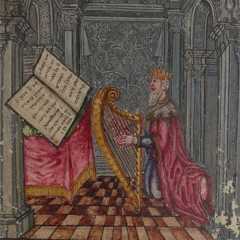
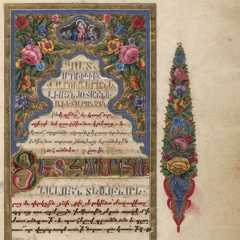
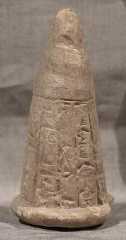
As a major world resource center for Africa, the Middle East, Israel,the Caucasus, and Central Asia, AMED has the custody of more than onemillion physical collection materials in the languages of the regionsuch as Amharic, Arabic, Aramaic, Armenian, Azerbaijani, Baluchi, Chechen,Coptic, Ge’ez, Georgian, Hebrew, Kazakh, Kiswahili, Kurdish, Ladino,Oromo, Ossetian, Pashto, Persian, Somali, Syriac, Tigrinya, Turkish,Turkmen, Uighur, Uzbek, and Yiddish. Included in these collections arebooks, periodicals, newspapers, microforms, grey literature, and raritiessuch as cuneiform tablets, manuscripts, incunabula (works printed before1501), and other early African and Middle Eastern publications. Among themost prized items are also several sizable pamphlet collections on AfricanStudies.