


ABC 7 (Nabonidus Chronicle)
The Chronicle Concerning the Reign of Nabonidus (ABC 7) is one of the most important historiographical texts from ancient Babylonia. It deals not just with the reign ofNabonidus (r.556-539 BCE), but also with the rise of the Persian kingCyrus the Great, the demise of theBabylonian Empire, and the founding of theAchaemenid Empire.
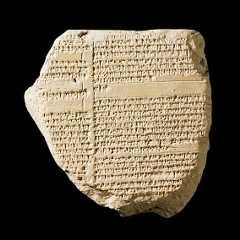
The Nabonidus Chronicle tells the story of the rule ofNabonidus, the last king of independentBabylonia. The text is badly damaged and contains many lacunas. However, it makes clear that the rise ofCyrus was not unexpected. We meet him for the first time in Nabonidus' sixth year (=550 BCE), when he defeats theMedian leaderAstyages. A second reference can be found in year nine, when he defeats the king of a country thatcannot be identified (547 BCE).
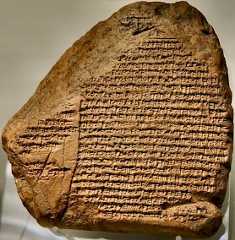
In addition, we learn that Nabonidus was not inBabylon for ten years. Instead, he seems to have tried to subjectArabia. In year three he conquered the kingdomEdom, which controls the direct road from Babylon to the Gulf of Aqaba. From year seven until year sixteen, Nabonidus stayed in the oasis ofTayma in the Arab desert, from where he could easily go as far south as the oasis Yatrib (modern Medina).
The events of year seventeen look rather desperate: although theNew Year's festival (Akitu) could be celebrated, several divine guests fail to attend, which suggests that their home towns were under siege. We also learn about a short invasion by soldiers from the Sea Land.
Throughout this text, "Akkad" meansBabylonia; the first years show Babylonian military activity in Syria and the southeast of modern Turkey.
The translation below was made by A.K. Grayson, with some changes based on more recent research.
Column I
[i.1] [destroyed]
[i.2] [Accession year:note[556/555 BCE.]] ... he carried, the king
[i.3] ... of] their land he/they brought toBabylon.
[i.4] [First year:note[555/554 BCE.]] ...
[i.5] [...] …his? …they trembled? and he did not carry.
[i.6] [...] ... their whole family
[i.7] [...] the king mustered his army and to Humenote[I.e.,Cilicia.]
[i.8] [he marched]. ...[he marched]. ...
[i.9] [The second year:note[554/553 BCE.] I] the monthTebetu, in Hamath it was cold.
[i.10] [...] ...
[i.11] [The third year:note[553/552 BCE.] ... the mon]thAbu, theAmanus Mountains
[i.12] [...] ... orchards, all of the fruit
[i.13] [...] ... from within them to Babylon
[i.14] [... became i]ll but recuperated. In the monthKislimu, the king
[i.15] [mustered] his army14 and to Nabû-tat-tan-úsur
[i.16] .. of Amurru to
[i.17] they/he encamped [againstE]dom
[i.18] [...] the large army
[i.19] [... the g]ate of RUGdini
[i.20] [...] ... he killed/defeated him
[i.21] [...] ...
[i.22] [...] army
[broken off]
Column ii
[ii.1] [The sixth year:note[550/549 BCE.] Astyages] mustered (his army) and marched against Cyrus, king of Anšan, for conquest [...]
[ii.2] The army rebelled against Astyages and he was taken prisoner.Th[ey handed him over] to Cyrus. ([...])
[ii.3] Cyrus <marched> toEcbatana, the royal city. The silver, gold, goods, property, [...]
[ii.4] which he carried off as booty (from) Ecbatana, he took to Anšan. The goods (and) property of the army of [...].
[ii.5] The seventh year:note[549/548 BCE.] The king (was) inTayma (while) the prince, his officers, (and) his army (were) in Akkad. [In the month Nisannu, the king]
[ii.6] did not come to Babylon. Nabu did not come to Babylon. Bel did not come out. The [Akitu festiv]al [did not take place].
[ii.7] The offerings to the gods op Babylon and Borsippa,a[s in normal times], inEsagila andEzida
[ii.8] were presented. Theurigallû-priest made a libation and inspected the temple. ([...])
[ii.9] The eighth year:note[548/547 BCE.][Blank space]
[ii.10] The ninth year:note[547/546 BCE.] Nabonidus the king (was) <in> Tayma, (while) the prince, the officers, (and) the army (were) in Akkad. The king, in the month Nisanu, to Babylon
[ii.11] did not come. Nabu did not come to Babylon. Bel did not come out. The Akitu festival did not take place.
[ii.12] The offerings were presented (to) the gods of <Babylon> and Borsippaas in normal times in Esagil and Ezida.
[ii.13] On the fifth day of the month Nisanu the queen mother, in Dur-Karašu, which is on the banks of theEuphrates upstream fromSippar,
[ii.14] she died. The prince and his army were in mourning for three days (and) there was (an official) mourning period. In the month Simanu, in Akkad,
[ii.15] there was (an official) mourning period for the queen mother. In the month Nisanu, Cyrus, king of Parsu, mustered his army and
[ii.16] crossed theTigris belowArbela. In the monthAjaru, he marched to the land of...note[One of the most notorious lacunas. Some scholars recognize anU, which suggests that the country was Urartu, but the tablet is very damaged. The implications are discussedhere.]
[ii.17] He killed its king, took his possessions, (and) stationed his own garrison (there) [...]
[ii.18] Afterwards the king and his garrison was in it ([...])
[ii.19] The tenth year:note[546/545 BCE.] The king (was) in Tayma (while) the prince, the officers, and his army (were) in Akkad. The king [did not come to Babylon in the month Nisanu.]
[ii.20] Nabu did not come to Babylon. Bel did not come out. The Akitu festival did not take place. The offerings in E[sagil and Ezida]
[ii.21] were presented (to) the gods of Babylon and Borsippa as in normal times. On the twenty-first day of the month Simanu [...]
[ii.22] of Elammya in Akkad ... [...] the district governor of Uru[k ...]
[ii.23] The eleventh year:note[545/544 BCE.] the king (was) in Tayma (while) the prince, the officers, and his army (were) in Akkad. [The king did not come to Babylon in the month Nisanu.]
[ii.24] [Nabu] did not come [to Bab]ylon. Bel did not come out. The Akitu festival did not take place. The of[ferings in Esagil and Ezida]
[ii.25] were presented [(to) the gods of Bab]ylon and Borsippa [as in normal times].
[Broken off]
Column iii
[iii.1] [lacuna]
[The sixteenth year:note[539/538 BCE.]]killed/defeated. The river ... [...]
[iii.2] [...] ... IshtarUruk [...]
[iii.3] [...] of Per[sia...]
[iii.4] [...] ... [...]
[iii.5] [The seventeenth year:note[539/538 BCE.] N]abu [came] from Borsippa for the procession ofBel. Bel came out.]
[iii.6] [... In the month]Tebetu the king enteredEturkalamma. In thetemple [...]
[iii.7] [...] ... He made a libation of wine ... [...]
[iii.8] [... B]el came out. They performed theAkitu festivalas in normal times. In the month [...]
[iii.9] [... the gods] of Marad, Zababa, and the gods of Kish, Ninlil [and the gods of]
[iii.10] Hursagkalamma enteredBabylon. Until the end of the monthUlulu the gods ofAkkad [...]
[iii.11] from everywhere were entering Babylon. The gods of Borsippa, Cuthah,
[iii.12] and Sippar did not enter (Babylon). When13Cyrus did13 battle atOpis on the [bank of]
[iii.13] theTigris against the army of Akkad, the people of Akkad
[iii.14] retreated. He carried off the plunder (and) slaughtered the people. On the fourteenth day Sippar was captured without a battle.
[iii.15] Nabonidus fled. On the sixteenth day,Ugbaru, governor ofGutium, and the army of Cyrus, without battle
[iii.16] they entered Babylon. Afterwards, after Nabonidus retreated, he was captured in Babylon. Until the end of the month, the shield-(bearing troops)
[iii.17] from Gutium surrounded the gates ofEsagil. (But) interruption (of rites) in Esagil or the (other) temples
[iii.18] there was not, and no date (for a performance) was missed. On the third day of the monthArahsamna, Cyrus entered Babylon.
[iii.19] Theharû-vessels were filled before him. There was peace in the city while Cyrus, (his) greeting to
[iii.20] Babylon in its entirety spoke. Gubaru, his district officer, appointed the district officers in Babylon.
[iii.21] From the monthKislimu to the monthAddaru, the gods of Akkad which Nabonidus had brought to Babylon
[iii.22] returned to their places. On the night of the eleventh of the month Arahsamna, Ugbaru died. In the mon[th Addaru]
[iii.23] the king's wife died. From the twenty-seventh of the month Addaru to the third of the monthNisannu [there was] (an official) mourning period in Akkad.
[iii.24] All of the people bared their heads. On the fourth day whenCambyses, son of C[yrus],
[iii.25] went to Egidrikalammasummu the ...-official of Nabu, who ... [...]
[iii.26] When he came, because of the Elamite dress! the hand of Nabu [...] ... [...]
[iii.27] [sp]ears and quivers from [...] ...crown prince to thewo[rk ...]
[iii.28] [...] Nabu to Esagil ... before Bel and the son of B[el ...]
Column iv
[iv.1] [...]
[iv.2] [...] Babylon, water
[iv.3] [...] ... clouded over
[iv.4] [...] ... the gate was ruined
[iv.5] [...] Eanna of Ezen-x-kas
[iv.6] [...]bit mummu, he went out
[iv.7] [...] ...
[iv.8] [...] in Babylon ...
[iv.9] [...] Babylon he strove.
Author
Language
Countries
Categories
Subdisciplines
Tags
See also
- Babylonian Empire(article)
- Cyrus the Great(article)
- Cyrus takes Babylon(article)
- Nabonidus(article)
- Mesopotamian Chronicles(text)