Live Science Plus






When were boats invented?
The oldest physical boat is a canoe from roughly 10,000 years ago, but evidence suggests humans have been using watercraft for at least 50,000 years.
When you purchase through links on our site, we may earn an affiliate commission.Here’s how it works.

Get the world’s most fascinating discoveries delivered straight to your inbox.
You are now subscribed
Your newsletter sign-up was successful
Want to add more newsletters?

Delivered Daily
Daily Newsletter
Sign up for the latest discoveries, groundbreaking research and fascinating breakthroughs that impact you and the wider world direct to your inbox.

Once a week
Life's Little Mysteries
Feed your curiosity with an exclusive mystery every week, solved with science and delivered direct to your inbox before it's seen anywhere else.

Once a week
How It Works
Sign up to our free science & technology newsletter for your weekly fix of fascinating articles, quick quizzes, amazing images, and more

Delivered daily
Space.com Newsletter
Breaking space news, the latest updates on rocket launches, skywatching events and more!

Once a month
Watch This Space
Sign up to our monthly entertainment newsletter to keep up with all our coverage of the latest sci-fi and space movies, tv shows, games and books.

Once a week
Night Sky This Week
Discover this week's must-see night sky events, moon phases, and stunning astrophotos. Sign up for our skywatching newsletter and explore the universe with us!
Join the club
Get full access to premium articles, exclusive features and a growing list of member rewards.
Around 8000 B.C., a canoe carved from a single pine log came to rest in what is now the Netherlands. The roughly 10-foot-long (3 meters) boat wasn't discovered until 1955, whena road crew unearthed it from a peat bog near the village of Pesse. The artifact, now known as thePesse canoe, is the world's oldest physical example of a boat.
But there is significant indirect evidence that humans have been using boats for much longer than 10,000 years. So exactly when did humans invent boats?
You may like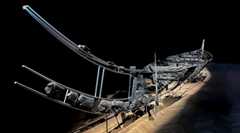


Sign up for our weeklyLife's Little Mysteries newsletter to get the latest mysteries before they appear online.
"We have solid evidence that humans were in modern-day Australia between 50,000 and 65,000 years ago," Fauvelle told Live Science via email. "This would have required open-ocean seafaring between mainland Asia and thepaleocontinent of Sahul (of which Australia was then a part). Some sort of watercraft, therefore, must have been in use by at least circa 50,000 years ago."
The evidence in this case is not from the physical remains of an ancient boat. Instead, it comes fromDNA: A recent study analyzed almost 2,500 genomes from ancient and contemporary Aboriginal people throughout Australia and nearby countries, and investigated when Australian populations diverged from those on other continents. Their statistical models suggested thatnorthern Australia was first settled around 60,000 years ago. Those findings also line up with contemporaneoustools and pigments unearthed at Australian dig sites.

Other, more controversial archaeological evidence raises the possibility that humans were seafaring much earlier.
"There is some tantalizing evidence from Greece," Fauvelle said. "Paleolithic stone tools found on Crete have been dated based on their find-context to [at least]130,000 years ago. Some archaeologistshave disputed these dates, but if they hold up, it would mean that ancient humans would have traveled there by boat during the Middle Holocene." Crete is dozens of miles from mainland Greece (and has been an island forabout 5 million years).
Some experts would push back the clock on sea travel by hundreds of thousands of years, if not over a million, which would mean boats predate our species.
A1998 study led by archaeologist Michael Morwood dated stone tools found on the Indonesian island of Flores to about 800,000 years ago and concluded thatHomo erectus may have used watercraft to get there. Morwood later co-authored a2010 study that found tools from a different site in Flores may have originated 1.02 million years ago, if not earlier. And in a study published last year in the journalNature, a different research team proposed that pieces of stone tools found on the nearby Indonesian island of Sulawesi suggest ancient human relativeswere crafting tools there at least 1.04 million years ago.
Still, there is plenty of debate about how and when ancient human relatives arrived on those islands.John Cherry, a professor emeritus of archaeology at Brown University, said one problem with the stone artifacts from Crete is that they are "surface finds," whichsit in plain sight above ground, as opposed to "stratified" objects, which are found in distinctsoil layers. They are also "lacking absoluteradiometric dates," which could further clarify when the tools were built. If the data in Crete "stand up to further scrutiny, or can be better dated," we can draw better conclusions, he told Live Science in an email.
You may like

The studies in Indonesia "are all very solid," Cherry told Live Science. But he hypothesizes that hominins reached Flores and Sulawesi accidentally. "Basically, a chunk of land with vegetation on it breaks away from the mainland," potentially during flooding from monsoons or rivers and are "carried by the currents and the winds out into the ocean itself," Cherry explained.
He pointed to a 2025 study that suggested someiguanas may have rafted 5,000 miles (8,000 kilometers) from North America to Fiji.
"We know it happened with thousands of other species, including primates such asmonkeys and lemurs, so why not humans?" Cherry said. In addition, the hominins in Flores and Sulawesi were most likelyH. erectus, and "orthodox understanding ofhuman evolution makes it unlikely that[H.]erectus had the requisite social structures, communication capabilities, or complex additive technologies necessary for undertaking sea crossings," he added.
No matter when ancient humans did set to sea, there is still the question of what drove them to do so. Fauvelle has a few ideas. One was the search for food.
"Aquatic environments are full of rich food resources. … It is highly likely that many early experiments with watercraft on lakes, rivers, or estuaries were for the purposes of fishing or gathering other aquatic food resources," Fauvelle said. Boats also would have been "the best tools available for easily transporting large amounts of material," such as "large animal carcasses from hunting grounds back home, or for the transportation of flint or obsidian from stone quarries."
And perhaps humans have always had a drive to explore the unknown.
"There has been a strong tendency throughout human history to explore new regions, and in many instances such exploration was done by boat," Fauvelle said. "If you are moving to a new region with your family you likely need to bring many things with you, and the logistical capacities of boats would greatly facilitate such travel."
Human evolution quiz: What do you know about Homo sapiens?

Jesse Steinmetz is a freelance reporter and public radio producer based in Massachusetts. His stories have covered everything from seaweed farmers to a minimalist smartphone company to the big business of online scammers and much more. His work has appeared in Inc. Magazine, Duolingo, CommonWealth Beacon, and the NPR affiliates GBH, WFAE and Connecticut Public, among other outlets. He holds a bachelors of arts degree in English at Hampshire College and another in music at Eastern Connecticut State University. When he isn't reporting, you can probably find him biking around Boston.
You must confirm your public display name before commenting
Please logout and then login again, you will then be prompted to enter your display name.