 Live Science Plus




Deforestation: Facts about the widespread destruction of Earth's forests
Everything you need to know about deforestation, including the damage clearing trees does to people, wildlife and the climate.
When you purchase through links on our site, we may earn an affiliate commission.Here’s how it works.

Get the world’s most fascinating discoveries delivered straight to your inbox.
You are now subscribed
Your newsletter sign-up was successful
Want to add more newsletters?

Delivered Daily
Daily Newsletter
Sign up for the latest discoveries, groundbreaking research and fascinating breakthroughs that impact you and the wider world direct to your inbox.

Once a week
Life's Little Mysteries
Feed your curiosity with an exclusive mystery every week, solved with science and delivered direct to your inbox before it's seen anywhere else.

Once a week
How It Works
Sign up to our free science & technology newsletter for your weekly fix of fascinating articles, quick quizzes, amazing images, and more

Delivered daily
Space.com Newsletter
Breaking space news, the latest updates on rocket launches, skywatching events and more!

Once a month
Watch This Space
Sign up to our monthly entertainment newsletter to keep up with all our coverage of the latest sci-fi and space movies, tv shows, games and books.

Once a week
Night Sky This Week
Discover this week's must-see night sky events, moon phases, and stunning astrophotos. Sign up for our skywatching newsletter and explore the universe with us!
Join the club
Get full access to premium articles, exclusive features and a growing list of member rewards.
Humans are destroying forests all over the world in a process called deforestation. Forests are cleared to make space for agriculture, and so humans can use the wood to make paper and other products. Deforestation is a very destructive process that threatens the health of our planet and its inhabitants.
Forests cover almost one-third of the planet's land, according to the World Wide Fund For Nature (WWF). Countless plants, animals, fungi and microbes live in forests, so when these forests are destroyed, the wildlife can't survive. The same is true for many human communities living in forests, particularly Indigenous people.
You may like


What is deforestation?
Deforestation is the clearing of forests. Most deforestation takes place in the tropics, where beef farming is by far the biggest reason forests are cleared, according toWWF. People destroy trees in these regions so the land can be used to raise cattle to eat. The second biggest driver of deforestation is the demand for soybean, which is a crop grown to feed farm animals and to make biofuels, according toOur World In Data.
Forests are also cleared to make space forpalm oil plantations, particularly in Indonesia. Palm oil is an edible vegetable oil that's found inhalf of all supermarket products. Behind palm oil, the fourth biggest driver of deforestation is the demand for paper and other products made from wood.
When did deforestation start?
Humans have been clearing trees for thousands of years, even before we started farming around 10,000 years ago, according to the bookBiological and Environmental Hazards, Risks, and Disasters (Elsevier, 2023). However, deforestation has gotten worse over time. About half of the total deforestation caused by humans happened between 8,000 B.C. and 1900, while the other half has happened since 1900.
Global forest loss has slowed down a bit since the 1980s, when the rate of deforestation peaked, according toOur World In Data. However, deforestation is still very high across the world. There are also other factors affecting the health of our forests. For example, Australian rainforests have beendying much faster since the 1980s, with trees living about half as long, likely because ofclimate change.
Get the world’s most fascinating discoveries delivered straight to your inbox.
What are the impacts of deforestation?

Deforestation is a major threat to humans, wildlife and the planet. Forests support most of the wildlife that lives on land, as well as human communities around the world, particularly Indigenous people and communities living in forests — an estimated780 million people live within 0.6 miles (1 km) of a forest. Forests provide shelter, food, water, medicine, work and fuel to these communities, so deforestation is a major threat to their existence.
Deforestation can also directly influence the weather. For example, removing trees in tropical regions can reduce rainfall because it changes the way water vapor forms over the forest canopy. Healthy forests help minimize extreme weather by regulating rainfall and stabilizing local climates, according to the United Nations' 2024State of the World's Forests report. Researchers have found that in North America, Europe and Asia, deforestation leads to more intense heatwaves, according to MIT'sClimate Portal.
Does deforestation contribute to global warming?
Deforestation contributes toglobal warming in a variety of different ways. Global warming, or climate change, is caused by humans releasinggreenhouse gases such as carbon dioxide into the atmosphere. Forests naturally pull billions of tons of carbon dioxide out of the atmosphere, so when we remove them, we lose one of the ways Earth captures and stores that greenhouse gas. Destroying trees also releases the carbon dioxide they've stored back into the atmosphere.
You may like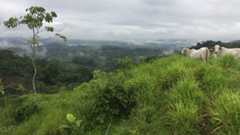
Deforestation is the main way humans change our planet's landscape, and it produces up to 20% of global greenhouse gas emissions, according to theGrantham Research Institute on Climate Change and the Environment at the London School of Economics. Damaging forests can also cause them toproduce more carbon than they capture.
Deforestation in the Amazon

South America'sAmazon rainforest is the largest forest in the world, but it's under threat from deforestation. Humans have removed about 386,000 square miles (1 million square km) of theAmazon rainforest since 1978, as the amount of tree cover hasdeclined by at least 17% over the last 50 years.
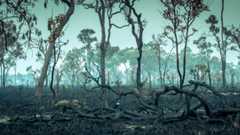
One of the biggest drivers ofdeforestation in the Amazon is industrial farming. Setting fire to the forest is one of the main ways humans get rid of trees. Burning trees also makes the forest hotter and drier, which makes itmore flammable, so additional fires do more damage.
How to stop deforestation
Deforestation is a global problem that will require a variety of different solutions, such as better monitoring of industries destroying forests and encouraging sustainable farming practices. According to the 2024 State of the World's Forests report, innovation is required to scale up forest conservation. The report pointed to new technologies for gathering data on forests and developing locally led solutions with underrepresented groups such as women, young people and Indigenous peoples.
At COP26 in 2021, more than 100 world leaderspledged to end deforestation by 2030. The rate of deforestation is currently too high to meet the 2030 pledge, with every region off target, according to theForest Declaration Assessment, which tracks world leaders' progress against the COP26 target.
Humans can restore forests they've damaged to help counter deforestation. The goal of forest restoration is to return the forest to its original state before it was cleared, according to theU.S. Forest Service. Restoring damaged forests can be as easy as leaving them alone and allowing them to grow back. However, humans usually need to assist in some way, such as by planting new trees of the same type that were lost.
Deforestation photos



Patrick Pester is the trending news writer at Live Science. His work has appeared on other science websites, such as BBC Science Focus and Scientific American. Patrick retrained as a journalist after spending his early career working in zoos and wildlife conservation. He was awarded the Master's Excellence Scholarship to study at Cardiff University where he completed a master's degree in international journalism. He also has a second master's degree in biodiversity, evolution and conservation in action from Middlesex University London. When he isn't writing news, Patrick investigates the sale of human remains.


