The so-called "gay and trans panic" defenses are legal strategies which, according to theAmerican Bar Association, "seek to partially or completely excuse crimes such as murder and assault on the grounds that the victim's sexual orientation or gender identity is to blame for the defendant's violent reaction." Research by theWilliams Institute shows that "no state recognizes gay and trans panic defenses as freestanding defenses under their respective penal codes," but defendants have used panic defenses in conjunction with other defense strategies to attempt to reduce the severity of their charges or sentencing.
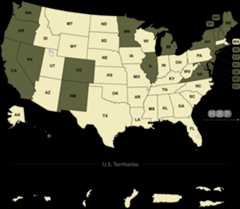
These defenses are based in irrational fears and prejudice toward LGBTQ people, and they imply that violence against LGBTQ people is acceptable or understandable under certain conditions. TheAmerican Bar Association issued a unanimous resolution in 2013 calling on "federal, tribal, state, local, and territorial governments" to prohibit the use of this defense, but many states still permit this practice, as shown in the map below.

*Note: These percentages reflect estimates of the LGBTQ adult population living in the 50 states and the District of Columbia. Estimates of the LGBTQ adult population in the five inhabited U.S. territories are not available, and so cannot be reflected here.
46 % of LGBTQ population lives in states that prohibit the use of legal defenses claiming the victim's sexual orientation and/or gender identity contributed to the defendant's actions
54 % of LGBTQ population lives in states that do not prohibit the use of legal defenses claiming the victim's sexual orientation and/or gender identity contributed to the defendant's actions
| State | Panic Defense Ban | Year Passed |
| Citations | ||
| Alabama | ||
| Alaska | ||
| American Samoa | ||
| Arizona | ||
| Arkansas | ||
| California | State has law that covers sexual orientation and gender identity | 2014 |
| Colorado | State has law that covers sexual orientation and gender identity | 2020 |
| Connecticut | State has law that covers sexual orientation and gender identity | 2019 |
| Delaware | State has law that covers sexual orientation and gender identity | 2023 |
| District of Columbia | State has law that covers sexual orientation and gender identity | 2020 (effective 2021) |
| Florida | ||
| Georgia | ||
| Guam | ||
| Hawaii | State has law that covers sexual orientation and gender identity | 2019 |
| Idaho | ||
| Illinois | State has law that covers sexual orientation and gender identity | 2017 |
| Indiana | ||
| Iowa | ||
| Kansas | ||
| Kentucky | ||
| Louisiana | ||
| Maine | State has law that covers sexual orientation and gender identity | 2019 |
| Maryland | State has law that covers sexual orientation and gender identity | 2021 |
| Massachusetts | ||
| Michigan | State has law that covers sexual orientation and gender identity | 2024 |
| Minnesota | State has law that covers sexual orientation and gender identity | 2024 |
| Mississippi | ||
| Missouri | ||
| Montana | ||
| Nebraska | ||
| Nevada | State has law that covers sexual orientation and gender identity | 2019 |
| New Hampshire | State has law that covers sexual orientation and gender identity | 2023 |
| New Jersey | State has law that covers sexual orientation and gender identity | 2020 |
| New Mexico | State has law that covers sexual orientation and gender identity | 2022 |
| New York | State has law that covers sexual orientation and gender identity | 2019 |
| North Carolina | ||
| North Dakota | ||
| Northern Mariana Islands | ||
| Ohio | ||
| Oklahoma | ||
| Oregon | State has law that covers sexual orientation and gender identity | 2021 |
| Pennsylvania | ||
| Puerto Rico | ||
| Rhode Island | State has law that covers sexual orientation and gender identity | 2018 |
| South Carolina | ||
| South Dakota | ||
| Tennessee | ||
| Texas | ||
| U.S. Virgin Islands | ||
| Utah | ||
| Vermont | State has law that covers sexual orientation and gender identity | 2021 |
| Virginia | State has law that covers sexual orientation and gender identity | 2021 |
| Washington | State has law that covers sexual orientation and gender identity | 2020 |
| West Virginia | ||
| Wisconsin | ||
| Wyoming |
Be the first to know about new reports and MAP news by signing up for our newsletter
Founded in 2006, the Movement Advancement Project (MAP) is an independent, nonprofit think tank that provides rigorous research, insight and communications that help speed equality and opportunity for all.
MAP works to ensure that all people have a fair chance to pursue health and happiness, earn a living, take care of the ones they love, be safe in their communities, and participate in civic life. MAP is a nonprofit 501(c)(3) organization and donations to MAP are 100% tax-deductible. You can read more about MAP and the work we do on ourAbout page.
A limited set of materials is restricted to the staff and board members of LGBTQ movement organizations. Click below to request user access.
Join MAPView ourprivacy policy.
The term “sexual orientation” is loosely defined as a person’s pattern of romantic or sexual attraction to people of the opposite sex or gender, the same sex or gender, or more than one sex or gender. Laws that explicitly mention sexual orientation primarily protect or harm lesbian, gay, and bisexual people. That said, transgender people who are lesbian, gay or bisexual can be affected by laws that explicitly mention sexual orientation.
“Gender identity” is a person’s deeply-felt inner sense of being male, female, or something else or in-between. “Gender expression” refers to a person’s characteristics and behaviors such as appearance, dress, mannerisms and speech patterns that can be described as masculine, feminine, or something else. Gender identity and expression are independent of sexual orientation, and transgender people may identify as heterosexual, lesbian, gay or bisexual. Laws that explicitly mention “gender identity” or “gender identity and expression” primarily protect or harm transgender people. These laws also can apply to people who are not transgender, but whose sense of gender or manner of dress does not adhere to gender stereotypes.
We appreciate you signing up for the MAP newsletter. You will receive an automatic email confirmation shortly.