The future is flexible, the future is open
Cerith D. Rhys Jones believes the creation of the Commission for Tertiary Education and Research offers a real opportunity for Wales to think differently about education.
When theCommission for Tertiary Education and Research (CTER) comes into existence next spring, it will be the second largest public body in Wales, second only to the NHS in budget terms – and the decisions it makes will impact all of us. It will be responsible for organising and funding all post-16 education and research, from sixth forms and colleges, to universities, work-based learning, and adults learning in the community.
Creating an organisation with such a broad remit, and with so many stakeholders to keep happy, is no small task, and is not without its challenges and potential pitfalls. Everyone has their own view of what its priorities should be and what changes it should, and shouldn’t, make. But with its statutory duty of promoting lifelong learning, the creation of CTER offers a real opportunity for us to think differently about education and, perhaps, to return learning throughout life to its rightful place at the heart of our culture as a nation.
There remain far too many cut off and drop off points where learners face getting to a certain level in their learning and then finding that there is no higher provision available, even though there ought to be.
Despite some good work, both by government and by education providers, the way our post-compulsory education system is currently organised really doesn’t make it easy for people to hop in and out of learning throughout life. There remain far too many cut off and drop off points where learners face getting to a certain level in their learning and then finding that there is no higher provision available, even though there ought to be.
What’s more, although there is no doubt that the traditional 3- or 4-year full-time undergraduate model will remain the dominant form of higher education for the foreseeable future, we have now got to a point where, in many cases, it is the only viable form of higher education that providers can deliver. Unfortunately, what that means is less choice and flexibility for students, fewer opportunities to learn throughout life, and an economy which finds itself reliant on graduates who are supposed to have learned all they could possibly need to learn for the rest of their lives right at the start of their careers.
What will our education system look like under CTER?
As CTER starts to reshape things, what we can instead begin to imagine is a system that looks something like this:
- Every person in Wales can access high-quality learning at whatever level and pace, and by whichever mode suits them and their needs best.
- There are a multitude of learning opportunities – not focused solely on full-time or in person, but with far more flexible and distance learning opportunities.
- People can top up or refresh their knowledge and skills with modular, or bite-sized study.
- Post-16 education not only generates highly skilled and employable members of the workforce, but also healthy, confident, and active members of society.
- Progression is easily navigable, be that to an ever-higher level of study within the same subject or area, or back and forth to different levels in different areas.
- Education providers, regardless of sector, work together to serve the needs and interests of learners, communities, businesses, and the nation at large.
Achieving real change will take time and effort by all of us who are invested in our post-16 system.
How can we achieve real change?
Achieving a system that looks anything like this, though, depends on far more than one piece of legislation (gargantuan though the Tertiary Education and Research (Wales) Act 2022 is!) or the creation of one new public body. Indeed, the act of winding upHigher Education Funding Council for Wales(HEFCW) and creating CTER is but the foundation stone. Achieving real change will take time and effort by all of us who are invested in our post-16 system. It will also require CTER, when it exists, to be prepared to think boldly about the way it works: to be willing to reimagine the way funding is allocated and to redefine the purpose and value of tertiary education, and how it all fits together.
So, over the coming months, as the consultations on various regulations start to appear, and commencement orders are laid, there is a job for all of us to do. We must all start asking ourselves what we want the future to look like. Are we content with what we already have? Are we satisfied that the system we presently have is the best it gets? Or do we instead want to choose a future that is much more flexible and much more open, where achieving ever higher knowledge is an achievable goal for everyone?
There’s no doubt doing that would take much more effort, but the rewards we’ll reap – for learners and students, for providers and institutions, for communities and for the economy – will be much, much greater.
All articles published on the welsh agenda are subject to IWA’s disclaimer. If you want to support our work tackling Wales’ key challenges, consider becoming a member.
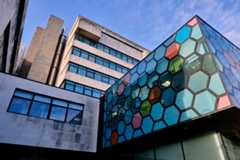
Cardiff University Biomedical Science Building. Image by Flickr.