

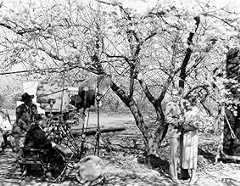
One of the most innovative of pioneer cameramen, Lee Garmes started hiscareer on the East Coast with the New York Motion Picture Company, butwas soon persuaded by the directorThomas H. Ince to join him in Hollywood.Garmes quickly climbed his way up the ladder, from painter's assistantto prop boy (future directorHenry Hathaway shared the same duties at'Inceville'), to camera assistant. He struck up a singularly fruitful collaboration with directorMalcolm St. Clair,with whom he worked on one- and two-reel shorts. Many of these earlycomedies were shot on a shoe-string budget and necessitated cleverimprovisation, especially in the usage of lead-sheet reflectors(re-directing sunlight) which substituted for proper lighting. Garmesalso introduced incandescent tungsten filament Mazda lights as asignificant cost-saving venture. In 1925, now as a fully-fledgeddirector of photography, Garmes went over to Paramount, first undercontract from 1925 to 1926. He perfected his craft at First Nationaland Warner Brothers (1927-1930), before returning to Paramount andmaking a significant contribution to some of the most outstandingblack-and-white films made by the studio during the early andmid-1930's. His most recognizable trademark was to naturally light hissets from a northward orientation.
Said to have been influenced by the paintings of Rembrandt, Garmesshowed a great flair in the use of chiaroscuro, light and shade, whichenhanced the expressionistic European look of darkly exotic ventureslikeMorocco (1930) andShanghai Express (1932). Bothpictures were directed byJosef von Sternberg and starred oneof Paramount's most bankable assets,Marlene Dietrich, flatteringlyphotographed by Garmes with subdued lighting amid swirling, mistybackgrounds. "Shanghai Express" led to an Academy Award and establishedGarmes as one of the top cinematographers in the business. His careersuffered a setback, however, when he was replaced byDavid O. Selznick months into shootingKaze to tomo ni sarinu (1939)(Selznick objected to the Garmes technique of soft lighting, preferringthe harsher'picture postcard' colours). Though the first hour of GWTW was almost entirely shot by Garmes (most of it directed byGeorge Cukor,who was also fired), he was not credited for his efforts.
Lee Garmes imbued many more seminal films of the 1940's and 50's withhis own particular style, creating the romantic moods ofLydia (1941), the exotic splendour ofAlexander Korda's technicolorJungle Book (1942) and thesemi-documentary realism ofWilliam Wyler'sDetective Story (1951). He becameone of few cinematographers to be given additional responsibilities indirecting and production and in 1972 became one of the first advocatesfor the use of videotape in filmmaking. Garmes was twice recipient ofthe Eastman Kodak Award. He served as present of the American Societyof Cinematographers from 1960 to 1961.
Said to have been influenced by the paintings of Rembrandt, Garmesshowed a great flair in the use of chiaroscuro, light and shade, whichenhanced the expressionistic European look of darkly exotic ventureslikeMorocco (1930) andShanghai Express (1932). Bothpictures were directed byJosef von Sternberg and starred oneof Paramount's most bankable assets,Marlene Dietrich, flatteringlyphotographed by Garmes with subdued lighting amid swirling, mistybackgrounds. "Shanghai Express" led to an Academy Award and establishedGarmes as one of the top cinematographers in the business. His careersuffered a setback, however, when he was replaced byDavid O. Selznick months into shootingKaze to tomo ni sarinu (1939)(Selznick objected to the Garmes technique of soft lighting, preferringthe harsher'picture postcard' colours). Though the first hour of GWTW was almost entirely shot by Garmes (most of it directed byGeorge Cukor,who was also fired), he was not credited for his efforts.
Lee Garmes imbued many more seminal films of the 1940's and 50's withhis own particular style, creating the romantic moods ofLydia (1941), the exotic splendour ofAlexander Korda's technicolorJungle Book (1942) and thesemi-documentary realism ofWilliam Wyler'sDetective Story (1951). He becameone of few cinematographers to be given additional responsibilities indirecting and production and in 1972 became one of the first advocatesfor the use of videotape in filmmaking. Garmes was twice recipient ofthe Eastman Kodak Award. He served as present of the American Societyof Cinematographers from 1960 to 1961.
BornMay 27, 1898
DiedAugust 31, 1978(80)
- Won 1 Oscar
- 1 win & 3 nominations total



Cinematographer





Director
Producer

- Born
- Died
- August 31,1978
- Los Angeles, California, USA(undisclosed)
- SpousesRuth Hall1933 - August 31, 1978 (his death, 2 children)
- Other worksUnsold pilot: Shot a pilot for a Western TV series that was to be titled "Mountain Man".
- Publicity listings
- TriviaWorked forGeorge Cukor on the filmKaze to tomo ni sarinu (1939) but was uncredited, as was Cukor.
- QuotesA cameraman is often the savior of a film. His lighting can be themain factor in its success.
- Salary
- (1939)$750 /week
Contribute to this page
Suggest an edit or add missing content
