Spain

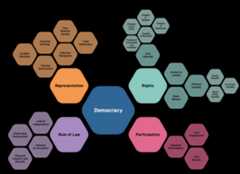
Spainperforms in the high range in all four categories of theGlobal State of Democracy framework, and it ranks in the top 25 percent of countries globally in almost all factors of democratic quality. Between 2019-2024, it experienced improvements in Access to Justice and Freedom of Expression, alongside declines in Credible Elections and Rule of Law (Absence of Corruption, Judicial Independence and Predictable Enforcement). It is home to one of the largest and fastest growingeconomies in Europe, driven by its services and manufacturing industries.
Spain transitionedfrom military dictatorship under Francisco Franco to a democracy in 1978 through a process of negotiation known as the Transición, which established free and competitive elections, created space for a multi-party system, and increased civilian control of the military. While theTransición awarded notable autonomy to regional governments, separatist group activities continued, with the 2017unauthorized referendum for the independence of Catalonia reflecting underlying tensions. The role of historical memory remainsa divisive issue in political debates. A 1977 amnesty law, part of the democratic transition and the associatedPact of Forgetting, limited prosecutions for Franco-era human rights abuses. However, recent legislation has sought to tackle the Franco legacy, including a 2022 Democratic Memory law, which banned organisations that glorify the Franco regime.
In the last decade, a more fragmented Parliament has increased pressure on the political system. The rise of new political parties, representing a more diverse spectrum of ideologies, has challenged the bipartisan party system that emerged during the transition and fuelled affective polarization. National unity remains elusive, with opposition groupscritical of an amnesty Lawfor pro-independence activists andmost former public officials involved in the Catalonia secession attempt.Meanwhile, new parliamentary rulesnow allow the use of Catalan, Galician and Basque languages in Parliament, reflecting regional diversity.
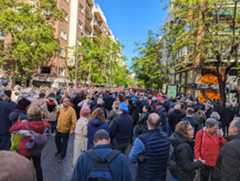
Although democratic institutions are strong, corruption scandals have undermined society’strustin political representatives. Judicial independence has also faced scrutiny, with ongoingdisagreements regarding judicial oversight and concerns about partisan influence in judicial appointments. Immigrationis also a key point of contention, particularly in relation to mass border crossings in the Spanish exclaves ofCeuta and Melilla, as well as in theCanary Islands. However,new immigration regulations are set to regularize the legal status of thousands.Economic equality is another important concern, particularly due to unaffordablehousing—an issue that hassparked protests, with local residents also mobilizing inovercrowded tourist hotspots.
Spain is high-performing in Gender Equality, with landmark “only yes is yes” consent laws, legislation promotinggender parity in political and business institutions, a broad range of reproductive rights legislation, and a law expanding transgender rights. However, gender-based violence hasincreased over the last decade.
Looking ahead, it will be important to watch Rule of Law amid rising polarization, corruption scandals and the recent response tonatural disasters andinfrastructure failures.Proposed reforms to thejudicial career access system will merit particular attention for their potential impact on Judicial Independence.
Last updated: June 2025
https://www.idea.int/democracytracker/
October 2025
Spain builds two migrant reception centres in Mauritania
On 17 October, Mauritania inaugurated two migrant reception centres built and financed by Spain through the Foundation for the Internationalisation of Public Administration (FIAP), a public organization under the Spanish Cooperation Agency, with additional funding from the European Union Emergency Trust Fund. The centres, which can accommodate around 200 people, will mainly host migrants from boats intercepted in Mauritanian waters while trying to reach Spain’s Canary Islands. The project is part of Spain’s outsourcing of migration management to Mauritania. According to Spanish authorities, the centres are modeled on facilities already operating in the Canary Islands and will house migrants for up to 72 hours. If individuals apply for asylum, Mauritanian authorities will be responsible for making the relevant decision. Opposition and rights groups have condemned the developments, citing Mauritania’s past record of migrant abuses and warning that the reception centers could in practice function as detention centers, and could erode oversight and accountability by Spain.
Sources:El Salto Diario,El Diario,Europa Press,Global Detention Project,Human Rights Watch,Foundation for the Internationalisation of Public Administration,OK Diario


September 2025
Attorney General to face trial over alleged media leakage
On 9 September, a Supreme Court judge announced that Attorney General Álvaro García Ortiz will stand trial for allegedly leaking confidential information to the press, what would constitute a breach of official secrecy under Spanish law. This marks the first time in modern Spanish democracy that an Attorney General will face criminal prosecution. The case revolves around the leak of an email sent by the lawyer of businessman Alberto González Amador (partner of Isabel Díaz Ayuso, President of the Community of Madrid and a member of the opposition People’s Party (PP)), to the prosecutor handling his tax fraud case. The email, containing details of a reportedly proposed settlement, was allegedly disclosed to the media by the Attorney General’s office. García Ortiz, who was appointed by the current government, has denied leaking any confidential information and continues to serve in office, with the judge having set bail at EUR 150,000. The outcome of the case remains pending, with the trial scheduled for the first half of November.
Update: On 20 November, the Supreme Court convicted Attorney General García Ortiz, sentencing him to two years’ disqualification from public office, a EUR 7,200 fine, and EUR 10,000 in damages. By a 5-2 vote, the Court cited ‘strong circumstantial evidence’ that he or ‘someone in his circle’ disclosed the email, while the two dissenting judges argued proof was insufficient. The fast-tracked case has sparked controversy, with the Unión Progresista de Fiscales (UPF), a professional association of public prosecutors, seeking the scrutiny of UN Special Rapporteur on the Independence of Judges and Lawyers over potential irregularities. García Ortiz, who resigned, is expected to pursue an extraordinary challenge or appeal to the Constitutional Court, having stated that he needs to ‘study the sentence and prepare the brief well’.
Sources:Radio Televisión Española,El País (1),El País (2),Judiciary of Spain,Associated Press,Eldiario.es,Cadena SER,El País (3),El País (4),La Sexta,Radio Televisión Española (2)

August 2025
Lower court indicts PM Sánchez’s wife on embezzlement charges
On 18 August, a lower court indicted Begoña Gómez, wife of Prime Minister Pedro Sánchez, on charges of embezzling public funds in connection with her work at the Complutense University of Madrid. Prosecutors allege she misused public resources to pay her personal assistant for non-academic duties, adding to ongoing investigations into influence peddling dating back to 2024. Prime Minister Sánchez denounced the case as politically motivated ‘lawfare,’ coming after other legal proceedings involving his brother. Sánchez had also previously filed a complaint against the judge that handles the case, alleging judicial misconduct; but this was dismissed by the Madrid High Court. The proceedings against Gómez were initiated by the far-right group Manos Limpias (known for filing corruption-related lawsuits), with backing from the Vox party and the advocacy group Hazte Oír (which typically campaigns against LGBTQIA+ and abortion rights in Spain). The case is ongoing.
Sources: EU Observer, Cadena SER, El País, EuropaPress
July 2025
Far-right anti-migrant violence erupts in southeastern town
On 13 July, a rare wave of anti-migrant violence erupted in Torre Pacheco, a town in the southeastern region of Murcia. The unrest was sparked by the beating of an elderly local man by three young men of North African origin on 9 July. Far-right groups, including some from outside the region, co-opted the incident (which was circulated on social media alongside inflammatory misinformation) to mobilize, and staged violent and racially motivated marches in the town. Over five days, these groups vandalized migrant-owned businesses and intimidated residents in the town’s neighborhoods, home to a large migrant population. Security forces were deployed to contain the violence and prevent direct clashes between agitators and locals. Authorities arrested at least 14 people, including the leader of a far-right group on hate crime charges. The Murcia Prosecutor’s Office also launched an investigation into the regional leader of the far-right Vox party for alleged incitement to hatred.
Sources:El País (1),El País (2),Cadena Ser,Eldiario.es,British Broadcasting Corporation


Former minister Montoro indicted in corruption probe involving gas companies
On 17 July, a lower court charged former finance minister Cristobal Montoro, along with 27 others, including high-ranking officials, in a corruption case involving the creation of a criminal network that altered laws to benefit gas companies during Montoro’s latest tenure between 2011 and 2018. Equipo Económico, a tax consulting firm originally founded by Montoro and involved in providing advice to businesses, has been implicated in the scandal, with the investigation looking into whether this firm went beyond legitimate ‘lobbying’ in influencing certain legislative projects to benefit its clients, securing the support of officials in the Ministry and the Tax Agency through kickbacks. Montoro resigned from his party membership in the Popular Party (PP) following the indictment. Current Prime Minister Pedro Sanchez announced that the government will seek to repeal the fiscal privileges granted to the companies involved in the scandal.The investigation is ongoing.
See all event reports for this country
Global ranking per category of democratic performance in 2024

Basic Information

Human Rights Treaties
 State party
 Signatory
 No action
Create your monthly alerts
and receive a customized selection of reports directly in your inbox
Performance by category over the last 6 months


Global State of Democracy Indices
Hover over the trend lines to see the exact data points across the years


Factors of Democratic Performance Over Time
Use the slider below to see how democratic performance has changed over time